New paper and course modules: Foundational Causality
Causality is fundamental to systems thinking, explanation, diagnosis and intervention. Yet causal relationships are often represented in highly compressed form: A → B.
My latest General Systems Theory paper, Foundational Causality, asks what lies behind that arrow.
Beginning with processes and physical transfers of matter, energy and embodied information, the paper progressively examines multiple causal contributions, causal chains and networks, PTP and TPT perspectives, recurring causal structures, persistent causal organisation, conditions and constraints, systems and emergence, causal leverage, and the development of causal knowledge.
A central idea is causal decompression: progressively exposing the processes, transfers, conditions and constraints concealed within apparently simple causal relationships.
The paper is accompanied by eleven free course modules (GST 81–91). These take the learner from elementary cause-and-effect reasoning through causal networks and systems to leverage, causal knowledge and the interaction between hypotheses, explanations and theories.
A single flooding example develops throughout the modules so that learners can see a simple causal representation progressively become a systems-level causal analysis.
Recent research in science education has highlighted the importance of mechanistic reasoning, while other recent work has explicitly explored its relationship with systems thinking. The paper approaches that territory from a General Systems Theory perspective.
Alongside the paper I have also published a new set of General Systems Theory course modules featuring plain-English explanations, diagrams, examples, and practical exercises.
Both the paper and the course modules are open access. The paper is available at:
🔗 Supported learning: via Google Classroom through the ISSS Student SIG
Those in full-time or part-time education are especially encouraged to join the Student SIG, where they can benefit from guidance by experienced systems scientists, discussion with fellow learners, and access to a wider international community. To join go to: https://isss.org
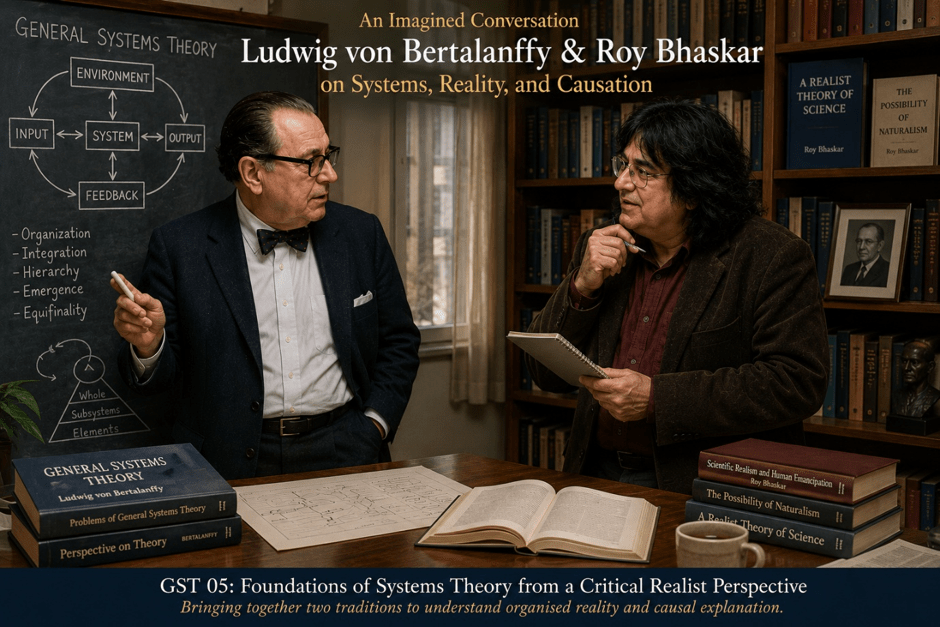
The following is, of course, an imaginary conversation, but one I suspect might have taken place had Ludwig von Bertalanffy and Roy Bhaskar ever met.
Bertalanffy: For many years I have argued that science has become fragmented into isolated disciplines. We need a General Systems Theory capable of describing organised wholes wherever they occur.
Bhaskar: I share your concern. But before we ask how systems are organised, should we not first ask what it is that exists independently of our descriptions of it?
Bertalanffy: You mean that systems are part of reality, not merely ways of thinking about reality?
Bhaskar: Precisely. Reality possesses structures and causal powers that continue to exist whether we observe them or not. Science succeeds because it progressively discovers those structures rather than inventing them.
Bertalanffy: Then perhaps I should ask you a question. What makes a system real rather than simply a useful way of describing the world?
Bhaskar: A good question. A system is real if it possesses an organised structure capable of generating causal powers and events. Our descriptions may differ, but the underlying organisation exists independently of us.
Bertalanffy: That is remarkably close to what I had in mind when I described organised wholes. My concern was always that science had become so specialised that it lost sight of organisation itself. Perhaps I did not make the philosophical foundations explicit enough.
Bhaskar: And perhaps philosophy has not developed a sufficiently rich language for describing organised reality. It can explain why generative mechanisms matter, but it says rather less about how they become organised into the systems we encounter throughout nature and society.
Bertalanffy: Then our ideas may be more complementary than either of us realised.
Bhaskar: I think they deserve to be explored together.
Narrator; Ludwig von Bertalanffy and Roy Bhaskar never met. Yet their work points in remarkably complementary directions. General Systems Theory provides a language for describing organised wholes, interaction, emergence and organisation. Critical Realism provides a philosophical account of why those organisations are objectively real and how they generate the events we observe.
Author: My latest paper explores what happens when these two traditions are considered together.
GST 05 – Foundations of Systems Theory from a Critical Realist Perspective
Alongside the paper, I have also added a new set of course modules to the General Systems Theory (GST) course. These modules correspond to the concepts developed in the paper and are designed to make them accessible through:
Those in full-time or part-time education are especially encouraged to join the Student SIG, where they can benefit from guidance by experienced systems scientists, discussion with fellow learners, and access to a wider international community. To join go to: https://isss.org
If Bertalanffy and Bhaskar had met, do you think they would have recognised each other as fellow travellers, or would important disagreements have remained?
Why is it so difficult to combine knowledge from different disciplines?
An economist, sociologist, psychologist, engineer, and biologist may examine closely related aspects of reality, yet describe them using different concepts, terminology, and forms of explanation.
The problem may not be disagreement. They may simply be unable to see how their different perspectives fit together.
My latest paper in the General Systems Theory series explores a possible way forward:
👉 Productive co-ordination
The proposed process is simple in principle: Decompress → Recompress → Compare
Specialist propositions are first translated into plain language. Their underlying systems structures—entities, processes, transfers, constraints, feedbacks, and related concepts—are then identified using a common systems idiom.
The resulting structures can be compared and this may reveal:
The objective is not to force agreement. It is to understand more clearly how different perspectives relate to one another.
But developing the methodology revealed a deeper problem. Most attempts to create a common systems language focus upon developing a common systems vocabulary or idiom.
Yet language does more than name things. Its grammatical structures also represent relationships, processes, and causality. If reality is systemic, and language evolved to represent reality, then systems structures may already be reflected within language itself.
This suggests a potentially important distinction between:
🔹 The Systems Idiom – a common vocabulary for expressing systems structures.
🔹 Systems Linguistics – the study of how systems structures are represented within language.
At present, productive co-ordination can compare identified systems concepts and structures. A more developed systems linguistics may eventually allow deeper comparison between the propositions and causal structures expressed by different disciplines.
This may be one of the missing pieces in the long-standing General Systems Theory dream of integrating knowledge across disciplinary boundaries.
Alongside the paper, I have published four short General Systems Theory course modules featuring plain-English explanations, diagrams, examples, and practical exercises:
GST 38 – Productive Co-ordination GST 39 – The Productive Co-ordination Process GST 40 – Comparing Perspectives GST 41 – Systems Linguistics and the Systems Idiom
Both the paper and course modules are open access.
🔗 Supported learning: via Google Classroom through the ISSS Student SIG.
Those in full-time or part-time education are especially encouraged to join the Student SIG, where they can benefit from guidance by experienced systems scientists, discussion with fellow learners, and access to a wider international community. To join, go to ISSS.
I hope the paper proves useful to those interested in systems theory, interdisciplinary research, communication, knowledge integration, and the future of collective problem-solving.
Reality exists whether we understand it or not. The challenge is that none of us ever see it completely.
Reality is far more complex than the human mind can fully comprehend, so we all rely on simplifications. Those simplifications differ from person to person because they are shaped by our experiences, education, profession, culture, and interests. This is one reason why communication can be so difficult.
It is important to celebrate the contributions of great thinkers and researchers, but no individual can fully understand reality on their own. Every perspective reveals something valuable while overlooking something else.
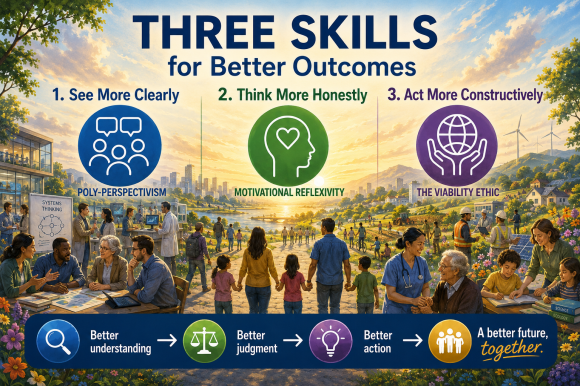
That is why I believe poly-perspectivism is such an important personal skill. It is the ability to recognise that different perspectives often contain different pieces of the same puzzle, and that a better understanding emerges through productive coordination rather than competition.
A second skill is motivational reflexivity. This is the ability to ask ourselves where our beliefs come from. Are they supported by good evidence, or do they satisfy personal needs such as certainty, identity, belonging, or status? Why do we sometimes resist changing our minds, even when presented with new evidence?
A third skill is what I call the viability ethic. If our understanding of reality is always incomplete, then our actions should not be judged solely by whether they advance our own interests, but also by whether they enhance the long-term viability of the wider systems on which we all depend—our families, communities, organisations, societies, and ultimately the natural environment.
These three ideas can be summarised quite simply:
See more clearly through poly-perspectivism. Think more honestly through motivational reflexivity. Act more constructively through the viability ethic.
Could these three skills help in preventing political debates from becoming polarised?
Could they help experts from different disciplines work together more effectively on complex problems?
Could they help us make better decisions about issues such as climate change, public health, migration, economic policy, or international conflict?
And might they help us respond more effectively to the growing interaction of environmental, economic, political, technological and social challenges that many now describe as the poly-crisis?
Our understanding of reality will always remain incomplete. But perhaps these are three of the most valuable skills we can develop if we wish to understand it a little better—and to work together a little more wisely.
Why do intelligent people looking at the same reality often describe it in completely different ways?
An economist, a psychologist, an engineer, a biologist, and a sociologist may all study the same broad phenomenon, yet use different concepts, different terminology, and different explanations.
The result is often misunderstanding, fragmentation, and difficulty working together.
My latest paper in the General Systems Theory series explores a simple but powerful idea:
👉 Human understanding depends upon compression.
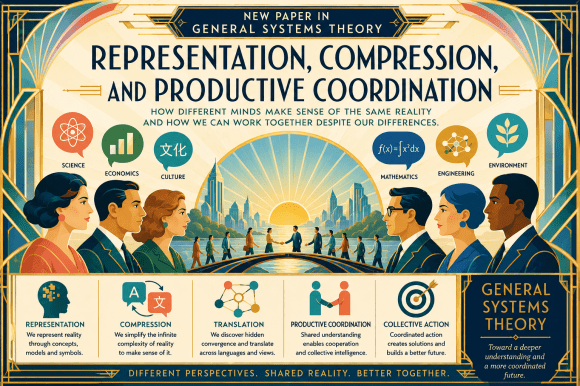
Reality is far too complex to comprehend in full detail. We therefore simplify it through concepts, models, symbols, language, and theories. Different people, disciplines, and cultures develop different compressions of overlapping aspects of reality.
This helps explain both the extraordinary power of human knowledge and the communication difficulties that frequently arise between individuals, disciplines, and communities.
The paper introduces and explores:
🔹 Configurational and causal cognition 🔹 Configurational and causal compression 🔹 Linguistic divergence and hidden convergence 🔹 Systems linguistics as a tool for translation and comparison 🔹 Productive coordination as a means of improving shared understanding
Ultimately, the paper asks a broader question:
How can finite minds understand an infinitely complex reality well enough to coordinate action and maintain viability?
Alongside the paper I have also published a new set of General Systems Theory course modules featuring plain-English explanations, diagrams, examples, and practical exercises.
Both the paper and the course modules are open access. The paper is available at:
🔗 Supported learning: via Google Classroom through the ISSS Student SIG
Those in full-time or part-time education are especially encouraged to join the Student SIG, where they can benefit from guidance by experienced systems scientists, discussion with fellow learners, and access to a wider international community. To join go to: https://isss.org
I hope it proves useful to those interested in systems theory, communication, complexity, interdisciplinary research, and the future of collective problem-solving.
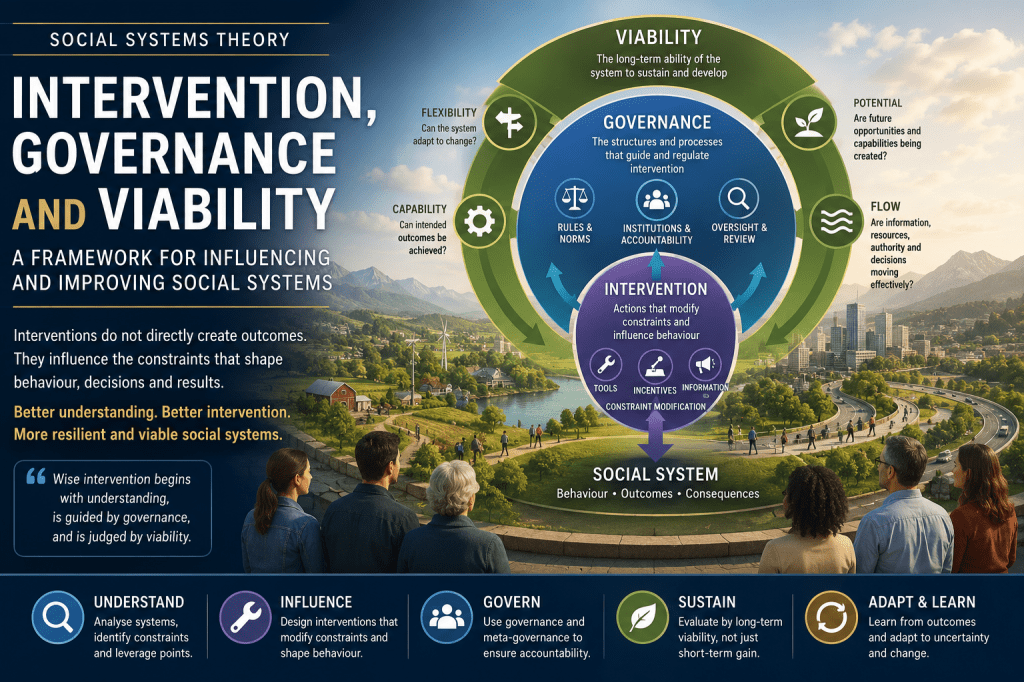
I’m pleased to share a new paper and accompanying course modules on Intervention, Governance and Viability — a practical framework for understanding how social systems can be influenced and improved.
Social systems are constantly changing. Some changes emerge spontaneously through the normal operation of social processes, while others result from deliberate attempts to influence behaviour and outcomes. Yet interventions often succeed in some respects, fail in others, and frequently produce unintended consequences.
The paper argues that effective intervention requires more than good intentions.
It proposes three key ideas:
🔶 Social instability often reflects patterns of constraint misalignment.
🔶 Interventions influence outcomes indirectly by modifying the constraints that shape behaviour.
🔶 Effective intervention requires governance and should be guided by the long-term viability of the systems affected.
The paper explores:
🔷 intervention as constraint modification
🔷 causal leverage and significant flows
🔷 why interventions succeed or fail
🔷 bounded rationality and unintended consequences
🔷 governance and meta-governance
🔷 trust and the social contract
🔷 viability as a criterion for evaluating social change
A central theme is that interventions do not directly create outcomes. Instead, they influence the circumstances, conditions, and constraints within which individuals and organisations operate. Understanding these relationships provides opportunities for more effective and adaptive forms of governance.
This work forms part of a broader programme developing a social systems framework grounded in causality, constraints, adaptive governance, and systemic viability.
Alongside the paper, I have also added a new set of course modules to the Social Systems Theory (SST) course. These modules correspond to the concepts developed in the paper and are designed to make them accessible through:
🔗 Supported learning: via Google Classroom through the ISSS Student SIG
Those in full-time or part-time education are especially encouraged to join the Student SIG, where they can benefit from guidance by experienced systems scientists, discussion with fellow learners, and access to a wider international community.
I’m pleased to share the publication of my latest paper:
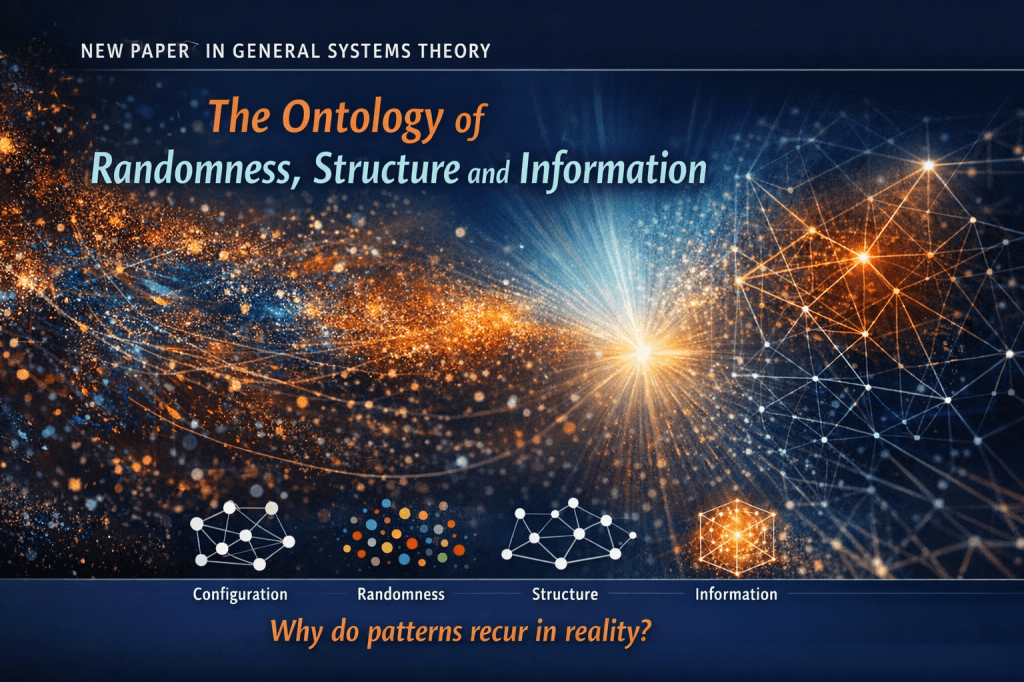
The Ontology of Randomness, Structure and Information
This paper is the third in a series on General Systems Theory. It develops a clear, physically grounded account of how patterns arise in reality, addressing a fundamental question:
👉 Why does the world exhibit recurring structure rather than remaining a field of transient variation?
The paper introduces and systematically distinguishes four key concepts:
configuration — the arrangement of entities in space-time
randomness — non-recurring variation in configuration
structure — configuration with causal connectivity
information — recurring structure
A central claim is that recurrence requires causality, establishing structure as a necessary condition for information and grounding pattern in causally organised processes rather than in arrangement alone.
The aim, as with earlier papers, is not to add complexity, but to clarify foundational concepts and provide a consistent basis for understanding pattern and information across physical, biological, and social domains.
Alongside the paper, I have also added a new set of course modules to the General Systems Theory (GST) course. These modules correspond to the concepts developed in the paper and are designed to make them accessible through:
Those in full-time or part-time education are especially encouraged to join the Student SIG, where they can benefit from guidance by experienced systems scientists, discussion with fellow learners, and access to a wider international community. To join go to: https://isss.org
I hope these resources are useful to those interested in systems theory.
Human societies now operate at a scale unprecedented in history, yet they struggle to coordinate effectively in the face of environmental, social, and geopolitical crises. Climate change, institutional breakdown, misinformation, and persistent inequality are often treated as separate problems, to be solved through better politics, better technology, or better ethics. This paper starts from a different premise: that many of these difficulties are not failures of intention or morality, but symptoms of an unfinished stage of social development.
Using ideas from systems theory and evolutionary biology, the paper explores the possibility that human societies are still undergoing a process of evolutionary assembly, similar in important ways to the biological evolution that produced complex organisms. Social systems, ranging from individuals and organisations to nations, exhibit recurring structural patterns, but as they grow larger they tend to become less integrated even as their power increases. Functional specialisation expands what societies can do, but integration and control often lag behind.
The paper also argues that human needs themselves emerged in a developmental sequence, existence, relatedness, then growth, and that societies tend to follow the same pattern. When social systems prioritise growth before basic needs for security, belonging, and integration are met, instability and pathology predictably follow. From this perspective, phenomena such as criminality, institutional fragility, and environmental overshoot are not anomalies, but signals of insufficient integration at larger scales. Rather than proposing political solutions or institutional blueprints, the paper offers a way of understanding where humanity may be in its social evolutionary trajectory. It identifies two key barriers to further development, informational breakdown and weak systemic commitment, and suggests that the long-term viability of human societies depends on new forms of large-scale coordination and regulation grounded in accurate information, shared understanding, and recognition of deep interdependence.
We often speak of “information” as though it floats freely in cyberspace or the human mind, detached from anything physical. Yet every bit of information, from the letters on this page to the thoughts in your head, is carried by matter or energy. This simple observation lies at the heart of cognitive physicalism, the view that cognition, communication, and social coordination are all thermodynamic processes.
Information Is Order
In physical terms, information is negative entropy; order among components of a system. When the atoms of a crystal, the base pairs of DNA, or the neurons of a brain are arranged in regular patterns, they hold information by reducing randomness. This definition, first clarified by Léon Brillouin and Erwin Schrödinger, gives information the same physical dimensions as entropy:
Energy provides the capacity for work (); information provides the form that directs that work. Together they make organisation possible.
How Physics Becomes Mind
In purely physical systems, energy and entropy simply flow. With life, informational structures emerge that regulate those flows. A cell maintains order by channelling chemical energy through genetic and enzymatic constraints. With evolution, feedback control grows more elaborate: nervous systems model the world, predict outcomes, and choose among options. Agency, the ability to act purposefully, appears when informational form controls energetic process.
At higher levels, the same principle produces cognition, language, and society. Neural firing, conversation, and economic exchange are all manifestations of energy flows organised by information.
Why Equations Matter
When information theory borrowed from thermodynamics, it kept Boltzmann’s equation but quietly normalised away the constant Doing so made information appear dimensionless; handy for communication engineers, but misleading for science. As Rolf Landauer later reminded us, information is physical: erasing a single bit requires energy and generates heat. Ignoring this fact masks the cost of learning, computing, and communicating; costs that become crucial when we extend systems thinking to living and social domains.
The Structure of Agency
Agency can be described in three physical layers:
Level
Description
Dimensions
Agentic information structure
pattern that directs energy
Agentic potential
information-structured energy capacity
Actualised agency
directed energy flow through time
Energy provides the means, information the form, and their coupling the act. Whether in a cell, a mind, or a society, the same dimensional hierarchy holds.
The Sun and the Spectrum of Agency
All terrestrial agency begins with the Sun. Photons striking chlorophyll are converted into chemical potential, which sustains metabolism, cognition, and eventually culture. Every thought, conversation, or social reform is therefore a distant echo of solar radiation; a transformation of sunlight into structured work.
The Cost of Thought and Change
Learning, decision, and communication are thermodynamic operations. Brain imaging shows energy consumption rising during problem-solving; each new memory reduces neural entropy while producing waste heat. The same principle scales up: cultural and institutional change require energy to reorganise shared information. Schools, media, and political movements are energetic engines for lowering societal entropy. When their energy supply falters, coherence and collective agency decline.
Why This Matters for Systems Science
Re-embedding information and agency in physics brings fresh clarity to systems thinking. It explains why order must be sustained by flows, why “effort” feels costly, and why every form of coordination, from metabolism to governance, depends on continual energy input. It also offers a bridge between natural and social sciences: the same thermodynamic grammar governs both.
As Ilya Prigogine showed, local order can grow even while global entropy rises. Life, mind, and society are all such dissipative structures, islands of organisation maintained by throughputs of energy and information. Understanding this continuity reminds us that progress itself carries an energetic price.
From Theory to Application
Recognising the physical nature of information could reshape how we approach education, technology, and governance. Policies and systems that ignore their energetic base risk collapse; those that respect it can harness energy more efficiently to sustain informational order.
Energy is the means, information the form, and agency the dance between them. Seen thermodynamically, every act of understanding is a small victory over entropy; a local flowering of order in the great energetic flow from the Sun.
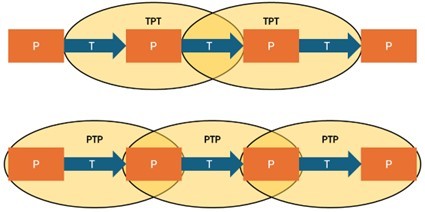
This article explores two fundamental modes of causal reasoning: TPT (Transfer-Process-Transfer) and PTP (Process-Transfer-Process) structures. These structures help clarify how humans and artificial intelligences like large language models reason about cause and effect, why both are susceptible to error, and why combining them is essential for a robust understanding.
The two forms of reasoning derive from the following:
Causal transfers take time and travelling through any causal network in the direction of the arrow of time will yield a chain of alternating processes and transfers, i.e.: … P – T – P – T – P …
Causes are effects, and effects are causes.
Every system or event in a causal chain shares a component with its predecessor and successor.
The PTP structure equates to an event in which something does something to something else. The TPT structure equates to a system with its inputs, processes and outputs.
TPT Reasoning: Pattern Recognition and Unconscious Inference
TPT causality refers to a structure in which two processes are linked by an inferred or unknown transfer, i.e. each cause and effect has the structure TPT and the two are linked by a common T. In human cognition, this reflects pattern recognition: we notice that two processes frequently co-occur, and infer a causal link, even if we cannot identify what mediates the connection.
This form of reasoning is fast, intuitive, and largely unconscious. It allows us to make rapid inferences from experience, often without awareness of the intermediate mechanisms. However, it is error-prone. TPT reasoning is vulnerable to spurious associations and errors caused by unseen common causes. In these cases, the inferred causal link is false, despite the pattern appearing consistent.
Large language models also rely heavily on TPT-type reasoning. They identify recurring associations in their training data and reproduce those patterns in response. This allows them to answer questions, complete prompts, and simulate explanations even when they do not possess internal models of the causal transfers involved.
PTP Reasoning: Explicit Inference and Conscious Verification
In PTP causality, by contrast, causes and effects consist of a process, a known transfer, and another process. Each cause or effect has a PTP structure and the two are linked by a common P. This represents structured reasoning in which a clearly identified mechanism links cause and effect. In human cognition, this kind of reasoning is associated with conscious, reflective thinking. It is slow, deliberate, and effortful, but less prone to error.
Verification through PTP reasoning is essential when pattern-based inferences (TPT) are in doubt. It allows us to examine whether a supposed cause-effect relationship is supported by identifiable transfers. In systems theory terms, it confirms that the output of one process is indeed the input to another.
Error and Verification in Human and AI Cognition
Both humans and artificial intelligences are vulnerable to error when relying solely on TPT reasoning. A classic example is the post hoc fallacy: assuming that because B follows A, A caused B. Without identifying the actual transfer, such reasoning remains speculative.
AI systems, too, may generate plausible but incorrect answers when their training data contains coincidental patterns. They may infer connections that resemble PTP structures but are not grounded in causality.
This is why PTP reasoning is vital for verification. It distinguishes genuine causal chains from coincidental associations by demanding an explicit causal transfer.
A Unified Framework of Reasoning
A key insight from systems theory is that these two modes of reasoning are not exclusive. In fact, they are complementary. TPT reasoning allows for quick hypothesis generation and intuitive understanding. PTP reasoning provides a structure for verification, deeper analysis, and error correction.
Understanding and integrating both types of causal reasoning is central to building a theory of cognition, both biological and artificial. It also has direct implications for epistemology, systems modelling, and the future of AI development.
Conclusion
TPT and PTP causality offer a powerful lens for interpreting human and artificial thought. TPT supports rapid pattern recognition; PTP ensures that those patterns are grounded in real causal mechanisms. Awareness of this dual structure is essential for improving reasoning, communication, and the development of intelligent systems.
Future work may involve identifying when to trust each mode, and how to better integrate them in education, epistemology, and machine reasoning architectures.



 ); information provides the form that directs that work. Together they make organisation possible.
 but quietly normalised away the constant
  Doing so made information appear dimensionless; handy for communication engineers, but misleading for science. As Rolf Landauer later reminded us, information is physical: erasing a single bit requires energy and generates heat. Ignoring this fact masks the cost of learning, computing, and communicating; costs that become crucial when we extend systems thinking to living and social domains.