Categories
EFGST

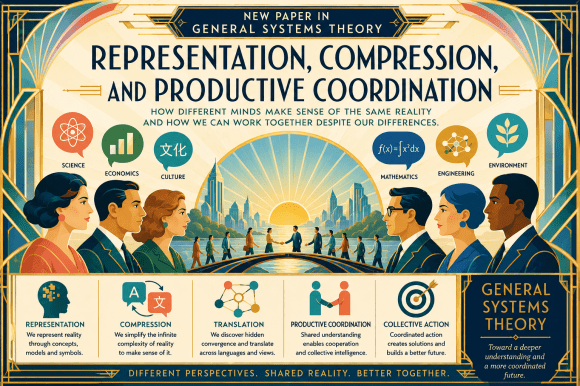
Systems Linguistics: Representation, Compression, and Productive Coordination

Why do intelligent people looking at the same reality often describe it in completely different ways?

An economist, a psychologist, an engineer, a biologist, and a sociologist may all study the same broad phenomenon, yet use different concepts, different terminology, and different explanations.

The result is often misunderstanding, fragmentation, and difficulty working together.

My latest paper in the General Systems Theory series explores a simple but powerful idea:

👉 Human understanding depends upon compression.

Reality is far too complex to comprehend in full detail. We therefore simplify it through concepts, models, symbols, language, and theories. Different people, disciplines, and cultures develop different compressions of overlapping aspects of reality.

This helps explain both the extraordinary power of human knowledge and the communication difficulties that frequently arise between individuals, disciplines, and communities.

The paper introduces and explores:

🔹 Configurational and causal cognition
🔹 Configurational and causal compression
🔹 Linguistic divergence and hidden convergence
🔹 Systems linguistics as a tool for translation and comparison
🔹 Productive coordination as a means of improving shared understanding

Ultimately, the paper asks a broader question:

How can finite minds understand an infinitely complex reality well enough to coordinate action and maintain viability?

Alongside the paper I have also published a new set of General Systems Theory course modules featuring plain-English explanations, diagrams, examples, and practical exercises.

Both the paper and the course modules are open access. The paper is available at:

https://rational-understanding.com/efgst

https://www.academia.edu/169040199/Systems_Linguistics_Representation_Compression_and_Productive_Coordination

The course materials are available in two ways:

🔗 Open access (self-paced): https://rational-understanding.com/gst-course/

🔗 Supported learning: via Google Classroom through the ISSS Student SIG

Those in full-time or part-time education are especially encouraged to join the Student SIG, where they can benefit from guidance by experienced systems scientists, discussion with fellow learners, and access to a wider international community. To join go to: https://isss.org

I hope it proves useful to those interested in systems theory, communication, complexity, interdisciplinary research, and the future of collective problem-solving.

Categories
45. From Organisms to Nations: A Systems–Evolutionary Perspective on Social Development

From Organisms to Nations: A Systems–Evolutionary Perspective on Social Development

Human societies now operate at a scale unprecedented in history, yet they struggle to coordinate effectively in the face of environmental, social, and geopolitical crises. Climate change, institutional breakdown, misinformation, and persistent inequality are often treated as separate problems, to be solved through better politics, better technology, or better ethics. This paper starts from a different premise: that many of these difficulties are not failures of intention or morality, but symptoms of an unfinished stage of social development.

Using ideas from systems theory and evolutionary biology, the paper explores the possibility that human societies are still undergoing a process of evolutionary assembly, similar in important ways to the biological evolution that produced complex organisms. Social systems, ranging from individuals and organisations to nations, exhibit recurring structural patterns, but as they grow larger they tend to become less integrated even as their power increases. Functional specialisation expands what societies can do, but integration and control often lag behind.

The paper also argues that human needs themselves emerged in a developmental sequence, existence, relatedness, then growth, and that societies tend to follow the same pattern. When social systems prioritise growth before basic needs for security, belonging, and integration are met, instability and pathology predictably follow. From this perspective, phenomena such as criminality, institutional fragility, and environmental overshoot are not anomalies, but signals of insufficient integration at larger scales. Rather than proposing political solutions or institutional blueprints, the paper offers a way of understanding where humanity may be in its social evolutionary trajectory. It identifies two key barriers to further development, informational breakdown and weak systemic commitment, and suggests that the long-term viability of human societies depends on new forms of large-scale coordination and regulation grounded in accurate information, shared understanding, and recognition of deep interdependence.

The full paper can be downloaded in pdf format at https://rational understanding.com/sst