Categories
SST

Intervention, Governance and Viability

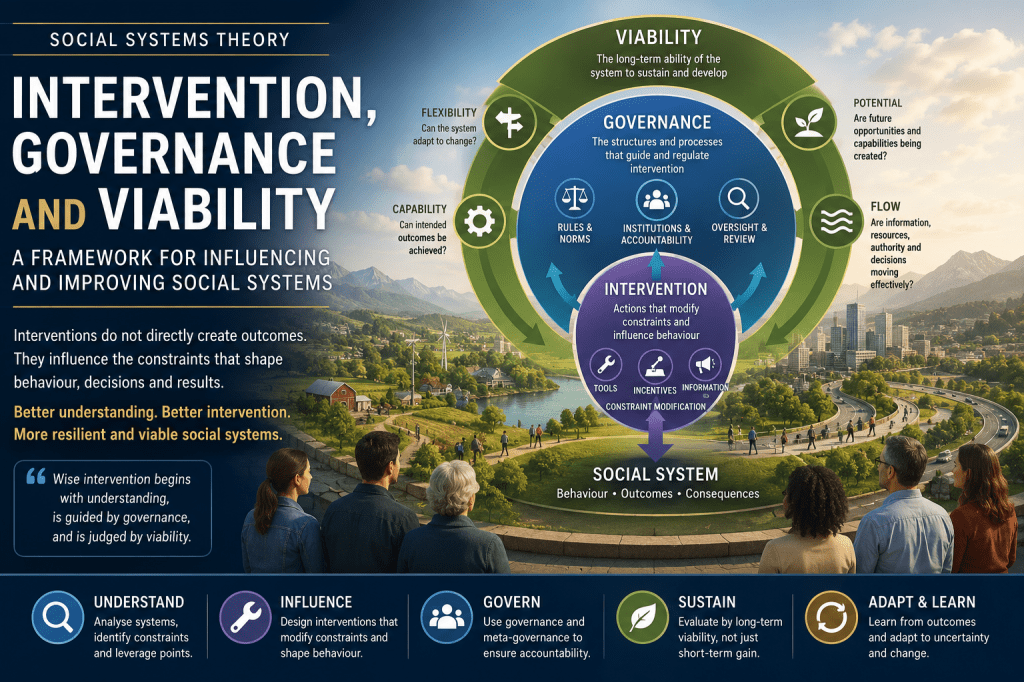
I’m pleased to share a new paper and accompanying course modules on Intervention, Governance and Viability — a practical framework for understanding how social systems can be influenced and improved.

Social systems are constantly changing. Some changes emerge spontaneously through the normal operation of social processes, while others result from deliberate attempts to influence behaviour and outcomes. Yet interventions often succeed in some respects, fail in others, and frequently produce unintended consequences.

The paper argues that effective intervention requires more than good intentions.

It proposes three key ideas:

šŸ”¶ Social instability often reflects patterns of constraint misalignment.

šŸ”¶ Interventions influence outcomes indirectly by modifying the constraints that shape behaviour.

šŸ”¶ Effective intervention requires governance and should be guided by the long-term viability of the systems affected.

The paper explores:

šŸ”· intervention as constraint modification

šŸ”· causal leverage and significant flows

šŸ”· why interventions succeed or fail

šŸ”· bounded rationality and unintended consequences

šŸ”· governance and meta-governance

šŸ”· trust and the social contract

šŸ”· viability as a criterion for evaluating social change

A central theme is that interventions do not directly create outcomes. Instead, they influence the circumstances, conditions, and constraints within which individuals and organisations operate. Understanding these relationships provides opportunities for more effective and adaptive forms of governance.

This work forms part of a broader programme developing a social systems framework grounded in causality, constraints, adaptive governance, and systemic viability.

The paper is available via the following links:

šŸ”— Academia: https://www.academia.edu/168724321/Social_Systems_Intervention_Governance_and_Viability

šŸ”— Website: https://rational-understanding.com/sst/

Alongside the paper, I have also added a new set of course modules to the Social Systems Theory (SST) course. These modules correspond to the concepts developed in the paper and are designed to make them accessible through:

šŸ”· plain-English explanations

šŸ”· diagrams and illustrations

šŸ”· worked examples

šŸ”· practical exercises

The course materials are available in two ways:

šŸ”— Open access (self-paced): https://rational-understanding.com/sst-course/

šŸ”— Supported learning: via Google Classroom through the ISSS Student SIG

Those in full-time or part-time education are especially encouraged to join the Student SIG, where they can benefit from guidance by experienced systems scientists, discussion with fellow learners, and access to a wider international community.

#SystemsThinking #SystemsScience #ComplexSystems #SocialSystems #Governance #Intervention #Viability #ConstraintAnalysis #AdaptiveGovernance

Categories
SST

Social System Diagnostics

I’m pleased to share a new paper and accompanying course modules on Social System Diagnostics — a practical framework for identifying problems in complex social systems and determining where further investigation should be focused.

Complex systems rarely fail for a single reason. Before we can explain why a problem exists, we must first recognise it and identify the areas requiring closer attention.

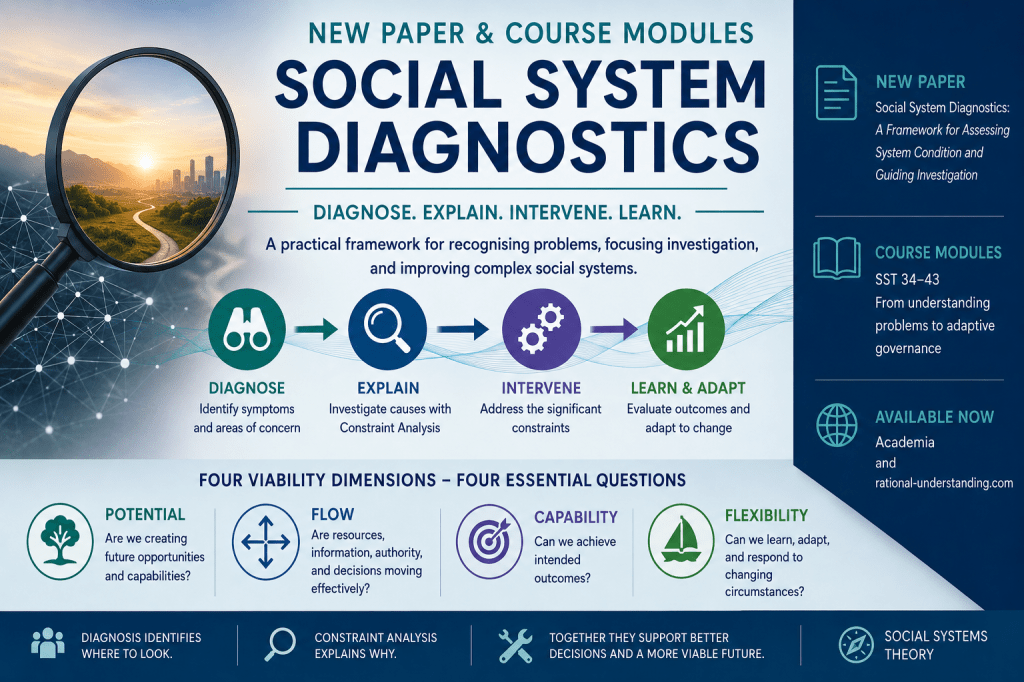
The paper introduces Systemic Diagnostics as a complement to Constraint Analysis.

It argues that diagnosis and explanation are distinct but complementary processes:

šŸ”¶ Diagnostics identifies symptoms and areas of concern.

šŸ”¶ Constraint Analysis investigates the underlying causes responsible for those conditions.

To support this process, the paper introduces a diagnostic hierarchy based upon system viability.

Because viability cannot be observed directly, it is disaggregated into four diagnostic dimensions:

šŸ”· Potential – Are future opportunities and capabilities being created?

šŸ”· Flow – Are information, resources, authority, and decisions moving effectively?

šŸ”· Capability – Can intended outcomes be achieved?

šŸ”· Flexibility – Can the system adapt to changing circumstances?

Together, these dimensions provide a structured framework for assessing system condition and identifying areas requiring further investigation.

The paper explores:

šŸ”¶ diagnosis as progressive expansion

šŸ”¶ viability and viability dimensions

šŸ”¶ diagnostic indicators

šŸ”¶ the relationship between symptoms and causes

šŸ”¶ the transition from diagnosis to Constraint Analysis

šŸ”¶ governance, learning, and adaptive decision-making

This work forms part of a broader programme developing a social systems framework grounded in causality, constraints, and adaptive governance.

The paper is available via the following links:

šŸ”— Academia: https://www.academia.edu/168478652/Social_System_Diagnostics

šŸ”— Website: https://rational-understanding.com/sst/

Alongside the paper, I have also added a new set of course modules to the Social Systems Theory (SST) course. These modules correspond to the concepts developed in the paper and are designed to make them accessible through:

šŸ”· plain-English explanations

šŸ”· diagrams and illustrations

šŸ”· worked examples

šŸ”· practical exercises

The course materials are available in two ways:

šŸ”— Open access (self-paced): https://rational-understanding.com/sst-course/

šŸ”— Supported learning: via Google Classroom through the ISSS Student SIG

Those in full-time or part-time education are especially encouraged to join the Student SIG, where they can benefit from guidance by experienced systems scientists, discussion with fellow learners, and access to a wider international community.

Categories
SST

Social Destabilisation

Recurring Patterns of Constraint Misalignment

Why do organisations, communities, and societies become unstable?

Political crises, economic decline, organisational dysfunction, social fragmentation, and governance failures often appear unique. However, beneath the surface they frequently exhibit recurring patterns.

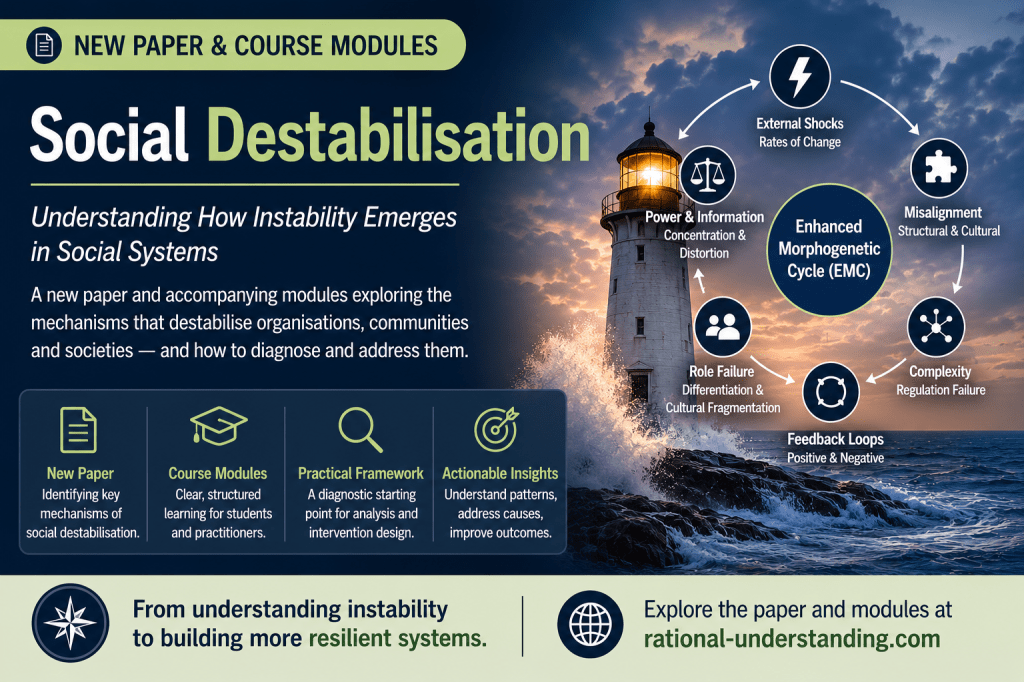
In this new paper, Social Destabilisation, I explore how instability can emerge from the misalignment of constraints within social systems. Drawing upon the Enhanced Morphogenetic Cycle (EMC) and Constraint Analysis, the paper identifies a number of recurring destabilising mechanisms, including:

• External shocks and differential rates of change
• Structural and cultural misalignment
• Complexity and constraint regulation failure
• Positive feedback and resource depletion
• Role differentiation failure and cultural fragmentation
• Power concentration and feedback distortion

Rather than treating crises as isolated events, the paper argues that many can be understood as recurring patterns of constraint misalignment.

The paper is accompanied by a series of course modules designed to make the concepts accessible to students, practitioners, and anyone interested in understanding how social systems change.

The final section introduces a practical diagnostic framework that can be used as a starting point for more detailed constraint analysis and intervention design.

Understanding instability is often the first step towards improving stability, adaptability, and long-term viability.

As always, this paper and the course modules are open access and can be read here:

Paper: https://www.academia.edu/168127594/Recurring_Patterns_of_Constraint_Misalignment

https://rational-understanding.com/sst/

Course Modules:

https://rational-understanding.com/sst-course/

Categories
SST

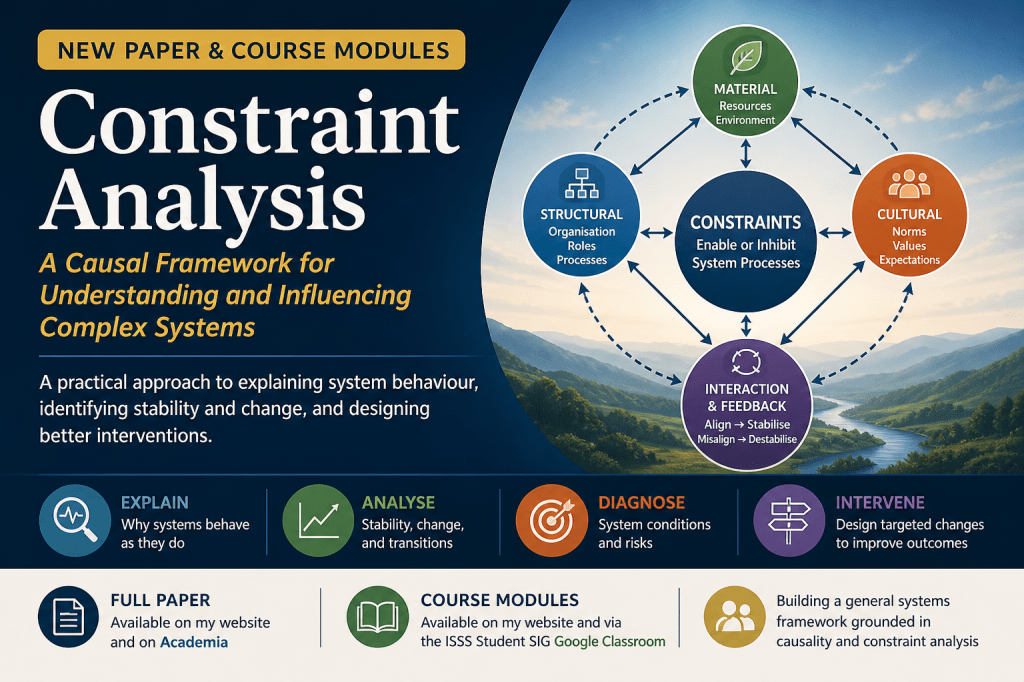
Constraint Analysis

I’m pleased to share a new paper and accompanying course modules on Constraint Analysis; a structured approach to understanding how complex systems behave, change, and sometimes fail.

Rather than looking for single causes, this framework focuses on the conditions that enable or inhibit system processes, and how these interact across different domains:

šŸ”¶ Material (resources, environment)

šŸ”¶ Structural (organisation, roles, processes)

šŸ”¶ Cultural (norms, values, expectations)

By analysing how these constraints align, or become misaligned, it becomes possible to explain:

šŸ”· stability and instability

šŸ”· patterns of behaviour

šŸ”· transitions between system states

šŸ”· and potential points of intervention

The paper sets out the full theoretical framework, including:

šŸ”¶ constraints as causally effective conditions

šŸ”¶ enabling vs inhibiting dynamics (including presence and absence)

šŸ”¶ interaction and feedback across domains

šŸ”¶ attractors, transitions, and system viability

šŸ”¶ a detailed step-by-step analytical method

This work is part of a broader programme developing a social systems framework grounded in causality and constraint-based analysis.

The paper is available via the following links:

šŸ”— Academia: Ā https://www.academia.edu/167298197/Constraint_Analysis_A_Causal_Framework_for_Understanding_and_Influencing_Complex_Systems
šŸ”— Website: https://rational-understanding.com/sst/

Alongside the paper, I have also added a new set of course modules to the Social Systems Theory (SST) course. These modules correspond to the concepts developed in the paper and are designed to make them accessible through:

šŸ”· plain-English explanations

šŸ”· diagrams

šŸ”· practical exercises

The course materials are available in two ways:

šŸ”— Open access (self-paced): https://rational-understanding.com/sst-course/
šŸ”— Supported learning: via Google Classroom through the ISSS Student SIG

Those in full-time or part-time education are especially encouraged to join the Student SIG, where they can benefit from guidance by experienced systems scientists, discussion with fellow learners, and access to a wider international community. To join go to: https://isss.org

#SystemsThinking #ComplexSystems #SystemsScience #Causality #SocialSystems #ConstraintAnalysis

Categories
EFGST

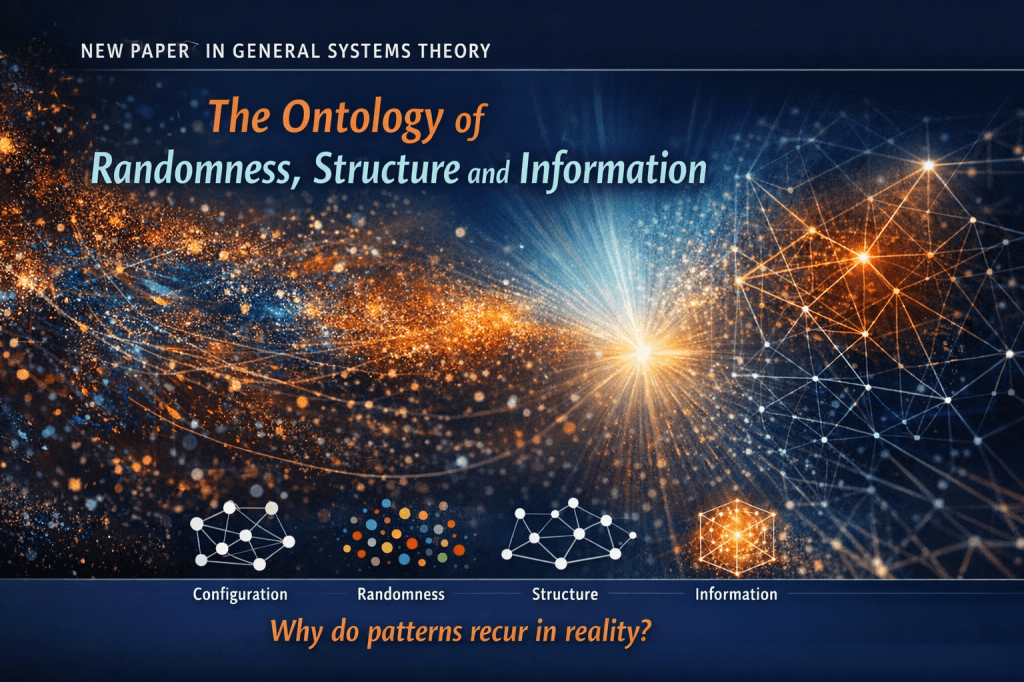
The Ontology of Randomness, Structure and Information

I’m pleased to share the publication of my latest paper:

The Ontology of Randomness, Structure and Information

This paper is the third in a series on General Systems Theory. It develops a clear, physically grounded account of how patterns arise in reality, addressing a fundamental question:

šŸ‘‰ Why does the world exhibit recurring structure rather than remaining a field of transient variation?

The paper introduces and systematically distinguishes four key concepts:

  • configuration — the arrangement of entities in space-time
  • randomness — non-recurring variation in configuration
  • structure — configuration with causal connectivity
  • information — recurring structure

A central claim is that recurrence requires causality, establishing structure as a necessary condition for information and grounding pattern in causally organised processes rather than in arrangement alone.

The aim, as with earlier papers, is not to add complexity, but to clarify foundational concepts and provide a consistent basis for understanding pattern and information across physical, biological, and social domains.

The paper is available via the following links:

šŸ”— Academia: https://www.academia.edu/166175568/The_Ontology_of_Randomness_Structure_and_Information
šŸ”— Website: https://rational-understanding.com/efgst

Alongside the paper, I have also added a new set of course modules to the General Systems Theory (GST) course. These modules correspond to the concepts developed in the paper and are designed to make them accessible through:

  • plain-English explanations
  • diagrams
  • practical exercises

The course materials are available in two ways:

šŸ”— Open access (self-paced): https://rational-understanding.com/gst-course/
šŸ”— Supported learning: via Google Classroom through the ISSS Student SIG

Those in full-time or part-time education are especially encouraged to join the Student SIG, where they can benefit from guidance by experienced systems scientists, discussion with fellow learners, and access to a wider international community. To join go to: https://isss.org

I hope these resources are useful to those interested in systems theory.

#SystemsScience #GeneralSystemsTheory #Complexity #Cybernetics #Information #PhilosophyOfScience #Education

Categories
12. A Framwork For A General System Theory

Framework For A General System Theory

This paper, freely downloadable at https://rational-understanding.com/UUDH#framework, presents a comprehensive framework for understanding systems across all domains of complexity: physical, biological, cognitive, and social. The framework builds upon, unifies, and extends classical systems science by grounding systemic behaviour in open system thermodynamics, energy landscapes, systems causality, and recursive emergence. At its core lies the concept of information at source: a measure of internal recursively structured order, and its dynamic relationship with energy and entropy.

Systems are defined by the emergence of properties absent from their components, and their operation depends on the balance between energy available for maintaining internal structure and that required for exercising function. The framework explains how systems form, persist, collapse, or evolve by stabilising in attractor basins within energy landscapes, scaling recursively through fractal architecture.

Sets of formal definitions and propositions, whose provenance is given, underpin the theory, offering a structured, logically coherent, and cross-disciplinary model. The framework unifies foundational work by von Bertalanffy, Ashby, Beer, Bateson, Prigogine, Rosen, and others. It also incorporates more recent developments by Bhaskar, Cronin and Walker, Parisi, and the author.