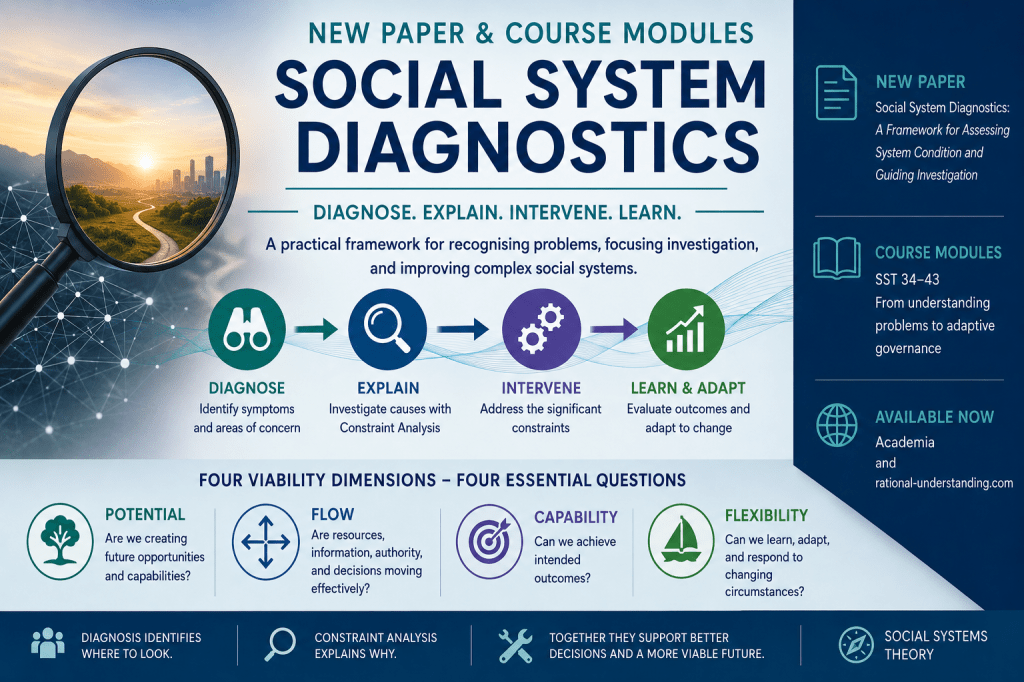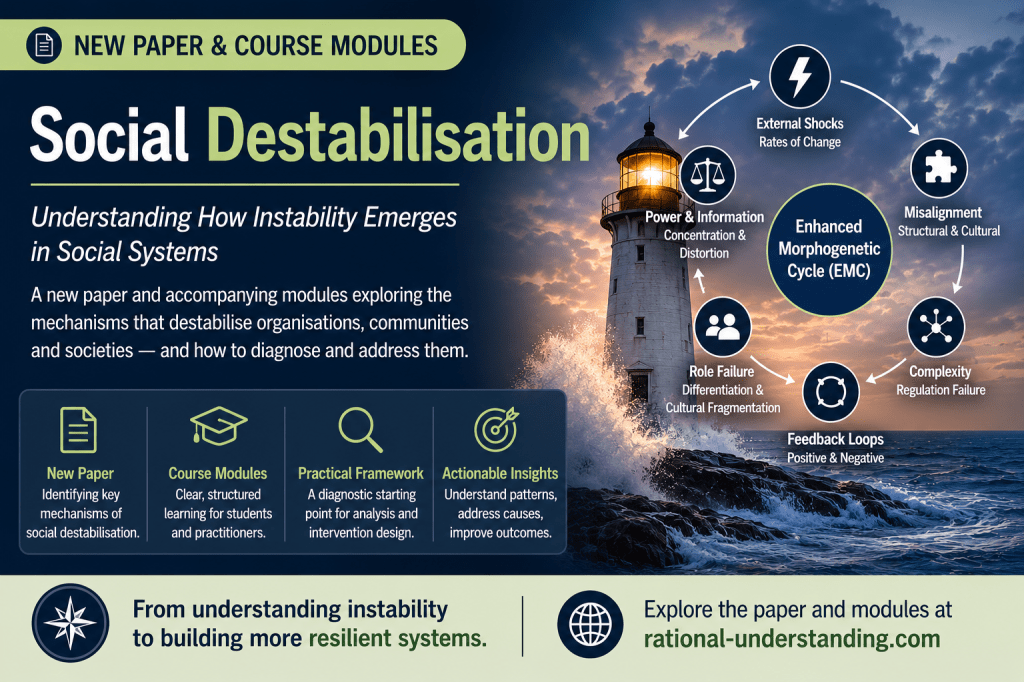
I’m pleased to share a new paper and accompanying course modules on Intervention, Governance and Viability — a practical framework for understanding how social systems can be influenced and improved.
Social systems are constantly changing. Some changes emerge spontaneously through the normal operation of social processes, while others result from deliberate attempts to influence behaviour and outcomes. Yet interventions often succeed in some respects, fail in others, and frequently produce unintended consequences.
The paper argues that effective intervention requires more than good intentions.
It proposes three key ideas:
🔶 Social instability often reflects patterns of constraint misalignment.
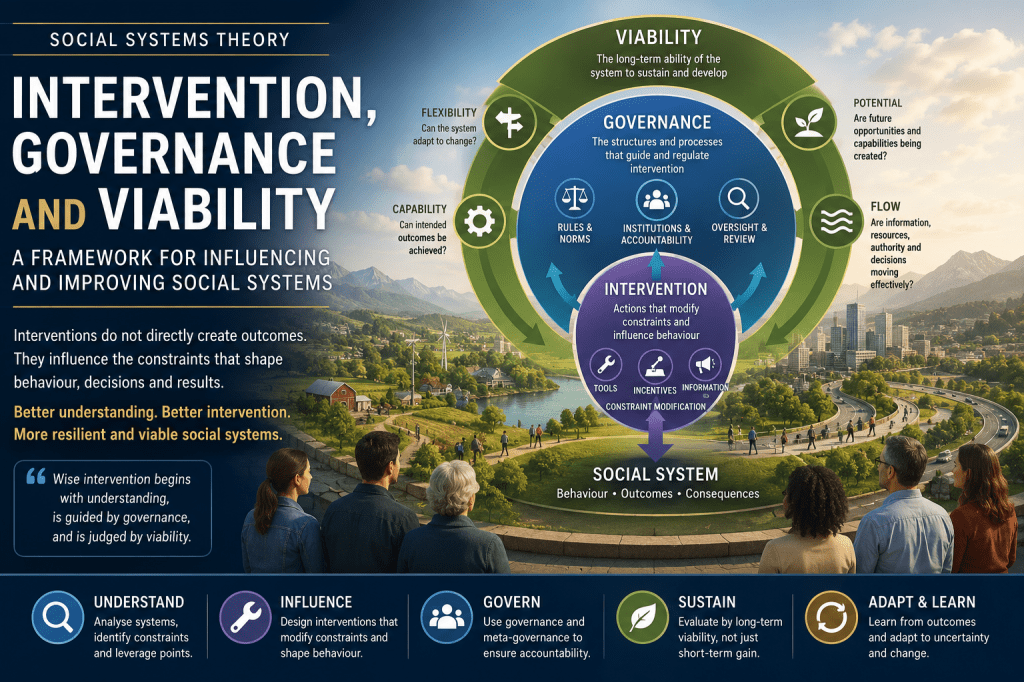
🔶 Interventions influence outcomes indirectly by modifying the constraints that shape behaviour.
🔶 Effective intervention requires governance and should be guided by the long-term viability of the systems affected.
The paper explores:
🔷 intervention as constraint modification
🔷 causal leverage and significant flows
🔷 why interventions succeed or fail
🔷 bounded rationality and unintended consequences
🔷 governance and meta-governance
🔷 trust and the social contract
🔷 viability as a criterion for evaluating social change
A central theme is that interventions do not directly create outcomes. Instead, they influence the circumstances, conditions, and constraints within which individuals and organisations operate. Understanding these relationships provides opportunities for more effective and adaptive forms of governance.
This work forms part of a broader programme developing a social systems framework grounded in causality, constraints, adaptive governance, and systemic viability.
The paper is available via the following links:
🔗 Academia: https://www.academia.edu/168724321/Social_Systems_Intervention_Governance_and_Viability
🔗 Website: https://rational-understanding.com/sst/
Alongside the paper, I have also added a new set of course modules to the Social Systems Theory (SST) course. These modules correspond to the concepts developed in the paper and are designed to make them accessible through:
🔷 plain-English explanations
🔷 diagrams and illustrations
🔷 worked examples
🔷 practical exercises
The course materials are available in two ways:
🔗 Open access (self-paced): https://rational-understanding.com/sst-course/
🔗 Supported learning: via Google Classroom through the ISSS Student SIG
Those in full-time or part-time education are especially encouraged to join the Student SIG, where they can benefit from guidance by experienced systems scientists, discussion with fellow learners, and access to a wider international community.
#SystemsThinking #SystemsScience #ComplexSystems #SocialSystems #Governance #Intervention #Viability #ConstraintAnalysis #AdaptiveGovernance