Categories
SST

Constraint Analysis

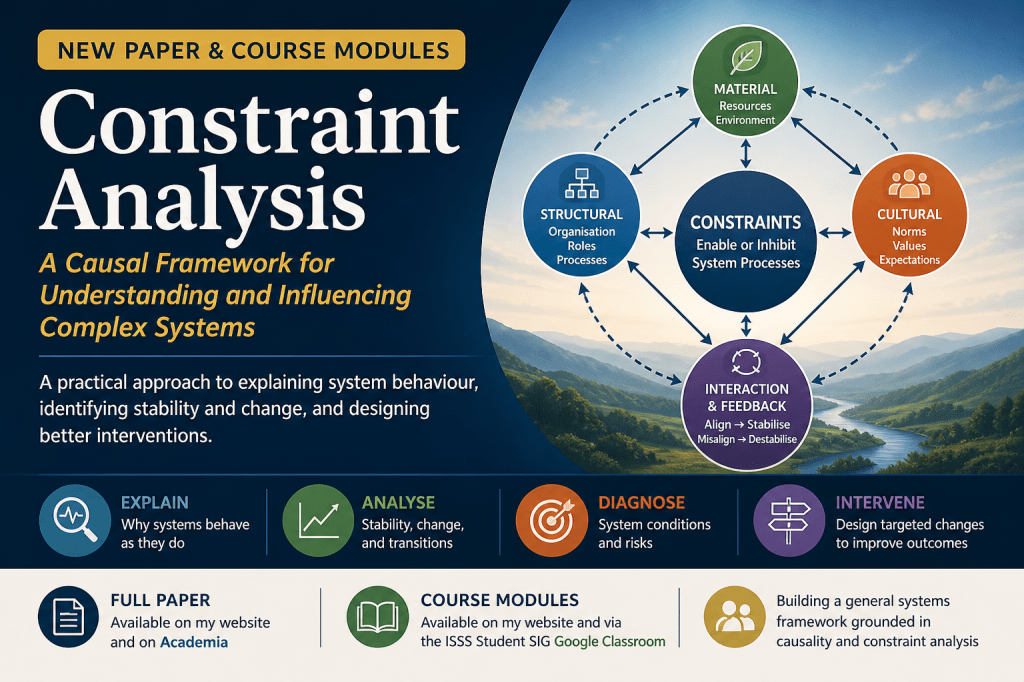
I’m pleased to share a new paper and accompanying course modules on Constraint Analysis; a structured approach to understanding how complex systems behave, change, and sometimes fail.

Rather than looking for single causes, this framework focuses on the conditions that enable or inhibit system processes, and how these interact across different domains:

πŸ”Ά Material (resources, environment)

πŸ”Ά Structural (organisation, roles, processes)

πŸ”Ά Cultural (norms, values, expectations)

By analysing how these constraints align, or become misaligned, it becomes possible to explain:

πŸ”· stability and instability

πŸ”· patterns of behaviour

πŸ”· transitions between system states

πŸ”· and potential points of intervention

The paper sets out the full theoretical framework, including:

πŸ”Ά constraints as causally effective conditions

πŸ”Ά enabling vs inhibiting dynamics (including presence and absence)

πŸ”Ά interaction and feedback across domains

πŸ”Ά attractors, transitions, and system viability

πŸ”Ά a detailed step-by-step analytical method

This work is part of a broader programme developing a social systems framework grounded in causality and constraint-based analysis.

The paper is available via the following links:

πŸ”— Academia: Β https://www.academia.edu/167298197/Constraint_Analysis_A_Causal_Framework_for_Understanding_and_Influencing_Complex_Systems
πŸ”— Website: https://rational-understanding.com/sst/

Alongside the paper, I have also added a new set of course modules to the Social Systems Theory (SST) course. These modules correspond to the concepts developed in the paper and are designed to make them accessible through:

πŸ”· plain-English explanations

πŸ”· diagrams

πŸ”· practical exercises

The course materials are available in two ways:

πŸ”— Open access (self-paced): https://rational-understanding.com/sst-course/
πŸ”— Supported learning: via Google Classroom through the ISSS Student SIG

Those in full-time or part-time education are especially encouraged to join the Student SIG, where they can benefit from guidance by experienced systems scientists, discussion with fellow learners, and access to a wider international community. To join go to: https://isss.org

#SystemsThinking #ComplexSystems #SystemsScience #Causality #SocialSystems #ConstraintAnalysis

Categories
SST

The Evolutionary Basis of the Enhanced Morphogenetic Cycle

I’m pleased to share the second paper in my Social Systems Theory (SST) series which describes the enhanced morphogenetic cycle as the latest expression of an evolutionary process.

In this paper, I explore a simple but far-reaching idea:

πŸ‘‰ The enhanced morphogenetic cycle is not unique to human society
πŸ‘‰ It is the latest stage in a much longer evolutionary process

Across the natural world, systems persist by regulating the conditions that support or undermine their viability. From early chemical organisation, through living systems, to human societies, increasingly complex forms of organisation have emerged that improve this capacity.

This paper shows how:

πŸ”Ά Material constraints define what must be satisfied for systems to persist

πŸ”Ά Structural constraints define what systems can and cannot do

πŸ”Ά Cultural constraints define what agents should and should not do

As systems evolve, new capabilities emerge:

πŸ”Ά metabolism and replication

πŸ”Ά nervous systems and learning

πŸ”Ά symbolic communication and reflexive agency

In human societies, these developments culminate in the enhanced morphogenetic cycle, where agents actively reproduce or transform the conditions that shape their behaviour.

The paper also introduces:

πŸ”Ά a general framework of constraint regulation

πŸ”Ά the role of satisfiers and contra-satisfiers as causal inputs

πŸ”Ά a proposed evo-socio correspondence between organisms and societies

The aim is to place social theory on a broader foundation by linking it to general principles governing the emergence and persistence of organised systems.

πŸ“„ The full paper is available here:
πŸ”— On my website: https://rational-understanding.com/sst#02
πŸ”— On Academia.edu: https://www.academia.edu/165290275/The_Evolutionary_Foundations_of_the_Enhanced_Morphogenetic_Cycle_Constraint_Regulation_and_the_Emergence_of_Reflexive_Agency

#SystemsThinking #SocialTheory #ComplexSystems #Morphogenesis #InterdisciplinaryResearch

Categories
SST

The Enhanced Morphogenetic Cycle

How do societies adapt to change? Why do some institutions reform successfully while others persist in arrangements that no longer work?

These questions sit at the heart of sociology and systems science. Margaret Archer’s Morphogenetic Approach has long provided a powerful way of analysing them by separating structure, culture, and agency and examining how their interaction over time produces stability or transformation.

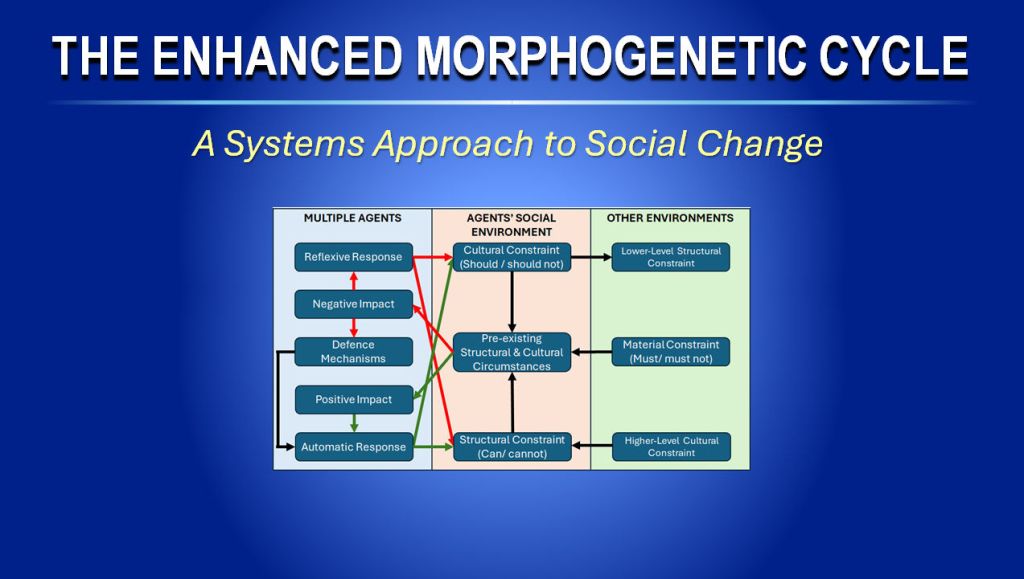
A new paper introduces the Enhanced Morphogenetic Cycle (EMC), a systems-based refinement of the morphogenetic framework designed to clarify the mechanisms through which social systems reproduce or transform.

The enhanced framework introduces several key ideas:

β€’ Three domains of constraint, material, relational, and cultural, which together define the conditions within which social interaction occurs.
β€’ Needs, satisfiers, and contra-satisfiers, which explain how interactions provide feedback that stabilises or destabilises social processes.
β€’ Defensive filtering and needs-driven beliefs, which help explain why individuals and institutions sometimes ignore signals that change is necessary.
β€’ Recognition that social systems are overlapping, hierarchical, and multi-scalar, with agency operating not only at the level of individuals but also through organisations and institutions.

One of the most interesting implications of the model is that the morphogenetic cycle can also be interpreted as a learning process. Individuals, organisations, and societies all receive feedback from their interactions with the environment. When that feedback is interpreted reflexively, systems can adapt. When it is filtered or ignored, instability may accumulate.

The Enhanced Morphogenetic Cycle therefore provides a systems perspective on social adaptation, linking individual learning, organisational decision-making, and broader societal transformation.

This paper serves as the foundation for a series of studies that will explore these ideas in greater detail, including topics such as organisational learning, institutional capture, political dynamics, and social responses to environmental challenges. You can read the full paper here:

https://rational-understanding.com/sst