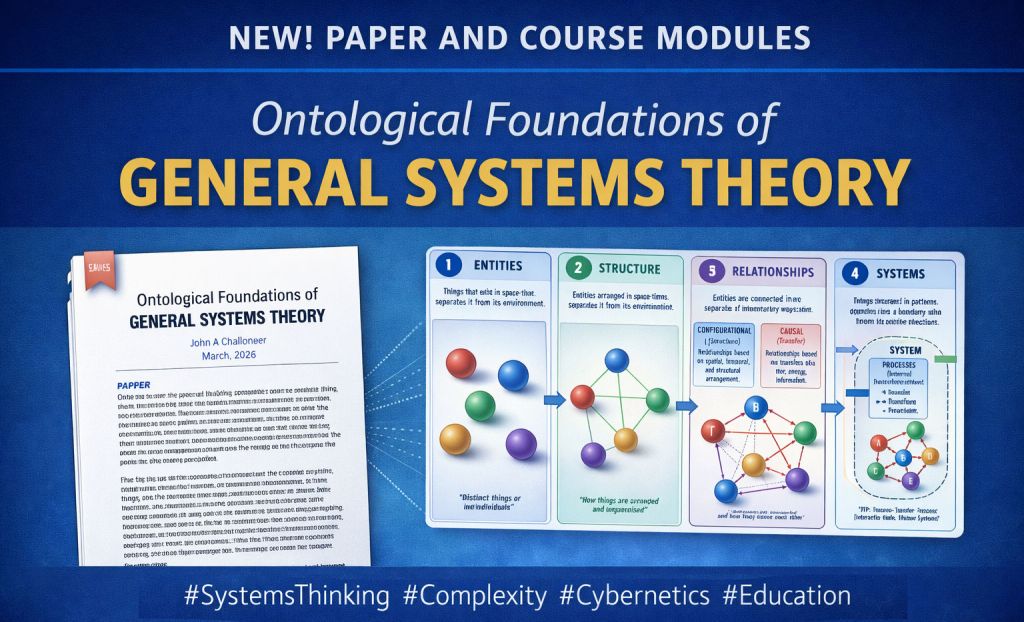
I have recently been developing a new series of course modules introducing the work of some of the researchers who have made important contributions to the foundations of systems science.
The first five modules cover Ludwig von Bertalanffy, W. Ross Ashby, Alexander Bogdanov, Ilya Prigogine and Roy Bhaskar. Together they introduce important ideas concerning systems and organisation, states and transformations, regulation and constraint, open systems and thermodynamics, causality, emergence and the relationship between general and more specialised systems theories.
The modules are intended both for people new to systems science and for those already familiar with the field who would like a concise way of comparing different theoretical traditions.
Each module contains a short biography and principal publications, followed by the researcher’s key definitions and propositions. An important feature is the distinction between ideas that may be applicable to General Systems Theory and those whose validity depends upon particular kinds of systems. The researcher’s original concepts are also translated into a common systems idiom, while retaining the original terminology so that similarities should not be mistaken for equivalence.
This comparative approach has another purpose. Systems science has developed through many partly separate intellectual traditions, often using different terminology for related ideas. Representing the contributions of major researchers in a consistent form makes it easier to identify genuine areas of agreement, differences that need to be understood, and questions that remain unresolved. The aim is therefore not only to study the history of systems science, but to use that history as evidence for its continuing development.
Further researcher modules will be added progressively.
The course modules are open access and are available in two ways:
🔗 Open access (self-paced): https://rational-understanding.com/researchers/
🔗 Supported learning via Google Classroom through the ISSS Student SIG
Those in full-time or part-time education are especially encouraged to join the Student SIG, where they can benefit from guidance by experienced systems scientists, discussion with fellow learners, and access to a wider international community. To join go to: ISSS