Categories
EFGST

The Ontology of Randomness, Structure and Information

Iโ€™m pleased to share the publication of my latest paper:

The Ontology of Randomness, Structure and Information

This paper is the third in a series on General Systems Theory. It develops a clear, physically grounded account of how patterns arise in reality, addressing a fundamental question:

๐Ÿ‘‰ Why does the world exhibit recurring structure rather than remaining a field of transient variation?

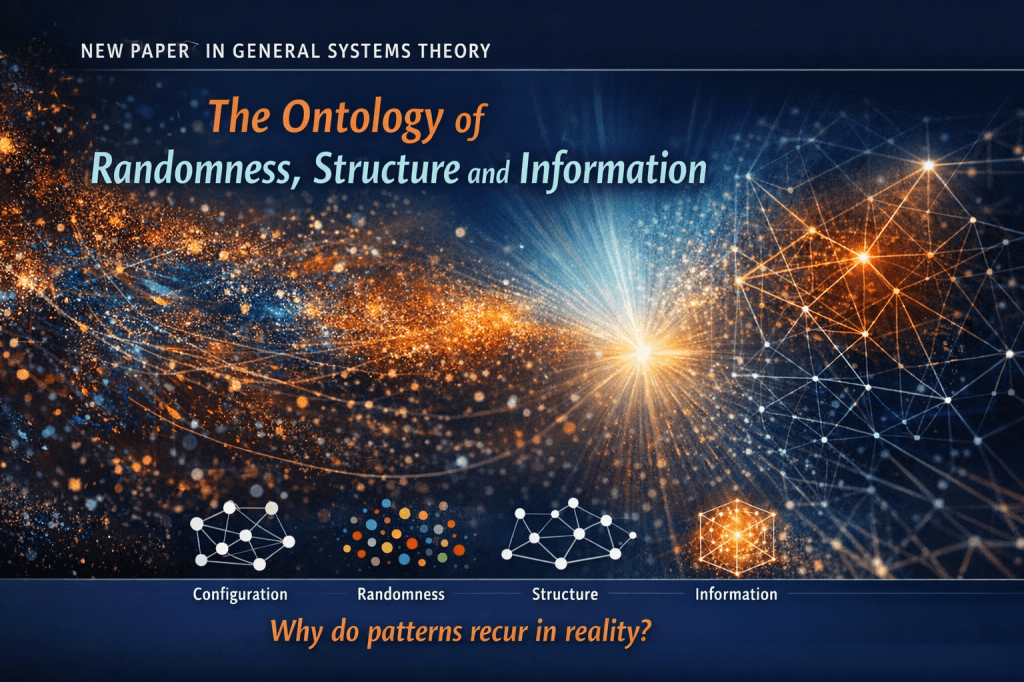
The paper introduces and systematically distinguishes four key concepts:

  • configuration โ€” the arrangement of entities in space-time
  • randomness โ€” non-recurring variation in configuration
  • structure โ€” configuration with causal connectivity
  • information โ€” recurring structure

A central claim is that recurrence requires causality, establishing structure as a necessary condition for information and grounding pattern in causally organised processes rather than in arrangement alone.

The aim, as with earlier papers, is not to add complexity, but to clarify foundational concepts and provide a consistent basis for understanding pattern and information across physical, biological, and social domains.

The paper is available via the following links:

๐Ÿ”— Academia: https://www.academia.edu/166175568/The_Ontology_of_Randomness_Structure_and_Information
๐Ÿ”— Website: https://rational-understanding.com/efgst

Alongside the paper, I have also added a new set of course modules to the General Systems Theory (GST) course. These modules correspond to the concepts developed in the paper and are designed to make them accessible through:

  • plain-English explanations
  • diagrams
  • practical exercises

The course materials are available in two ways:

๐Ÿ”— Open access (self-paced): https://rational-understanding.com/gst-course/
๐Ÿ”— Supported learning: via Google Classroom through the ISSS Student SIG

Those in full-time or part-time education are especially encouraged to join the Student SIG, where they can benefit from guidance by experienced systems scientists, discussion with fellow learners, and access to a wider international community. To join go to: https://isss.org

I hope these resources are useful to those interested in systems theory.

#SystemsScience #GeneralSystemsTheory #Complexity #Cybernetics #Information #PhilosophyOfScience #Education

Categories
EFGST

Ontological Foundations of General Systems Theory

Iโ€™m pleased to share the publication of my latest paper:

Ontological Foundations of General Systems Theory

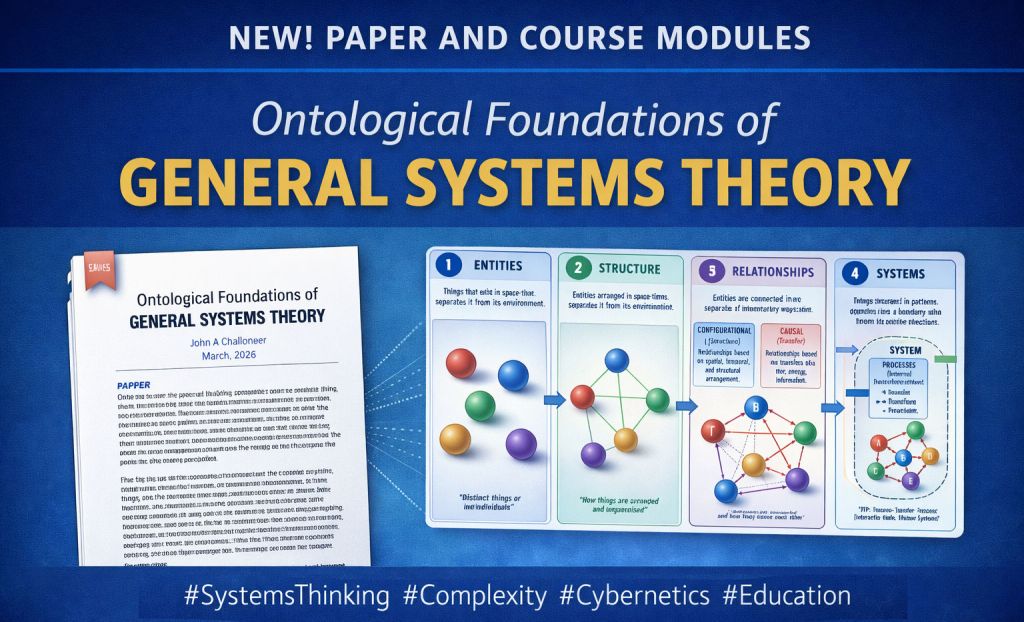
This paper is the second in a series on General Systems Theory. It sets out a clear, physically grounded framework for understanding reality in systems terms. It brings together concepts of space-time, entities, structure, relationships, causality, and change into a single coherent ontology.

The aim is not to introduce new complexity, but to clarify the foundations on which systems theory rests; providing a consistent basis for analysing systems across physical, biological, and social domains.

The paper is available via the following links:

๐Ÿ”—Academia: https://www.academia.edu/165495501/Ontological_Foundations_of_General_Systems_Theory

๐Ÿ”—Website: https://rational-understanding.com/efgst

Alongside the paper, I have also added a new set of course modules to an existing General Systems Theory (GST) course. These modules correspond to the ontological foundations developed in the paper and are designed to make the concepts accessible through plain-English explanations, diagrams, and practical exercises.

The course materials are available in two ways:

๐Ÿ”—Open access (self-paced): via my website https://rational-understanding.com/gst-course/
๐Ÿ”—Supported learning: via Google Classroom through the ISSS Student SIG.

Those in full-time or part-time education are especially encouraged to join the Student SIG, where they can benefit from guidance by experienced systems scientists, discussion with fellow learners, and access to a wider international community. To join go to : https://isss.org

I hope these resources are useful to those interested in systems theory.

Categories
EFGST

01 Philosophical Foundations of General Systems Theory

This paper sets out the philosophical basis for the Extended Framework for General Systems Theory (EFGST), integrating two complementary perspectives:

  • Cognitive Physicalism โ€“ everything that exists is physical and located in spaceโ€“time, including cognition itself
  • Critical Realism โ€“ reality exists independently of our knowledge, but our understanding of it is always mediated

Together, these provide a realist yet epistemically modest foundation for systems science.

The paper explores several key implications, including:

  • systems as real, structured physical entities
  • knowledge as model-based and necessarily partial
  • the distinction between observable events and underlying causal structures
  • and the idea that the future is constrained but not predetermined, unfolding through branching possibilities shaped by interaction and agency

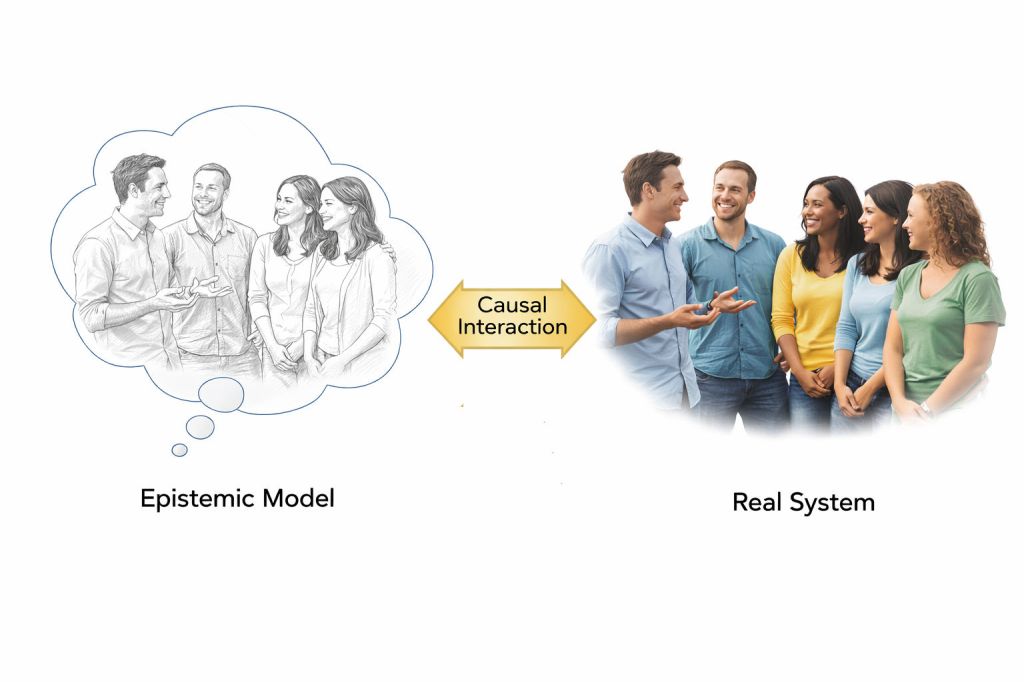
One theme that runs throughout is that we never act directly on reality itself, but on representations of it; representations that are sufficient for action, but never complete.

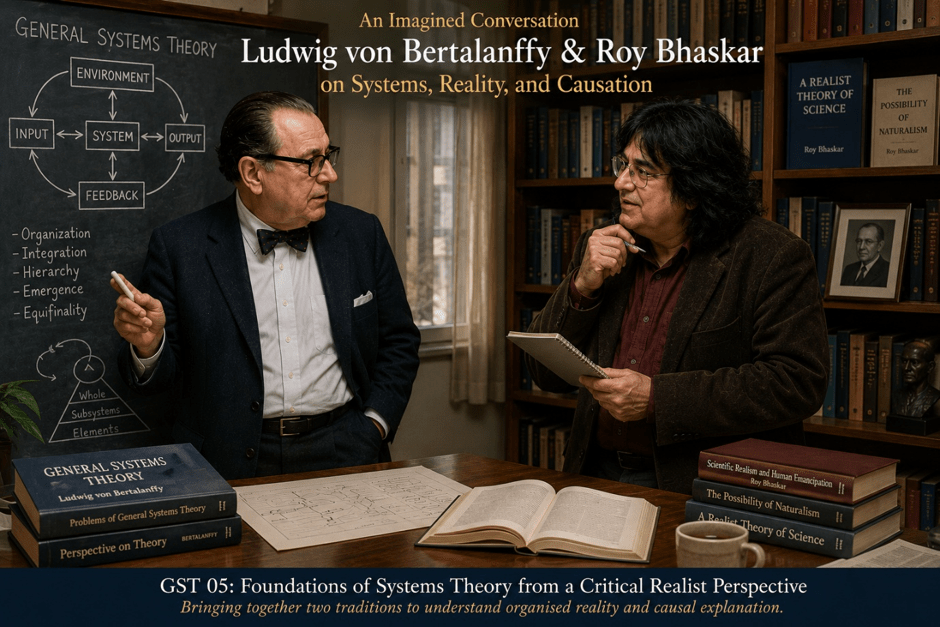
To illustrate this, Iโ€™ve included a banner image accompanying the paper.
You might like to take a careful look at itโ€ฆ

The paper can be downloaded in pdf format from https://rational-understanding.com/EFGST#01