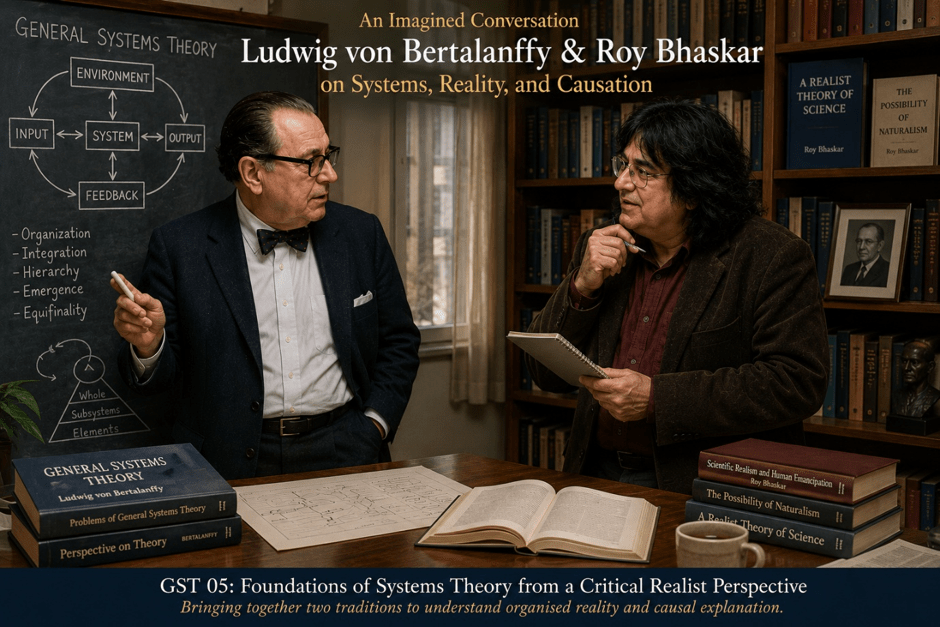
The following is, of course, an imaginary conversation, but one I suspect might have taken place had Ludwig von Bertalanffy and Roy Bhaskar ever met.
Bertalanffy: For many years I have argued that science has become fragmented into isolated disciplines. We need a General Systems Theory capable of describing organised wholes wherever they occur.
Bhaskar: I share your concern. But before we ask how systems are organised, should we not first ask what it is that exists independently of our descriptions of it?
Bertalanffy: You mean that systems are part of reality, not merely ways of thinking about reality?
Bhaskar: Precisely. Reality possesses structures and causal powers that continue to exist whether we observe them or not. Science succeeds because it progressively discovers those structures rather than inventing them.
Bertalanffy: Then perhaps I should ask you a question. What makes a system real rather than simply a useful way of describing the world?
Bhaskar: A good question. A system is real if it possesses an organised structure capable of generating causal powers and events. Our descriptions may differ, but the underlying organisation exists independently of us.
Bertalanffy: That is remarkably close to what I had in mind when I described organised wholes. My concern was always that science had become so specialised that it lost sight of organisation itself. Perhaps I did not make the philosophical foundations explicit enough.
Bhaskar: And perhaps philosophy has not developed a sufficiently rich language for describing organised reality. It can explain why generative mechanisms matter, but it says rather less about how they become organised into the systems we encounter throughout nature and society.
Bertalanffy: Then our ideas may be more complementary than either of us realised.
Bhaskar: I think they deserve to be explored together.
Narrator; Ludwig von Bertalanffy and Roy Bhaskar never met. Yet their work points in remarkably complementary directions. General Systems Theory provides a language for describing organised wholes, interaction, emergence and organisation. Critical Realism provides a philosophical account of why those organisations are objectively real and how they generate the events we observe.
Author: My latest paper explores what happens when these two traditions are considered together.
GST 05 – Foundations of Systems Theory from a Critical Realist Perspective
You can read the paper here:
🔗 Rational Understanding:
https://Rational-understanding.com/efgst/
Alongside the paper, I have also added a new set of course modules to the General Systems Theory (GST) course. These modules correspond to the concepts developed in the paper and are designed to make them accessible through:
🔷 plain-English explanations
🔷 diagrams
🔷 practical exercises
The course materials are available in two ways:
🔗 Open access (self-paced): https://rational-understanding.com/gst-course/
🔗 Supported learning: via Google Classroom through the ISSS Student SIG
Those in full-time or part-time education are especially encouraged to join the Student SIG, where they can benefit from guidance by experienced systems scientists, discussion with fellow learners, and access to a wider international community. To join go to: https://isss.org
If Bertalanffy and Bhaskar had met, do you think they would have recognised each other as fellow travellers, or would important disagreements have remained?

