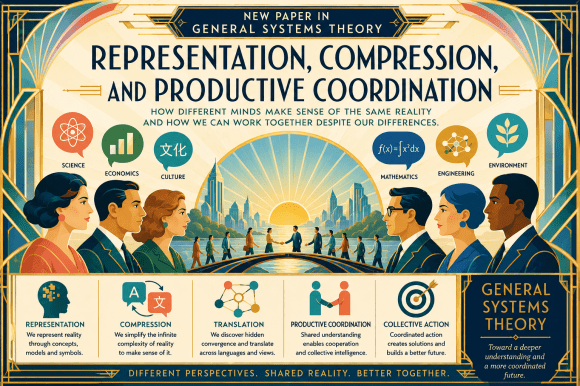
Why is it so difficult to combine knowledge from different disciplines?
An economist, sociologist, psychologist, engineer, and biologist may examine closely related aspects of reality, yet describe them using different concepts, terminology, and forms of explanation.
The problem may not be disagreement. They may simply be unable to see how their different perspectives fit together.
My latest paper in the General Systems Theory series explores a possible way forward:
👉 Productive co-ordination
The proposed process is simple in principle: Decompress → Recompress → Compare
Specialist propositions are first translated into plain language. Their underlying systems structures—entities, processes, transfers, constraints, feedbacks, and related concepts—are then identified using a common systems idiom.
The resulting structures can be compared and this may reveal:
🔹 Equivalence
🔹 Complementarity
🔹 Nesting
🔹 Contradiction
🔹 Independent utility
The objective is not to force agreement. It is to understand more clearly how different perspectives relate to one another.
But developing the methodology revealed a deeper problem. Most attempts to create a common systems language focus upon developing a common systems vocabulary or idiom.
Yet language does more than name things. Its grammatical structures also represent relationships, processes, and causality. If reality is systemic, and language evolved to represent reality, then systems structures may already be reflected within language itself.
This suggests a potentially important distinction between:
🔹 The Systems Idiom – a common vocabulary for expressing systems structures.
🔹 Systems Linguistics – the study of how systems structures are represented within language.
At present, productive co-ordination can compare identified systems concepts and structures. A more developed systems linguistics may eventually allow deeper comparison between the propositions and causal structures expressed by different disciplines.
This may be one of the missing pieces in the long-standing General Systems Theory dream of integrating knowledge across disciplinary boundaries.
Alongside the paper, I have published four short General Systems Theory course modules featuring plain-English explanations, diagrams, examples, and practical exercises:
GST 38 – Productive Co-ordination
GST 39 – The Productive Co-ordination Process
GST 40 – Comparing Perspectives
GST 41 – Systems Linguistics and the Systems Idiom
Both the paper and course modules are open access.
The paper is available at:
https://www.academia.edu/169817426/Productive_Co_ordination
https://rational-understanding.com/efgst
The course materials are available in two ways:
🔗 Open access (self-paced):
https://rational-understanding.com/gst-course
🔗 Supported learning: via Google Classroom through the ISSS Student SIG.
Those in full-time or part-time education are especially encouraged to join the Student SIG, where they can benefit from guidance by experienced systems scientists, discussion with fellow learners, and access to a wider international community. To join, go to ISSS.
I hope the paper proves useful to those interested in systems theory, interdisciplinary research, communication, knowledge integration, and the future of collective problem-solving.