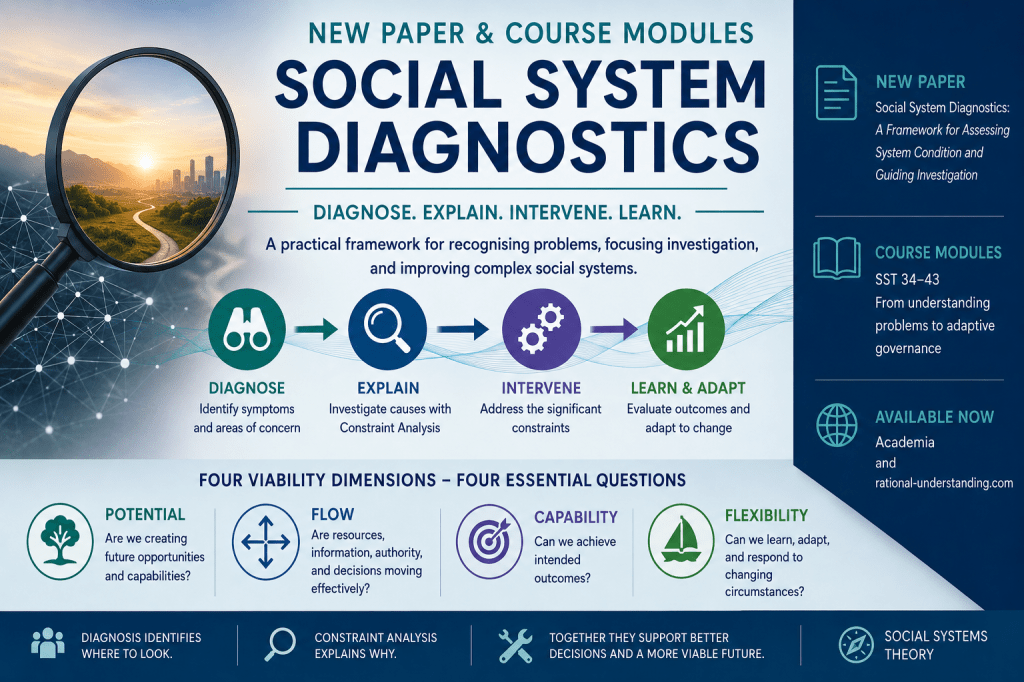
I’m pleased to share a new paper and accompanying course modules on Social System Diagnostics — a practical framework for identifying problems in complex social systems and determining where further investigation should be focused.
Complex systems rarely fail for a single reason. Before we can explain why a problem exists, we must first recognise it and identify the areas requiring closer attention.
The paper introduces Systemic Diagnostics as a complement to Constraint Analysis.
It argues that diagnosis and explanation are distinct but complementary processes:
🔶 Diagnostics identifies symptoms and areas of concern.
🔶 Constraint Analysis investigates the underlying causes responsible for those conditions.
To support this process, the paper introduces a diagnostic hierarchy based upon system viability.
Because viability cannot be observed directly, it is disaggregated into four diagnostic dimensions:
🔷 Potential – Are future opportunities and capabilities being created?
🔷 Flow – Are information, resources, authority, and decisions moving effectively?
🔷 Capability – Can intended outcomes be achieved?
🔷 Flexibility – Can the system adapt to changing circumstances?
Together, these dimensions provide a structured framework for assessing system condition and identifying areas requiring further investigation.
The paper explores:
🔶 diagnosis as progressive expansion
🔶 viability and viability dimensions
🔶 diagnostic indicators
🔶 the relationship between symptoms and causes
🔶 the transition from diagnosis to Constraint Analysis
🔶 governance, learning, and adaptive decision-making
This work forms part of a broader programme developing a social systems framework grounded in causality, constraints, and adaptive governance.
The paper is available via the following links:
🔗 Academia: https://www.academia.edu/168478652/Social_System_Diagnostics
🔗 Website: https://rational-understanding.com/sst/
Alongside the paper, I have also added a new set of course modules to the Social Systems Theory (SST) course. These modules correspond to the concepts developed in the paper and are designed to make them accessible through:
🔷 plain-English explanations
🔷 diagrams and illustrations
🔷 worked examples
🔷 practical exercises
The course materials are available in two ways:
🔗 Open access (self-paced): https://rational-understanding.com/sst-course/
🔗 Supported learning: via Google Classroom through the ISSS Student SIG
Those in full-time or part-time education are especially encouraged to join the Student SIG, where they can benefit from guidance by experienced systems scientists, discussion with fellow learners, and access to a wider international community.

