Human societies now operate at a scale unprecedented in history, yet they struggle to coordinate effectively in the face of environmental, social, and geopolitical crises. Climate change, institutional breakdown, misinformation, and persistent inequality are often treated as separate problems, to be solved through better politics, better technology, or better ethics. This paper starts from a different premise: that many of these difficulties are not failures of intention or morality, but symptoms of an unfinished stage of social development.
Using ideas from systems theory and evolutionary biology, the paper explores the possibility that human societies are still undergoing a process of evolutionary assembly, similar in important ways to the biological evolution that produced complex organisms. Social systems, ranging from individuals and organisations to nations, exhibit recurring structural patterns, but as they grow larger they tend to become less integrated even as their power increases. Functional specialisation expands what societies can do, but integration and control often lag behind.
The paper also argues that human needs themselves emerged in a developmental sequence, existence, relatedness, then growth, and that societies tend to follow the same pattern. When social systems prioritise growth before basic needs for security, belonging, and integration are met, instability and pathology predictably follow. From this perspective, phenomena such as criminality, institutional fragility, and environmental overshoot are not anomalies, but signals of insufficient integration at larger scales. Rather than proposing political solutions or institutional blueprints, the paper offers a way of understanding where humanity may be in its social evolutionary trajectory. It identifies two key barriers to further development, informational breakdown and weak systemic commitment, and suggests that the long-term viability of human societies depends on new forms of large-scale coordination and regulation grounded in accurate information, shared understanding, and recognition of deep interdependence.
We often speak of “information” as though it floats freely in cyberspace or the human mind, detached from anything physical. Yet every bit of information, from the letters on this page to the thoughts in your head, is carried by matter or energy. This simple observation lies at the heart of cognitive physicalism, the view that cognition, communication, and social coordination are all thermodynamic processes.
Information Is Order
In physical terms, information is negative entropy; order among components of a system. When the atoms of a crystal, the base pairs of DNA, or the neurons of a brain are arranged in regular patterns, they hold information by reducing randomness. This definition, first clarified by Léon Brillouin and Erwin Schrödinger, gives information the same physical dimensions as entropy:
Energy provides the capacity for work (); information provides the form that directs that work. Together they make organisation possible.
How Physics Becomes Mind
In purely physical systems, energy and entropy simply flow. With life, informational structures emerge that regulate those flows. A cell maintains order by channelling chemical energy through genetic and enzymatic constraints. With evolution, feedback control grows more elaborate: nervous systems model the world, predict outcomes, and choose among options. Agency, the ability to act purposefully, appears when informational form controls energetic process.
At higher levels, the same principle produces cognition, language, and society. Neural firing, conversation, and economic exchange are all manifestations of energy flows organised by information.
Why Equations Matter
When information theory borrowed from thermodynamics, it kept Boltzmann’s equation but quietly normalised away the constant Doing so made information appear dimensionless; handy for communication engineers, but misleading for science. As Rolf Landauer later reminded us, information is physical: erasing a single bit requires energy and generates heat. Ignoring this fact masks the cost of learning, computing, and communicating; costs that become crucial when we extend systems thinking to living and social domains.
The Structure of Agency
Agency can be described in three physical layers:
Level
Description
Dimensions
Agentic information structure
pattern that directs energy
Agentic potential
information-structured energy capacity
Actualised agency
directed energy flow through time
Energy provides the means, information the form, and their coupling the act. Whether in a cell, a mind, or a society, the same dimensional hierarchy holds.
The Sun and the Spectrum of Agency
All terrestrial agency begins with the Sun. Photons striking chlorophyll are converted into chemical potential, which sustains metabolism, cognition, and eventually culture. Every thought, conversation, or social reform is therefore a distant echo of solar radiation; a transformation of sunlight into structured work.
The Cost of Thought and Change
Learning, decision, and communication are thermodynamic operations. Brain imaging shows energy consumption rising during problem-solving; each new memory reduces neural entropy while producing waste heat. The same principle scales up: cultural and institutional change require energy to reorganise shared information. Schools, media, and political movements are energetic engines for lowering societal entropy. When their energy supply falters, coherence and collective agency decline.
Why This Matters for Systems Science
Re-embedding information and agency in physics brings fresh clarity to systems thinking. It explains why order must be sustained by flows, why “effort” feels costly, and why every form of coordination, from metabolism to governance, depends on continual energy input. It also offers a bridge between natural and social sciences: the same thermodynamic grammar governs both.
As Ilya Prigogine showed, local order can grow even while global entropy rises. Life, mind, and society are all such dissipative structures, islands of organisation maintained by throughputs of energy and information. Understanding this continuity reminds us that progress itself carries an energetic price.
From Theory to Application
Recognising the physical nature of information could reshape how we approach education, technology, and governance. Policies and systems that ignore their energetic base risk collapse; those that respect it can harness energy more efficiently to sustain informational order.
Energy is the means, information the form, and agency the dance between them. Seen thermodynamically, every act of understanding is a small victory over entropy; a local flowering of order in the great energetic flow from the Sun.
This article explores two fundamental modes of causal reasoning: TPT (Transfer-Process-Transfer) and PTP (Process-Transfer-Process) structures. These structures help clarify how humans and artificial intelligences like large language models reason about cause and effect, why both are susceptible to error, and why combining them is essential for a robust understanding.
The two forms of reasoning derive from the following:
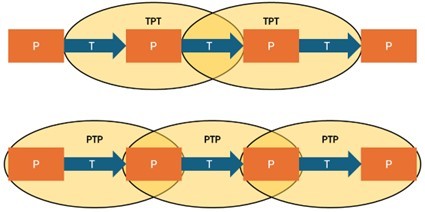
Causal transfers take time and travelling through any causal network in the direction of the arrow of time will yield a chain of alternating processes and transfers, i.e.: … P – T – P – T – P …
Causes are effects, and effects are causes.
Every system or event in a causal chain shares a component with its predecessor and successor.
The PTP structure equates to an event in which something does something to something else. The TPT structure equates to a system with its inputs, processes and outputs.
TPT Reasoning: Pattern Recognition and Unconscious Inference
TPT causality refers to a structure in which two processes are linked by an inferred or unknown transfer, i.e. each cause and effect has the structure TPT and the two are linked by a common T. In human cognition, this reflects pattern recognition: we notice that two processes frequently co-occur, and infer a causal link, even if we cannot identify what mediates the connection.
This form of reasoning is fast, intuitive, and largely unconscious. It allows us to make rapid inferences from experience, often without awareness of the intermediate mechanisms. However, it is error-prone. TPT reasoning is vulnerable to spurious associations and errors caused by unseen common causes. In these cases, the inferred causal link is false, despite the pattern appearing consistent.
Large language models also rely heavily on TPT-type reasoning. They identify recurring associations in their training data and reproduce those patterns in response. This allows them to answer questions, complete prompts, and simulate explanations even when they do not possess internal models of the causal transfers involved.
PTP Reasoning: Explicit Inference and Conscious Verification
In PTP causality, by contrast, causes and effects consist of a process, a known transfer, and another process. Each cause or effect has a PTP structure and the two are linked by a common P. This represents structured reasoning in which a clearly identified mechanism links cause and effect. In human cognition, this kind of reasoning is associated with conscious, reflective thinking. It is slow, deliberate, and effortful, but less prone to error.
Verification through PTP reasoning is essential when pattern-based inferences (TPT) are in doubt. It allows us to examine whether a supposed cause-effect relationship is supported by identifiable transfers. In systems theory terms, it confirms that the output of one process is indeed the input to another.
Error and Verification in Human and AI Cognition
Both humans and artificial intelligences are vulnerable to error when relying solely on TPT reasoning. A classic example is the post hoc fallacy: assuming that because B follows A, A caused B. Without identifying the actual transfer, such reasoning remains speculative.
AI systems, too, may generate plausible but incorrect answers when their training data contains coincidental patterns. They may infer connections that resemble PTP structures but are not grounded in causality.
This is why PTP reasoning is vital for verification. It distinguishes genuine causal chains from coincidental associations by demanding an explicit causal transfer.
A Unified Framework of Reasoning
A key insight from systems theory is that these two modes of reasoning are not exclusive. In fact, they are complementary. TPT reasoning allows for quick hypothesis generation and intuitive understanding. PTP reasoning provides a structure for verification, deeper analysis, and error correction.
Understanding and integrating both types of causal reasoning is central to building a theory of cognition, both biological and artificial. It also has direct implications for epistemology, systems modelling, and the future of AI development.
Conclusion
TPT and PTP causality offer a powerful lens for interpreting human and artificial thought. TPT supports rapid pattern recognition; PTP ensures that those patterns are grounded in real causal mechanisms. Awareness of this dual structure is essential for improving reasoning, communication, and the development of intelligent systems.
Future work may involve identifying when to trust each mode, and how to better integrate them in education, epistemology, and machine reasoning architectures.
Operant conditioning was first described by the American psychologist B. F. Skinner (1904 – 1990) (Skinner, 1938). It is a method of learning that uses satisfiers and contra-satisfiers to alter behaviour. Skinner found that, if a behaviour was associated with a satisfier, or as it is more commonly referred to as a reward, then it was likely to be repeated. This is referred to as reinforcement of the behaviour. Ultimately, if a behaviour is sufficiently reinforced, it can become automatic or unconscious. On the other hand, if a behaviour was associated with a contra-satisfier or punishment, then it was less likely to be repeated. If it was sufficiently punished, then it could become entirely forgotten or extinguished.
Normally, before we act, a decision is made unconsciously and passed to the conscious mind which then vets it. If the act is deemed to be satisfactory, the conscious mind approves it. However, if it is deemed unsatisfactory, then it is blocked and the unconscious mind must think again. In this way our more rational conscious mind can condition our more creative unconscious. It is like riding a bicycle. Initially, it can take considerable conscious effort, but over time we learn to control the bicycle unconsciously with little or no conscious intervention. The same principle applies to operant conditioning. However, in the case of conditioning the conscious mind is replaced by satisfiers or contra-satisfiers from an external agent.
An example of extinguishment is cultural denial. If a topic is one that causes people anxiety, then we are discouraged from raising it by other members of our community. That is, they punish us socially for doing so, and ultimately the topic becomes extinguished from our minds. That is, we fall into denial.
Although operant conditioning was first formally recognised by Skinner, it has been used in practice for a very long time. In fact, because the practice of conditioning others can be seen in alpha members of animal herds and packs, it probably predates the evolution of homo sapiens. To cite human examples, some religions have conditioned behaviours and beliefs in their members through regular ritual practices, and continue to do so. Kings and emperors have conditioned compliance through reward or threats of physical punishment. In the present day, we are conditioned as consumers through advertisements that promise psychological or practical rewards for our purchases.
Once a threshold percentage of the population has been conditioned to behave in a particular way, that behaviour becomes a part of its culture, i.e., a value, a norm, or a belief. The conditioning then becomes self-sustaining through a process of socialization. That is, we reward one another socially for compliance, and punish one another for non-compliance. Aspects of the culture in our social environment can act as a satisfier, as a contra-satisfier, or can be neutral for an individual or organisation depending on their needs and circumstances. The more a culture acts as a satisfier the more likely it is to be adopted and the less likely it is to be rejected. Together, conditioning, socialization and acceptance can steer the evolution of a culture. This is almost certainly the case with the shift from traditional values, often religiously inspired, to self-expression values, often consumption inspired, noted by the World Values Survey (World Values Survey Association, 2020). Bluntly put, the satisfaction of our more basic needs today is a stronger driver of behaviour than the satisfaction of our higher needs tomorrow. So, consumer conditioning has replaced religious conditioning.
Unfortunately, we are all susceptible to conditioning. This is because of the way that our minds have evolved. Both religious and consumer conditioning are ways of controlling the majority in the interest of an elite minority. Thus, many aspects of religion and consumerism are harmful to society. Additionally, many aspects of consumerism are harmful to the natural environment. Fortunately, providing we develop the more rational and conscious aspect of our minds, there is much that we can do to avoid or overcome such conditioning. However, before describing my suggested approach, I would like to clarify the nature of consciousness.
A detailed explanation of consciousness can be found at https://rational-understanding.com/2021/10/22/consciousness/. In summary, however, it is an awareness of one’s own mental processes. Unfortunately, the popular definition incorrectly includes an awareness of one’s surroundings. Very primitive animals, that we would hesitate to describe as being conscious, are aware of their surroundings and, because people have evolved from simpler organisms, this awareness is a function of our unconscious mind. The unconscious mind then passes relevant information, particularly any threats or opportunities, to the conscious one. For example, a noise while we are sleeping will awaken us, or the flick of a curtain on the opposite side of the street will automatically draw our attention. Because of this misunderstanding, use of the internet search term “increasing consciousness” will yield advice on how to improve one’s perception of the external world, or how to achieve a mystical “higher level of consciousness”. However, from personal experience, I would recommend painting or photography to increase one’s perception of the external world. After some practice, colours will become more vibrant, and the arrangement of objects more interesting. Returning to the correct definition of consciousness, some of us are more conscious of our own minds than others. Nevertheless, this too can be improved with practice and the appropriate internet search term is “increasing self-awareness”.
The approach that I would recommend for avoiding or removing any conditioning is therefore as follows.
Consciously recognise conditioning attempts whilst they are happening. This is not difficult. There will be much repetition accompanied by implied or overt promises of satisfiers, or threats of contra-satisfiers.
Consciously recognise any social pressures from, for example, friends, colleagues, and advertising, to accept a value, norm, or belief.
Consciously recognise when we are engaging in conditioned behaviour. Again, there will be repetition and the behaviour will be carried out unconsciously. There may also be a sense of compulsion or addiction.
Consciously question whether the behaviour makes sense and is good for us, our society, and the natural environment.
Armed with this knowledge, it is then possible to avoid conditioning. It is also possible, but difficult, to de-condition ourselves. The latter is sometimes referred to as self-control.
Firstly, avoid any further conditioning attempts and any social pressures. For example, don’t watch adverts and don’t mix with people who pressurise others in this way.
Consciously block conditioned behaviours whenever they are prompted by the unconscious mind. To this end it may be necessary to stimulate conscious thought by, for example, using sticky labels on anything used in the behaviour or by asking a friend or partner to alert you to such behaviour. Keep your responses to ones of gratitude though, or they will quickly become conditioned against helping you.
Rehearse the negatives of a conditioned behaviour whenever you become aware of it. A written list will help. This is a mild form of aversion therapy, but I would not recommend any stronger form.
Nor would I recommend rewarding yourself whenever you block a behaviour except to feel pleased. Anything more may condition some other behaviour.
References
B.F. Skinner (1938). “The Behavior of Organisms: An Experimental Analysis.” Cambridge, Massachusetts: B.F. Skinner Foundation. ISBN 1-58390-007-1, ISBN 0-87411-487-X
To maintain our independence of mind it is necessary to avoid unconscious beliefs and attitudes that we would prefer not to have. Suggestions as to how we might do so are listed below.
Question the motives of charismatic leaders and role models.
Avoid following authoritarian leaders or being managed by authoritarian managers. They will insist that we adopt their point of view if we wish to remain in the group that they lead. Inclusive leaders and managers, on the other hand, respect, and value independence of mind.
Avoid following populist leaders. They will often place the blame for any difficult circumstances we find ourselves in on an “outgroup” rather than address the true reasons.
Avoid ideologies. If we need to join a group to socialize, then we should join one whose members have a wide range of views rather than a particular ideology. This can be checked by adding “ism” to words in a group’s name.
Practice awareness of our own emotions and those of others with whom we interact. Emotional contagion and emotional carry-over from previous decisions can both affect our current decisions. Furthermore, our emotions can be deliberately manipulated by others to achieve their desired ends.
Our conscious skills can be strengthened by practicing highly focused mental and, possibly, physical activities, e.g., a personal project or Sudoku puzzles.
Develop a clear personal ethic and set of values. It may need to evolve over time as circumstances alter it, but that is normal.
Consciously rehearsing our ethics and values can strengthen them. A strongly held ethic makes it more difficult for contradictory unconscious beliefs and attitudes to gain a foothold.
Acquaint ourselves with the verifiable facts around an issue before making decisions associated with it.
Consciously criticise our decisions, especially apparently spontaneous ones. Judge them against our personal ethic and values. If necessary, veto them and think again.
Avoid watching unsolicited advertising. For example, watch advertisement free channels or mute the TV when they are on. Cover the advertisements on the back of seats of buses and aircraft. If we need something we can search for it on the internet or consult a shopkeeper.
It is particularly important to avoid watching the same advert repetitively. In the UK it is illegal for an ad. to repeat the same message more than three times as this subliminally reinforces it. So how do advertisers get around this? By frequently repeating their ad.
Lobby government for greater controls over advertising. It should be factual, unintrusive, not personally targeted, not excessively repetitive, and not imply that the product has false benefits.
The English philosopher, John Locke, (1632 – 1704) described consciousness as “the perception of what passes in a man’s own mind”. He was, of course, a man of his age and, today, we would understand this definition to include all genders and some animals. More recently, Locke’s definition has been extended to include awareness of the external world but, unfortunately, this is a red herring. Even bacteria respond to stimuli in the external world and, so, are aware of it. However, we would not regard them as being conscious. Furthermore, the unconscious human mind is aware of the external world, which is why, for example, a noise will wake us from sleep. Finally, it is possible for a human being to be conscious in the complete absence of external stimuli. Locke’s original definition seems more apt, therefore.
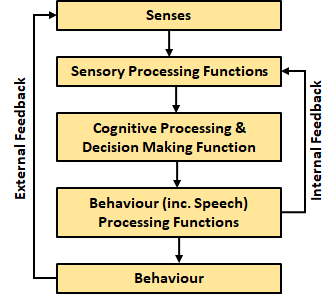
As mentioned in the previous article, consciousness is probably an emergent property of our complex brains and caused by feedback loops. A highly simplified model of the human mind might be:
These “functions” and the concepts of the “conscious and unconscious mind” do not, of course, refer to specific regions of the brain, but rather to processes that it follows.
We perceive the consequences of our actual behaviour with our senses, and this provides external feedback. For example, when driving a car, we continuously observe our position in the road and correct it when necessary. With sufficient practice, this can be done almost unconsciously. However, we can also “know” proposed behaviour before we act. For example, we can “hear” words that we might speak before saying them, “hear” music that we might play without playing it and “see” actions that we might take before taking them. Sensory processing functions are, therefore, connected to and aware of behaviour processing functions. Awareness of our own minds and awareness of the external world can be similar because both are processed by the same sensory processing functions. This creates the potential for feedback, and it is this feedback which, in the author’s view, leads to the emergence of consciousness.
This is supported by Francis Crick and Christof Koch who, in their paper “A Framework for Consciousness”, note that there is substantial evidence that a top-down flow of neural activity from the frontal cortex, which governs behaviour, to the sensory areas, is more predictive of conscious awareness than the reverse, bottom-up flow (Crick & Koch, 2003). This top-down flow is labelled “internal feedback” in the diagram above.
The existence of this internal feedback is confirmed by optical illusions. In the particularly powerful illusion below, all the thin grey lines are horizontal and parallel, just like those on the extreme left and extreme right. However, they do not appear to be so. What we are seeing is what our cognitive processing function has interpreted, and this, in turn, has been fed back into our optical processing function.
Experiments carried out, in the 1970s by the American neuroscientist, Benjamin Libet (1916 – 2007), provide further support for this model. Libet found that unconscious electrical processes in the brain preceded the conscious decision to perform an act. Significantly, however, he also found that the conscious mind could veto those decisions (Libet et al., 1983).
Such internal feedback loops have several evolutionary advantages:
They allow us to review the likely consequences of potential behaviour before engaging in it. For example, in the case of language, the internal oral/aural feedback loop enables us to review and refine the information we would communicate, and assess its potential impact on any recipients. The cognitive processing and decision-making function passes a form of words to the behaviour processing function. The sensory processing function hears these words internally. It then passes them back to the cognitive processing function, which reviews them from the standpoint of the recipient. In effect, this is a form of empathy, one of the skills that we have as social animals.
The logical rules that we have learnt and that the cognitive processing function employs in arriving at its conclusions are reflected in the structure of spoken language, and vice versa. This enables us to pass these rules on subliminally.
Short term memory can be regarded as residing in the conscious mind, i.e., in the feedback loop. Long-term memory, on the other hand, resides in the unconscious mind and is strongly linked to the cognitive processing function. Internal feedback enables us to internally “rehearse” a wide range of information and behaviour which, in turn, serves to reinforce long-term memory..
In a feedback loop, the emergent property regulates the components. Thus, the loop which causes consciousness may regulate the mind and enable us to concentrate on specific problems. This includes regulation of the unconscious mind but, as we are unaware of this, it cannot be regarded as “conscious regulation of the unconscious”.
When we relax our conscious efforts, the unconscious mind operates more freely and, for example, solutions to problems that we have been working on come more readily.
Finally, it can offer a degree of control over intuitive behaviour, providing we think before we act.
However, there are three circumstances in which we do not consciously verify a decision.
There is no time for conscious reflection and our unconscious decisions must be trusted. This can occur when, for example, a road traffic accident is imminent. In his book, “Thinking fast and Slow”, the American psychologist Daniel Kahneman referred to this process as “System 1” thinking. He also referred to the more deliberate and logical conscious process as “System 2” (Kahneman, 2011).
Circumstances defy conscious analysis and we have to go with the unconscious decision, or “gut feeling”, if we are to make one at all.
The unconscious has been well trained by the conscious mind and its decisions are trusted.
There is a question over where consciousness resides in the brain. I am of the view that it resides in a large part of it. In fact, I would go as far as to say that parts of the brain can operate either consciously or unconsciously depending on how the various parts are interacting with one another. Certainly, the unconscious has access to the same memory as the conscious mind but can roam more freely and creatively over it. The most notable evidence is the fact that our unconscious minds are not as good at producing ideas when, consciously, we are very heavily focussed on a problem. We must let go of conscious thought to allow unconsciously generated thoughts to flow and, very often, it seems that this is necessary to solve a problem.
Where feedback loops come in is the way in which parts of the brain interact with one another. Going back to the analogy of a microphone in front of a loudspeaker, it cannot be said that the howl it produces lies in any one part of the system. Yes, there is a loud sound in the air between the microphone and the speaker. However, there is an equally strong electrical current within the microphone, amplifier, and loudspeaker. In a way, the whole system can be said to be howling. This is an emergent property of the system and the way that its parts interact and is analogous to consciousness. However, if we turn down the volume control on the amplifier, the emergent property disappears and the whole system becomes quiescent – both the sound and the electrical currents. This is analogous to unconsciousness.
The audio analogy cannot be taken too far, however. Firstly, because whatever happens in the brain is probably far more complex. Secondly, unlike the audio system, which is either howling or not, we appear to experience degrees of consciousness and unconsciousness.
It is certainly the case that some parts of the brain only act unconsciously. For example, even when conscious, we are not aware of what takes place in the cognitive processing and decision-making function. It is a part of the unconscious mind. Rather, we are only aware of how the decisions that it passes to the behaviour processing function are interpreted. Knowing the information on which these decisions are based we can, to a limited extent, deduce the processes behind them. However, this is not the same as being consciously aware of them. Such deductions can be coloured by our needs and are, therefore, often a rationalization of our true decision-making process.
When we are awake, the feedback loops are on, and we are conscious. While we are asleep, they are off, and we are unconscious. However, unlike the audio analogy, which is either howling or not, we experience degrees of consciousness and unconsciousness. Consciousness is at its strongest when we are concentrating on a problem and at its weakest when we are in the depths of sleep. Neither state prevents the cognitive processing function, from receiving input from the sensory processing functions. Nor does it prevent it from passing instructions to the behaviour processing functions. We are unconsciously aware of the external world and can wake or give it our conscious attention when necessary. We can also sleepwalk and act on “autopilot”. This implies that our level of consciousness is regulated by communication between the behaviour processing functions and the sensory processing functions, which is consistent with Crick and Koch’s findings. Notably, parts of the prefrontal cortex are deactivated during sleep. However, this does not necessarily mean that they are where consciousness resides. Rather it may only mean that they are analogous to the volume control and regulate the feedback loops. In the absence of regulation by consciousness, the cognitive processing function behaves more freely. We will, for example, dream. When we wake, we catch the tail end of dreams because that is what has been fed by the cognitive processing function to our behaviour processing functions while we slept. However, as soon as consciousness returns it regulates the cognitive processing function, and so, such dreams may become extinguished.
If this hypothesis is correct, then it has the following implications:
Animals that use tools or simple forms of communication may be conscious.
The strength of human consciousness must surely vary from individual to individual.
We may be able to strengthen our conscious skills by practicing activities which require a high level of concentration.
Due to its advantages, greater consciousness may still be evolving in humans and other creatures.
Using similar feedback processes in machines of sufficient complexity, it might theoretically be possible to replicate consciousness.
We can take in information or knowledge subliminally, i.e., without being consciously aware of it. This can occur when our consciousness is at a low level, when it is distracted by more pressing concerns, or when the information does not appear to require a response. Such knowledge can also be reinforced subliminally through repetition. It can then affect our beliefs and, also, our behaviour when faced with a relevant situation.
Cognitive processing relies, of course, on knowledge. In my next post I will, therefore, discuss the nature of our knowledge.
References
Crick, F. & Koch, C., 2003. “A Framework for Consciousness”. March 2003, Nature Neuroscience 6(2):119-26. DOI:10.1038/nn0203-119.
Kahneman, D., 2011. “Thinking fast and Slow”. Macmillan. ISBN 978-1-4299-6935-2.
Libet, B., Gleason, C.A., Wright, E.W., Pearl, D.K., 1983. “Time of Conscious Intention to Act in Relation to Onset of Cerebral Activity (Readiness-Potential) – The Unconscious Initiation of a Freely Voluntary Act”. Brain. 106 (3): 623–642. doi:10.1093/brain/106.3.623. PMID 6640273.

 ); information provides the form that directs that work. Together they make organisation possible.
 but quietly normalised away the constant
  Doing so made information appear dimensionless; handy for communication engineers, but misleading for science. As Rolf Landauer later reminded us, information is physical: erasing a single bit requires energy and generates heat. Ignoring this fact masks the cost of learning, computing, and communicating; costs that become crucial when we extend systems thinking to living and social domains.



 Rational-Understanding.com