We usually think of organisations as things designed around goals, authority, or culture. But there is a deeper and more fundamental reason why they exist.
Start with a simple network of people. With two people, interaction is straightforward. Add a third, and something changes: coalitions, mediation, and exclusion become possible. Add a fourth, and the situation becomes noticeably harder to follow. People are no longer responding just to those they speak with directly, but to what others are doing with each other. The network stops feeling like a set of links and starts to feel like an interaction field.
As group size increases, the number of interaction consequences grows much faster than the number of direct relationships. Each person must track exchanges, infer intentions, anticipate outcomes, and protect their own interests. Very quickly, this becomes cognitively demanding.
So people adapt.
They focus on some interactions and ignore others. They adopt roles. They rely on heuristics. They form coalitions. They withdraw from overload. And when many people do this at once, shared rules begin to appear: agendas, turn-taking, chairs, representatives, procedures, boundaries.
At that point, the group has become something new.
It has become an organisation.
From this perspective, committees, hierarchies, and procedures are not arbitrary inventions. They are practical solutions to a problem of interaction complexity. They help people manage the cognitive load of being in large groups. At the same time, they help ensure that useful exchanges happen reliably and disruptive ones are reduced; all in pursuit of a shared purpose.
In a new article, From Agent Networks to Organisational Architecture, I explore how interaction growth, cognitive limits, coping strategies, and shared purpose together explain why organisations can naturally emerge when groups of agents become large and interconnected.
In today’s interconnected world, understanding how our beliefs, cultural frameworks, and social structures interact is more crucial than ever. In my latest article, A Deep Dive into Beliefs, Schemata, Tropes, and Culture, I explore these foundational elements of human cognition and culture, offering insights into how they shape individual behaviour, societal norms, and cultural evolution.
At its heart, the article examines the Modified Morphogenetic Cycle, an original extension of Margaret Archer’s framework, which includes the often-overlooked interplay between human cognition and the natural environment. This innovation provides a comprehensive model to understand how individual schemata, shared tropes, and societal culture influence, and are influenced by, our surroundings.
Key highlights include:
Schemata as Cognitive Foundations: How individual mental frameworks shape beliefs and behaviour.
Tropes and Cultural Patterns: The emergent collective structures that guide societal values and norms.
Dynamic Interactions: How culture and societal structures evolve through individual agency and collective action.
Implications for Change: Practical applications for interdisciplinary collaboration, problem-solving, and fostering innovation in an ever-changing world.
Two Motivational Reflexivity Community groups have been created on LinkedIn and Facebook, where you can ask questions, share your experiences, provide feedback, and stay updated on developments. These groups are open to all who are interested in deepening their understanding of Motivational Reflexivity and connecting with others practicing this approach.
These resources and community spaces are free to access. Feel free to download, engage, and share the links with anyone who might benefit. Your participation and feedback are invaluable as we build a supportive community around this practice.
In the longer term, I am planning to produce guidelines for trainers, a dedicated website, and online training courses, all of which will be free to share and use. Their availability will be announced here and in the Facebook and LinkedIn groups.
I’m pleased to announce that two essential resources on the concept of Motivational Reflexivity are now available for free download. For those interested in understanding and practicing motivational reflexivity, both an Introduction to the Concept and Guidance for Practitioners are now accessible in PDF form.
What is Motivational Reflexivity?
Motivational Reflexivity is a process that enables individuals to reflect on and refine their beliefs, aligning them more closely with reality and pro-social values. By examining the motivations behind beliefs, practitioners can gain a deeper understanding of their influences and transform those that may not serve their well-being. This practice is designed to benefit not only individuals but also foster positive impacts on society and the environment.
Resources Available for Download
An Introduction to Motivational Reflexivity: This introductory guide provides an overview of the foundational principles, offering readers a strong starting point for understanding the motivations and needs driving their beliefs.
Motivational Reflexivity: Guidance for Practitioners: This comprehensive guide offers step-by-step guidance on the practice of motivational reflexivity, with exercises, prompts, and reflections designed to support practitioners in their journey.
These resources are free to download and provide a valuable starting point for anyone interested in exploring motivational reflexivity. Feel free to share these links with anyone who might benefit from this practice. Your engagement and feedback are always appreciated as we build a community around this important work.
In the longer term, I am planning to produce guidelines for trainers, a dedicated website, and online training courses, all of which will be free to share and use. Their availability will be announced here.
Motivational Reflexivity is a reflective practice aimed at understanding the motivations behind our personal beliefs, especially those driven by the satisfaction of needs. Drawing from diverse theoretical foundations in psychology, sociology, and philosophy, this concept offers individuals a means to critically evaluate their beliefs and decisions. In particular, Motivational Reflexivity helps distinguish between beliefs grounded in objective reality and those formed to satisfy emotional or psychological needs. This paper explores the foundations of Motivational Reflexivity through the lenses of human needs, automaticity, reflexivity, and the morphogenic cycle, ultimately offering strategies for integrating this practice into daily life.
Needs
Human needs are fundamental conditions necessary for well-being and personal development. Drawing from theories such as Maslow’s Hierarchy of Needs (Maslow, 1943) and Alderfer’s ERG model, these encompass both basic physiological needs (e.g., food and shelter) and higher-order psychological needs (e.g., self-esteem and belonging). Needs drive our behaviour and inform our beliefs.
Satisfiers
Satisfiers are the resources or elements that fulfil or enhance the satisfaction of these needs (Max-Neef, 1991). They can be external (e.g., food, shelter, social connections) or internal (e.g., beliefs, values [9], emotional states). Not all satisfiers are grounded in reality—some might provide temporary emotional comfort without addressing the true nature of the need.
Contra-satisfiers
Contra-satisfiers are elements that reduce or threaten the satisfaction of needs. These can trigger a defensive response or reflexivity when they undermine well-being. Reflexivity often emerges in response to contra-satisfiers as individuals seek ways to address unmet needs or eliminate threats.
Emotions
Emotions act as signals and motivators in relation to needs. Positive emotions (e.g., joy, satisfaction) arise when needs are met, while negative emotions (e.g., fear, anxiety, frustration) signal unmet needs or the presence of contra-satisfiers [1]. These emotional responses often lead individuals to engage in reflexive thought, where they reassess their beliefs and behaviours to better satisfy their needs.
Consciousness
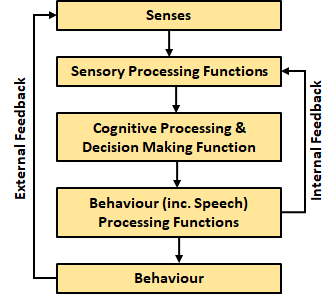
Consciousness refers to self-awareness and the ability to reflect on one’s thoughts and actions. Consciousness is underpinned by internal feedback loops, where individuals evaluate their potential actions before executing them [2]. This ability to simulate actions internally is what enables reflexivity.
Figure 1. A simplified model of the feedback processes involved in human consciousness.
Reflexivity
Reflexivity involves engaging in internal dialogue to critically assess one’s beliefs and behaviours. It is especially important when individuals face unmet needs or threats to their well-being. Reflexivity allows for the interruption of automatic behaviour, prompting individuals to evaluate whether their beliefs align with objective reality or are motivated by personal needs.
Automaticity
Automaticity refers to habitual, unconscious behaviour that does not require reflective thought. While efficient, automaticity can prevent individuals from questioning the motivations behind their actions. Reflexivity interrupts automaticity, encouraging individuals to reexamine their decisions. For example, driving becomes an automatic task after sufficient practice, but when unexpected events occur (e.g., road hazards), reflexivity is triggered, requiring conscious engagement to adapt. [3]
The Modified Morphogenetic Cycle
The morphogenetic cycle, developed by Margaret Archer and Roy Bhaskar, describes the interaction between societal structures and individuals through a series of feedback loops (Archer, 2003)(Bhaskar, 1975). These loops shape individual beliefs and behaviours by assigning roles, norms, and expectations. When these societal roles serve as satisfiers, individuals tend to automatically affirm them. However, if societal roles act as contra-satisfiers, individuals engage in reflexivity to challenge or alter their roles and the demands made of them. [4] The modified morphogenetic cycle also includes the environment as a factor. Society’s actions impact the environment (e.g., through pollution or deforestation), which in turn affects individuals’ ability to satisfy their needs, prompting reflexivity in response to environmental degradation. [5]
Figure 2. Diagrammatic Representation of the Modified Morphogenetic Cycle.
Society (yellow circle) enculturates individuals with values [9], norms, and beliefs. Society also impacts on the natural environment (green circle) which in turn impacts on the individual. If these three impacts are satisfiers (happy person to the right) then the individual automatically affirms society. However, if one or more act as contra-satisfiers (unhappy person to the left), then the individual reflects on potential solutions and then attempts to alter society’s culture or structure accordingly. For example, he or she may alter society’s structure by leaving unsatisfactory employment.
Cultural Evolution
Cultural evolution occurs as societal norms and values [9] shift over time due to reflexivity and new ideas introduced by individuals. Reflexivity plays a central role in this evolution by allowing individuals to critically reflect on cultural elements and adopt practices that better serve their needs and goals.
Cultural Speciation
Cultural speciation refers to the emergence of distinct cultural practices from mainstream society. Reflexivity allows individuals to break away from dominant societal beliefs and form subcultures with unique values [9], norms, beliefs and structures. For example, the isolation of subcultures, such as during the Northern Ireland Troubles, led to the development of divergent cultural beliefs within a single society. [6]
Needs-Driven Beliefs
Needs-driven beliefs are those adopted primarily to satisfy personal needs, regardless of their alignment with reality. Such beliefs often arise when individuals face contra-satisfiers and adopt beliefs that provide emotional or psychological comfort (Kunda, 1990). For example, individuals might support political ideologies that align with their economic or social interests, even if the belief does not reflect broader realities. [7]
Psychological Defence Mechanisms
When needs-based beliefs are challenged, individuals may employ psychological defence mechanisms (e.g., denial, rationalisation) to protect themselves from emotional discomfort (Freud, S.,1920)(Freud, A., 1936). These defences prevent individuals from critically reflecting on the truth of their beliefs. Motivational Reflexivity challenges these mechanisms, helping individuals recognize when their beliefs are motivated by needs rather than objective truth. [8]
Motivational Reflexivity
Motivational Reflexivity involves regularly questioning the motivations behind one’s beliefs and actions. By asking questions like “Why do I hold this belief?” and “Is this belief serving a deeper emotional need?”, individuals become more conscious of the needs driving their decisions. Over time, this process allows individuals to align their beliefs more closely with reality.
Benefits for the Individual
The practice of Motivational Reflexivity leads to greater self-awareness, helping individuals uncover the underlying motivations behind their beliefs. By aligning beliefs with objective truth, individuals experience personal growth and a deeper understanding of their true needs. Reflexivity also fosters empathy, enhancing the ability to understand others’ beliefs and motivations.
Benefits for Society & the Environment
On a societal level, Motivational Reflexivity promotes cultural evolution by helping individuals challenge false beliefs that may be perpetuated through advertising, propaganda, or social pressure. It also supports sustainable practices, as individuals become more aware of the environmental impact of their actions and adjust their behaviours accordingly.
Challenges and Mitigation
While Motivational Reflexivity offers significant benefits, it can also present challenges, such as emotional discomfort (Festinger, 1957) or social conflict. Individuals may find it difficult to confront long-held beliefs, and societal resistance may arise when dominant beliefs are questioned. To mitigate these challenges, Motivational Reflexivity must be practiced with empathy and within supportive frameworks that encourage open dialogue and respect for diverse perspectives.
Conclusion
Motivational Reflexivity empowers individuals to engage in a deep, reflective practice that aligns their beliefs with reality and enhances personal growth. By regularly reflecting on the emotional and psychological needs behind their beliefs, individuals can develop self-awareness, cultivate empathy, and make more informed decisions.
On a broader scale, Motivational Reflexivity offers the potential for societal and environmental progress. By challenging the enculturation of false needs-based beliefs and promoting sustainable practices, Motivational Reflexivity can drive positive change for both individuals and the larger social and environmental systems they inhabit.
Notes
We prioritize our needs based on the intensity of negative emotions that arise when a need goes unmet or is threatened.
These potential actions can also be ones of speech. That is we review what we intend to say before we say it in order to judge its likely effects. The feedback loops can also be external. That is, we observe the consequences of our actions and learn from them.
Automaticity may also arise from socialization—for example, learning cultural norms or professional routines through repeated exposure. Lastly, automaticity can be an instinctive reaction to immediate danger, such as the fight-or-flight response, which is activated without conscious deliberation to ensure survival.
The modified morphogenetic cycle is continuously ongoing. It distinguishes between society’s cultural elements, i.e., values, norms and beliefs, and society’s structure, i.e., individual roles. Either can act as a satisfier and be automatically accepted or as a contra-satisfier triggering reflexivity and attempts to alter the situation.
The natural environment can also produce satisfiers and contra-satisfiers independent of society, such as natural disasters (e.g., volcanoes, droughts), which impact individuals’ needs. In the early development of humanity, the natural environment played the leading role in cultural evolution but with population growth social forces now play the leading role.
When a subculture isolates itself (geographically or ideologically), a new culture may evolve that is distinct from the original. However, if the subculture cannot isolate itself, it may be reabsorbed, modifying the dominant culture. Alternatively, if there is conflict between the cultures, it may result in tensions, such as those seen in the Northern Ireland Troubles.
In the natural environment, needs-driven beliefs are rare, as natural phenomena (like climate) are not influenced by human beliefs. However, in social contexts, needs-driven beliefs are more common, as society can be influenced or shaped by these beliefs to satisfy personal needs.
Psychological defence mechanisms can also be triggered when we are unable to satisfy a need or are unable to avoid a contra-satisfier.
Values are a special type of belief, i.e., beliefs about what is good or bad. Good and bad are, in turn, defined by ethics. Values are shortcuts that avoid detailed ethical analysis. If followed in relevant circumstances they will normally lead to ethical behaviour. Furthermore, they can be propagated through society without the need for reference to the detailed ethics that underpin them. Finally, like any other belief, they can be needs-driven. So, not all people have pro-social or pro-environmental values. This of course implies that Motivational Reflexivity promotes two core beliefs. Firstly, that it is good for our beliefs to conform to reality and, secondly, that our values should be pro-social and pro-environmental.
References
Archer, M. S. (2003). Structure, Agency and the Internal Conversation. Cambridge University Press.
Bhaskar, R. (1975). A Realist Theory of Science. Leeds: Leeds Books.
Festinger, L. (1957). A Theory of Cognitive Dissonance. Stanford University Press.
Freud, A. (1936). The Ego and the Mechanisms of Defence. London: Hogarth Press and the Institute of Psychoanalysis.
Freud, S. (1920). Beyond the Pleasure Principle. London: International Psycho-Analytical Press.
Kunda, Z. (1990). The case for motivated reasoning. Psychological Bulletin, 108(3), 480–498.
Maslow, A. H. (1943). A Theory of Human Motivation. Psychological Review, 50(4), 370–396.
Max-Neef, M. A. (1991). Human Scale Development: Conception, Application and Further Reflections. New York: Apex Press.
Part 1 discussed the structure of society, i.e., the relationships between human holons, such as individuals, organisations or nations, the various forms these relationships can take, and how they alter with time. It notes that, with a very few exceptions, human interactions are much the same as those encountered elsewhere in the animal world. Conventionally, the structure of society is taken to mean its network of cooperative relationships. However, in this series of papers, a much broader definition is used that includes non-cooperative ones. Thus, for example, ongoing wars are also considered a part of this structure. It is also acknowledged that it is not only human needs that dictate relationships and the way that they change but also the values, norms and beliefs held by the related parties. Thus, the subsequent Parts of this series discuss the latter in more detail.
Part 2 described the work of the English philosopher of science, Roy Bhaskar (1944 – 2014), and the English sociologist, Margaret Archer (1943 – 2023). Roy Bhaskar is regarded as the founder of Critical Realism, a philosophy that holds reality to exist and to be the source of truth. It also holds that our beliefs about reality are not necessarily true. Both Roy Bhaskar and Margaret Archer described how culture affects individual agency and how individual agency alters culture. Bhaskar referred to his model as the Transformational Model of Social Activity (TMSA), and Archer to her model as the Morphogenetic Cycle. Archer also described how reflexivity, i.e., an agent’s internal conversations, can lead to cultural and structural change.
Part 3 built on the work of Margaret Archer to describe the outcomes of those internal conversations in more detail. It explains that to satisfy our needs or to avoid contra-satisfiers, we can adopt, form and propagate beliefs that are not necessarily true, but ones thought likely to satisfy our needs. Furthermore, to avoid anxiety caused by circumstances beyond our control we can adopt beliefs that act as psychological defence mechanisms. These beliefs when propagated do, of course, influence culture and structure.
Part 4 now draws on the preceding three parts to discuss the nature of culture in more detail, together with the processes of cultural evolution, stagnation, regression and speciation.
Part 1 of this series of papers focussed largely on the principles of systems, ecology, and evolution to describe the ways in which individuals and organisations of all types interact, and so, create the structure of society. That is, how they exchange satisfiers and contra-satisfiers; satisfiers being those things that increase the level of satisfaction of our needs, and contra-satisfiers those things that decrease their level of satisfaction. However, Part 1 did not account for the choices that we make in the ways that we interact.
Human needs motivate our behaviour, but beliefs determine what form that behaviour takes. Although needs are fundamental to everything that has a function, beliefs are an emergent property of humanity, and a consequence of our ability to manipulate information and our highly social nature. However, beliefs can be true, or they can be false. In observing reality, we make mistakes and frequently distort it to satisfy our needs or avoid our contra-needs.
Part 3 will, therefore, discuss the psychological and social psychological aspects of our nature, particularly the beliefs, psychological defence mechanisms, and their socio-cultural reinforcement, that lead to our choices.
Operant conditioning was first described by the American psychologist B. F. Skinner (1904 – 1990) (Skinner, 1938). It is a method of learning that uses satisfiers and contra-satisfiers to alter behaviour. Skinner found that, if a behaviour was associated with a satisfier, or as it is more commonly referred to as a reward, then it was likely to be repeated. This is referred to as reinforcement of the behaviour. Ultimately, if a behaviour is sufficiently reinforced, it can become automatic or unconscious. On the other hand, if a behaviour was associated with a contra-satisfier or punishment, then it was less likely to be repeated. If it was sufficiently punished, then it could become entirely forgotten or extinguished.
Normally, before we act, a decision is made unconsciously and passed to the conscious mind which then vets it. If the act is deemed to be satisfactory, the conscious mind approves it. However, if it is deemed unsatisfactory, then it is blocked and the unconscious mind must think again. In this way our more rational conscious mind can condition our more creative unconscious. It is like riding a bicycle. Initially, it can take considerable conscious effort, but over time we learn to control the bicycle unconsciously with little or no conscious intervention. The same principle applies to operant conditioning. However, in the case of conditioning the conscious mind is replaced by satisfiers or contra-satisfiers from an external agent.
An example of extinguishment is cultural denial. If a topic is one that causes people anxiety, then we are discouraged from raising it by other members of our community. That is, they punish us socially for doing so, and ultimately the topic becomes extinguished from our minds. That is, we fall into denial.
Although operant conditioning was first formally recognised by Skinner, it has been used in practice for a very long time. In fact, because the practice of conditioning others can be seen in alpha members of animal herds and packs, it probably predates the evolution of homo sapiens. To cite human examples, some religions have conditioned behaviours and beliefs in their members through regular ritual practices, and continue to do so. Kings and emperors have conditioned compliance through reward or threats of physical punishment. In the present day, we are conditioned as consumers through advertisements that promise psychological or practical rewards for our purchases.
Once a threshold percentage of the population has been conditioned to behave in a particular way, that behaviour becomes a part of its culture, i.e., a value, a norm, or a belief. The conditioning then becomes self-sustaining through a process of socialization. That is, we reward one another socially for compliance, and punish one another for non-compliance. Aspects of the culture in our social environment can act as a satisfier, as a contra-satisfier, or can be neutral for an individual or organisation depending on their needs and circumstances. The more a culture acts as a satisfier the more likely it is to be adopted and the less likely it is to be rejected. Together, conditioning, socialization and acceptance can steer the evolution of a culture. This is almost certainly the case with the shift from traditional values, often religiously inspired, to self-expression values, often consumption inspired, noted by the World Values Survey (World Values Survey Association, 2020). Bluntly put, the satisfaction of our more basic needs today is a stronger driver of behaviour than the satisfaction of our higher needs tomorrow. So, consumer conditioning has replaced religious conditioning.
Unfortunately, we are all susceptible to conditioning. This is because of the way that our minds have evolved. Both religious and consumer conditioning are ways of controlling the majority in the interest of an elite minority. Thus, many aspects of religion and consumerism are harmful to society. Additionally, many aspects of consumerism are harmful to the natural environment. Fortunately, providing we develop the more rational and conscious aspect of our minds, there is much that we can do to avoid or overcome such conditioning. However, before describing my suggested approach, I would like to clarify the nature of consciousness.
A detailed explanation of consciousness can be found at https://rational-understanding.com/2021/10/22/consciousness/. In summary, however, it is an awareness of one’s own mental processes. Unfortunately, the popular definition incorrectly includes an awareness of one’s surroundings. Very primitive animals, that we would hesitate to describe as being conscious, are aware of their surroundings and, because people have evolved from simpler organisms, this awareness is a function of our unconscious mind. The unconscious mind then passes relevant information, particularly any threats or opportunities, to the conscious one. For example, a noise while we are sleeping will awaken us, or the flick of a curtain on the opposite side of the street will automatically draw our attention. Because of this misunderstanding, use of the internet search term “increasing consciousness” will yield advice on how to improve one’s perception of the external world, or how to achieve a mystical “higher level of consciousness”. However, from personal experience, I would recommend painting or photography to increase one’s perception of the external world. After some practice, colours will become more vibrant, and the arrangement of objects more interesting. Returning to the correct definition of consciousness, some of us are more conscious of our own minds than others. Nevertheless, this too can be improved with practice and the appropriate internet search term is “increasing self-awareness”.
The approach that I would recommend for avoiding or removing any conditioning is therefore as follows.
Consciously recognise conditioning attempts whilst they are happening. This is not difficult. There will be much repetition accompanied by implied or overt promises of satisfiers, or threats of contra-satisfiers.
Consciously recognise any social pressures from, for example, friends, colleagues, and advertising, to accept a value, norm, or belief.
Consciously recognise when we are engaging in conditioned behaviour. Again, there will be repetition and the behaviour will be carried out unconsciously. There may also be a sense of compulsion or addiction.
Consciously question whether the behaviour makes sense and is good for us, our society, and the natural environment.
Armed with this knowledge, it is then possible to avoid conditioning. It is also possible, but difficult, to de-condition ourselves. The latter is sometimes referred to as self-control.
Firstly, avoid any further conditioning attempts and any social pressures. For example, don’t watch adverts and don’t mix with people who pressurise others in this way.
Consciously block conditioned behaviours whenever they are prompted by the unconscious mind. To this end it may be necessary to stimulate conscious thought by, for example, using sticky labels on anything used in the behaviour or by asking a friend or partner to alert you to such behaviour. Keep your responses to ones of gratitude though, or they will quickly become conditioned against helping you.
Rehearse the negatives of a conditioned behaviour whenever you become aware of it. A written list will help. This is a mild form of aversion therapy, but I would not recommend any stronger form.
Nor would I recommend rewarding yourself whenever you block a behaviour except to feel pleased. Anything more may condition some other behaviour.
References
B.F. Skinner (1938). “The Behavior of Organisms: An Experimental Analysis.” Cambridge, Massachusetts: B.F. Skinner Foundation. ISBN 1-58390-007-1, ISBN 0-87411-487-X
The lack of a unified theory of human society is hampering our ability to tackle the self-induced existential threats that we currently face. This paper presents a practical social systems theory that addresses that absence. Furthermore, because the theory has been derived largely from the principles of systems science, ecology, and evolution, it has a broader application to natural ecosystems, artificial ones, and the interactions between them and the human species. The theory draws on an empirical observation of society; on the principles of systems science to describe the general structure of society; on the principles of ecology to describe the ways in which components of society can interact; and on the principles of psychology and evolution to demonstrate how those interactions can alter with time. The principles employed are fundamental to the field from which they were derived, are broadly accepted by practitioners in those fields, and were obtained by research of the literature. What is new, in this paper, is the combined application of principles from these different fields to human society. The result is a model that accurately reflects real situations involving social units of all sizes from individuals, through organisations, to nations. Methods are suggested for symbolising, diagramming, and analysing these interactions and how they change over time. This provides a basis for better understanding the causes of the threats that humanity and the natural world faces, and for designing interventions to counter them.
It is targeted at a broad audience which may include specialists from various disciplines. Interpretation of the language used and the concepts that underpin this theory may differ from individual to individual and from discipline to discipline. No prior knowledge is assumed, therefore. Furthermore, the paper is written in plain English and, where any technical terms have been used, they are clearly defined.
Over the next few months, I will begin applying the theory to some relatively simple practical social issues and will publish the results here. If you would like to join me in this venture, please contact me at email@johnachalloner.com. If there is sufficient interest, then I am also willing to provide free online training.

 Rational-Understanding.com