Categories
01. An Introduction to Motivational Reflexivity

An Introduction to Motivational Reflexivity

Introduction

Motivational Reflexivity is a reflective practice aimed at understanding the motivations behind our personal beliefs, especially those driven by the satisfaction of needs. Drawing from diverse theoretical foundations in psychology, sociology, and philosophy, this concept offers individuals a means to critically evaluate their beliefs and decisions. In particular, Motivational Reflexivity helps distinguish between beliefs grounded in objective reality and those formed to satisfy emotional or psychological needs. This paper explores the foundations of Motivational Reflexivity through the lenses of human needs, automaticity, reflexivity, and the morphogenic cycle, ultimately offering strategies for integrating this practice into daily life.

Needs

Human needs are fundamental conditions necessary for well-being and personal development. Drawing from theories such as Maslow’s Hierarchy of Needs (Maslow, 1943) and Alderfer’s ERG model, these encompass both basic physiological needs (e.g., food and shelter) and higher-order psychological needs (e.g., self-esteem and belonging). Needs drive our behaviour and inform our beliefs.

Satisfiers

Satisfiers are the resources or elements that fulfil or enhance the satisfaction of these needs (Max-Neef, 1991). They can be external (e.g., food, shelter, social connections) or internal (e.g., beliefs, values [9], emotional states). Not all satisfiers are grounded in reality—some might provide temporary emotional comfort without addressing the true nature of the need.

Contra-satisfiers

Contra-satisfiers are elements that reduce or threaten the satisfaction of needs. These can trigger a defensive response or reflexivity when they undermine well-being. Reflexivity often emerges in response to contra-satisfiers as individuals seek ways to address unmet needs or eliminate threats.

Emotions

Emotions act as signals and motivators in relation to needs. Positive emotions (e.g., joy, satisfaction) arise when needs are met, while negative emotions (e.g., fear, anxiety, frustration) signal unmet needs or the presence of contra-satisfiers [1]. These emotional responses often lead individuals to engage in reflexive thought, where they reassess their beliefs and behaviours to better satisfy their needs.

Consciousness

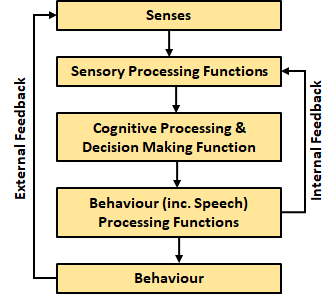
Consciousness refers to self-awareness and the ability to reflect on one’s thoughts and actions. Consciousness is underpinned by internal feedback loops, where individuals evaluate their potential actions before executing them [2]. This ability to simulate actions internally is what enables reflexivity.

Figure 1. A simplified model of the feedback processes involved in human consciousness.

Reflexivity

Reflexivity involves engaging in internal dialogue to critically assess one’s beliefs and behaviours. It is especially important when individuals face unmet needs or threats to their well-being. Reflexivity allows for the interruption of automatic behaviour, prompting individuals to evaluate whether their beliefs align with objective reality or are motivated by personal needs.

Automaticity

Automaticity refers to habitual, unconscious behaviour that does not require reflective thought. While efficient, automaticity can prevent individuals from questioning the motivations behind their actions. Reflexivity interrupts automaticity, encouraging individuals to reexamine their decisions. For example, driving becomes an automatic task after sufficient practice, but when unexpected events occur (e.g., road hazards), reflexivity is triggered, requiring conscious engagement to adapt. [3]

The Modified Morphogenetic Cycle

The morphogenetic cycle, developed by Margaret Archer and Roy Bhaskar, describes the interaction between societal structures and individuals through a series of feedback loops (Archer, 2003)(Bhaskar, 1975). These loops shape individual beliefs and behaviours by assigning roles, norms, and expectations. When these societal roles serve as satisfiers, individuals tend to automatically affirm them. However, if societal roles act as contra-satisfiers, individuals engage in reflexivity to challenge or alter their roles and the demands made of them. [4] The modified morphogenetic cycle also includes the environment as a factor. Society’s actions impact the environment (e.g., through pollution or deforestation), which in turn affects individuals’ ability to satisfy their needs, prompting reflexivity in response to environmental degradation. [5]

Figure 2. Diagrammatic Representation of the Modified Morphogenetic Cycle.

Society (yellow circle) enculturates individuals with values [9], norms, and beliefs. Society also impacts on the natural environment (green circle) which in turn impacts on the individual. If these three impacts are satisfiers (happy person to the right) then the individual automatically affirms society. However, if one or more act as contra-satisfiers (unhappy person to the left), then the individual reflects on potential solutions and then attempts to alter society’s culture or structure accordingly. For example, he or she may alter society’s structure by leaving unsatisfactory employment.

Cultural Evolution

Cultural evolution occurs as societal norms and values [9] shift over time due to reflexivity and new ideas introduced by individuals. Reflexivity plays a central role in this evolution by allowing individuals to critically reflect on cultural elements and adopt practices that better serve their needs and goals.

Cultural Speciation

Cultural speciation refers to the emergence of distinct cultural practices from mainstream society. Reflexivity allows individuals to break away from dominant societal beliefs and form subcultures with unique values [9], norms, beliefs and structures. For example, the isolation of subcultures, such as during the Northern Ireland Troubles, led to the development of divergent cultural beliefs within a single society. [6]

Needs-Driven Beliefs

Needs-driven beliefs are those adopted primarily to satisfy personal needs, regardless of their alignment with reality. Such beliefs often arise when individuals face contra-satisfiers and adopt beliefs that provide emotional or psychological comfort (Kunda, 1990). For example, individuals might support political ideologies that align with their economic or social interests, even if the belief does not reflect broader realities. [7]

Psychological Defence Mechanisms

When needs-based beliefs are challenged, individuals may employ psychological defence mechanisms (e.g., denial, rationalisation) to protect themselves from emotional discomfort (Freud, S.,1920)(Freud, A., 1936). These defences prevent individuals from critically reflecting on the truth of their beliefs. Motivational Reflexivity challenges these mechanisms, helping individuals recognize when their beliefs are motivated by needs rather than objective truth. [8]

Motivational Reflexivity

Motivational Reflexivity involves regularly questioning the motivations behind one’s beliefs and actions. By asking questions like “Why do I hold this belief?” and “Is this belief serving a deeper emotional need?”, individuals become more conscious of the needs driving their decisions. Over time, this process allows individuals to align their beliefs more closely with reality.

Benefits for the Individual

The practice of Motivational Reflexivity leads to greater self-awareness, helping individuals uncover the underlying motivations behind their beliefs. By aligning beliefs with objective truth, individuals experience personal growth and a deeper understanding of their true needs. Reflexivity also fosters empathy, enhancing the ability to understand others’ beliefs and motivations.

Benefits for Society & the Environment

On a societal level, Motivational Reflexivity promotes cultural evolution by helping individuals challenge false beliefs that may be perpetuated through advertising, propaganda, or social pressure. It also supports sustainable practices, as individuals become more aware of the environmental impact of their actions and adjust their behaviours accordingly.

Challenges and Mitigation

While Motivational Reflexivity offers significant benefits, it can also present challenges, such as emotional discomfort (Festinger, 1957) or social conflict. Individuals may find it difficult to confront long-held beliefs, and societal resistance may arise when dominant beliefs are questioned. To mitigate these challenges, Motivational Reflexivity must be practiced with empathy and within supportive frameworks that encourage open dialogue and respect for diverse perspectives.

Conclusion

Motivational Reflexivity empowers individuals to engage in a deep, reflective practice that aligns their beliefs with reality and enhances personal growth. By regularly reflecting on the emotional and psychological needs behind their beliefs, individuals can develop self-awareness, cultivate empathy, and make more informed decisions.

On a broader scale, Motivational Reflexivity offers the potential for societal and environmental progress. By challenging the enculturation of false needs-based beliefs and promoting sustainable practices, Motivational Reflexivity can drive positive change for both individuals and the larger social and environmental systems they inhabit.

Notes

  1. We prioritize our needs based on the intensity of negative emotions that arise when a need goes unmet or is threatened.
  2. These potential actions can also be ones of speech. That is we review what we intend to say before we say it in order to judge its likely effects. The feedback loops can also be external. That is, we observe the consequences of our actions and learn from them.
  3. Automaticity may also arise from socialization—for example, learning cultural norms or professional routines through repeated exposure. Lastly, automaticity can be an instinctive reaction to immediate danger, such as the fight-or-flight response, which is activated without conscious deliberation to ensure survival.
  4. The modified morphogenetic cycle is continuously ongoing. It distinguishes between society’s cultural elements, i.e., values, norms and beliefs, and society’s structure, i.e., individual roles. Either can act as a satisfier and be automatically accepted or as a contra-satisfier triggering reflexivity and attempts to alter the situation.  
  5. The natural environment can also produce satisfiers and contra-satisfiers independent of society, such as natural disasters (e.g., volcanoes, droughts), which impact individuals’ needs. In the early development of humanity, the natural environment played the leading role in cultural evolution but with population growth social forces now play the leading role.
  6. When a subculture isolates itself (geographically or ideologically), a new culture may evolve that is distinct from the original. However, if the subculture cannot isolate itself, it may be reabsorbed, modifying the dominant culture. Alternatively, if there is conflict between the cultures, it may result in tensions, such as those seen in the Northern Ireland Troubles.
  7. In the natural environment, needs-driven beliefs are rare, as natural phenomena (like climate) are not influenced by human beliefs. However, in social contexts, needs-driven beliefs are more common, as society can be influenced or shaped by these beliefs to satisfy personal needs.
  8. Psychological defence mechanisms can also be triggered when we are unable to satisfy a need or are unable to avoid a contra-satisfier.
  9. Values are a special type of belief, i.e., beliefs about what is good or bad. Good and bad are, in turn, defined by ethics. Values are shortcuts that avoid detailed ethical analysis. If followed in relevant circumstances they will normally lead to ethical behaviour. Furthermore, they can be propagated through society without the need for reference to the detailed ethics that underpin them. Finally, like any other belief, they can be needs-driven. So, not all people have pro-social or pro-environmental values. This of course implies that Motivational Reflexivity promotes two core beliefs. Firstly, that it is good for our beliefs to conform to reality and, secondly, that our values should be pro-social and pro-environmental.

References

  • Archer, M. S. (2003). Structure, Agency and the Internal Conversation. Cambridge University Press.
  • Bhaskar, R. (1975). A Realist Theory of Science. Leeds: Leeds Books.
  • Festinger, L. (1957). A Theory of Cognitive Dissonance. Stanford University Press.
  • Freud, A. (1936). The Ego and the Mechanisms of Defence. London: Hogarth Press and the Institute of Psychoanalysis.
  • Freud, S. (1920). Beyond the Pleasure Principle. London: International Psycho-Analytical Press.
  • Kunda, Z. (1990). The case for motivated reasoning. Psychological Bulletin, 108(3), 480–498.
  • Maslow, A. H. (1943). A Theory of Human Motivation. Psychological Review, 50(4), 370–396.
  • Max-Neef, M. A. (1991). Human Scale Development: Conception, Application and Further Reflections. New York: Apex Press.
Categories
11. The Hierarchy of Organising Principles Uncategorized

The Hierarchy of Organising Principles

I haven’t posted for a while because I have been working on this paper. It is quite long and contains many diagrams. So, I have produced it in pdf format and you can download it via the following link https://rational-understanding.com/my-books#hierarchy-of-organising-principles.

The paper presents a comprehensive hypothesis that seeks to explain the nature of reality and how humans understand it, integrating foundational concepts from critical realism, systems theory, and causality. The hypothesis holds that reality can be viewed as a fractal-like structure, generated by underlying organising principles that operate at various ranks in a hierarchy. Starting from acausal foundational principles, the paper explores how systems interact, transfer matter, energy, and information, and contribute to the complexity observed at different levels of organisation. The hypothesis extends to the idea that human understanding is structured by organising principles that differ from reality’s, leading to distinct layers of comprehension reflected in scientific disciplines. The paper suggests that integrating these principles may help bridge gaps between disciplines, such as the disconnect between social sciences and the biological sciences. This unification has the potential to deepen our understanding of both the natural world and human social behaviour, while identifying new pathways for societal change.

Categories
41. A Theory of Society Derived form the Principles of Systems, Psychology, Ecology & Evolution Part 4

A Theory of Society Derived from the Principles of Systems, Psychology, Ecology & Evolution, Part 4

Part 4 of this series of papers is open access and can be downloaded in pdf format free of charge at https://rational-understanding.com/my-books#theory-of-society-4

Part 1 discussed the structure of society, i.e., the relationships between human holons, such as individuals, organisations or nations, the various forms these relationships can take, and how they alter with time. It notes that, with a very few exceptions, human interactions are much the same as those encountered elsewhere in the animal world. Conventionally, the structure of society is taken to mean its network of cooperative relationships. However, in this series of papers, a much broader definition is used that includes non-cooperative ones. Thus, for example, ongoing wars are also considered a part of this structure. It is also acknowledged that it is not only human needs that dictate relationships and the way that they change but also the values, norms and beliefs held by the related parties. Thus, the subsequent Parts of this series discuss the latter in more detail.

Part 2 described the work of the English philosopher of science, Roy Bhaskar (1944 – 2014), and the English sociologist, Margaret Archer (1943 – 2023). Roy Bhaskar is regarded as the founder of Critical Realism, a philosophy that holds reality to exist and to be the source of truth. It also holds that our beliefs about reality are not necessarily true. Both Roy Bhaskar and Margaret Archer described how culture affects individual agency and how individual agency alters culture. Bhaskar referred to his model as the Transformational Model of Social Activity (TMSA), and Archer to her model as the Morphogenetic Cycle. Archer also described how reflexivity, i.e., an agent’s internal conversations, can lead to cultural and structural change.

Part 3 built on the work of Margaret Archer to describe the outcomes of those internal conversations in more detail. It explains that to satisfy our needs or to avoid contra-satisfiers, we can adopt, form and propagate beliefs that are not necessarily true, but ones thought likely to satisfy our needs. Furthermore, to avoid anxiety caused by circumstances beyond our control we can adopt beliefs that act as psychological defence mechanisms. These beliefs when propagated do, of course, influence culture and structure.

Part 4 now draws on the preceding three parts to discuss the nature of culture in more detail, together with the processes of cultural evolution, stagnation, regression and speciation.

Categories
40. Harmful Beliefs about Truth and Agency

Harmful Beliefs about Truth and Agency

I do worry about some of the opinions that have been coming out of the academic establishment recently. Unfortunately, they appear to be caused by cultural manipulation. That is, the fostering of cultural beliefs by minority vested interests, which can influence academia in the same way as everyone else. Some of these opinions can be extremely harmful to society. Consider for example, the popular view that we lack free will, and that everything is preordained. The justification for this view appears to come from a simplistic assumption about space-time and causality which, although commonly held, lacks empirical evidence. If we were to accept this opinion, then it would completely undermine our sense of agency, i.e., our ability to make decisions and act accordingly. This, in turn, would have an adverse impact on both our psychological wellbeing and our ability to deal with social and environmental problems.

Recently, I had a conversation with an influential academic who expressed the following opinion. “My issue with the concept of truth is that its temporariness tends to get lost as we speak of beliefs, reality and objectivity. … It is not a question of being agnostic (or not) about the knowability of an external, objective world; the question is irrelevant. … I worry that acceptance of an external, objective reality privileges those [who] can claim, based on their authority, to know that reality and dismiss those who do not. This then leads to a justification of oppression and violence.”

Personally, I do think that there is a reality, that we are a part of it, and that it defines what is true and what is not. I have also come to the conclusion that we interact differently with our natural and social environments. The former has no agency and hits us randomly with threats and opportunities that we have evolved to navigate. We do so quite well, in my view, and our success as a species is largely down to this. So, objective truth is important when dealing with the natural environment and this is reflected in our approach to the natural sciences.

On the other hand, our social environment does have agency, and we regard objective truth as being less important. So, we often engage in psychological defence mechanisms such as denial. We also often accept, form, and propagate beliefs that are not necessarily true, but rather ones that we feel are likely to satisfy our needs. So, interaction with our social environment can be very complex indeed. Nevertheless, we are a part of reality, governed by its rules, and there are techniques for identifying those rules, or something close to them, even though the endeavour is far more difficult than in the natural sciences.

However, the endeavour is worth pursuing. We now have a population of 8 billion and this, along with some of our behaviour, is unsustainable. So, if we are to have any hope of altering that situation, then we need to know the objective truth about human nature and our behaviour.

In view of the chaos of conflicting beliefs that we are currently presented with, we do need to find ways of coping. The strategy adopted by the academic referred to above is a good one, so long as it remains entirely personal. However, he is influential, and suggesting to others that  there is no objective truth or that it is irrelevant is not a good idea. If there is no objective truth, then all ideas, views, opinions, morals, ethics, etc. are equally valid, or should I say invalid? Because culture relies on shared values, norms, and beliefs, this can undermine the cultural consensus, leading to cultural disintegration.

Approximately 13% of the population are estimated to have dark personality traits such as narcissism, psychopathy or Machiavellianism. I should emphasise that these are personality traits rather than pathologies, and that the behaviour of people with these traits is otherwise normal. However, by virtue of reduced moral and ethical standards, those with such traits are more likely to ascend to positions of power than others. Unfortunately therefore, many of our leaders have these traits. We rarely oppose those with greater power for fear of reprisal. So, our response can be to support them in our personal interest, flight to other organisations or nations, but, in most cases, it is denial. That is, we do not consciously acknowledge the existence of dark leaders until, for example, such time as war breaks out. Such leaders do often falsely claim the truth and it is sensible to point this out. Personally, I would never knowingly follow one, but unfortunately, many do.

However, as well as engaging in other forms of cultural manipulation, it is possible for dark leaders to undermine a belief in objective truth and, for the reasons given above, this is dangerous too. The argument that a belief in the existence of truth empowers dark leaders is incorrect. Rather, a disbelief in objective truth makes their lies much easier to follow.

In summary, people do have a problem with discovering and expressing the truth, particularly in the context of society, and it’s fair for academia to say that. However, academia should also point out that reality defines the truth, and that some human beliefs are closer to it than others.

These are difficult concepts to accept, can undermine our self-image, and this in itself can lead to denial. However, once we are aware of the problem there are techniques that we can use to bring our beliefs closer to the truth than they might otherwise have been. The Buddha even taught this 2500 years ago. Ones worth mentioning are the sociologist Margaret Archer’s meta-reflexivity. This involves reflecting on decisions that we have previously made and beliefs that we already hold to ascertain whether they are associated with our needs. If so, we can make a conscious effort to disassociate and revise them. Then there is the consistency of reality. If two ideas contradict one another, one must be false. Another important technique is empirical evidence gained from observation. Academic, political or other authority is no guarantee of the truth. Psychological defence mechanisms, satisfying beliefs, and vested interests operate in those arenas too. All opinions should be questioned no matter what the source.

Finally, you may also find this entertaining “Beginners Guide to Critical Realism” by Tom Fryer helpful. https://tfryer.com/ontology-guide/

Categories
39. Reactions to Dark Leadership

Reactions to Dark Leadership

In every nation or organisation, leaders with dark personality traits, i.e., narcissism, psychopathy, or Machiavellianism, are more likely to rise to power than others. The primary interest of leaders with these traits is self-interest, rather than the interest of members of the nation or organisation that they lead. This frees them from ethical constraints when competing for leadership positions. It also frees them from the same constraints when determining the actions of their nation or organisation.

The reactions of members of the nation or organisation to dark leadership are as follows (Challoner, 2024).

  • They can support the leader. This involves entering into an informal contract with him or her to provide support and assistance in return for the benefits of delegated power.
  • They can practice a psychological defence mechanism such as denial. That is a failure to acknowledge that the leader has dark personality traits, despite evidence to the contrary.
  • They can avoid the leader by, for example, emigrating to another nation or joining another organisation. This is also, a psychological defence mechanism.
  • They can oppose the leader. However, this brings with it the risk of contra-satisfiers such as coercion, threats, or punishments.

The relative proportions of people who react in these ways depends on the culture of the nation or organisation. So, for example, if a culture regards the leader’s behaviour as normal or acceptable, the proportion that support him or her will be greater than in a culture that does not.

However, the greater the proportion of the population that support a dark leader, the lower the proportion that opposes him or her, and the more overt and extreme his or her behaviour will be. Furthermore, if they die or are deposed, it is more likely that another dark leader will take their place. On the other hand, the greater the opposition to a dark leader, the less overt and extreme his or her behaviour. However, the greater the tendency for denial and avoidance. So, dark leadership can still exist in nations and organisations that generally oppose it.

The English philosopher of science, Roy Bhaskar’s Transformational Model of Social Activity (TMSA) recognises that society has two main strands: (a) the network of relationships and interactions between individuals and groups that forms the structure of society and is the subject of sociology; and (b) the individual human volition or agency that is the subject of psychology (Collier, 1994). A similar model, proposed by the English Sociologist, Margaret Archer, comprises three strands: Structure, Culture and Agency (Archer, 1995). In both models there is a feedback process in which society enculturates individuals and individuals enculture society. That is, society forms the individual’s role, values, norms, and beliefs through the processes of socialisation, social learning, cultural manipulation, etc. After a time delay and, sometimes, after alteration, individuals then propagate social structure along with their values, norms, and beliefs, into society. This process is continuously ongoing. Although it can result in social change, it is also possible for society to become trapped in a positive feedback loop in which, for example, a population’s reaction to dark leadership becomes ever more biassed towards support or opposition.

Examples are given in Daren Acemoglu and James A Robinson’s excellent and well researched book, “Why Nations Fail”. This book focuses on extractive, as opposed to inclusive institutions. That is, those institutions that extract wealth from a society for the benefit of a minority or external agents, as opposed to those that share it more equitably within the society. Institutions are groups or organisations that have values, norms, and beliefs. They also have a specific function in society, e.g., water supply or policing. So, an institution comprises both culture and structure. In much the same way as Bhaskar and Archer, Acemoglu and Robinson argue that there is a feedback loop between institutions and individuals that can trap a society in an extractive or an inclusive mode. They refer to the former as a vicious circle and the latter as a virtuous one.

However, extraction vs. inclusive institutions are just one example of vicious vs. virtuous circles. Other examples include: imperialism vs. respect for other nations; war vs. peaceful co-existence; corruption vs. integrity; elitism vs. egalitarianism; and extreme economic inequality vs. its alternative. Many nations and organisations currently behave in the former ways, and I will leave the reader to decide which. However, this behaviour is ultimately a result of support for dark leadership and the vicious circle that it creates. Pre-existing social structures, values, norms, and beliefs that allow these behaviours to flourish are learnt by individuals who, in turn, propagate them unaltered.

So, to avoid extraction, imperialism, war, corruption, extreme economic inequality, etc., it is necessary to alter the culture from one that supports it to one that opposes it. That change can be accomplished by demonstrating to those who support dark leadership that there is a better way to satisfy their needs. This, of course, means the provision of real opportunities for them to do so. In this way, the social structures, values, norms, and beliefs that prevent extraction, etc. from flourishing will be learnt and propagated, and a virtuous circle will be established. There will, of course, be resistance by established vested interests. So, the process will be a slow one requiring much care, patience, and persistence.

References

Acemoglu, D. and Robinson, J.A., 2012, “Why Nations Fail. The Origins of Power, Prosperity and Poverty”. London, Profile Books.

Archer, M., 1995. “Realist Social Theory: The Morphogenetic Approach”. Cambridge University Press, Cambridge.

Challoner, J.A., 2024. “A Theory of Society Derived from the Principles of Systems, Psychology Ecology and Evolution (Parts 1, 2 & 3) ”. https://rationalunderstanding.com/my-books/

Collier, A. 1994. “Critical Realism. An Introduction to Roy Bhaskar’s Philosophy.” Verso, London, UK. ISBN 0-86091-437-2.

Categories
38. A Theory of Society Derived from the Principles of Systems, Psychology, Ecology and Evolution Part 3

A Theory of Society Derived from the Principles of Systems, Psychology, Ecology, & Evolution (Part 3)

This paper is open access and can be downloaded free of charge in pdf format at https://rational-understanding.com/my-books#theory-of-society-3

Part 1 of this series of papers focussed largely on the principles of systems, ecology, and evolution to describe the ways in which individuals and organisations of all types interact, and so, create the structure of society. That is, how they exchange satisfiers and contra-satisfiers; satisfiers being those things that increase the level of satisfaction of our needs, and contra-satisfiers those things that decrease their level of satisfaction. However, Part 1 did not account for the choices that we make in the ways that we interact.

Human needs motivate our behaviour, but beliefs determine what form that behaviour takes. Although needs are fundamental to everything that has a function, beliefs are an emergent property of humanity, and a consequence of our ability to manipulate information and our highly social nature. However, beliefs can be true, or they can be false. In observing reality, we make mistakes and frequently distort it to satisfy our needs or avoid our contra-needs.

Part 3 will, therefore, discuss the psychological and social psychological aspects of our nature, particularly the beliefs, psychological defence mechanisms, and their socio-cultural reinforcement, that lead to our choices.

Categories
37. A Theory of Society Derived from the Principles of Systems Psychology Ecology and Evolution Part 2 Uncategorized

A Theory of Society Derived from the Principles of Systems, Psychology, Ecology and Evolution (Part 2)

This paper is open access and can be downloaded free of charge in pdf format at https://rational-understanding.com/my-books#theory-of-society-2

In this part, the work of the English philosopher of science, Roy Bhaskar (1944 – 2014), and the English sociologist, Margaret Archer (1943 – 2023), is described and commented upon. Bhaskar’s contribution to the theory of society was twofold. Firstly, his “transcendental realism” dealt with the nature of science in general, and secondly, his “critical naturalism” with the social sciences in particular. The two terms were later conflated by his followers into “critical realism”, the philosophy of science of which he is now regarded as the founder. His transcendental realism is consistent with the author’s “Systems Theory from a Cognitive and Physicalist Perspective”. The latter was derived independently, largely from work on symbolic logic. However, Bhaskar also provides further insights that will be described in the paper. His work can be regarded as falling within the discipline of systems science, although Bhaskar makes little reference to systems. Regarding Bhaskar’s critical naturalism, I generally agree with this. However, there are details on which we diverge that will also be described. Archer’s main contributions to the theory of society were her explanations of social morphogenesis and reflexivity, both of which are also described and commented upon.

Categories
06. Systems Theory from a Cognitive and Physicalist Perspective

Systems Theory from A Cognitive and Physicalist Perspective Updated

This paper, is available for download in pdf form at https://rational-understanding.com/my-books#Systems-Theory-from-a-Cognitive-and-Physicalist-Perspective

It was originally published in January, 2023, has been updated to include observations from:

  • “A Conceptual Framework for General System Theory”, John A. Challoner, March, 2024.
  • “Different Interpretations of Systems Terms” sent to the Research towards a General Systems Theory SIG of the International Society for the Systems Sciences’ in April, 2024.
  • “The Mathematics of Language and Thought”, John A. Challoner, 2021.

The paper discusses systems theory from a cognitive and physicalist perspective. The cognitive perspective holds that we are our minds and cannot escape the constraints imposed by their biology and evolutionary history. Nevertheless, human cognition is a reasonably accurate representation of reality. Physicalism holds that space-time comprises the whole of reality and that everything, including abstract concepts and information, exists within it.

From this perspective, conceptual and theoretical frameworks for systems theory are proposed and described. Concepts include: the importance of structure; the nature of relationships, causality, and physical laws; and the significance of recursion, hierarchy, holism, and emergence. Human cognitive factors are also discussed, including: their limitations; the nature of information and language; and the search for knowledge in a world of complexity and apparent disorder.

The paper includes the implications of this perspective for General System Theory and Social Systems Theory, suggesting further work to advance those disciplines.

Categories
21. Socio-culturally Reinforced Psychological Defense Mechanisms

Socio-Culturally Reinforced Psychological Defense Mechanisms

Introduction

In this article, I discuss the reasons for our tolerance of leaders with dark personality traits, our tolerance of extreme economic inequality, and our inability to tackle the threats of climate change and biodiversity loss.

Why, instead of tackling these major issues, do we put so much effort into comparatively minor ones? The explanation lies in how socio-cultural attitudes are formed. These attitudes are a set of apparent beliefs, values, and practices outwardly expressed by a group of people. They have a strong influence on our behaviour but are not necessarily rational. Rather they have a strong emotional basis founded on our psychological defence mechanisms.

Psychological defence mechanisms were first identified by the psychoanalyst Sigmund Freud. They were later developed by his daughter, Anna Freud, who published her work in the 1936 book, “The Ego and the Mechanisms of Defence”. Essentially, these mechanisms protect us from anxieties brought about by contra-satisfiers, i.e., those external things that reduce the level of satisfaction of our needs. This is especially the case for those contra-satisfiers over which we feel we have no control. Thus, for example, we may deal with the anxiety of public speaking by avoiding it.

The purpose of anxiety is to motivate us to deal with its cause. However, there are times when we are powerless to do so. Defence mechanisms provide a means of escaping ongoing anxiety in the interest of our mental wellbeing. The Freuds were, of course, psychotherapists and so their principal focus was on self-induced anxiety. However, anxieties can also be brought about by external causes and the same defence mechanisms can be used to allay them. It is on the latter that I will focus. Although the Freuds’ explanation of the processes behind these defence mechanisms is no longer widely accepted, the mechanisms themselves have stood the test of time, and have been expanded upon by subsequent psychologists.

Defence mechanisms are personal rather than social, and their use varies from individual to individual. They can be broadly categorized, but in practice, they can be partially of one type and partially of another. Furthermore, an individual can use several mechanisms to address a single potential cause of anxiety.

Defence mechanisms are socio-culturally reinforced. When a common circumstance results in contra-satisfiers for a group of people, their defence mechanisms are strengthened by social interaction. The actual contra-satisfier experienced may differ from individual to individual. What is important is that all individuals suffer a contra-satisfier in one form or another, feel powerless to prevent it, and, without some form of psychological defence, would suffer ongoing anxiety.

Methods of Reinforcement

There are several ways in which socio-cultural reinforcement can occur. These can be vertical, i.e., between senior and junior individuals in a hierarchy, or they can be horizontal, i.e., between peers. The main methods are as follows.

Upbringing (Vertical) is the most powerful means of socio-cultural reinforcement. Children rely on their parents and teachers for their initial worldview and, although this can change in later life, it is highly resistant to doing so.

Propaganda (Vertical) is the provision of information, particularly of a biased or misleading nature, to promote the interests of an individual or group. It can include the provision of ready-made rationales to explain a given situation.

Coercion (Vertical) involves a more powerful individual or group persuading a less powerful one to comply with their wishes by using force or threats. This can be the threat or imposition of a contra-satisfier or the threat of denial of a satisfier.

Media & Advertising (Vertical and Horizontal) are a relatively modern and very powerful means of creating socio-cultural attitudes. Normally, they are focussed on selling a particular product or ideology, but in doing so, they often portray the product or ideology as contributing to an ideal lifestyle. This lifestyle may, in turn, involve the adoption of psychological defence mechanisms, for example regression.

Social Learning (Vertical and Horizontal) involves the emulation of role models whose behaviour is perceived as bringing them benefits that we would also like to enjoy.

Socialisation (Horizontal) comprises social reward from our peers for compliance with their values, norms, or beliefs. Values are those things that help us to decide what is right or wrong, good or bad, and norms are those behaviours regarded as being good or bad. Examples of social rewards are status, friendship, and approval. Socialisation also comprises punishment for non-compliance, such as shunning.

Emotional Contagion (Horizontal) is the unconscious mimicry of the emotional states and behavioural attitudes of others.

Types of Defense Mechanism

Numerous psychological defense mechanisms have been identified. Those which are probably most subject to socio-cultural reinforcement and the ways in which they can be reinforced are given below.

Denial is a refusal to recognise objective facts or events that would cause us anxiety. We simply block them from our awareness. When this is done unconsciously, it is referred to as repression; when it is done consciously, it is known as suppression. Clearly, we do not wish others to remind us of those facts or events. So, we discourage them from doing so by using the rewards and punishments of socialisation. In a hierarchy, coercion can also be used to encourage silence. Thus, the apparent failure of all members of a group to recognise facts or events reinforces each member of the group’s personal denial.

My articles at https://rational-understanding.com/2023/09/05/cultural-denial-or-conspiracy-of-silence/ and at https://rational-understanding.com/2024/03/20/management-denial-syndrome/ discuss the socio-cultural reinforcement of the denial defense mechanism and its consequences in more detail.

Reaction Formation is a defence mechanism in which we go beyond denial, and behave in a way that is the opposite to what we unconsciously think or feel. It can occur when we find ourselves in a culture whose values, norms, or beliefs contradict those that we hold. It is, of course, reinforced by coercion, socialisation, media, and advertising. This behaviour outwardly supports the values, norms, or beliefs that we are opposed to, and through socialisation and social learning, encourages others to also do so.

Avoidance means physically avoiding circumstances that cause us anxiety. We do, of course, rationalise our reasons for this and express our rationales to others. This can, in turn, lead to them avoiding the same situation.

Projection involves the attribution of one’s own attitudes, motives, or behaviours to another individual or group. It is frequently reinforced by propaganda, socialisation, and emotional contagion. As a consequence, minority groups have often been scapegoated.

Displacement involves the redirection of a reaction against a contra-satisfier from its originator to another less powerful individual or group. Again, this can be reinforced by propaganda and can result in the scapegoating of less powerful individuals or minority groups.

Regression involves a reversion to behaviours at an earlier developmental stage. In effect it is a reversion to the satisfaction of more basic needs whilst avoiding the higher ones that we feel powerless to satisfy. It involves a focus on simple basic pleasures and can result in overindulgence. In the extreme, this can be referred to as decadence. Unfortunately, regression is now relatively common in Western culture, due to the effect of media and advertising.

Sublimation. In the psychotherapeutic context, sublimation means the channelling of urges that would contravene social norms into more constructive activities such as work or a hobby. This defence mechanism is strongly reinforced by socialisation. However, it means that we neglect major concerns that we feel unable to tackle, but rather, focus on more minor ones on which we feel we can have an effect, for example gender issues rather than climate change or biodiversity loss.

Introjection, also known as Identification, involves making the personality traits of another person one’s own. We do so to avoid anxiety over some difficulty such as potential contra-satisfiers from that person. However, our behaviour socially reinforces the personality traits, and helps to create a culture that values them. The defence mechanism Identification with the Agressor is a particular example in which we adopt the behaviour of a more powerful person in the hope of avoiding any potential hostility from them towards us.  Ultimately, however, we begin to feel an emotional connection with and empathy towards that person. Thus, this defence mechanism plays a large part in our support for leaders with dark personality traits.

Compartmentalisation means separating the components of one’s life into different categories to avoid conflicting values or norms. It occurs when we face a culture in one part of our lives which conflicts with that in another, and which, without compartmentalisation, would cause us anxiety. Typically, for example, it can affect the behaviour of employees in a work culture that conflicts with their more general one. This can be deemed professionalism. However, the failure to criticise a work culture can socially reinforce it, even if it is generally unacceptable.

Rationalisation involves a conscious and seemingly rational distortion of the facts to justify a behaviour that contravenes our values and norms. We do this to avoid the anxiety that our behaviour would otherwise cause. Rationales can come ready made via upbringing, propaganda, media or advertising. Intellectualisation is an example of rationalisation in which we focus on the intellectual rather than the emotional aspects of a problem in order to avoid the anxiety caused by those emotions. For example, one may write a blog about social issues rather than admit to oneself the distress that they cause.

Summary

In summary, an adverse situation can result in different contra-satisfiers for different people. The psychological defence mechanisms that we use to cope with the situation also vary. However, because we all suffer a contra-satisfier of some sort and behave defensively in some way, we reinforce one another’s defence mechanisms by the way that we interact socially with one another.

Categories
03. The Relationship between National Fragility, Trust and Religion (Part 2)

The Relationship between National Fragility, Trust, and Religion (Part 2)

Introduction

Part 1 of this article can be found at https://rational-understanding.com/2023/04/12/the-relationship-between-national-fragility-trust-and-religion/. In summary, it compared data from two reputable research organisations: the World Values Survey and the National Fragility Index. This comparison showed that:

  1. National fragility and belief in God, on a national scale, are moderately related, having a coefficient of correlation of 0.70.
  2. The percentage of a national population who believe that you need to be very careful in dealing with people (Q57), and the percentage of the population who believe in God (Q165) are strongly related with a coefficient of correlation of 0.86.

The most likely conclusion was thought to be that national fragility and the need for care in dealing with people are, in part at least, causes of a belief in God. As a state becomes more trustworthy and supportive, so it becomes less necessary for its population to follow a religion.

However, cause and effect were unclear, suggesting that feedback processes were involved. This article investigates those processes in some detail and finds that the relationship between the three factors is complex.

The article also provides a general model that is applicable to circumstances in which any two competing cultures, ideologies, or cults draw on the same population.

Ideology and Culture

Before discussing the processes, I would like to describe the differences between a culture, an ideology, and a cult. Some of the characteristics of these three belief systems are examined in the table below. This shows ideologies and cults to be subsets of cultures, and so, the latter term will be used generically. However, individuals vary in their acceptance of values, norms, and beliefs. This variation lies on a scale from extremism, through moderate acceptance and moderate rejection, to extreme rejection. This blurs the boundary between an ideology, a cult and a culture.

CharacteristicCultureIdeologyCult
Includes norms?YYY
Includes values?YYY
Includes beliefs?YYY
Includes symbols or identity demarcation?YYY
Organises a group of people?YYY
Has written or spoken guidelines that are taught?YYY
Is socialized through community reward and punishment?YYY
Creates an “us and them” distinction?YYY
Has a political focus?NYN
Has a religious focus?NNY
Has evolved?YNN
Has been invented by a founding agent or agents?NYY
Is doctrinal, i.e., rigid, fixed, resilient, dogmatic, involving certainty of belief, and resistant to evidence based updating?NYY
Has strong in-group favoritism and strong out-group distrust?NYY
Is evangelized or propagandized?NYY
Uses family and kinship metaphors, e.g., “brothers of the revolution”?NYY
Table 1 – Comparison of the characteristics of cultures, ideologies and cults. Derived in part from (Zmigrod, L., 2022)

Cultures, ideologies, and cults all satisfy the needs of their subscribers. They can also act as contra-satisfiers for others. The greater the overall level of satisfaction they provide, compared with other available alternatives, the greater the likelihood that the culture, ideology, or cult will be adopted. The ideal culture is, therefore, one that satisfies all of everyone’s needs. However, this satisfaction must be within the limits of sustainability, based on truth, and flexible in the event of change.

Religion

Religious cultures preceded more modern ones, such as secularism and consumerism, and have become well established across the world. The latter are, in general, relative newcomers and can therefore be perceived as a threat.

Religion provides many satisfiers, for example a community that satisfies our need for relatedness. In particular, however, it provides a ready-made psychological defence mechanism against anxiety caused by our existential givens. Four existential givens were identified by the American psychotherapist, Irvin D. Yalom (Yalom,1980), and a religion can provide a defence mechanism against each. It does so by altering our beliefs from truths that cause us anxiety to promises that are less painful and can neither be proven nor disproven.

Existential givens are contra-needs or states that we wish to avoid but are unable to. Further details can be found at https://rational-understanding.com/2021/08/20/contra-needs-and-existentialism/. The four existential givens are:

  1. Death. Yalom regards death as being the most pressing of our concerns. Death is inevitable and the knowledge of it pervades the conscious and unconscious mind. This leads, at times, to great anxiety. However, most religions promote a belief in some form of existence after death that alleviates this anxiety.
  2. Freedom (lack of guidance). In the existential sense, freedom does not mean social and political liberty. Rather it means fear arising from a lack of guidance in our lives. Most religions provide an ethical framework that gives us this guidance.
  3. Isolation (separateness). Existential isolation is not the same as loneliness. The latter arises from the physical absence of other human beings with whom to interact. Existential isolation refers to the unbridgeable gap between oneself as an individual, others, and the world that we inhabit. It means that, inevitably, we are apart from others and cannot merge ourselves with them. Most religions encourage the belief that we have a very close relationship with God, can communicate with him through prayer, and that he knows our minds. Some call this oneness with God. Again, this alleviates the anxiety of isolation.
  4. Meaninglessness. Yalom argues that we need meaning in our lives. However, meaning is not inherent in the physical universe, but rather it is something that we create for ourselves. The absence of meaning can lead to distress and even suicide. So, most religions provide a source of meaning for their followers.

Without the satisfiers provided by a religion, the knowledge of death, freedom, isolation, and meaninglessness can be a contra-satisfier that it is difficult to come to terms with. To know that these states are unavoidable is a cause of distress and anxiety. So, to alleviate this we may turn to religion. However, once we accept a religion:

  1. We become a part of its culture.
  2. We do not wish to give up its more tangible satisfiers such as community and will be unwilling to do so unless, at the same time, we put effort into replacing them.
  3. We resist accepting the truth about our existential givens: firstly, because it would require considerable effort to revise our existing belief system or mental schemata; and secondly, because such a major effort would not necessarily reward us. Unless we seek other ways of coming to terms with our existential givens, rejecting a religion would create new anxieties, and we have not evolved to actively seek these.

Cultural Change

A transition from a religious to a secular consumer culture is ongoing in the West and is spilling over into other countries, for example, those in the Middle East. Both the religious culture and the secular consumer culture are conditioned in their adherents by the cultures’ leaders. They are also instilled in us by our peers through a process of socialization. Both processes involve the promise of satisfiers and the threat of contra-satisfiers in return for cultural compliance. So, socialization is also a form of operant conditioning.

We learn our core beliefs through socialization in childhood. Although they can alter as we age, for most of us they do not. So, any change in the need for religion will lag by about a generation after any change in a nation’s other institutions. Thus, more than one culture may be actively promoting itself within a nation at any one time.

Not all aspects of a culture are a satisfier for everyone. Some will regard certain aspects as a contra-satisfier. If they regard a culture as a net contra-satisfier then they will resist attempts at conditioning and socialization. In the case of religion vs. secular consumerism, the latter appeals to our more basic needs to which, if they are not satisfied, we give a greater priority than our higher needs. So, particularly among the more deprived sections of a population, a secular consumer culture will be attractive. In turn, this attracts people who see the secular consumer culture as a potential source of power.

Interactions between competing cultures

The interactions between two competing cultures that draw on the same population are shown in the diagrams below. These diagrams describe a general process in which the two cultures A and B might, for example, be two businesses competing for the same customers or two ideologies, such as nationalism and globalism, competing for the same followers. Thus, culture A could be a religion and culture B secular consumerism.

    Figure 1 – Interactions between two competing cultures. Note that X is broken down in more detail in Figures 2 and 3.

    Figure 2 – Interactions between two competing cultures. Detail of X.

    Figure 3 – Interactions between two competing cultures. Further detail of X.

    The key to symbols used in these diagrams is given in my article on social systems theory at https://rational-understanding.com/2024/03/06/a-theory-of-society-derived-from-the-principles-of-systems-psychology-ecology-evolution/.

    The diagrams are explained as follows, where (YZ) means the relationship between Y, a cause, and Z, an effect.

    (AA) The leaders of two competing cultures see any growth in the power of the other as a contra-satisfier. This contra-satisfier diminishes the level of satisfaction of their need for power. Conversely, any decrease in the power of the other is a satisfier that increases their level of satisfaction.

    (GA) This power is based on the number of people subscribed to the culture. So, any increase in this number is a satisfier that increases the leaders’ level of satisfaction. Conversely, any decrease in the number is a contra-satisfier that decreases their level of satisfaction.

    (AC) Any decrease in the level of satisfaction of the leaders of a culture will result in them engaging in increased competition. This takes the form of increased conditioning behaviour.

    (GC) An increase in the number of people who subscribe to a culture results in an increase in socialization behaviour.

    (XH) Efforts by one culture to increase the number of people who subscribe to it are regarded as a contra-satisfier by a competing culture and increase its level of fear and distrust. Note that (CH) or the level of conditioning and socialization by the other culture, (FH) or the number of people joining the other culture, and (GH) or the number of people subscribed to the other culture all contribute to (XH).

    (CJ) Attempts to condition or socialize people who subscribe to the other culture will result in resistance by them. That is, they will impose contra-satisfiers on those who attempt this. The greater the conditioning and socialization effort, and the greater the number of people subscribed to the other culture the greater the resistance. This also contributes to XH.

    (HC) An increase in the level of fear and distrust among those who subscribe to a culture will also increase their level of socialization behaviour.

    (CF) The conditioning and socialization of people into a culture involves the offer of satisfiers or rewards for compliance and the imposition of contra-satisfiers or punishments for non-compliance. Initially, this competition can be positive with an emphasis on the satisfiers that the culture brings to its subscribers. However, it can become negative citing the contra-satisfiers of the other culture or it can become coercive by imposing contra-satisfiers on non-subscribers.

    (DF) However, only those who regard a culture as a greater overall satisfier or a lower overall contra-satisfier than the alternatives will subscribe to it. If none do, then there will be no new subscribers irrespective of the amount of conditioning or socialization effort.

    (BD) The more one culture offers greater overall satisfaction or lower overall contra-satisfaction than another, the more people favour it over the other.

    (FG) The more people who join a culture the more people there are subscribing to it.

    (CEG) People will leave a culture either because they have come to prefer the alternatives or through natural wastage. An increase in conditioning and/or socialization will reduce the former but not the latter.

    (CGC) Thus, a positive feedback loop can form in which socialization effort increases with the number of people subscribed to a culture, and the number of people subscribed to the culture increases with socialization effort. However, this increase in the number of people subscribed to a culture is limited by the availability of non-members who see the culture as a greater overall satisfier or a lesser overall contra-satisfier than the alternatives.

    (ACGA) There is also a feedback loop in which a reduction in the leaders’ level of satisfaction causes an increase in conditioning behaviour. This in turn, causes an increase in the number of people subscribed to the culture which then increases the leaders’ level of satisfaction.

    (GG) The number of people in a population is finite. So, the more people who subscribe to one culture, the fewer there are to subscribe to the other.

    (HC) The greater the level of fear and distrust in a culture the greater the level of socialization.

    (GH) An increase in the number of people who subscribe to a culture is a satisfier for the members of that culture and reduces their level of fear and distrust of other cultures. On the other hand, a decrease in the number of members is a contra-satisfier that increases their level of fear and distrust.

    (CGHC) Thus, a feedback loop can develop in which an increase in socialization effort causes an increase in the number of people subscribed to a culture. This, in turn, causes a decrease in the level of fear and distrust, leading to a reduction in socialization effort. Conversely, a decrease in socialization effort results in a decrease in the number of members, an increase in fear and distrust, and thus, an increase in socialization effort.

    (HI) An increase in the level of fear and distrust causes the subscribers to a culture to increase their level of active hostility towards another culture, i.e., the former engage in conflict by imposing contra-satisfiers on the latter.

    (IH) An increase in the level of hostility from one culture increases the other culture’s level of fear and distrust.

    (HIHIH) Thus, a feedback loop forms in which conflict escalates. Without intervention, this can become violent.

    Discussion and Conclusions

    A relationship between national fragility, trust and religion does exist, both in practice and theoretically.

    When an established religious culture meets a secular consumer culture, the latter often offers greater overall satisfaction and begins to gain adherents. This threatens the established religious culture generating greater fear and distrust, greater conditioning and socialization behaviour, some of which can be coercive, and greater conflict with adherents to the secular consumer culture. This coercion and conflict contributes to national fragility. Correlations between national fragility, trust and religion involve several feedback loops that make it unclear which is the cause and which the effect. However, the overall cause is probably a new secular consumer culture gaining traction within a traditional religious one.

    There are, of course, other possible causes. However, I have searched the data and have not found any correlation as strong as the ones above. For example, confidence in government and belief in God have a coefficient of correlation of 0.20; confidence in government and trust have a coefficient of correlation of 0.21.

    The above diagrams can be used to identify interventions that may stabilize the relationship between two cultures that draw on the same population and prevent conflict from escalating into violence. For example, power sharing in Northern Ireland was an intervention in the relationship (AA).

    References

    Haerpfer, C., Inglehart, R., Moreno, A., Welzel, C., Kizilova, K., Diez-Medrano J., M. Lagos, P. Norris, E. Ponarin & B. Puranen (eds.). 2022. World Values Survey: Round Seven – Country-Pooled Datafile Version 5.0. Madrid, Spain & Vienna, Austria: JD Systems Institute & WVSA Secretariat. doi:10.14281/18241.20

    Yalom, I. D. (1980). “Existential psychotherapy”. New York, Basic Books.

    Zmigrod, L., (2022). “A Psychology of Ideology: Unpacking the Psychological Structure of Ideological Thinking”. Association for Psychological Science, Perspectives on Psychological Science, 2022, Vol. 17(4) 1072 – 1092. Sage.