Categories
03. The Failure of Control Systems

The Failure of Control Systems

Introduction

Control systems are a property that emerges with life. They do not appear in non-living things, except those created by mankind. Control systems co-ordinate the activities of the various specialised parts of an organism, or group of organisms, towards a common goal. However, because all systems comprise sub-systems, and those sub-systems, in turn, have control systems, there is a control hierarchy.

Due to the VUCA nature of the world, control systems must delegate if they are to be effective. If they do so, this enables the organism or group to deal with complexity. The information on which decisions are made is progressively simplified as it ascends the control hierarchy. Conversely, as instructions descend, the components of the organism or group increasingly interpret it.

If all decisions are centralised, then the larger the system, the less and more simplified the information on which a decision is based, and the greater the risk of error. Furthermore, as explained in a previous article, if decisions are made by trial and error, then only a single decision occurs rather than several. So, there is less likelihood of decisions being successful and of the system learning from its successes and failures.

In the case of human organisations, the control systems are management or government hierarchies. If there is no control system, then there is no organisation. So, the collapse of businesses, civilisations and nations is often due to the collapse of their managing or governing system. For example, an effective centralised state is necessary for a successful economy. It provides order, laws, mechanisms for resolving disputes, and basic public goods and services. Failed states, such as South Sudan and Somalia, have no central organisation or one which has no influence outside of the nation’s capital.

The Social Contract vs. The Personal Contract

The concept of the social contract is an ancient one. It was first described in the Greek philosopher Plato’s “Republic” in about 375 BC. The social contract is an explanation of the relationship between leaders and the led. In 1762, the French philosopher, Jean-Jaques Rousseau interpreted this relationship as one in which individuals are willing to give up some of their rights in the collective interest. They will, therefore, follow the instructions of a leader who acts in that collective interest.

On the other hand, as explained in previous articles, leaders can rise to power by delegating  benefits, such as power, wealth or status, to followers who support them. Leaders then use that support to gain benefits for themselves. This is a form of personal contract and is often how a leadership hierarchy develops.

In practical human affairs, there is an interplay between the social contract and the personal one. The actual motives of both leaders and followers lie somewhere on a scale between the two. The position on the scale varies from individual to individual. An organisation is also subject to this interplay. Individuals and other organisations will interact with it if this benefits them. However, they also expect the organisation to act in the collective interest. Again, the actual motive for interaction lies somewhere on a scale between the two.

Both leader-follower interactions and inter-organisational ones are a manifestation of our eusocial nature. This, in turn, is a consequence of evolution. We have evolved to optimise the satisfaction of our needs by balancing the immediate self-interest of the personal contract with the longer-term self-interest of the social contract. A more central and less extreme position is normally the optimum.

The balance point that defines actual behaviour is a consequence, in the case of individuals, of their personality, and in the case of organisations, of their culture. However, to a very large extent, the culture of an organisation is determined by its leaders, and so, individual personality is again the principal factor.

There is a relationship between the World Values Survey’s survival values and a tendency towards the social contract. For example, those with survival values are described as: tending “to seek strong authoritarian leadership to bind the community together into its survival endeavour”; as having a “tendency towards obedience of leaders”; and as having “a tendency towards conformity to group norms”. Thus, societies of this nature influence their members to favour the social contract. However, there does not appear to be a relationship between the World Values Survey’s self-expression values and either the personal or the social contract. Thus, societies of this nature do not influence their members one way or the other.

Trust is an important factor in deciding which leaders we will follow. We assess whether the leader will deliver on the social contract or personal contract. Trust or distrust is based on experience but can be passed from one individual, group, or generation to the next.

If a leader cannot be trusted to deliver on the social contract, and there is no personal benefit for the follower, then the follower will not support that leader. If there are no leaders who can be trusted to deliver on the social contract, then the best option for a follower is to support one who can be trusted to deliver on the personal contract.

Unfortunately, leaders will often feign a focus on the social contract. This is particularly the case in democracies and pseudo-democracies where popular support is needed. Much effort is put into public relations. A follower can, therefore, find himself following a leader who provides no personal or social benefits. Press scrutiny has an important role to play in challenging such leaders. However, the press can also enter into personal contracts with the leader or be coerced into silence.

The social contract becomes more important as society grows ever more complex, and we become ever more dependent on one another. However, the personal contract is far easier to monitor and many of us have a natural leaning in that direction. In extreme cases it entirely trumps the social contract.

So, to improve leadership and avoid the failure of human organisations, it is necessary for:

a) potential followers to focus on the social contract in deciding which leaders to support and what organisations to interact with; and

b) potential leaders to focus on improving followers’ trust that they will deliver against the social contract.

Categories
02. The Relationship between National Fragility, Trust and Religion (Part 1)

The Relationship between National Fragility, Trust, and Religion.

In this article I compare data taken from the World Values Survey and the Fragile States Index which shed some light on why people follow a religion.

The World Values Survey is a global network of social scientists who study changes in people’s values and the impact that these have on social and political life. The survey began in 1981 and conducts nationally representative surveys in almost 100 countries, comprising almost 90% of the world’s population. Interviews are conducted on a five-yearly cycle and, currently, the questionnaire consists of over 300 standard questions. The World Values Survey data and methodology can be found at https://www.worldvaluessurvey.org/wvs.jsp

The Fragile States Index data is compiled by the Fund for Peace and is intended to be a measure of the likelihood that a state will erupt into mass violence due to internal conflicts. The Fund for Peace holds that “Fault lines can emerge between identity groups, defined by language, religion, race, ethnicity, nationality, class, caste, clan, or area of origin. Tensions can deteriorate into conflict through a variety of circumstances, such as competition over resources, predatory or fractured leadership, corruption, or unresolved group grievances. The reasons for state fragility are complex but not unpredictable. ” The index aggregates the following twelve indicators each of which comprises many sub-factors:

  • security threats from, for example, crime, terrorism or rebel movements;
  • fragmentation along, for example, ethnic, class, or religious lines;
  • divisions between different groups in society, particularly those based on social or political characteristics;
  • economic decline;
  • inequality within the economy;
  • human flight and brain drain;
  • the population’s level of confidence in state institutions and processes;
  • essential public services such as health, education, water, sanitation, electricity, effective policing, etc.;
  • the protection of human rights and the rule of law;
  • demographic pressures such as population pressures on resources and public services, youth or age bulges, etc.;
  • the forced displacement of large communities due to political, environmental, or other causes; and
  • the influence and impact of external actors on the functioning of a state.

Data and the method by which it is gathered can be found at https://fragilestatesindex.org/

For the 54 countries where both sets of data exist, the graph below compares their National Fragility Index for 2022 with the percentage of the population who, according to the most recent wave of the World Values Survey, believe in God (Q165).

The coefficient of correlation is an indicator of how two variables are related to one another. It varies on a scale from 0, i.e., unrelated, to 1, i.e., perfectly related. The coefficient can also be positive or negative depending on whether one of the variables increases or decreases with the other. In the example below, the coefficient of correlation is 0.70 which indicates that national fragility and belief in God, on a national scale, are moderately related.

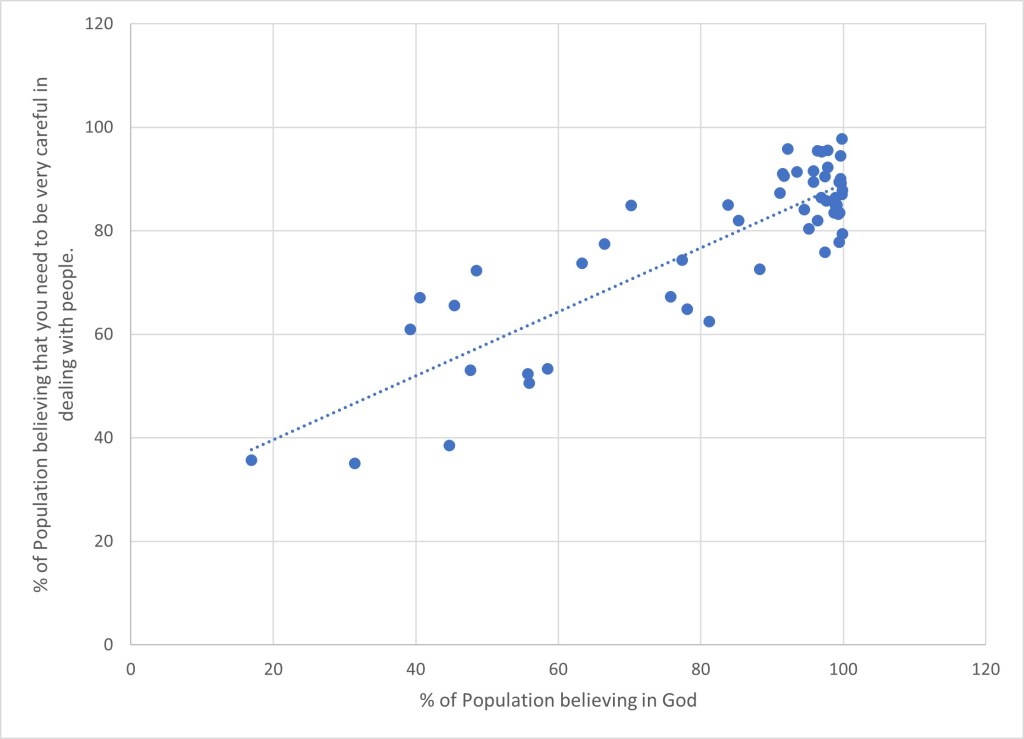
For the 54 countries where both sets of data exist, the graph below compares two sets of data from the most recent World Values Survey, i.e., the percentage of national population who believe that you need to be very careful in dealing with people (Q57), and the percentage of the population who believe in God (Q165). The coefficient of correlation here is 0.86 which indicates a strong relationship.

Correlation between two variables can indicate cause and effect, but not necessarily so. For example, the two variables may have a common cause. Thus, belief in God, fragility, and the need for care may all have a common cause. Alternatively, belief in God might be interpreted as causing fragility and the need for great care in dealing with people. These options seem unlikely, however. Firstly, because the national fragility index comprises a very wide range of variables and it is difficult to identify anything that has been overlooked which might cause both fragility and belief in God. Secondly, many religions emphasise good relationships with one’s fellow human beings, rather than distrust of them.

I would suggest, therefore, that the most likely relationship is one in which national fragility and the need for care in dealing with people are, in part at least, causes of a belief in God. If so, then this may be because people’s need for security and stability, when not provided by the state, is satisfied by believing in God. That is, belief in an infallible being with our own interest and our society’s interest at heart. Conversely, if the state does provide security and stability, then the need for a belief in God is reduced.

References

  • https://fragilestatesindex.org/
  • Haerpfer, C., Inglehart, R., Moreno, A., Welzel, C., Kizilova, K., Diez-Medrano J., M. Lagos, P. Norris, E. Ponarin & B. Puranen (eds.). 2022. World Values Survey: Round Seven – Country-Pooled Datafile Version 5.0. Madrid, Spain & Vienna, Austria: JD Systems Institute & WVSA Secretariat. doi:10.14281/18241.20
Categories
11. National Cultural Evolution

National Cultural Evolution

Introduction

Culture comprises: values or those things that we hold good; norms or acceptable forms of behaviour; knowledge or beliefs; and symbols or things that identify us as belonging to a cultural group, such as ceremonies, forms of dress, and so on. Every organisation, no matter what its type, has a culture.

Culture evolves through a process of mutation and natural selection. The inception of a culture is largely based on geographical factors, such as climate, topography, and available resources. However, as a culture matures, social circumstances, particularly sub-cultures, begin to play a significant part. Cultural evolution is like biological evolution, but with two main differences. Firstly, cultural mutations are not necessarily random, but more commonly a consequence of prevailing circumstances. Secondly, because culture is learnt, it can change far more rapidly. Indeed, cultural evolution in humanity is thought to precede biological evolution, providing that the relevant aspects of the culture endure for enough time.

Ronald Inglehart and The World Values Survey

The World Values Survey (WVS) was begun in 1981 by its founder and first president, the American political scientist, Ronald Inglehart. The project measures the values, norms, and beliefs of the populations of 120 countries, and any changes, by carrying out extensive surveys every 5 years. The results are open access, used extensively by social and political scientists, and can be found at https://www.worldvaluessurvey.org/wvs.jsp . Inglehart has also written an interpretation of the data in his 2018 book “Cultural Evolution”.

Nations can contain sub-cultures or counter-cultures. The values measured are, therefore, national averages and not those held by every individual or organisation. Nevertheless, these averages show very distinctive trends.

Cultural Dimensions

Inglehart and the WVS identified two independent dimensions to the values held by a culture. They are Traditional verses Secular-rational Values and Survival verses Self-expression Values. A change on one of these dimensions does not cause a change on the other, and they have different causes, therefore.

These values are explained below using quotes from Inglehart and the World Values Survey.

Traditional Values

  • Traditional values base morality on purported supernatural revelation or guidance (which is the source of religious ethics). (Inglehart)
  • “Traditional values emphasize the importance of religion, parent-child ties, deference to authority and traditional family values. People who embrace these values also reject divorce, abortion, euthanasia and suicide. These societies have high levels of national pride and a nationalistic outlook.” (WVS)

Secular-rational Values

  • Secular values base morality on human faculties such as logic, reason, or moral intuition. (Inglehart)
  • “Secular-rational values have the opposite preferences to the traditional values. These societies place less emphasis on religion, traditional family values and authority. Divorce, abortion, euthanasia and suicide are seen as relatively acceptable. (Suicide is not necessarily more common.)” (WVS)

Survival Values

  • Top priority is given to economic and physical safety. Inglehart calls this “the Authoritarian Reflex” and describes it as a deep-rooted human reaction to insecurity. Norms are linked with survival of the species or at least the in-group.
  • “Survival values place emphasis on economic and physical security. It is linked with a relatively ethnocentric outlook and low levels of trust and tolerance.” (WVS)

Examples include:

  • A tendency to seek strong authoritarian leadership to bind the community together into its survival endeavour.
  • A tendency towards obedience of leaders.
  • A tendency towards strong in-group solidarity.
  • A tendency towards conformity to group norms.
  • A tendency towards rigid adherence to traditional cultural norms.
  • Intolerance of difference.
  • Xenophobia.
  • An emphasis in child upbringing on hard work.

Self-expression Values

  • These values are linked with the pursuit of individual wellbeing and tend to be democratic, secular and ones of tolerance for differences.
  • “Self-expression values give high priority to environmental protection, growing tolerance of foreigners, gays and lesbians and gender equality, and rising demands for participation in decision-making in economic and political life.” (WVS)

Examples include:

  • An emphasis on gender equality.
  • Tolerance of LGBT people.
  • Tolerance of foreigners.
  • Tolerance of other outgroups.
  • Freedom of expression, e.g., speech.
  • Freedom of self-expression.
  • Freedom of choice on how to live one’s life.
  • Autonomy.
  • Creativity.
  • Participation in political and economic decision making.
  • Political activism.
  • The voice of the people.
  • Greater egalitarianism.
  • Equality of opportunity.
  • Openness to new ideas.
  • Openness to change.
  • Greater emphasis on environmental protection.
  • More tolerant of extramarital affairs.
  • More tolerant of suicide and euthanasia.
  • A rejection of hierarchical institutions.
  • Lack of deference to external authority.
  • Greater emphasis on the need for esteem.
  • Greater emphasis on aesthetic satisfaction.
  • An emphasis in child upbringing on imagination and tolerance.

Culture Mapping

Because the survival/self-expression and traditional/secular rational dimensions are almost entirely independent, Inglehart and the World Values Survey have been able to plot cultures as points on a graph. The most recent survey results are shown in the diagram below. Cultures with traditional and survival values are plotted in the bottom left and ones with secular-rational and self-expression values in the top right. This shows that countries cluster together to form cultural groups.

The Inglehart-Welzel World Cultural Map – World Values Survey 7 (2022). Source: http://www.worldvaluessurvey.org/

As one moves in a direction from bottom left to top right, one moves from economically poorer to richer countries. A country’s position in the graph reflects both its economic and its socio-cultural history. Values vary from individual to individual within those countries, of course. These variations are according to gender, generation, ethnicity, religious denomination, education, income and so forth. However, the standard deviation for an individual country is much smaller than the differences in position between rich and poor countries, and, in many cases, than between adjacent countries. Thus, the likelihood of a person in Sweden or the USA having the same values as a person in Nigeria or Jordan is very small. The predictive power of nationality is much stronger than that of income, education, region within the country, or gender.

If countries are mapped on this graph at different times, they show a distinct trajectory of cultural change. An animated graph can be found at https://www.youtube.com/watch?v=AiIpymGeGoo

An Interpretation of the WVS’s Findings

Cultural evolution is a relatively new concept and, whilst there is extensive data from recent years, its interpretation should be treated with caution. For example, is the shift in the West from a change in values on the Traditional/Secular dimension to a change in values on the Survival/Self-expression dimension a consequence of post-industrialism or a consequence of consumerism and advertising?

The German Political Scientist, Christian Welzel, provides one interpretation in his book “Freedom Rising”. His main points can be found at https://www.worldvaluessurvey.org/WVSContents.jsp. They include:

  1. “Since 1981, economic development, democratization, and rising social tolerance have increased the extent to which people perceive that they have free choice, which in turn has led to higher levels of happiness around the world.”
  2. “People’s priorities shift from traditional to secular-rational values as their sense of existential security increases…” and “The largest increase in existential security occurs with the transition from agrarian to industrial societies. Consequently, the largest shift from traditional towards secular-rational values happens in this phase.”
  3. “People’s priorities shift from survival to self-expression values as their sense of individual agency increases…” and “The largest increase in individual agency occurs with the transition from industrial to knowledge societies. Consequently, the largest shift from survival to self-expression values happens in this phase.”
Categories
08. Belief System Emergence - Culture

Belief System Emergence – Culture

Worldviews were discussed in a previous article and tend to be a form of personal, rather than communal, belief system. I will now move on to discuss the latter, i.e., culture, therefore.

Community, whether it be a family, clan, organisation, or nation, is based on the economics of needs. It allows individuals to specialise and to create satisfiers more efficiently by developing specific tools, knowledge, and skills. In turn, this benefits all members of the community through the process of trading. One individual or group of individuals will provide a satisfier to address the needs of another, and in return, reasonable reciprocation is expected. The community can also satisfy the social needs of an individual member, and in return, that member is expected to contribute to the group. Community relies on the reciprocal satisfaction of one another’s needs and this reciprocation relies on trading in the social sense and not necessarily the commercial sense.

The majority but not all of us have an inherited predisposition to create and abide by the cultures which bind us together into co-operative groups. A culture comprises: norms or acceptable forms of behaviour; values or things held good by the community; beliefs or those things that the community holds true; and symbols, i.e., modes of dress, logos, rituals, and other physical things with a shared meaning which identify individuals as being members the community.

Norms and values are developed to ensure that satisfiers and resources are equitably traded and do, of course, include morality and ethics. They can be described as good or bad. For example, it is usually held bad simply to take or steal from others. Thus, what we sometimes refer to as the ethics and morals of a community do not have a religious source, but rather a practical secular one.

The norms, values, beliefs, and symbols of a community are initially of a pragmatic nature and are enforced through the process of socialisation. That is, members are rewarded for correct behaviour and receive disapproval for incorrect behaviour. However, with time, these norms may become formally established as laws.

The detail of a culture is not genetically inherited. The diversity of cultures across the world and the manner in which they can rapidly change from generation to generation suggest that cultures, and hence our morals and ethics, are acquired, respond to circumstances and are passed on via socialisation. As Richard Dawkins has pointed out, for a culture to be hereditary and change at the rate at which it does, it would be necessary for those who participate in it to breed far more rapidly and successfully than those who do not. This is clearly not the case. However, cultures do form memes, and there is a degree of competition for acceptance between them. This is more so in a global economy where contact between different cultures is greater than it has ever been.

In response to globalisation of the economy, culture in the West is currently moving from a more national/tribal one to a more global one. Many see the global economy as group co-operation on a grand scale, and as bringing great benefits to humanity. We are learning that it requires a more tolerant and inclusive attitude to enable us to co-operate successfully at that scale. However, this change is not without resistance from ideological and other interest groups concerned that they may lose what they currently hold. Difficulties have also been caused by the transfer of consumerism to nations without the infrastructure to support it.

Humanity also faces great risks at the global scale and the move from national/tribal to global morals and ethics needs to be encouraged so that we can better co-operate in tackling these risks.

The political scientist, Ronald Inglehart, using the extensive research of the World Values Survey, identified two key independent dimensions in national culture. These are:

  1. Traditional vs. Secular-rational values. The World Values Survey describes these values as follows. “Traditional values emphasize the importance of religion, parent-child ties, deference to authority and traditional family values. People who embrace these values also reject divorce, abortion, euthanasia and suicide. These societies have high levels of national pride and a nationalistic outlook.”. On the other hand, “Secular-rational values have the opposite preferences to the traditional values. These societies place less emphasis on religion, traditional family values and authority. Divorce, abortion, euthanasia and suicide are seen as relatively acceptable. (Suicide is not necessarily more common.)”
  2. Survival vs. Self Expression Values. Again, these are described by the World Values Survey as follows. “Survival values place emphasis on economic and physical security. It is linked with a relatively ethnocentric outlook and low levels of trust and tolerance.”. On the other hand, “Self-expression values give high priority to environmental protection, growing tolerance of foreigners, gays and lesbians and gender equality, and rising demands for participation in decision-making in economic and political life.”

It is argued that a national culture can be measured by assessing where it sits between the two extremes on the two dimensions. More details, including a fascinating map of where each nation currently sits on these two dimensions can be found at: https://www.worldvaluessurvey.org/wvs.jsp.