Two Motivational Reflexivity Community groups have been created on LinkedIn and Facebook, where you can ask questions, share your experiences, provide feedback, and stay updated on developments. These groups are open to all who are interested in deepening their understanding of Motivational Reflexivity and connecting with others practicing this approach.
These resources and community spaces are free to access. Feel free to download, engage, and share the links with anyone who might benefit. Your participation and feedback are invaluable as we build a supportive community around this practice.
In the longer term, I am planning to produce guidelines for trainers, a dedicated website, and online training courses, all of which will be free to share and use. Their availability will be announced here and in the Facebook and LinkedIn groups.
Motivational Reflexivity is a reflective practice aimed at understanding the motivations behind our personal beliefs, especially those driven by the satisfaction of needs. Drawing from diverse theoretical foundations in psychology, sociology, and philosophy, this concept offers individuals a means to critically evaluate their beliefs and decisions. In particular, Motivational Reflexivity helps distinguish between beliefs grounded in objective reality and those formed to satisfy emotional or psychological needs. This paper explores the foundations of Motivational Reflexivity through the lenses of human needs, automaticity, reflexivity, and the morphogenic cycle, ultimately offering strategies for integrating this practice into daily life.
Needs
Human needs are fundamental conditions necessary for well-being and personal development. Drawing from theories such as Maslow’s Hierarchy of Needs (Maslow, 1943) and Alderfer’s ERG model, these encompass both basic physiological needs (e.g., food and shelter) and higher-order psychological needs (e.g., self-esteem and belonging). Needs drive our behaviour and inform our beliefs.
Satisfiers
Satisfiers are the resources or elements that fulfil or enhance the satisfaction of these needs (Max-Neef, 1991). They can be external (e.g., food, shelter, social connections) or internal (e.g., beliefs, values [9], emotional states). Not all satisfiers are grounded in reality—some might provide temporary emotional comfort without addressing the true nature of the need.
Contra-satisfiers
Contra-satisfiers are elements that reduce or threaten the satisfaction of needs. These can trigger a defensive response or reflexivity when they undermine well-being. Reflexivity often emerges in response to contra-satisfiers as individuals seek ways to address unmet needs or eliminate threats.
Emotions
Emotions act as signals and motivators in relation to needs. Positive emotions (e.g., joy, satisfaction) arise when needs are met, while negative emotions (e.g., fear, anxiety, frustration) signal unmet needs or the presence of contra-satisfiers [1]. These emotional responses often lead individuals to engage in reflexive thought, where they reassess their beliefs and behaviours to better satisfy their needs.
Consciousness
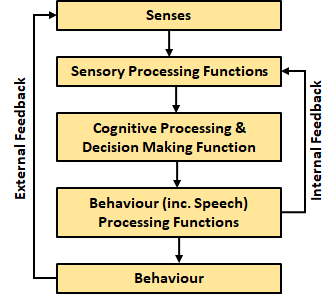
Consciousness refers to self-awareness and the ability to reflect on one’s thoughts and actions. Consciousness is underpinned by internal feedback loops, where individuals evaluate their potential actions before executing them [2]. This ability to simulate actions internally is what enables reflexivity.
Figure 1. A simplified model of the feedback processes involved in human consciousness.
Reflexivity
Reflexivity involves engaging in internal dialogue to critically assess one’s beliefs and behaviours. It is especially important when individuals face unmet needs or threats to their well-being. Reflexivity allows for the interruption of automatic behaviour, prompting individuals to evaluate whether their beliefs align with objective reality or are motivated by personal needs.
Automaticity
Automaticity refers to habitual, unconscious behaviour that does not require reflective thought. While efficient, automaticity can prevent individuals from questioning the motivations behind their actions. Reflexivity interrupts automaticity, encouraging individuals to reexamine their decisions. For example, driving becomes an automatic task after sufficient practice, but when unexpected events occur (e.g., road hazards), reflexivity is triggered, requiring conscious engagement to adapt. [3]
The Modified Morphogenetic Cycle
The morphogenetic cycle, developed by Margaret Archer and Roy Bhaskar, describes the interaction between societal structures and individuals through a series of feedback loops (Archer, 2003)(Bhaskar, 1975). These loops shape individual beliefs and behaviours by assigning roles, norms, and expectations. When these societal roles serve as satisfiers, individuals tend to automatically affirm them. However, if societal roles act as contra-satisfiers, individuals engage in reflexivity to challenge or alter their roles and the demands made of them. [4] The modified morphogenetic cycle also includes the environment as a factor. Society’s actions impact the environment (e.g., through pollution or deforestation), which in turn affects individuals’ ability to satisfy their needs, prompting reflexivity in response to environmental degradation. [5]
Figure 2. Diagrammatic Representation of the Modified Morphogenetic Cycle.
Society (yellow circle) enculturates individuals with values [9], norms, and beliefs. Society also impacts on the natural environment (green circle) which in turn impacts on the individual. If these three impacts are satisfiers (happy person to the right) then the individual automatically affirms society. However, if one or more act as contra-satisfiers (unhappy person to the left), then the individual reflects on potential solutions and then attempts to alter society’s culture or structure accordingly. For example, he or she may alter society’s structure by leaving unsatisfactory employment.
Cultural Evolution
Cultural evolution occurs as societal norms and values [9] shift over time due to reflexivity and new ideas introduced by individuals. Reflexivity plays a central role in this evolution by allowing individuals to critically reflect on cultural elements and adopt practices that better serve their needs and goals.
Cultural Speciation
Cultural speciation refers to the emergence of distinct cultural practices from mainstream society. Reflexivity allows individuals to break away from dominant societal beliefs and form subcultures with unique values [9], norms, beliefs and structures. For example, the isolation of subcultures, such as during the Northern Ireland Troubles, led to the development of divergent cultural beliefs within a single society. [6]
Needs-Driven Beliefs
Needs-driven beliefs are those adopted primarily to satisfy personal needs, regardless of their alignment with reality. Such beliefs often arise when individuals face contra-satisfiers and adopt beliefs that provide emotional or psychological comfort (Kunda, 1990). For example, individuals might support political ideologies that align with their economic or social interests, even if the belief does not reflect broader realities. [7]
Psychological Defence Mechanisms
When needs-based beliefs are challenged, individuals may employ psychological defence mechanisms (e.g., denial, rationalisation) to protect themselves from emotional discomfort (Freud, S.,1920)(Freud, A., 1936). These defences prevent individuals from critically reflecting on the truth of their beliefs. Motivational Reflexivity challenges these mechanisms, helping individuals recognize when their beliefs are motivated by needs rather than objective truth. [8]
Motivational Reflexivity
Motivational Reflexivity involves regularly questioning the motivations behind one’s beliefs and actions. By asking questions like “Why do I hold this belief?” and “Is this belief serving a deeper emotional need?”, individuals become more conscious of the needs driving their decisions. Over time, this process allows individuals to align their beliefs more closely with reality.
Benefits for the Individual
The practice of Motivational Reflexivity leads to greater self-awareness, helping individuals uncover the underlying motivations behind their beliefs. By aligning beliefs with objective truth, individuals experience personal growth and a deeper understanding of their true needs. Reflexivity also fosters empathy, enhancing the ability to understand others’ beliefs and motivations.
Benefits for Society & the Environment
On a societal level, Motivational Reflexivity promotes cultural evolution by helping individuals challenge false beliefs that may be perpetuated through advertising, propaganda, or social pressure. It also supports sustainable practices, as individuals become more aware of the environmental impact of their actions and adjust their behaviours accordingly.
Challenges and Mitigation
While Motivational Reflexivity offers significant benefits, it can also present challenges, such as emotional discomfort (Festinger, 1957) or social conflict. Individuals may find it difficult to confront long-held beliefs, and societal resistance may arise when dominant beliefs are questioned. To mitigate these challenges, Motivational Reflexivity must be practiced with empathy and within supportive frameworks that encourage open dialogue and respect for diverse perspectives.
Conclusion
Motivational Reflexivity empowers individuals to engage in a deep, reflective practice that aligns their beliefs with reality and enhances personal growth. By regularly reflecting on the emotional and psychological needs behind their beliefs, individuals can develop self-awareness, cultivate empathy, and make more informed decisions.
On a broader scale, Motivational Reflexivity offers the potential for societal and environmental progress. By challenging the enculturation of false needs-based beliefs and promoting sustainable practices, Motivational Reflexivity can drive positive change for both individuals and the larger social and environmental systems they inhabit.
Notes
We prioritize our needs based on the intensity of negative emotions that arise when a need goes unmet or is threatened.
These potential actions can also be ones of speech. That is we review what we intend to say before we say it in order to judge its likely effects. The feedback loops can also be external. That is, we observe the consequences of our actions and learn from them.
Automaticity may also arise from socialization—for example, learning cultural norms or professional routines through repeated exposure. Lastly, automaticity can be an instinctive reaction to immediate danger, such as the fight-or-flight response, which is activated without conscious deliberation to ensure survival.
The modified morphogenetic cycle is continuously ongoing. It distinguishes between society’s cultural elements, i.e., values, norms and beliefs, and society’s structure, i.e., individual roles. Either can act as a satisfier and be automatically accepted or as a contra-satisfier triggering reflexivity and attempts to alter the situation.
The natural environment can also produce satisfiers and contra-satisfiers independent of society, such as natural disasters (e.g., volcanoes, droughts), which impact individuals’ needs. In the early development of humanity, the natural environment played the leading role in cultural evolution but with population growth social forces now play the leading role.
When a subculture isolates itself (geographically or ideologically), a new culture may evolve that is distinct from the original. However, if the subculture cannot isolate itself, it may be reabsorbed, modifying the dominant culture. Alternatively, if there is conflict between the cultures, it may result in tensions, such as those seen in the Northern Ireland Troubles.
In the natural environment, needs-driven beliefs are rare, as natural phenomena (like climate) are not influenced by human beliefs. However, in social contexts, needs-driven beliefs are more common, as society can be influenced or shaped by these beliefs to satisfy personal needs.
Psychological defence mechanisms can also be triggered when we are unable to satisfy a need or are unable to avoid a contra-satisfier.
Values are a special type of belief, i.e., beliefs about what is good or bad. Good and bad are, in turn, defined by ethics. Values are shortcuts that avoid detailed ethical analysis. If followed in relevant circumstances they will normally lead to ethical behaviour. Furthermore, they can be propagated through society without the need for reference to the detailed ethics that underpin them. Finally, like any other belief, they can be needs-driven. So, not all people have pro-social or pro-environmental values. This of course implies that Motivational Reflexivity promotes two core beliefs. Firstly, that it is good for our beliefs to conform to reality and, secondly, that our values should be pro-social and pro-environmental.
References
Archer, M. S. (2003). Structure, Agency and the Internal Conversation. Cambridge University Press.
Bhaskar, R. (1975). A Realist Theory of Science. Leeds: Leeds Books.
Festinger, L. (1957). A Theory of Cognitive Dissonance. Stanford University Press.
Freud, A. (1936). The Ego and the Mechanisms of Defence. London: Hogarth Press and the Institute of Psychoanalysis.
Freud, S. (1920). Beyond the Pleasure Principle. London: International Psycho-Analytical Press.
Kunda, Z. (1990). The case for motivated reasoning. Psychological Bulletin, 108(3), 480–498.
Maslow, A. H. (1943). A Theory of Human Motivation. Psychological Review, 50(4), 370–396.
Max-Neef, M. A. (1991). Human Scale Development: Conception, Application and Further Reflections. New York: Apex Press.
A healthy society is one which provides for the wellbeing of all its members. It is one which enables its members to strive to satisfy their needs and which does not put obstacles in their way. In practice, this means equitable access to resources and protection from the anti-social needs of others. However, society is rarely, if ever, perfect and some examples of the difficulties we currently face in the West are described below.
In early, small scale societies relationships were complex. Between each pair of individuals there were several types of relationship and the quality of each had to be balanced with the quality of others. This type of society is the one in which we have evolved to live. In modern society, relationships between individuals often serve a single, relatively simple purpose and people learn to act out a role.
Furthermore, even these relationships are being replaced by technology, and we are beginning to interact either with, or via machines to a significant extent. Indeed, the difficulties involved in learning successful social interaction and in building our social capital have not been helped by the comparatively recent intervention of technology and commerce in our social lives. Social media have communication benefits, but have also led to more distant, impersonal social connections, to online bullying, grooming and exploitation, to commercial opportunities, the spread of fake news, the spread of conspiracy theories, and pressure to conform to fast changing fashions.
The pressure of producing and consuming in an economy which relies on constant growth means that the time available for more complex interaction with family, children, and friends is much reduced. Thus, we are no longer interacting with one another in the way that we have evolved to do. Our social nature is not being satisfied, and we are suffering a poverty of relatedness needs.
Security in the satisfaction of our needs involves an accumulation of material capital, for example the deposit for a home. However, several factors currently conspire against this: the ever-growing wage gap; insecurity of employment; the high cost of purchasing a home; the availability of cheap credit; the pressure to accept it; social and advertising pressures to purchase consumer products; and so on. These are all consequences of consumer-capitalism which, because of its in-built reliance on economic growth, has become exploitative and is approaching the limits of sustainability. The Office of National Statistics Survey reports that “An increasing proportion of young people aged 16 to 24 years in the UK reported that they were finding it difficult or very difficult to get by financially.” In 2016/17 this was 6%. In 2017/18 it had increased to 9%. In particular, “the increase was significant among young men of this age.”
In his book “Cultural Evolution”, Ronald Inglehart says that, in a post-industrial culture, we place greater emphasis on the growth need of self-expression, and data from the World Values Survey bears this out. Culture affects what we believe our growth needs to be and how we go about satisfying them. However, our culture is often steered by royal, aristocratic, political, religious, or commercial elites in their own interest, rather than in that of the general population.
Some have argued that the free-market, consumer economy in the West was brought about by elites as a reaction to a decline in their relative wealth after the two world wars. Again, the statistics bear this out. The documentary filmmaker Adam Curtis also provides convincing evidence that the present emphasis on individuality has been steered, by commercial elites and consultant psychologists, into self-expression through consumption. The concept of lifestyle has been promoted, primarily via advertising, and we have been encouraged to see it as a way of expressing our individuality.
If a need is satisfied, then it no longer motivates us. So, to persuade us to buy products, advertising offers false promises. It is often suggested, incorrectly, that a product will satisfy our needs for relatedness, belonging, and self-esteem. Furthermore, it does so in a subliminal manner, often not recognized by the conscious mind.
The involvement of commerce in the way we make our social connections adds an extra layer of complexity and difficulty to the satisfaction of our relatedness needs. For example, social media influencers are, essentially, engaging in lifestyle-based advertising and earn their living by promoting products. However, they are also role models in terms of behaviour, social status, and appearance. Most cosmetics, for example, are now sold to the 20 to 23 age group, which, ironically, is when the majority of us are physically at our most attractive. There is also a growing tendency for men to use cosmetics.
Whilst people imagine that they are satisfying their needs for individuality, self-esteem and belonging in the way they consume products and services, this is merely a pseudo-satisfier. It is unsurprising, therefore, that mental ill-health is becoming a significant concern, particularly among the younger generations. The survey by the UK’s Office of National Statistics also found that:
“Several measures of personal well-being of young women aged 20 to 24 years in the UK have declined in March 2020 from five years previously”.
There was “a fall in the percentage of young women in this age group reporting very high life satisfaction and happiness, and very low anxiety.”
“There is evidence of increasing anxiety and depression among young women aged 16 to 24 years”. In 2016/17, 26% reported some evidence of depression or anxiety . In 2017/18 this increased to 31%.
“There was a decline in young people’s satisfaction with their health …”. In 2016/17, 59% of those aged 16 to 24 years said they were mostly or completely satisfied with their health. In 2017/18, this fell to 52%.
“Young people aged 16 to 24 years” … “may also be feeling more disconnected from their communities”. In 2014/15, 57% agreed or strongly agreed that they felt a sense of belonging to their neighbourhood. In 2017/18, this fell to 48%.
To truly satisfy our need for individuality, it is necessary to build up a resistance to these advertising pressures. We can learn to resist some of them, but others are beyond our individual control. As Mark Carney, a past governor of the Bank of England, put it in his 2020, BBC Reith Lectures, the economy is driving society’s values and not vice versa. He argues that we now need a post-consumer economy which delivers on society’s values. That is, what society holds to be good, rather than what has a monetary value. However, he also believes that this cannot be left to free markets, which tend to follow the same path until a bubble bursts. One way in which the latter can occur is through the over-exploitation and wastage of resources and it is quite likely that we have now begun to see the effects of this. He argues, therefore, that government intervention is needed to steer markets in the appropriate direction.
Unfortunately, politics has taken a lesson from commerce and is beginning to operate in a similar way, employing psychologists and, with their advice and insights, also exploiting our needs.
We use resources to create satisfiers. Resources include, for example, time, physical effort, mental effort, emotional resources, and material resources or property. A key feature of resources is that they become depleted with use. Knowledge is not a resource in this sense, however, because it does not become depleted.
Property is the resource that an individual or group of people hold to satisfy their needs and which they will defend. Ownership attaches to property, it is associated with a particular individual or group, and only they have the right to use it. It is human nature to hold property and respect for ownership must be reciprocal if ownership is to exist.
An inability to satisfy one’s needs due to a lack of adequate resources or other obstacles can be described as poverty. Normally, due to its prevalence, this term applies to an inability to satisfy our existence needs. However, it can also be used to describe an inability to satisfy other needs. It can be a poverty of existence and procreation needs, for example an inability to feed or house oneself, a poverty of relatedness needs, for example an absence of kin and other people with whom to form relationships, or a poverty of growth needs, e.g., an inability to develop one’s talents and skills.
The term “wellbeing” is commonly used in the medical profession as an indicator of physical and psychological health. Here, however, it is given a broader meaning, i.e., the extent to which the needs of an individual or population are satisfied and, of course, the extent to which contra-needs are not.
Wellbeing is far more than “something that it is nice to have”. It affects the way in which we behave as individuals and the success or failure of a society. There are positive and negative feedback loops between individuals and society. If society, which can be regarded as a satisfier, provides wellbeing then individuals will support it, will be able to pursue their needs and will be better able to contribute to that society. This is a positive feedback loop. Conversely, if society becomes a contra-satisfier, for example when a minority exploit the majority, then the latter will become alienated, engage in conflict and the society will fail. This is a negative feedback loop.
Different cultures provide for the needs of their population in different ways, and their success in doing so varies. It is possible to evaluate a culture from the way it uses the available resources to satisfy the needs of its population and others with whom it interacts. In general, resources satisfy the wellbeing of the population most efficiently if they are used in an egalitarian manner. That is not to say that every resource should be apportioned equally. As individuals ascend the tree of needs their needs begin to differ from those of others, and so too do the resources required to satisfy them. Thus, equitable sharing is related to needs satisfied rather than the resources applied.
Numerous attempts have been made to measure the wellbeing of populations: the Gini Index, a measure of the income distribution of a country’s residents and thought to be a good indicator of the level of inequality; Bhutan’s measure of Gross National Happiness; the OECD’s Better Life Index; the Index of Sustainable Economic Welfare (ISEW); subjective wellbeing (SWB); and so on. In the author’s view, however, it may be possible to measure an individual’s wellbeing in terms of the value they place on the resources available to satisfy their needs. For example, if they place a high value on personal time or money then this implies that they have insufficient to satisfy their needs. All these approaches have their flaws and can be criticised. I do not propose to look at them in detail, therefore. I merely wish to establish the principle that wellbeing can be measured, and serious attempts are being made to do so.
Pursuing the satisfaction of our natural human needs is what motivates us. However, much effort is involved in doing so. It is a lifelong process, and we meet many challenges on the way. If we can overcome those challenges, then this contributes to a general sense of happiness and wellbeing. Happiness is a relatively short-lived emotion that we experience from time to time. However, wellbeing is a state of mind which persists for so long as we are satisfied. On the other hand, if we encounter insurmountable obstacles, then we can experience frustration, a low sense of wellbeing, ill health or even death.
Maslow’s theory maintains that needs lower in the hierarchy must be largely satisfied before we can move on to higher needs. However, as explained in an earlier article, there is little evidence that we do actually prioritise our needs in this way. There is not a simple correlation between age and the hierarchy of needs. Rather, several other factors can cause significant differences between generations and age-groups. They can also cause significant differences between individuals from the same generation and age-group. Examples of these factors include:
Biological Factors. For example, our individual capabilities and the physiological and health risks that we face in childhood, as a parent, or in old age.
Social Role. At different stages in our lives, society provides us with different forms of support and demands different forms of contribution. Some are common to all societies. For example, in childhood our existence needs are provided for by our parents. However, support and demands also vary according to the nature of our society, our gender, and our socio-economic status. Social support and demands are significant factors in deciding how we prioritise our needs at different stages in our lives.
Cultural Change. The culture of a society can alter rapidly from generation to generation, and the prevailing culture in our formative years will affect our priorities in later life. Thus, different generations can be typified by different priorities, irrespective of age. Today, cultural change is far more rapid than it has been in the past and is, therefore, having a much greater influence.
Significant Events. World Wars, epidemics, and economic depressions, when they occur, can reshape the priorities of all generations. However, if they occur during our formative years, they can have a particularly long-lasting effect on our priorities. This can cause different generations to be typified by different priorities.
Time to Learn. It can take considerable time and effort to learn how to satisfy a need, sustain that satisfaction and deal with the difficulties associated with doing so. The natural world and human society are both extraordinarily complex. Understanding them and learning successful behaviour requires much effort, therefore, and whilst making that effort we age.
Thus, whilst there is a general trend in the way that different age-groups prioritise their needs, there is also considerable variability as different generations come to occupy an age-group. There is also considerable variability between individuals within an age-group.
Some examples from Western society may serve to demonstrate how the above factors interact to cause a general trend in the priorities of different age groups. Whilst this trend may be true of humanity in general it is not necessarily so for the individual.
When we are born, we aspire to satisfy our existence needs, i.e., food, warmth, shelter, etc. Satisfiers are, of course, provided by our parents and we must merely cry or smile when a need arises. Our social skills are innate, and we have yet to develop the cognitive skills to pursue higher needs.
In our teens and early twenties, security in the provision of our basic needs continues to be provided by our parents, and so, our aspirations focus on social relatedness. Historically, we would seek a partner and reproduce in our teens and early twenties, so biological factors may also have a part to play.
Later, as we raise children, our existence needs must be secured for us to do so successfully. An example is the desire to own a home of our own because, in most cases, our need for shelter will previously have been satisfied in a less secure way by living with our parents or by renting.
It has been suggested that our large brains evolved to enable successful social interaction. However, these brains also bestow on us the ability to safeguard the satisfaction of our existence and relatedness needs. This is where our aspirations are next likely to be focused, therefore. However, the way in which we satisfy this need is also affected by our cultural upbringing. In some cases, it may be by accumulating wealth and property. In other cases, it may be by building strong social connectedness and support networks.
Our large brains also give us a need for meaning in our lives, curiosity, creativity, and an ability to master complex skills. It is to these that we turn when other needs are largely satisfied. Due to the time involved in learning how to satisfy all our needs, these tend to come to the fore as we become older. It is notable, however, that some creative people will forego the satisfaction of lesser needs.
A culture can assign different roles to different genders. Furthermore, hormones are known to affect the state of mind of both sexes. It is conceivable, therefore, that there are gender differences in the way that we prioritise and satisfy our needs. Unfortunately, little objective research has been done on this subject.
Finally, evidence from surveys shows that the need for safety or freedom from existential threat is a more significant aspiration amongst older people.
In very general terms then, but with much variance, the Western trend in priorities can be summarized as: the satisfaction of existential needs as a small child; relatedness needs in our teens and early twenties; safety and procreation needs in later adulthood; and security, safety and growth needs thereafter.

 Rational-Understanding.com