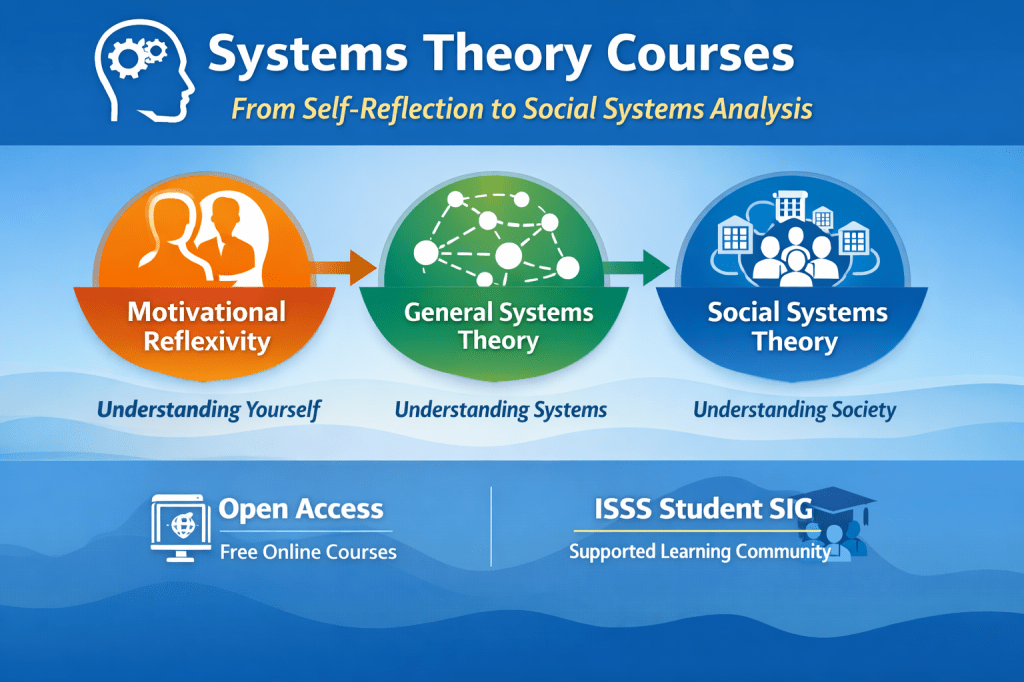
I’m pleased to announce the launch of a new series of Systems Theory courses, now available both as open-access materials and as supported courses through the International Society for the Systems Sciences (ISSS). The programme currently includes: 📜 Motivational Reflexivity (full course available) 📜 General Systems Theory (modules being released progressively) 📜 Social Systems Theory (modules being released progressively) These courses provide a structured pathway from: 💡 understanding individual behaviour and motivation 💡 through core systems theory 💡 to the analysis of complex social systems All materials are freely available on my website for open, self-paced study. For those who would prefer a more structured and supported learning experience, the courses are also available via Google Classroom through the ISSS Student SIG, which is currently free to join for students. Those in full-time or part-time education are especially encouraged to take this route, as it provides access to a supportive learning environment, including guidance from experienced systems scientists, opportunities for discussion with fellow learners, and engagement with a wider international community. ISSS membership also offers access to a range of resources, events, and professional networks that support both academic and personal development in systems theory. Access the courses: Open courses (website): 🔗 https://rational-understanding.com/motivational-reflexivity-course/ 🔗 https://rational-understanding.com/gst-course/ 🔗 https://rational-understanding.com/sst-course/
Supported courses (ISSS Student SIG): Join ISSS free of charge as a student at: 🔗 https://www.isss.org/home/ If you are interested in developing a deeper understanding of systems theory, you are very welcome to explore the materials or join us through ISSS for supported learning.
This paper sets out the philosophical basis for the Extended Framework for General Systems Theory (EFGST), integrating two complementary perspectives:
Cognitive Physicalism – everything that exists is physical and located in space–time, including cognition itself
Critical Realism – reality exists independently of our knowledge, but our understanding of it is always mediated
Together, these provide a realist yet epistemically modest foundation for systems science.
The paper explores several key implications, including:
systems as real, structured physical entities
knowledge as model-based and necessarily partial
the distinction between observable events and underlying causal structures
and the idea that the future is constrained but not predetermined, unfolding through branching possibilities shaped by interaction and agency
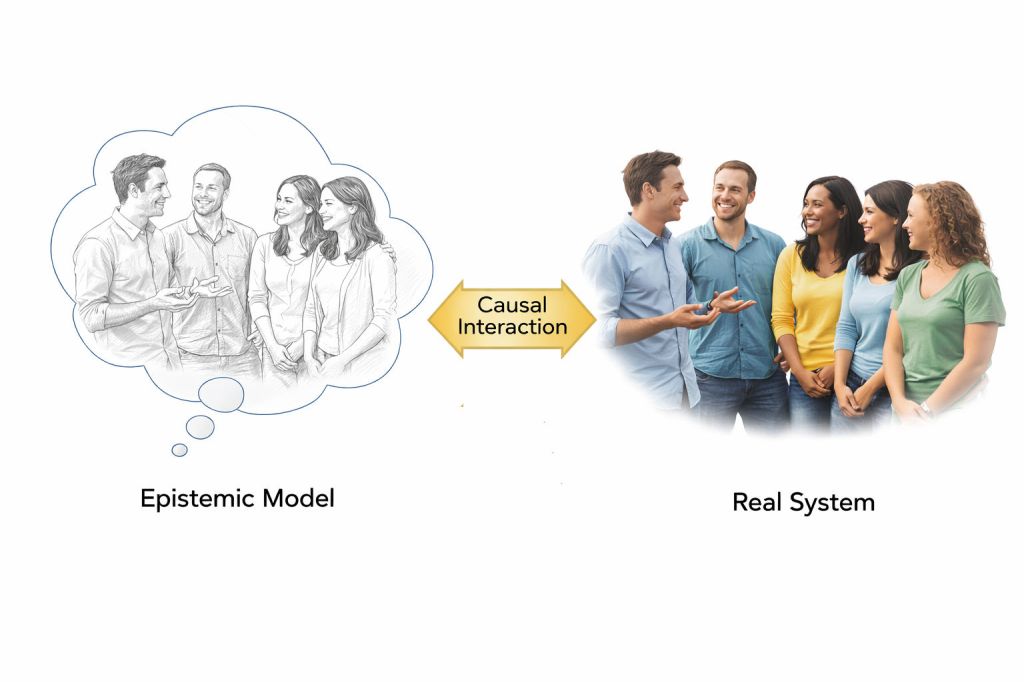
One theme that runs throughout is that we never act directly on reality itself, but on representations of it; representations that are sufficient for action, but never complete.
To illustrate this, I’ve included a banner image accompanying the paper. You might like to take a careful look at it…
Most of us have experienced moments when something “felt connected” before we could explain why.
A scientist senses a hidden relationship before finding the evidence. An engineer recognises a design flaw immediately, without calculation. A person feels that a situation makes sense long before they can articulate the reasons.
In my new paper, From Intuition to Explanation: How Belief Systems Form, I explore a simple but important idea:
Human beings detect patterns before they explain them.
The explanations we construct, whether scientific, religious, philosophical, or everyday, are shaped by the conceptual tools available to us at the time.
This perspective helps explain:
Why belief systems of different kinds can resemble one another
Why people can hold their views so strongly
Why communication across disciplines and cultures can be difficult
And how dialogue can be improved without dismissing the underlying experiences people are trying to explain
The paper draws on cognitive science, psychology, and systems thinking to propose a general model of how belief systems form and evolve.
It also has important implications for systems science itself, which historically has often sensed patterns of connectedness before fully formal tools were available to explain them.
Ultimately, the argument is simple:
The progress of knowledge is not a replacement of intuition, but a refinement of how we explain what we have long sensed.
One of the most intriguing features of living and social systems is that tiny actions often have enormous effects. A neuron fires and a limb moves. A policy is announced and an institution reorganises itself. A symbolic message spreads and a social movement begins.
Why does this happen?
A growing line of work, including a recent paper I’ve written, suggests that agency operates through a mechanism we might call causal leverage. In simple terms:
information, even when coupled with very little energy, can unlock or redirect far larger flows of energy elsewhere.
This idea bridges physics, biology, cognition, and social behaviour. It explains why:
control systems use small signals to regulate large processes,
communication changes minds with minimal physical effort,
leaders and institutions wield influence through words more than force,
and why humans naturally seek positions of “power”; because it increases the amplification of their actions.
Rather than treating agency and social power as abstract concepts, this approach roots them in the physical world. The full paper explores these ideas in more detail for those who are interested and can be downloaded in pdf format at https://rational-understanding.com/SST
Every system, from molecules to minds to markets, changes over time. These changes are not random. Systems tend to follow patterns: settling into stability, reacting to shocks, and sometimes undergoing deep transformations. One of the most powerful ways to understand this behaviour is through the medium of energy landscapes, a concept that is well established and widely used in physics.
Systems undergo phase transitions, a term borrowed from physics. When water freezes to ice, it experiences a type 1 phase transition; the change occurs almost instantaneously across the entire system. More complex systems, however, typically undergo a type 2 phase transition; one that requires them to traverse an energy landscape, moving step by step between stable states. Over geological time, for example, the Earth has shifted through such a landscape from a predominantly mineral state to a living one and may now be transitioning toward an informational one.
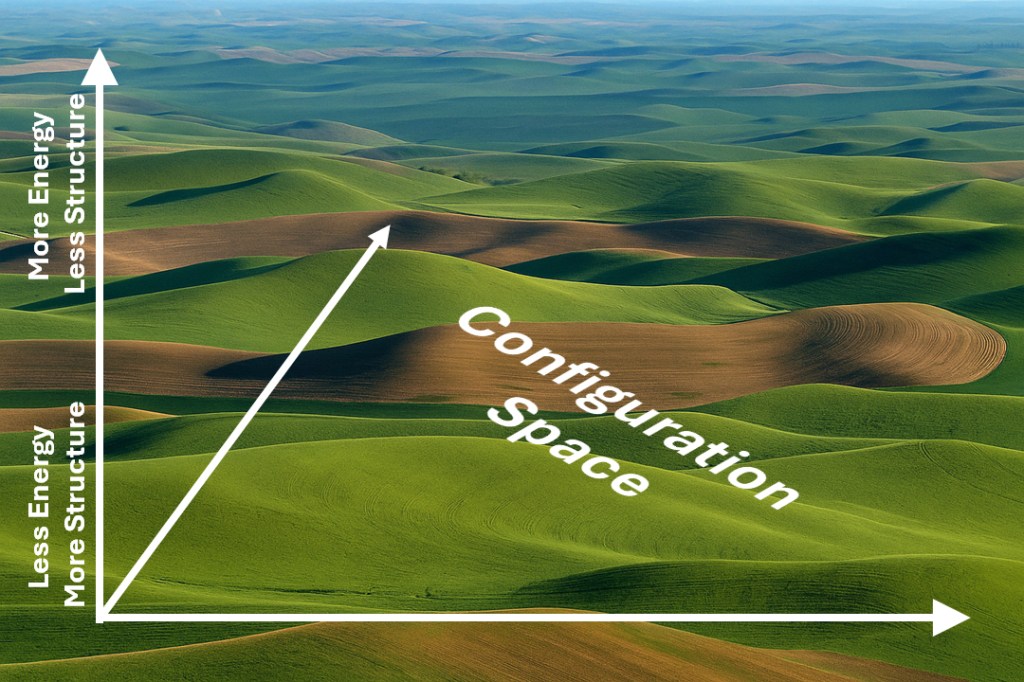
An energy landscape is a conceptual tool that maps all the possible configurations a system can take and shows how stable each of those configurations is. It is not a feature of the system itself, which at any given time exists in just one of those configurations. Instead, it is a representation of the system’s entire configuration space, i.e., the set of all possible arrangements of its components, whether or not those arrangements actually exist. While it is helpful to imagine this landscape in two dimensions, in practice it may have hundreds, thousands, or even millions of dimensions.
A system can be closed; that is, no energy or matter enters or leaves it; open to energy; or open to both energy and matter. The nature of the landscape differs for each. This is explained in more detail in the paper “Framework for a General System Theory” (Challoner, 2025) available at https://rational-understanding.com/2025/05/12/framework-for-a-general-system-theory/.
In the open systems encountered in nature, valleys in the energy landscape represent stable, low-energy states (also called attractors) where systems tend to settle. Hills or peaks are unstable, high-energy states where systems rarely remain for long. Over time, systems “move” across this landscape in response to internal dynamics and external influences.
In this context, internal dynamics refers to changes that arise from within the system itself, without major external shocks. In physical systems, this might be thermal fluctuations or ongoing chemical reactions; in biological systems, metabolic processes or genetic variation; in social systems, demographic shifts, gradual changes in norms and institutions, or structured cycles of change such as Margaret Archer’s Morphogenetic Cycle. Over time, these small, cumulative adjustments can alter the system’s configuration, nudging it toward a new position in its energy landscape.
If left undisturbed, however, most systems drift toward the lowest nearby valley; the most stable state available.
The Structure of Systems and Their Landscapes
To understand what defines a system’s configuration space, we need to know what the system’s components are. Systems theory describes reality as a nested hierarchy; each system is made of subsystems, which are themselves made of smaller subsystems, and so on. Assembly theory offers a compatible view from another angle; it sees every system as built from previously assembled components that themselves have been assembled from simpler, previously assembled parts.
Assembly theory assigns levels of assembly. The simplest structures occupy level 1. Assemblies made from level 1 components occupy level 2, and so on, increasing in complexity. Thus, any system can be described as level n, and composed of level n–1 components. The latter are, in turn, made of level n–2 sub-components, and so on.
The configuration space of a system of level n is defined by the degrees of freedom of its level n–1 components, that is, the independent ways in which they can vary.
Open System Energy Landscapes
An open system energy landscape maps the total energy of a system onto the configuration space of its components. In the simplified three-dimensional visualisation, valleys (low total energy) correspond to stable attractors. They are typically associated with high organisation and high “information at source”. Peaks, on the other hand, are unstable configurations, typically associated with high total energy, low organisation, and low “information at source”.
Figure 1 – An energy landscape visualised as hills and valleys in a two dimensional terrain.
In this framework, “information at source” is equivalent to Schrödinger’s negentropy, i.e., the degree to which a system’s entropy is less than its maximum possible value. Thus, in an open system energy landscape, valleys correspond to high-negentropy states, while peaks correspond to high-entropy states.
Static and Dynamic Landscapes
In open systems that are closed to mass but open to energy the landscape is relatively static. As energy enters or leaves a system its energy landscape moves up or down whilst retaining the same overall profile. An example that approximates to such a system is the Earth as a whole, which receives energy from the Sun but gains little matter.
However, not all energy landscapes are equally stable. Systems open to both energy and mass have landscapes that are dynamic, shifting like the surface of a storm-driven ocean. In such systems, attractors can deepen, vanish, or be replaced as new matter and energy flow in or out.
Natural systems such as coastal estuaries, and social systems such as globalised manufacturing, both illustrate how being open to energy and mass makes a landscape dynamic. In an estuary, tides, storms, and seasonal floods bring new sediment, nutrients, and species, reshaping which ecological communities dominate. In manufacturing, new technologies, raw materials, and workforce movements can build new industrial hubs or undermine existing ones. In both cases, stable configurations, ecological communities or production networks are attractors, but these can deepen, vanish, or be replaced entirely as continual flows of matter and energy reshape the landscape.
How Systems Traverse a Landscape
Over their lifecycles, open systems tend to shift into progressively deeper valleys, i.e., more complex and stable forms of organisation, until they are constrained by internal limits such as resource shortages or diverted by external shocks. Initially, a collection of components is only a subcritical structure; it lacks the emergent properties necessary for the novel functions and outputs lacked by its parts. As organisation increases, it may become a sub-optimal system, i.e., one that has an emergent function, but not yet enough structure to deliver outputs efficiently. Further organisation can lead to an optimal state, where the energy used for structural maintenance and the energy used for output are balanced to maximise performance. Beyond this point, the system becomes super-optimal; any additional complexity may draw too much energy into self-maintenance, reducing output and eventually leading to collapse if maintenance demands outstrip available energy.
Systems can also oscillate around an attractor, making continual small adjustments to remain stable. In real-world settings, such oscillations often produce repeating cycles, e.g., periods of growth followed by contraction, tension followed by resolution, or stability punctuated by brief disruptions. Over time, these cycles can reinforce the system’s current organisation, allowing it to return to the same attractor after each disturbance, a tendency known in systems theory as equifinality. However, if the oscillations amplify or are combined with large external shocks, the system may break from its cycle and transition into a different valley entirely, reorganising around a new attractor, a process referred to as multifinality. In social and ecological systems, such transitions may take the form of reorganisations, revolutions, or collapses.
Fractality in Energy Landscapes
Energy landscapes are often fractal. That is, similar patterns appear at different locations and scales. This arises because many configurations are variations of others. For example, components may be identical, allowing them to be interchanged without altering the whole, so different areas of the landscape share the same pattern. In addition, systems frequently assemble recursively, meaning that smaller subsystems are built in the same way as the larger system they belong to. This repetition of assembly patterns across levels produces repeating structures in the landscape itself: the routes to forming a subsystem resemble the routes to forming the whole, creating self-similar pathways and clusters of attractors at multiple scales.
This fractal nature means that, as a system traverses its energy landscape, patterns of change it has followed before may reappear later in its life, and often at different scales. Because similar configurations and pathways exist in multiple locations across the landscape, the system can encounter familiar transitions in new contexts. This is why history can sometimes guide our expectations, although the self-similarity of the landscape never guarantees identical outcomes. For example, in ecology, the process by which vegetation colonises bare ground after a small landslide can resemble the much larger-scale succession that occurs after a volcanic eruption. The sequence of pioneer species, intermediate communities, and mature forest repeats the same general pattern, even though the scale, timing, and specific species differ. Similarly, in economics, a localised boom-and-bust cycle in a single industry can follow the same trajectory as a national economic cycle, but on a smaller scale and over a shorter period.
This fractal nature also means that systems can become trapped in “valleys within hilltops”. That is, zones of local stability nested inside larger instabilities. In such cases, a system may appear stable in the short term while, in reality, the broader configuration it occupies is unstable and heading toward change or collapse. For example, a government may maintain political stability through a fragile coalition, yet the entire national system faces deepening economic and environmental crises that will eventually destabilise it. Similarly, a supercooled liquid can remain in a seemingly stable state until the slightest disturbance triggers a complete and irreversible phase change.
From Physics to Society
The concept of energy landscapes is not limited to physics or chemistry. Social systems, such as international relations, also move across landscapes defined by stability and change. These systems are open to new energy in the form of ideas, movements, and crises, but largely closed to new matter, since nations rarely appear or disappear. Like physical systems, they experience periods of self-maintenance, oscillation, disruption, and transformation. And just as in natural systems, their landscapes can be reshaped by sustained flows of energy or sudden shocks.
Conclusion
Energy landscapes offer a way to see not just where a system is, but how it might change. They explain why systems settle into certain patterns, why some shocks cause sudden transitions while others do not, and why some paths are easier to follow than others. They also show how patterns can repeat, recombine, and evolve over time. By viewing systems through this lens, and by recognising that landscapes themselves can shift, we gain a powerful method for thinking about change in everything from molecules to markets.
Part 1 discussed the structure of society, i.e., the relationships between human holons, such as individuals, organisations or nations, the various forms these relationships can take, and how they alter with time. It notes that, with a very few exceptions, human interactions are much the same as those encountered elsewhere in the animal world. Conventionally, the structure of society is taken to mean its network of cooperative relationships. However, in this series of papers, a much broader definition is used that includes non-cooperative ones. Thus, for example, ongoing wars are also considered a part of this structure. It is also acknowledged that it is not only human needs that dictate relationships and the way that they change but also the values, norms and beliefs held by the related parties. Thus, the subsequent Parts of this series discuss the latter in more detail.
Part 2 described the work of the English philosopher of science, Roy Bhaskar (1944 – 2014), and the English sociologist, Margaret Archer (1943 – 2023). Roy Bhaskar is regarded as the founder of Critical Realism, a philosophy that holds reality to exist and to be the source of truth. It also holds that our beliefs about reality are not necessarily true. Both Roy Bhaskar and Margaret Archer described how culture affects individual agency and how individual agency alters culture. Bhaskar referred to his model as the Transformational Model of Social Activity (TMSA), and Archer to her model as the Morphogenetic Cycle. Archer also described how reflexivity, i.e., an agent’s internal conversations, can lead to cultural and structural change.
Part 3 built on the work of Margaret Archer to describe the outcomes of those internal conversations in more detail. It explains that to satisfy our needs or to avoid contra-satisfiers, we can adopt, form and propagate beliefs that are not necessarily true, but ones thought likely to satisfy our needs. Furthermore, to avoid anxiety caused by circumstances beyond our control we can adopt beliefs that act as psychological defence mechanisms. These beliefs when propagated do, of course, influence culture and structure.
Part 4 now draws on the preceding three parts to discuss the nature of culture in more detail, together with the processes of cultural evolution, stagnation, regression and speciation.
In this short series of articles, I will summarise the basic principles of Social Systems Theory. Full details are given in previous or subsequent articles.
The fundamental component of society or holon
The term holon was coined by Arthur Koestler in his 1967 book, The Ghost in The Machine. It refers to any entity that can be recognised as a whole in itself and which constitutes part of a larger whole. In social systems theory the fundamental component or holon of society is the organisation, that is, any group of people who work together with a common purpose. Organisations can be of any type and can range in size and extent from an individual, through clubs, businesses, sectors, political parties, governments, nations, and groups of nations, to the global community.
Family relationships between organisations
All organisations form a nested hierarchy. The structural relationships between them are similar to those in a family and the same names can be used. Thus, for example, child organisations are components of a parent one, and parent organisations are components of a grandparent one. Two organisations that are components of the same parent are known as sibling organisations. This nested hierarchy continues upwards until an isolated organisation or the global community is reached.
Every organisation comprises a number of component or child organisations, and this nested hierarchy continues downwards until individual people are reached.
Recursion
Recursion means that similar rules and principles can explain the behaviour of organisations irrespective of their size. Thus, for example, a department in a government agency has a leader, and so too does the entire agency.
The control component
All organisations have a control component, e.g., leadership or management, to co-ordinate their activities. Due to recursion, control components have their own control components until we arrive at the individual person. This creates a leadership or management hierarchy comprising individuals. It is natural to select leaders using a bottom-up process, i.e., followers choose a leader thought to be best qualified to co-ordinate their activities. However, managers are also frequently chosen by a top-down process whereby senior managers select junior ones thought to be best suited to the role.
Needs, satisfiers, and contra-satisfiers
All organisations have needs similar to those of individuals. These needs are prioritised using the same categories for individuals identified by Abraham Maslow and Clayton Alderfer, i.e., ERG or existence, followed by relatedness, in particular family relatedness, followed by growth. These priorities are consistent with the multilevel selection theory of evolution. This holds that we place greatest weight on personal survival and reproduction, followed by that of the community upon which we depend, followed by people more remote.
Satisfiers are those external things that increase the level of satisfaction of our needs, for example, food for hunger, or resources for manufacturing. Both individuals and larger organisations endeavour to gain satisfiers as efficiently as possible. Contra-satisfiers, on the other hand, are those external things that reduce the level of satisfaction of our needs and which we endeavour to avoid.
The applicability of systems science, function, and causality to organisations
All organisations are systems and comprise inputs, processes, and outputs. The fundamental principles of systems science apply to them, therefore.
Causality also applies to organisations. The combination of an input and the process is equivalent to a cause. The combination of the process and an output is equivalent to an effect. An organisation’s processes and outputs are also referred to as its function. Because causality applies to organisations we can, for example, say that a number of necessary causes or inputs are together sufficient for an effect in which the organisation carries out its function of producing outputs.
Matter, energy, or information is transferred from every organisation’s inputs to its outputs. This takes place within the region of space-time defined by the organisation’s process. Thus, the latter provides the overlap in space-time needed for a cause to be related to an effect.
All organisations comprise a group of people who work together with a common purpose. This purpose is also the organisation’s function, and the ability to carry out its function is an organisational need.
The applicability of motivation theory to organisations
All interactions between individuals, organisations, and parts of them comprise an exchange of satisfiers or contra-satisfiers for each other’s needs. These satisfiers and contra-satisfiers also take the form of matter, energy, or information. A satisfier or contra-satisfier received is an input, and one provided is an output. Thus, motivation theory also plays a key role in social systems theory.
The applicability of information theory to organisations
Information passes between organisations and flows within any organisation’s processes. Thus, information theory plays an essential role in social systems theory. Fundamentally, information is organised or structured matter or energy that we recognise due to its recurrence. It can exist “at source”, i.e., as the original structure perceived in the physical universe. It can also be translated into various symbolic forms capable of being transmitted, stored, or remembered. Importantly, information at source is, by definition, always true. However, information acquired in other ways, for example, from another organisation, can be false.
Direct interaction can only take place if two organisations are aware of one another, and for this to be the case, information must pass between them. However, organisations can be aware of one another but not interact. These criteria simplify the web of interactions in a social system.
Culture & interaction style
The ways in which individuals and organisations interact are determined by their culture and interaction style. These topics will be covered in a forthcoming article.
I have made much mention of Systems Science in my recent articles. If you would like to learn more on this topic, then I recommend following Shingai Thornton’s blog at: https://systemsexplorers.substack.com/
Shingai is a member of the International Society for the Systems Sciences (ISSS) and will write about the topic on a weekly basis. Each article takes about 5 to 10 minutes to read.
Initially, they will focus on making some of the core concepts in George Mobus’ Principles of Systems Science textbook easily accessible to a broader audience who might not have time to read the book.
Shingai is an aspiring systems scientist looking for critical feedback on his writing, and collaborations around the application of systems science to issues in the social sciences. He is receiving advice from George and other members of the ISSS education committee and together they are also developing an online course based on the book.
People understand the world through pattern recognition. Recurring patterns of events attract our attention, we remember them, attach meaning to them, and later use them as an aid to predicting the world. This trait has evolved to help our survival and the propagation of our genome. Non-recurring events are of lesser interest as they do not permit prediction. We are, therefore, less likely to remember and attach meaning to them.
Causality as a basis
Such recurring patterns of events have their basis in causality. It is likely that our perception of the latter has a hereditary basis. Certainly, other animals seem to understand causality, as evidenced by Pavlov’s famous behavioural experiments. Also, we have probably all experienced a young child repeating the question “why?”. This is probably him or her exercising hereditary skills in the recognition of causality.
Recognition
Noticing these patterns is highly tentative at first. We merely notice similarities between events and feel an intangible sense of order. We do not have the words to describe what we notice, and it is not integrated into our general worldview. However, as our brains absorb the new information and make the necessary connections our understanding grows, and we can find words to communicate the insights. A general rule forms that we can use predictively. Unfortunately, this can be a slow process often involving several nights of good sleep and some research into the topic. This is effectively the same as the creative process of saturation, incubation, inspiration, and verification described in an earlier article, but with saturation replaced by experience.
We can also seek the fundamental origins of the recurring patterns that we observe. For example, the very concept of causality was discovered in this way. Patterns were recognised and causality was recognised as another pattern within them.
Limitations
When we seek meaning we are essentially attempting to understand a pattern that describes the universe in its entirety. Unfortunately, however, pattern recognition is limited by our cognitive abilities. The principle of darkness applies, and our minds are simply not complex enough to model such a pattern. We can only recognise relatively simple ones such as causal relationships and feedback loops, and even those with difficulty. If there is any meaning to the universe, then it is certainly beyond our ability to perceive it. It would be more sensible to recognise this, rather than invent simplistic or mystical explanations. In practice, we must satisfy ourselves with understanding small parts of the world around us. For example, the purpose of this blog, is to convey an understanding of human nature and society.
Explanation
As explained above, to understand a recurring pattern, it must be integrated into our general worldview. Obviously, if our worldview is a mystical or religious one, then we may give those patterns an explanation of that type. On the other hand, we will give the patterns a scientific explanation if our worldview is of that nature.
Feedforward
The process of predicting events and acting proactively is known in systems science as feedforward. This term is also used in personnel management to describe the training of staff to meet future business needs. The term feedforward suggests that it is the negative of feedback. However, this is only so in the sense that feedback is reactive to past events, whilst feedforward is predictive of future events. Feedforward relies on a knowledge of causal patterns. It is, therefore, a feature of agents or of systems created by agents.
How to Use this Process
We can reverse this recognition process. This involves designing a causal pattern and then looking for it in the world around us. Another approach is to generalise theories from specialised fields into general causal patterns. Once a pattern, for example the replication of information, has been created, we can then look for manifestations of it in the real world. In this way we may, for example, notice cellular division, the viral spread of misinformation on the internet, and so on. As explained in the previous article, there are many ways in which information can be altered during replication. So, two copies of the same information can contain contradictions. This in turn can lead to competition regarding which is correct, and, as will be described in a future article, to conflict. From this model it is possible to suggest reasons for real world events such as conflicts between closely related religious factions, etc.
In different fields and specialities, different words are often used for similar concepts. This tends to obscure similarities between the causal processes involved. However, once we have a pattern in mind, its recognition in the real world or in another field of expertise becomes much easier.
 Rational-Understanding.com