Why do capable, well-intentioned teams so often fall into frustration, competition, or subtle conflict?
This article proposes a different way of understanding what is happening beneath the surface of group behaviour. It suggests that what we commonly call “roles” are not job titles or personality traits, but stabilised coping strategies that people adopt in order to manage the rising complexity of interacting within a group.
When these roles are recognised and complementary, teams work smoothly. When they are duplicated, ignored, overextended, or absent, tension and dysfunction appear, often without anyone understanding why.
The article also shows how the same pattern repeats across levels of systems: what appears as roles in teams appears as departments in organisations and as specialisations in economies and nations.
This provides not only a practical explanation for many common forms of team conflict, but a systems perspective on how cooperation can be improved within and between groups at every scale.
A colleague in LinkedIn has posted the following comment on my previous article: “Co-operation fails when the demands of the goal are put ahead of the needs of the relationships involved in the cooperative”. Although this comment uses different language to mine, I agree with it, and my reasons are given in this article. The comment also has some interesting implications that I will also explore here: why the needs of cooperative groups are so similar to the needs of individuals, and how cooperation can become coercion.
My explanation begins with cognitive physicalist philosophy, one of the key principles of social systems theory. The cognitive component of this philosophy holds that the universe is infinitely complex, but our minds are not. Therefore, to understand the universe we are obliged to mentally represent it in a simplified way. One of the ways we do this is by using holons. These are things whose structure we recognise due to its recurrence. Holons enable us to recognise threats and opportunities from experience or from knowledge passed on by others. We respond to holons in a way conducive to our survival and procreation, and so our ability to recognise them has an evolutionary source.
The physicalist component of cognitive physicalist philosophy holds that everything is physical, and nothing metaphysical. In other words, everything comprises matter or energy in space-time, and there is nothing other than that. If we also accept Einstein’s proposition that matter is organised energy, then this simplifies, yet further, to the premise that everything is energy in space-time.
There are two outputs from this philosophy of significance for social systems theory.
Firstly, information is physical in nature. It exists at source, i.e., in the original physical thing that we are thinking of or communicating about. Information at source is the structure or organisation that we recognise in that thing. Information at source can be translated into a simplified form capable of being held in and manipulated by our minds. This simplified form can be an icon or image, or it can be a symbol or word. This icon or symbol is also organised matter or energy that represents a holon in the physical universe. We can also create external representations of these internal ones in the form of drawings, words, etc. This enables us to communicate information to others. Both translations are fraught with difficulties, of course, but I will not expand on that here.
Secondly, even abstract things such as relationships and characteristics are physical in nature, rather than metaphysical. For example, a characteristic is the aggregate of all physical things that can be said to have it. Justice, for example, is the aggregate of all just acts. To cite another example, a relationship between two things is the aggregate of those two things. It exists only for as long as the characteristic that defines the relationship applies to those things. This implies that co-operation is physical in nature. A relationship does not exist independently of the two parties who, for example, co-operate. Rather, it IS those two parties for so long as they have the characteristic of cooperating with one another.
We recognise cooperative groups because they occur frequently in society. Parties who cooperate form a larger holon comprising several smaller ones. These smaller ones are the individuals who cooperate, plus any other living things, such as horses, and any artifacts, such as computers, necessary for the co-operative endeavour. Even individual people rely on other living things and artifacts. Examples include guide dogs for the blind and heart pacemakers. So, the needs of these things must be included with those of the individual person.
Another principle of social systems theory is that holons comprising more than one person have much the same range of needs as those of a single individual. This is because the needs of these larger holons comprise an aggregate of the needs of its component parts, i.e., the individuals concerned, and any other living things or artifacts necessary for cooperation. When the needs of these components are aggregated, they yield those of the cooperative group and no new needs emerge.
In summary, individuals have needs, relationships between them have needs, and groups of individuals have needs. They are all much the same as the needs of individuals.
Our growing reliance on artifacts, and where this may be leading is, of course, a significant topic in its own right. However, this will be discussed in a future article.
Evolution has resulted in people who carry out a form of risk-benefit-cost analysis when translating their needs into behaviour. Emotion plays a part in this. If a situation lowers the level of satisfaction of our needs, then we will experience negative emotions, e.g., grief. On the other hand, if the situation increases the level of satisfaction of our needs, then our emotions will be positive, e.g., happiness. These emotions affect our behaviour. If we believe that the effort involved in satisfying a need will outweigh the benefit to be gained, then we will wish to avoid negative emotions and will not voluntarily behave in that way.
Because larger holons have much the same needs, albeit aggregates, they follow the same rule. If the aggregate effort of the cooperative outweighs the aggregate benefit to be gained, then some parties in the cooperative endeavour will inevitably suffer a net disbenefit. They will, therefore, no longer cooperate voluntarily. So, co-operation fails when the aggregate cost of pursuing the mutual goal exceeds the benefits to be gained.
This has an interesting implication. If unsatisfiable needs exist, then cooperation with people who pursue them without restraint is impossible. An example of an unsatisfiable need is absolute power. No matter how much we have, there will always be someone or some group with more. The same is true of wealth. If we have people who prioritise their need for wealth or power and pursue it without restraint, then this will consume endless resources. However, the satisfiers that any cooperative can generate are finite. So, if co-operation were attempted with such people, then ultimately, we would face a situation in which the costs to us outweigh the benefits. Thus, any cooperation would fail.
In practice, for cooperation to be sustained, it is necessary to work within the constraints of the benefits that can be gained from it. Furthermore, the benefits generated by co-operation must be shared reasonably equitably so that all parties experience a net benefit. In practice, this is what good leaders do. It is also what dark leaders do – up to a point.
Once sufficient wealth and power is gained via cooperative means, then coercion becomes possible. Indeed, in the case of people who pursue power or wealth without constraint, it becomes inevitable. Once coercion becomes common practice, what may previously have been a democratic society becomes an authoritarian one, with extremes of wealth and power and extremes of powerlessness and poverty.
To avoid such a society, it is necessary to place constraints on the pursuit of wealth and power. These must be built into our governmental and democratic processes. Not everyone seems to realise this, unfortunately.
This article is a summary of one by Rosenthal, S. and Pittinsky, T.L., entitled “Narcissistic Leadership”, published in 2006, in The Leadership Quarterly. The latter article is a thorough review of the literature on the subject. The full article can be downloaded at:
It can be difficult, at first, to distinguish a narcissistic leader from one who simply has power, motivation, or charisma. An individual suffering Narcissistic Personality Disorder must, according to the American Psychiatric Association, show a “pervasive pattern of grandiosity”, “a need for admiration” and a “lack of empathy”. Their diagnostic criteria include:
a grandiose sense of self-importance;
a preoccupation with fantasies of unlimited success or power;
a belief in “special” or unique status (including fixation on associating with high-status people or institutions);
a requirement for excessive admiration;
an unreasonable sense and expectation of entitlement;
interpersonal exploitativeness;
a lack of empathy;
envy; and
arrogant behaviours or attitudes.
They can also display hostility and fragility of self-esteem. Clearly, such characteristics do not equip a leader to make rational strategic decisions and, when a narcissist is an adversary, they can be dangerous.
The root cause of Narcissistic Personality Disorder is thought to be associated with childhood upbringing, for example indifferent or aggressively rejecting parents. This leads to deep seated feelings of emptiness and inferiority and to a desire for revenge. Narcissists did not have their need for positive regard satisfied as a child, and so, pursue that need through their actions in later life. The need may also be amplified by a negative regard for oneself.
Psychological Defences
Narcissistic leaders resort to the following psychological defences against these deep seated feelings.
An insatiable need for recognition and excessive admiration. This isone of the main ways of coping with deep feelings of inferiority. However, even when regularly flattered by sycophants and in a position of unquestionable authority, narcissists are still unable to sustain positive feelings about themselves.
An insatiable need for superiority and fantasies of unlimited success or power. Another main way of coping with feelings of inferiority is a constant quest to prove their superiority over others.
A belief in their own special or unique status. They tend to have inflated views of themselves in respect of leadership performance, task performance, personality traits, expected academic performance, behavioural acts, intelligence, and/or physical attractiveness. However, these inflated assessments are not accompanied by greater actual ability.
A grandiose sense of self-importance.
An unreasonable sense and expectation of entitlement.
These characteristics explain the attraction of politics to a narcissist. However, pathological narcissists are unable to integrate these idealised beliefs about themselves with their actual inadequacies, and this results in fragility of self-esteem.
Attitudes and Behaviour
These defensive strategies and fragility of self-esteem lead to the following typical attitudes and forms of behaviour:
Arrogance, i.e., an attitude of superiority, self-importance, and pride, together with an overbearing manner.
Seeking leadership positions. The need for recognition causes narcissists to self-promote and self-nominate more than others. The desire to structure the external world in a manner which supports their grandiose needs is also a key motivator, and they will often seek power, therefore. Even when seemingly at the pinnacle of power, they crave yet more, often putting themselves and their followers at great risk. However, their leadership is motivated by their own personal, egotistical needs for power, recognition, and admiration.
Visionary leadership. Because they are inspired by power, glory, and legacy, they often embark on grandiose projects and can see the big picture. However, they tend to leave the analysis and detail to others.
Presentation. There is near unanimous agreement that charisma is key to the popularity and rise of such leaders. Their rhetoric tends to be that which will generate impact and recognition rather than meaning.
Amorality. Narcissistic leaders are likely to employ deception, manipulation, and intimidation to aid their rise to positions of power, including those for which they are not qualified. They are prone to lapses in personal conduct and can ignore or alter rules that do not suit them.
Taking excessive credit for successes whilst blaming others for failures. This is the case even when the successes are due to the efforts of others and the failures due to their own shortcomings. However, this strategy only temporarily alleviates and never entirely eliminates narcissistic leaders’ negative feelings about themselves.
Envy and a fixation on associating with high status people or institutions. This is due to a belief in their special or unique status and the tendency to seek recognition from idealised parent substitutes. In can also be a strategy to gain power through trading favours.
Conspicuous lifestyle. They engage in conspicuous consumption as a symbol of status.
Lack of empathy. Narcissistic leaders are lacking in empathy, i.e., they are incapable of understanding the perspectives of others. Thus, they are not driven by an empathic concern for those that they lead.
Interpersonal exploitativeness. Narcissistic leaders are not only likely to abuse their power but can also use their charisma to convince followers to buy into the abuse and take the blame for it.
Intimidatory behaviour. Followers who are not swayed by the narcissistic leaders’ charisma are often intimidated into subordination.
A demand for loyalty. Because narcissists have an insatiable need for recognition and superiority, they demand unquestioning loyalty from their followers.
Paranoia, hypersensitivity, and anger. It is rational to be wary of the true intentions of sycophantic followers, but narcissists go beyond rationality and distrust, reject, or destroy even their most loyal supporters. In this way they create enemies where there may have been none. Narcissists are hypersensitive to anything which might threaten their psychological defences of superiority and grandiosity, and the slightest misstep by a follower can result in a dangerously exaggerated reaction.
Hostility. Narcissistic leaders can be vengefully hostile in response to an insult and can commit horrific atrocities. They can demand the impossible from supporters and, when they do not get everything that they have asked for, can turn on them. Such behaviour can also be used strategically to gain and hold power.
Failure to recognise reality, complacency, inflexibility, and short-sightedness. Narcissistic leaders often resist adviser’s suggestions, ignore wise counsel, changes in circumstances, and new threats. This is thought to have their arrogant attitude as its root cause.
Irrationality. The transient fears and wishes of narcissists are a poor basis for rational decisions and they are prone to lapses in professional judgement. However, because of their drive and grandiosity, narcissists make poor judgements with greater certainty and confidence than others, and thus, have greater influence.
Consequences for society
These attitudes and forms of behaviour, in turn, have implications for society. Depending on the particular circumstances, these consequences can be neutral, negative, or positive. They can include:
Signifying a need for change. Narcissistic leaders tend to emerge in times that call for a new order to be established. Although such leaders may fail to effect the desired change their rise may signify that change is needed.
Ability to attract followers. The narcissist’s air of confidence, dominance, charisma, and grand vision causes them to appear leader-like and attract followers who may perceive them as super-human, may blindly believe them, and may follow them unconditionally. In turn, these followers fulfil the narcissistic leader’s need for admiration thereby bolstering his confidence and conviction in his visions. Some followers may themselves be narcissistic and feel worthwhile only when they relate to others that they can admire for their prestige, power, beauty, intelligence, or moral stature.
Abuses of power. Because they are driven by personal, egotistical motives, narcissists often use their power to satisfy personal needs rather than those of their followers. They can, however, do better in situations where their personal goals are the same as those of their followers.
Poor, overinvolved, and abusive management. Narcissists are notoriously poor, overinvolved, and abusive managers. They are also unable or unwilling to mentor subordinates.
Difficulties with interpersonal relationships. These are often caused by their arrogant behaviour, lack of empathy, poor management style, and unwillingness to heed advice.
Failures. Narcissistic leaders are more likely to make decisions based on an idiosyncratic, self-centred view of the world and to ignore advice which conflicts with their view. They also suffer from complacency, inflexibility short-sightedness and a failure to recognise reality. Finally, they make riskier decisions and are less interested in low-risk decisions than non-narcissists. These factors combine to result in a high incidence of failure.
Longer Term Sustainability of Leadership. The qualities needed to form a group differ from those needed to sustain it and, whilst a narcissistic leader may readily be able to form a group, the difficulties with interpersonal relationships, the poor talent for management and the failures which ultimately emerge cannot sustain it. Research has shown that narcissists receive higher initial leadership ratings because they are more outgoing and entertaining than non-narcissists, but that this positive effect wanes over time.
Conflict. Paranoia, hypersensitivity, and anger are, of course, dangerous characteristics in a world leader and, in a foreign policy context, particularly in times of crisis, may lead to a desire for revenge, aggressive behaviour, or war.
Downfall. Less rational and amoral behaviours, e.g., engaging in cruelties with no political purpose, undermining their power base by challenging conventional morality, over-reach in foreign engagements, etc., often place narcissistic leaders in a vulnerable position and ultimately result in their downfall.
Damaged Institutions. Even at their best, narcissistic leaders are bound to leave damaged systems and relationships in their wake.
Avoiding the negative consequences of narcissistic leaders
Suggestions that the narcissist is supported by an advisor who is rooted in reality, or that the leader submits to psychotherapy seem doomed to failure as a consequence of the very nature of narcissism. Organisational checks and balances, honest feedback, and the training of sub-ordinates to keep the leader under control are unlikely to be successful for the same reason.
Rather, it is suggested that the problem of narcissistic leaders is avoided by reducing their influence, moving them out of harms way, and keeping inexperienced and insecure subordinates out of their reach.
Further reading
An analysis of US presidents for narcissistic tendencies, published in 2013, can be found at:
I must admit that, because they trigger unhappy memories, I have been putting off writing the following set of articles. It is reassuring to believe that all human beings are social creatures, but unfortunately that is not the case. Some individuals with dark personalities place self-interest above all else. People of a more social nature who have had the misfortune to meet or interact with a dark individual will, as a minimum, have suffered disillusionment or a sense of injustice. They may also have suffered more material harm.
There are many reasons why we may not like to talk about dark individuals, or believe that they exist. We may blame ourselves for our misfortune or be embarrassed by it. Like me, we may wish to avoid the emotional pain of recalling it. We may prefer to maintain an illusion that such individuals do not exist and, finally, we may fear being labelled as cynics or false accusers. However, there is much objective evidence that such people do exist and can cause considerable social harm. Only if we acknowledge this can something be done about it.
The Dark Factor
The dark factor is a set of human personality traits. It is defined by the psychologists Moshagen, Hilbig, and Zettler, in their 2018 paper, “The dark core of personality”, as the tendency to maximise one’s individual utility – disregarding, accepting, or malevolently provoking dis-utility for others. In other words, looking after oneself, without concern for others, at their expense, or even whilst causing them harm.
Egoism. Excessive concern with one’s own pleasure or advantage, at the expense of community well-being.
Machiavellianism. Manipulativeness, callousness and a strategic-calculating orientation.
Moral Disengagement. A generalized cognitive orientation to the world that differentiates one’s thinking from that of others in a way that leads to unethical behaviour.
Narcissism. An all-consuming need for ego reinforcement.
Psychological Entitlement. A stable and pervasive sense that one deserves more, and is entitled to more, than others.
Psychopathy. Callousness, impulsivity, and deficits in feelings and self-control.
Sadism. Intentionally inflicting physical, sexual, or psychological pain or suffering on others in order to assert power and dominance, or for pleasure and enjoyment.
Self-Interest. The pursuit of gains in socially valued domains, including material goods, social status, recognition, academic or occupational achievement, and happiness.
Spitefulness. A preference that would harm another but that would also entail harm to oneself. This harm could be social, financial, physical or an inconvenience.
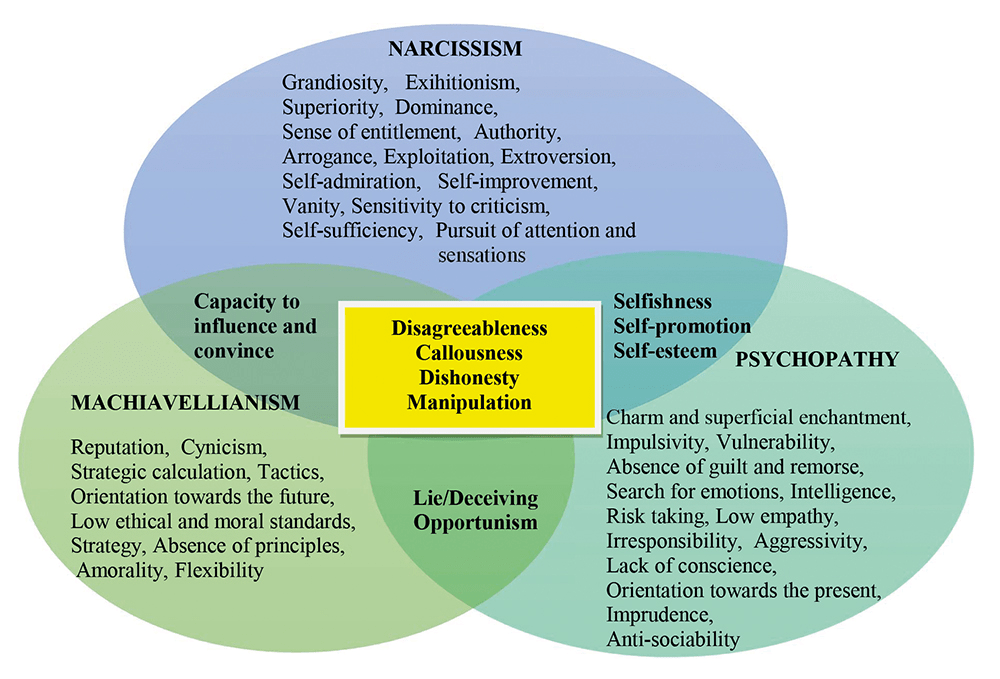
The British psychologist, Steve Taylor prefers the concept of “a “dark triad” of three personality traits that belong together: psychopathy, narcissism and Machiavellianism. This makes sense because these traits almost always overlap and are difficult to distinguish from one another. The traits exist on a continuum and are more pronounced in some people than others.”
Unfortunately, there are more ways in which something can “go wrong” than “go right”. For something to “go right” it must be ordered or structured in some way. For it to “go wrong” that order must have failed, and there are many ways in which it can do so. Thus, mental ill-health, for example, takes many forms. The same is true of the dark factor. Individuals with the above traits will have them in varying proportions. Nevertheless, we endeavour to categorise dark behaviours by their similarities. An emphasis on one will cause us to place an individual in that category. However, the correlation between these traits suggests that there is something more fundamental that unites them.
The three personality types have common features as well as their own distinct ones, as described in the Venn-Euler diagram below.
Source: D’Souza, M. F. (2016). Manobras financeiras e o dark triad: o despertar do lado sombrio na gestão (Doctoral Dissertation). São Paulo: Universidade de São Paulo. (Financial manoeuvres and the dark triad: the awakening of the dark side in management)
A notable feature of the three personality types is that some of their characteristics can be desirable in leaders, for example, the vision and charisma of narcissistists, the strategy and tactics of Machiavellians, and the creativity and good strategic thinking of psychopaths. Furthermore, there is evidence that people with dark personality traits are attracted to leadership positions (Furnham 2010). The psychologist Oliver James has identified the prevalence of these personality traits in the workplace (James 2013), and they have been found to be fairly well represented in senior management and chief executive officers (Alernic et al, 2010). Finally, the dark triad traits have been found to be associated with knowledge sabotage, i.e., the deliberate hiding of information or provision of misinformation (Serenko & Choo 2020).
There is disagreement among specialists as to whether dark behaviours are evolutionary traits or psychological disorders. However, significant research evidence suggests that they may be approximately 50% inherited in the form of a predisposition and 50% acquired. There are, for example, genes known to be linked with some of the psychopathic traits. However, psychopathy is also known to be associated with factors such as drug taking and upbringing. Irrespective of the cause, the children of people with the disorder do have a higher risk of suffering it themselves.
The evolutionary explanation for dark factors is unclear. Most evolutionary psychologists speculate that with 90% of the population interacting co-operatively, there has been scope for the evolution of free-riders, i.e., predatory individuals who will take advantage of the normal functioning of human society to meet their needs with minimum effort. However, this explanation seems unsatisfactory as it would require human beings first to evolve social traits and then a small proportion of them to revert to non-social ones.
I would therefore offer the following alternative hypothesis, which has the benefit of greater simplicity. Social behaviour in animals, including humans, has evolved. A focus on personal survival must necessarily have evolved first. Only then could survival be enhanced by social behaviour. The genes involved in social behaviour will have emerged via random mutation and then propagated through the population via natural selection. So, it seems likely, therefore, that these dark traits are a genetic hang-over from ancestor species, rather than mutations in an essentially social species. This hang-over may be because there has been a role in society for such traits that has enabled them to persist.
There are three possible reasons for this persistence, all of which may apply to some degree. Firstly, because, as mentioned above, it may have conferred an advantage on a small number of individuals in what was otherwise a social population. Two contradictory selective processes may have been in play: individual selection for non-social people and group selection for social ones, resulting in a mixed population. Secondly, dark traits may have had a role to play in group selection. Due to their lack of conscience, dark personalities can rise more easily in the social hierarchy to become leaders. Once in that position, they can enforce group cohesion by coercion. In the early stages of human society, when groups were in competition with one another, a dark leader may have improved the chances of group survival, and thus their own, through greater aggression towards other groups. It is surely no coincidence that the world is plagued by despots who gain power by appealing to tribalism and nationalism. Finally, dark personalities also tend to move from partner to partner and have a greater number of offspring whom they then abandon.
It is important to note that evolution cannot predict the future. Life evolves in response to the pressures of the present. Thus, whilst dark traits may have helped humanity to become the dominant species in the past, this is not necessarily the case for the future. Today our species is faced with several existential threats that can only be overcome through a very high level of co-operation, and this is undermined by dark behaviour.
Leaders with dark personality traits can gain power for the following reasons:
their behaviour is less constrained by concern for others;
they can be charismatic, their dark side only emerging when they are under pressure;
they can enjoy and be good at impression management;
some people are willing to follow them due to errors of judgement, self-interest, or fear; and
their environment may lack the controls to prevent such behaviour.
There is also evidence that dark personalities can be attracted to and flourish in particular types of organisation.
Once in a leadership position, they can “derail” the organisation. Organisations are usually co-operative ventures, i.e., people working together with a common aim. However, leaders with dark traits can steer the organisation in a direction more suited to their personal interest. Note that failure due to derailment and failure due to incompetence are two very different things.
Dark personalities also tend to generate a culture of negative competition. I liken this to a running race in which the competitors attempt to kick the feet out from under one another rather than trying to be first over the finish line. Obviously, this can end up in a brawl on the racetrack to the advantage of neither. In smaller relatively independent societies that competed with one another this may have been beneficial to one party, but in a larger global society it generally harms both competitors. We may once have needed dark personalities, but today they present serious risks, for example, nuclear war because of events in Ukraine, an inability to tackle climate change, and so on.
Ultimately, however, these factors lead to the ostracism or demise of an organisation with a dark leadership and associated culture.
Although much of the research on these personality types has been associated with business organisations, the same is true of organisations of all types including nations.
References
Alernic, J.H. & Craig, R.J. (2010) “Accounting as a Facilitator of Extreme Narcissism”. Journal of Business Ethics 96 (1): 79-93. doi:10.1007/s10551-010-0450-0.
Furnham, A., Richards, S.C., Paulhus, D.L. (2013). “The Dark Triad of Personality: A 10 Year Review: Dark Triad of Personality”. Social and Personality Psychology Compass 7 (3): 199-216. doi:10.1111/spc3.12018.
James, O. (2014) “Office Politics: How to Thrive in a World of Lying, Backstabbing and Dirty Tricks”. London, Vermillion. ISBN 978-1-4090-0557-5.
Serenko, A. & Choo, C.W. (2020). “Knowledge sabotage as an extreme form of counterproductive knowledge behaviour: The role of narcissism, Machiavellianism, psychopathy, and competitiveness.” Journal of Knowledge Management. 24 (9) 2299-2325. doi:10.1108/JKM-06-2020-0416.
In this short series of articles, I will summarise the basic principles of Social Systems Theory. Full details are given in previous or subsequent articles.
The fundamental component of society or holon
The term holon was coined by Arthur Koestler in his 1967 book, The Ghost in The Machine. It refers to any entity that can be recognised as a whole in itself and which constitutes part of a larger whole. In social systems theory the fundamental component or holon of society is the organisation, that is, any group of people who work together with a common purpose. Organisations can be of any type and can range in size and extent from an individual, through clubs, businesses, sectors, political parties, governments, nations, and groups of nations, to the global community.
Family relationships between organisations
All organisations form a nested hierarchy. The structural relationships between them are similar to those in a family and the same names can be used. Thus, for example, child organisations are components of a parent one, and parent organisations are components of a grandparent one. Two organisations that are components of the same parent are known as sibling organisations. This nested hierarchy continues upwards until an isolated organisation or the global community is reached.
Every organisation comprises a number of component or child organisations, and this nested hierarchy continues downwards until individual people are reached.
Recursion
Recursion means that similar rules and principles can explain the behaviour of organisations irrespective of their size. Thus, for example, a department in a government agency has a leader, and so too does the entire agency.
The control component
All organisations have a control component, e.g., leadership or management, to co-ordinate their activities. Due to recursion, control components have their own control components until we arrive at the individual person. This creates a leadership or management hierarchy comprising individuals. It is natural to select leaders using a bottom-up process, i.e., followers choose a leader thought to be best qualified to co-ordinate their activities. However, managers are also frequently chosen by a top-down process whereby senior managers select junior ones thought to be best suited to the role.
Needs, satisfiers, and contra-satisfiers
All organisations have needs similar to those of individuals. These needs are prioritised using the same categories for individuals identified by Abraham Maslow and Clayton Alderfer, i.e., ERG or existence, followed by relatedness, in particular family relatedness, followed by growth. These priorities are consistent with the multilevel selection theory of evolution. This holds that we place greatest weight on personal survival and reproduction, followed by that of the community upon which we depend, followed by people more remote.
Satisfiers are those external things that increase the level of satisfaction of our needs, for example, food for hunger, or resources for manufacturing. Both individuals and larger organisations endeavour to gain satisfiers as efficiently as possible. Contra-satisfiers, on the other hand, are those external things that reduce the level of satisfaction of our needs and which we endeavour to avoid.
The applicability of systems science, function, and causality to organisations
All organisations are systems and comprise inputs, processes, and outputs. The fundamental principles of systems science apply to them, therefore.
Causality also applies to organisations. The combination of an input and the process is equivalent to a cause. The combination of the process and an output is equivalent to an effect. An organisation’s processes and outputs are also referred to as its function. Because causality applies to organisations we can, for example, say that a number of necessary causes or inputs are together sufficient for an effect in which the organisation carries out its function of producing outputs.
Matter, energy, or information is transferred from every organisation’s inputs to its outputs. This takes place within the region of space-time defined by the organisation’s process. Thus, the latter provides the overlap in space-time needed for a cause to be related to an effect.
All organisations comprise a group of people who work together with a common purpose. This purpose is also the organisation’s function, and the ability to carry out its function is an organisational need.
The applicability of motivation theory to organisations
All interactions between individuals, organisations, and parts of them comprise an exchange of satisfiers or contra-satisfiers for each other’s needs. These satisfiers and contra-satisfiers also take the form of matter, energy, or information. A satisfier or contra-satisfier received is an input, and one provided is an output. Thus, motivation theory also plays a key role in social systems theory.
The applicability of information theory to organisations
Information passes between organisations and flows within any organisation’s processes. Thus, information theory plays an essential role in social systems theory. Fundamentally, information is organised or structured matter or energy that we recognise due to its recurrence. It can exist “at source”, i.e., as the original structure perceived in the physical universe. It can also be translated into various symbolic forms capable of being transmitted, stored, or remembered. Importantly, information at source is, by definition, always true. However, information acquired in other ways, for example, from another organisation, can be false.
Direct interaction can only take place if two organisations are aware of one another, and for this to be the case, information must pass between them. However, organisations can be aware of one another but not interact. These criteria simplify the web of interactions in a social system.
Culture & interaction style
The ways in which individuals and organisations interact are determined by their culture and interaction style. These topics will be covered in a forthcoming article.
Competence to lead an organisation requires certain skills. There are hundreds of lists of such skills on the internet, usually prepared by management consultants. We could even pick and choose between them to find the closest fit to ourselves. If I were to compile a complete list of the recommended skills, then their number would probably be in the thousands. No individual could possibly have them all. Fortunately, they can be condensed down into just five basic skills:
experience, i.e., an understanding of the organisation, its function, and its environment;
sound judgement and problem-solving ability;
an ability to inspire subordinates to enthusiastically co-operate in pursuing the organisation’s goals;
an ability to communicate those goals and ways of achieving them; and
an ability to acquire and understand information from sub-ordinates.
There are, of course, many ways in which those skills manifest themselves in a leader. For example, the ability to inspire followers can be through confidence, humour, likeability, setting an example, and so on. However, if any one of the basic skills is absent, then mistakes are inevitable, and some may cause the organisation to fail. So, I will discuss each skill in turn, giving reasons for why they may be absent. The topic is enormous and there are many such reasons. So, I will concentrate on just a few of the most significant ones and how they can be addressed.
Experience
The main reason why leaders lack experience is poor recruitment practice. For example, the founders of charities sometimes recruit board members who are friends or family members. The latter often have no experience of the goals of the organisation or basic operating practice. Another reason is the personal contract, i.e., trading status for support. Those who support a leader can be promoted to a managerial position despite a lack of experience. Filling a leadership role can also be a simple matter of expediency, i.e., “there is no-one suitable, but we must have someone in post”. Finally, experience can be absent in those whose skills are principally the acquisition of power.
Obviously, a lack of experience betrays itself through the questions a leader asks, and the mistakes that he or she makes. However, there is, a hierarchy of knowledge in an organisation. The higher we are in a leadership hierarchy, the broader but less detailed our knowledge must be, and the more reliant we are on subordinates for any necessary detail. We cannot expect our immediate leader to know the same detail as ourselves. However, to manage effectively, he or she must grasp the basic principles of our roles.
The solution to the problem of lack of experience clearly lies in the processes of recruitment, training, and promotion. We should carefully check that candidates have the necessary experience for a role and are being truthful about it. We should also avoid the need for expedient promotions by training people for greater responsibility.
Unfortunately, senior leaders control these processes. Leaders who lean towards the personal contract will be less supportive of them than those who lean towards the social one. Ultimately, the leader at the top of the hierarchy determines the quality of leadership below him, and so, a vicious circle can form. Self-interested leadership begets self-interested leadership until the organisation ultimately fails.
Judgement and Problem Solving
A leader’s judgement and problem-solving skills can be poor or even absent. The main reasons for this are: inexperience, poor communication, decision overload, personality traits, or mental incapacity. This problem manifests itself when upper management are not making educated decisions or are making very bad decisions despite the resources available to them.
Inexperience was discussed in the previous section. Communication will be discussed in the next.
Decision overload can be avoided by delegating less critical decisions to subordinates. However, if a leader tends toward the personal contract rather than the social one, then the leader’s trust and the abilities of the subordinates may not allow this. Thus, the leader who tends toward the personal contract risks either decision overload or poor-quality decisions by subordinates.
Personality traits include indecisiveness. They can also be due to mental incapacity, extreme age, low IQ, brain tumours, etc. These problems can all be tested for. However, senior leaders again control the process. Those who tend towards the personal contract are more likely to reject testing. So, a vicious circle prevents its introduction.
Inspiring Subordinates
The absence of an inability to inspire followers can be due to lack of experience and poor communication, as discussed in the relevant sections. There is no doubt that personality traits that inspire trust and confidence are also an important factor. But charm alone will not inspire subordinates. Experience and good decision making are also necessary.
Another factor is a lack of focus on the goals of the organisation, and the concentration of leaders on day-to-day operational activities. If this occurs, subordinates will fail to understand the goals of the organisation and will be unable to contribute to them. Furthermore, if managed in too much detail, they are less likely to take responsibility for operational activities or suggest improvements.
Finally, we are all motivated to satisfy our needs. Nothing inspires subordinates more to achieve an organisation’s goals than the promise of personal benefits. However, what has been promised must be delivered if subordinates are not to lose trust in the leader.
Communication
This section discusses the personal communication skills of leaders and the effect that this can have on an organisation. General communication within an organisation will be discussed in a future article. Good leadership communication increases morale, productivity and commitment. Poor communication has the reverse effect and, in the extreme, can lead to failure of the organisation.
The main constraint on communication is almost certainly a lack of time. This results in leadership invisibility. The solution is not to work longer hours as this impacts on the quality of decisions. Rather, it is to make time by delegating decisions and work. Leadership is a profession. It is OK to walk around and chat, providing this is mainly focussed on the organisation’s objectives.
Poor leader communication skills can also be due to a lack of transparency. That is, secrecy or a “need to know” attitude. This can result in subordinates believing that the leader has something to hide, uncertainty about the aims of the organisation, and poor decision making at lower levels in the hierarchy. So, unless there are very good reasons to the contrary, transparency will generally benefit the organisation.
A lack of mastery of language and presentation skills can lead to miscommunication, and thus, to poor decisions at subordinate level. However, this can easily be tested for during the appointment process and, if necessary, training provided.
Personality traits, such as a lack of confidence, extreme introversion or extroversion, can also hamper communication. Introverts can suffer information overload when in large groups and find it difficult to express themselves. They are more able to express themselves on a one-to-one basis where there is greater two-way communication. Extroverts, on the other hand find it difficult to take in information. They too can benefit from one-to-one communication. These difficulties can, however, be overcome through training and experience.
A lack of empathy can hinder communication. That is, the leader may not understand or may misinterpret a subordinate’s motives for saying what he does. The leader can also fail to understand the information that an effective subordinate requires. However, empathy can be developed. For example, people who spend more time with those different to themselves develop greater empathy. Reading novels also helps to foster empathy by putting us in the minds of others.
Conclusions
The conclusions are inescapable. Human capital must be developed if an organisation is to be successful. Organisations can fail for a multitude of reasons, but it is leaders who create the necessary conditions. The power of leaders must therefore be constrained by democratic control and the safeguards suggested above put in place. Many of these safeguards do, of course, seem idealistic. Vicious circles prevent their implementation. So, they can only be introduced progressively as opportunities arise. Are we sufficiently culturally advanced to begin doing so? Each country must make its own decision. However, those that do make a beginning are likely to be the most successful and experience least organisational failure.
It is human nature to balance self-interest with community interest. So, all leaders will, to some extent, act in their own self-interest. However, if the balance swings too far in that direction, then the leader will usurp the function of the organisation to the detriment of other stakeholders, such as employees or customers, and it will fail.
The exact balance struck between self-interest and collective interest depends on the personality of the leader. Aspects of personality that can cause leaders to lean towards self-interest include dominance, the habitual pursuit of power and a weak conscience or super-ego.
In their 2016 paper, Dominance and Prestige: Dual Strategies for Navigating Social Hierarchies, Maner and Case state the following. “The motivations that drive people to attain social rank thus play a profound role in guiding their leadership behavior and the extent to which they prioritize the goals of the group over their own social rank.” They also state that “Several studies suggest that leaders high in dominance motivation—those who seek to attain social rank through the use of coercion and intimidation—selfishly prioritize their social rank over the well-being of the group.…Leaders high in prestige motivation, on the other hand, are motivated primarily by the desire for respect and admiration.” https://www.sciencedirect.com/science/article/pii/S0065260116300144
Some leaders can fully internalise the pursuit and defence of power. It becomes a habitual and unconscious form of behaviour that persists as a need in its own right.
It is easier to climb an existing hierarchy than to create a new one with oneself at the pinnacle. This is not a universal rule, of course, and there are, for example, self-interested leaders who have built empires from a silver spoon passed on by their parents. Nevertheless, once established, an organisation can attract individuals who seek power to satisfy their own personal objectives, for example wealth, fame, or influence.
In the competition to ascend a hierarchy, individuals who are relatively unconstrained by ethical considerations, or are willing to use negative competition, or who have learnt the “rules of the game” have an advantage over others. Thus, they often take control of and corrupt organisations that may have been set up with the best of intentions. There are three personality types that are a particular risk: the psychopath, the narcissist, and the dark empath. They will be discussed in more detail in future articles.
The concentration of power, i.e., the ability to direct resources for the satisfaction of a particular need, in the hands of a few seems to be the greatest source of misery, poverty, and injustice in the world. To cite just one example, the German philosopher, Immanuel Kant, argued that democracies are less likely to go to war than absolutist states, i.e., states where power is concentrated in the hands of the ruler. In a truly democratic state, leaders require the support of the population if they are to engage in war. The population will, of course, weigh up the advantages and disadvantages to themselves before giving their support. Consider, for example, the popular opposition in the USA to the Vietnam war and, in the UK, to the invasion of Iraq. In an absolutist state, on the other hand, only the advantages and disadvantages for the ruler are taken into consideration and the suffering of the population has little or no bearing on the decision. An example is Russia’s invasion of Ukraine. Essentially, the decision is a risk/benefit/cost calculation, and rulers frequently have far more to gain than their population. This is, of course, just one example on an international scale, but similar issues exist in all walks of life and at all scales. So, if we wish to tackle poverty, strife, and injustice in the world, then we must tackle its root cause, the concentration of unregulated power in the hands of a few.
Control systems are a property that emerges with life. They do not appear in non-living things, except those created by mankind. Control systems co-ordinate the activities of the various specialised parts of an organism, or group of organisms, towards a common goal. However, because all systems comprise sub-systems, and those sub-systems, in turn, have control systems, there is a control hierarchy.
Due to the VUCA nature of the world, control systems must delegate if they are to be effective. If they do so, this enables the organism or group to deal with complexity. The information on which decisions are made is progressively simplified as it ascends the control hierarchy. Conversely, as instructions descend, the components of the organism or group increasingly interpret it.
If all decisions are centralised, then the larger the system, the less and more simplified the information on which a decision is based, and the greater the risk of error. Furthermore, as explained in a previous article, if decisions are made by trial and error, then only a single decision occurs rather than several. So, there is less likelihood of decisions being successful and of the system learning from its successes and failures.
In the case of human organisations, the control systems are management or government hierarchies. If there is no control system, then there is no organisation. So, the collapse of businesses, civilisations and nations is often due to the collapse of their managing or governing system. For example, an effective centralised state is necessary for a successful economy. It provides order, laws, mechanisms for resolving disputes, and basic public goods and services. Failed states, such as South Sudan and Somalia, have no central organisation or one which has no influence outside of the nation’s capital.
The Social Contract vs. The Personal Contract
The concept of the social contract is an ancient one. It was first described in the Greek philosopher Plato’s “Republic” in about 375 BC. The social contract is an explanation of the relationship between leaders and the led. In 1762, the French philosopher, Jean-Jaques Rousseau interpreted this relationship as one in which individuals are willing to give up some of their rights in the collective interest. They will, therefore, follow the instructions of a leader who acts in that collective interest.
On the other hand, as explained in previous articles, leaders can rise to power by delegating benefits, such as power, wealth or status, to followers who support them. Leaders then use that support to gain benefits for themselves. This is a form of personal contract and is often how a leadership hierarchy develops.
In practical human affairs, there is an interplay between the social contract and the personal one. The actual motives of both leaders and followers lie somewhere on a scale between the two. The position on the scale varies from individual to individual. An organisation is also subject to this interplay. Individuals and other organisations will interact with it if this benefits them. However, they also expect the organisation to act in the collective interest. Again, the actual motive for interaction lies somewhere on a scale between the two.
Both leader-follower interactions and inter-organisational ones are a manifestation of our eusocial nature. This, in turn, is a consequence of evolution. We have evolved to optimise the satisfaction of our needs by balancing the immediate self-interest of the personal contract with the longer-term self-interest of the social contract. A more central and less extreme position is normally the optimum.
The balance point that defines actual behaviour is a consequence, in the case of individuals, of their personality, and in the case of organisations, of their culture. However, to a very large extent, the culture of an organisation is determined by its leaders, and so, individual personality is again the principal factor.
There is a relationship between the World Values Survey’s survival values and a tendency towards the social contract. For example, those with survival values are described as: tending “to seek strong authoritarian leadership to bind the community together into its survival endeavour”; as having a “tendency towards obedience of leaders”; and as having “a tendency towards conformity to group norms”. Thus, societies of this nature influence their members to favour the social contract. However, there does not appear to be a relationship between the World Values Survey’s self-expression values and either the personal or the social contract. Thus, societies of this nature do not influence their members one way or the other.
Trust is an important factor in deciding which leaders we will follow. We assess whether the leader will deliver on the social contract or personal contract. Trust or distrust is based on experience but can be passed from one individual, group, or generation to the next.
If a leader cannot be trusted to deliver on the social contract, and there is no personal benefit for the follower, then the follower will not support that leader. If there are no leaders who can be trusted to deliver on the social contract, then the best option for a follower is to support one who can be trusted to deliver on the personal contract.
Unfortunately, leaders will often feign a focus on the social contract. This is particularly the case in democracies and pseudo-democracies where popular support is needed. Much effort is put into public relations. A follower can, therefore, find himself following a leader who provides no personal or social benefits. Press scrutiny has an important role to play in challenging such leaders. However, the press can also enter into personal contracts with the leader or be coerced into silence.
The social contract becomes more important as society grows ever more complex, and we become ever more dependent on one another. However, the personal contract is far easier to monitor and many of us have a natural leaning in that direction. In extreme cases it entirely trumps the social contract.
So, to improve leadership and avoid the failure of human organisations, it is necessary for:
a) potential followers to focus on the social contract in deciding which leaders to support and what organisations to interact with; and
b) potential leaders to focus on improving followers’ trust that they will deliver against the social contract.
The fundamental entity in social systems theory is the organisation. That is, any group of people who work together for a common purpose. An organisation may be an individual, a club or society, a business, a charity, a sector, a nation, or the global community. An organisation can also exist temporarily to carry out a short-term project or it can have a longer-term function. This series of articles discusses the ways in which organisations can fail and ways of avoiding this.
The articles also approach the topic from a systems perspective. Every organisation is also a system. It comprises inputs, processes, and outputs. Everything that is not part of the system is its environment. However, for organisations this terminology translates into that of social science. Processes are the needs of the organisation. Inputs are the satisfiers and contra-satisfiers of those needs. Outputs produced by its processes are the purpose of the organisation. That is, the provision of satisfiers and contra-satisfiers for others.
Figure 1. Systems and organisations compared.
Organisations do, however, have two additional features not held by systems in general.
Firstly, outputs are traded for inputs. That is, satisfiers or contra-satisfiers for others are traded for those required by the organisation. This is what binds us together into society. The word “trade” is used in a very general sense and applies not only to businesses but all organisations. Trade is a fundamental aspect of human nature. Its basis is the search to satisfy human and organisational needs. The term is derived from economics, a branch of social science that focusses on the trade of goods, services, and money. However, many regard economics as a specialised branch of psychology. It does, therefore, provide terminology that can be usefully employed in a more general sense. For example, we trade satisfiers for other “non-economic” needs such as relationships and personal growth. We do so in a way that is no less rational than the trading of goods, services, and money.
Secondly, an essential component of an organisation is its control component, i.e., leadership or management, without which the activities of other components cannot be co-ordinated, and without which an organisation does not exist.
Many factors are necessary but only together are they sufficient for an organisation to function satisfactorily. The organisation must receive its necessary inputs, i.e., the necessary satisfiers for its needs must be present, and any contra-satisfiers absent. The control component must carry out its function satisfactorily. There must also be satisfactory communication between it and the other components. The organisation must operate and maintain its processes satisfactorily. It must deliver its outputs of satisfiers or contra-satisfiers for others. Finally, it must adapt to any changes in its environment which impact on these factors.
This means that there are many more ways for an organisation to fail than succeed. In systems theory the causes of systems failures are known as system pathologies. In social systems theory they are, therefore, referred to as social systems pathologies or organisational pathologies. These pathologies can be categorised according to the aspect of the system in which they occur. They are summarised below.
The System’s Environment
The VUCA World (Volatile, Uncertain, Complex, and Ambiguous)
The Control System
Self-interest vs. Collective Interest
Leadership Competence
The Corrupting Effect of Power
Contra-Social Leadership Behaviour
Psychopathic Leaders
Narcissistic Leaders
Dark Empathic Leaders
Governance, Culture & Ethical Standards
Instability and Self-maintenance
Adaptation to Environmental Change
Vertical Communication
Knowledge of Processes
Feedback and Monitoring
Misinformation
Delayed or Absent Response
Inputs & Outputs
Mismanagement of Resources
Function & the Identification of Needs
Equitable Trade
Relationships
Protectionism and Blocking
Processes
Poor Process Design
Process Inflexibility
Unregulated Feedback
Multiple Causes
Extractive Institutions
The articles that follow will discuss each of these pathologies in turn. They can occur in any organisation irrespective of its size and function. However, the name used to describe the same pathology varies between types of organisation. The articles will, therefore, describe the effect of each pathology on a range of organisations of different types, from a small club to a nation.
Three main factors affect whether an organisation interacts co-operatively with another, or engages in positive or negative competition. The same principles apply to individuals except that they are their own leader. These are:
Leadership. Organisations reflect their leadership. Their behaviour differs according to whether the leader acts in his or her personal interest or in that of the organisation. Usually, there is a balance between the two.
Resources. If a necessary input or resource is plentiful, then there will normally be co-operation or positive competition for it. On the other hand, if it is, or is becoming, insufficient to satisfy all parties, then negative competition will result. The planning, establishment, existence, or growth of an organisation can act as negative motivator to another that, either directly or indirectly, needs the same resource. If a threatened organisation already exists, it will engage in negative competition. If it does not, then one may be established with the same result. When two organisations are in negative competition, then the belief system and culture of each is progressively strengthened and becomes more selfish. Positive feedback then occurs, in which stronger identity and self-interest leads to greater perceived threat, which in turn leads to stronger identity and self-interest. Ultimately, conflict can result. Usually, both parties lose, but negative competition can also lead to some maintaining or even improving their situation, whilst making the situation worse for others.
Distance. The effect that one organisation can have on another depends on distance, i.e., how many causally connected organisations form a chain. Clearly, if there is a chain of such connections between organisations, then it is also possible for there to be positive, negative, or regulating feedback. The example of negatively competing organisations given above embodies positive feedback. With just one organisation in a causal chain, feedback must, by definition, exist, i.e., the organisation’s outputs become its inputs. This is the basis of self-maintenance and growth. For example, a business normally reinvests some of its income. If there are two organisations in a chain, then the outputs from one form inputs for the other. As explained above, the former’s outputs may be necessary for the latter, or there may be other organisations providing the same inputs, i.e., redundancy, and this makes the recipient more resilient. A particular input may also be necessary, but not sufficient, and others are usually required for an organisation to carry out its function. Thus, the relationships on the input side of an organisation are more like a tree, with several organisations providing inputs for one, several also providing inputs to each of those, and so on. Nevertheless, a chain exists between any two organisations in this tree. For example, a farmer provides flour to a wholesaler, who refines it and supplies it to a baker, who in turn supplies bread to a supermarket. In general, the longer the chain, the more likely it is that redundancies will occur, and the less influence a supplier at one end will have over a consumer at the other. Nevertheless, there may still exist critical suppliers or consumers whose failure will either directly impact on an organisation or indirectly via the demise of others in the chain. For example, a critical supplier may source resources unethically, or a critical consumer may cause pollution, thereby generating opposition and their ultimate demise. So, longer term organisational survival depends on the identification of any such critical external organisations, and the introduction of changes or redundancies.
Intra-organisational Interactions
Social intra-organisational interactions are not possible for individuals. For an individual, internal interactions are biological. Thus, social interactions apply only to organisations comprising two people or more.
The same three factors, i.e., leadership, resources, and distance, affect intra-organisational interactions. Their impact is, however, via the attributes necessary for an organisation to carry out its purpose or function successfully. These are:
The purpose or function of the organisation:
relates to an external demand or need;
is agreed by members of the organisation, i.e., individuals and component organisations;
is clearly defined and communicated;
has the commitment of members of the organisation; and
is consistent with the culture of the organisation.
Organisational structure:
is effectively divided into component functions;
includes effective operational systems;
includes effective interaction between component functions, including the transmission of information; and
includes an acceptable balance of effort vs. reward for individuals and sub-organisations.
Leadership:
has the appropriate skills;
is effectively structured; and
comprises effective management, monitoring, and control.
Resources.
There is adequate availability of the necessary resources.
If all these attributes exist, then attitudes will be ones of of co-operation or positive competition. However, negative competition can arise if just one is deficient. There are causal relationships between these attributes, and a deficiency in one can lead to negative competition, which, in turn, can lead to a deficiency in another. For example, if the purpose of the organisation is not clearly defined and communicated, then competing opinions can arise. If these are expressed in the form of positive competition, then ultimately there will be agreement on the better option. However, if competition becomes negative, then members of the organisation will commit to one or the other, interactions between parts of the organisation will be less effective, and so on. There are many possibilities, and the range is too great to list here.
Extra-organisational Interactions
Positive extra-organisational competition is the natural order, i.e., both the natural world and humanity are evolving, in different ways, thereby improving our likelihood of survival. The outcome is unknown but, as mentioned in a previous article, the direction of travel seems to be one of subsuming the natural environment into the human economy.
For the present at least, the non-human environment generally lacks agency, and any agency that it does have cannot successfully compete with that of humanity. The natural world cannot engage in negative competition, therefore. Any apparent pushback, e.g., viral pandemics, is simply a matter of evolutionary adaptation to the existence of humanity.
We rely on the environment for our continued existence, and any environmental damage, depletion of resources, or other form of misuse ultimately has an adverse effect on us. If extra-organisational interactions comprise negative competition, i.e., if we prevent our environment from carrying out its function, then people will see this as a threat and engage in negative competition on the environment’s behalf.
On the other hand, if extra-organisational interactions are co-operative, then this leads to stable and sustainable relationships with the environment, in which both are able to pursue their destiny without the one impeding the other. The environment is unable to actively co-operate with humanity and help us in this. However, the reverse is not true and is the path that I would advocate.

 Rational-Understanding.com