Categories
13. Pattern and Process: Two Modes of Causal Reasoning in Human and Artificial Cognition

Pattern and Process: Two Modes of Causal Reasoning in Human and Artificial Cognition

Introduction

This article explores two fundamental modes of causal reasoning: TPT (Transfer-Process-Transfer) and PTP (Process-Transfer-Process) structures. These structures help clarify how humans and artificial intelligences like large language models reason about cause and effect, why both are susceptible to error, and why combining them is essential for a robust understanding.

A pdf verion of the article can be downloaded free of charge from: https://rational-understanding.com/my-books#TPTandPTP

The two forms of reasoning derive from the following:

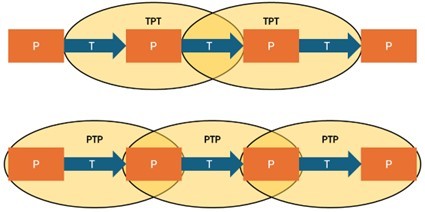
  • Causal transfers take time and travelling through any causal network in the direction of the arrow of time will yield a chain of alternating processes and transfers, i.e.:       … P – T – P – T – P …
  • Causes are effects, and effects are causes.
  • Every system or event in a causal chain shares a component with its predecessor and successor.

The PTP structure equates to an event in which something does something to something else. The TPT structure equates to a system with its inputs, processes and outputs. 

TPT Reasoning: Pattern Recognition and Unconscious Inference

TPT causality refers to a structure in which two processes are linked by an inferred or unknown transfer, i.e. each cause and effect has the structure TPT and the two are linked by a common T. In human cognition, this reflects pattern recognition: we notice that two processes frequently co-occur, and infer a causal link, even if we cannot identify what mediates the connection.

This form of reasoning is fast, intuitive, and largely unconscious. It allows us to make rapid inferences from experience, often without awareness of the intermediate mechanisms. However, it is error-prone. TPT reasoning is vulnerable to spurious associations and errors caused by unseen common causes. In these cases, the inferred causal link is false, despite the pattern appearing consistent.

Large language models also rely heavily on TPT-type reasoning. They identify recurring associations in their training data and reproduce those patterns in response. This allows them to answer questions, complete prompts, and simulate explanations even when they do not possess internal models of the causal transfers involved.

PTP Reasoning: Explicit Inference and Conscious Verification

In PTP causality, by contrast, causes and effects consist of a process, a known transfer, and another process. Each cause or effect has a PTP structure and the two are linked by a common P. This represents structured reasoning in which a clearly identified mechanism links cause and effect. In human cognition, this kind of reasoning is associated with conscious, reflective thinking. It is slow, deliberate, and effortful, but less prone to error.

Verification through PTP reasoning is essential when pattern-based inferences (TPT) are in doubt. It allows us to examine whether a supposed cause-effect relationship is supported by identifiable transfers. In systems theory terms, it confirms that the output of one process is indeed the input to another.

Error and Verification in Human and AI Cognition

Both humans and artificial intelligences are vulnerable to error when relying solely on TPT reasoning. A classic example is the post hoc fallacy: assuming that because B follows A, A caused B. Without identifying the actual transfer, such reasoning remains speculative.

AI systems, too, may generate plausible but incorrect answers when their training data contains coincidental patterns. They may infer connections that resemble PTP structures but are not grounded in causality.

This is why PTP reasoning is vital for verification. It distinguishes genuine causal chains from coincidental associations by demanding an explicit causal transfer.

A Unified Framework of Reasoning

A key insight from systems theory is that these two modes of reasoning are not exclusive. In fact, they are complementary. TPT reasoning allows for quick hypothesis generation and intuitive understanding. PTP reasoning provides a structure for verification, deeper analysis, and error correction.

Understanding and integrating both types of causal reasoning is central to building a theory of cognition, both biological and artificial. It also has direct implications for epistemology, systems modelling, and the future of AI development.

Conclusion

TPT and PTP causality offer a powerful lens for interpreting human and artificial thought. TPT supports rapid pattern recognition; PTP ensures that those patterns are grounded in real causal mechanisms. Awareness of this dual structure is essential for improving reasoning, communication, and the development of intelligent systems.

Future work may involve identifying when to trust each mode, and how to better integrate them in education, epistemology, and machine reasoning architectures.

Categories
10. Systems Causality Assembly Theory and the Discrete Accumulation of Negentropy

The Scientific Foundations of a Creative, Meaningful Universe

This paper entitled “Systems Causality, Assembly Theory and the Discrete Accumulation of Negentropy” explains why, despite the prevalence of entropy, decay and disorganisation, the universe is essentially creative. It also gives meaning and purpose to human existence from a scientific perspective, and so, challenges existential nihilism. It is deliberately written in plain English, and I have explained and defined any unavoidable technical terms. You can download a pdf free of charge via the following links:

and an abstract is given below.

The paper was written to help the International Society for the Systems Sciences in their search for a General System Theory. So, it draws together many systems related concepts , i.e., basic systems theory, causality, information, entropy, negentropy, emergence, Big History, why multiple scientific disciplines employing different laws are necessary and, and so on.

I see these concepts as applying to us in our day-to-day lives and this work will therefore help me a in developing social systems theory. So, that is what I plan to return to now.

Abstract

The Second Law of Thermodynamics states that entropy, or disorder, increases in closed systems. However, the observable universe has, over time, produced increasingly complex structured entities, from atoms and molecules to living organisms and civilisations. This paper explores the mechanisms behind this phenomenon, known as the accumulation of negentropy. That is, the growth of order despite the natural tendency toward disorder.

It is proposed that the accumulation of negentropy is not a separate force but rather a consequence of causal interactions whose structured complexity has increased over time. These interactions follow the principles of Systems Causality, where cause-and-effect relationships are shaped by the transfer of matter, energy, and information. Assembly Theory provides an explanation for the step-by-step emergence of ever more complex structured entities, including causal relationships, within the constraints of prior structures.  It also explains the emergence of new laws and scientific disciplines as complexity increases.

Using this framework, the paper analyses how causality has driven the emergence of increasingly complex structured entities throughout Big History, from quantum fluctuations and chemical selection to biological evolution and human civilisation. It also examines the implications for humanity today.

Categories
09. Unifying Universal Disciplines towards a General System Theory

Unifying Universal Disciplines towards a General System Theory

This paper can be downloaded free of charge from:

https://rational-understanding.com/UUDH#paper & https://www.academia.edu/127960952/Unifying_Universal_Disciplines_Towards_a_General_System_Theory

Systems theory, causality, natural language, and logic have traditionally been pursued as separate disciplines. However, underlying each of these domains are fundamental structures that suggest a deeper, unified framework. The way we structure our understanding of these disciplines is not arbitrary. Rather, it is dictated by principles that govern perception and cognition. It may also be dictated by principles that govern reality.

The Unified Universal Disciplines Hypothesis (UUDH) proposed in this paper posits that Fundamental systems theory, causality, natural language, and logic are different manifestations of the same underlying structure in the way that human beings perceive reality and reason. Each of these domains encodes and processes causal interactions in ways that reflect the level of complexity and perspective employed by the observer.

This paper presents the argument and describes the methodology for unifying these disciplines into a cohesive model that enables more precise reasoning across them. Symbolic Reasoning, an enhancement of traditional set theory, provides a formal tool to facilitate this unification.

UUDH has considerable and diverse explanatory power from quantum theory to human society. The unification of systems, causality, natural language, and logic represents a promising approach to developing a more comprehensive understanding of human cognition and external reality. By integrating these traditionally separate fields, we can enhance our ability to reason about complex systems in a coherent and structured manner. Symbolic Reasoning offers a powerful tool for this integration. However, the approach is hypothetical, and empirical testing is needed to verify it.

Categories
11. The Hierarchy of Organising Principles Uncategorized

The Hierarchy of Organising Principles

I haven’t posted for a while because I have been working on this paper. It is quite long and contains many diagrams. So, I have produced it in pdf format and you can download it via the following link https://rational-understanding.com/my-books#hierarchy-of-organising-principles.

The paper presents a comprehensive hypothesis that seeks to explain the nature of reality and how humans understand it, integrating foundational concepts from critical realism, systems theory, and causality. The hypothesis holds that reality can be viewed as a fractal-like structure, generated by underlying organising principles that operate at various ranks in a hierarchy. Starting from acausal foundational principles, the paper explores how systems interact, transfer matter, energy, and information, and contribute to the complexity observed at different levels of organisation. The hypothesis extends to the idea that human understanding is structured by organising principles that differ from reality’s, leading to distinct layers of comprehension reflected in scientific disciplines. The paper suggests that integrating these principles may help bridge gaps between disciplines, such as the disconnect between social sciences and the biological sciences. This unification has the potential to deepen our understanding of both the natural world and human social behaviour, while identifying new pathways for societal change.

Categories
07. A Conceptual Farmework for General System Theor

A Conceptual Framework for General System Theory

Introduction

This article proposes a single deep conceptual framework that unifies many of the concepts of systems theory, such as systems, holons, holism, relationships, emergence, causality, isomorphisms, etc. This framework may form the basis of a general system theory. Some of its definitions may seem obvious, but I have included them for the avoidance of doubt and to paint a complete picture.

Conceptual Frameworks

There are two ways to define a word. The first is by reference to observed reality. For example, we can all agree on the definition of the word “snake” because we can observe a snake in the external physical world. However, there is less agreement over more abstract words such as “justice” and “conflict”. This is because we are unable to observe all instances of those concepts. To overcome the latter problem, we attempt to define the word, but in doing so, we must use other words.

A conceptual framework is essentially a set of definitions of more abstract words that is internally consistent and founded on axiomatic words, i.e., words that are not defined and are taken as being self-evident. A conceptual framework comprises our understanding of the words and the universe that they represent. We all hold conceptual frameworks. However, they vary greatly in their depth and nature. The deeper a framework, the more fundamental and general the words it defines. For example, the word “relationship” is deep and has broad application, whilst “unhappiness” is far less so, applying only to human beings and some animals in a particular state.

The development of any theory first requires a conceptual framework. To use an analogy from physics, the absence of a framework is equivalent to attempting to build a structure with gas. On the other hand, if we do have a framework, then we are building with a solid. Furthermore, if more than one person is developing a theory, they will need to agree a single framework if they are to communicate successfully. It is OK to consider different perspectives, but ultimately, they must be drawn together into a single consistent whole. In the case of general system theory, we are attempting to develop a very general theory indeed. So, we need to ensure that the framework is as deep as we can make it.

The absence of a common framework can be seen on the internet. Authors do have their own conceptual frameworks of course, but rarely are they explained, and their number can be overwhelming. Furthermore, there is clearly competition between them for more general acceptance. So, the motives of their proponents must also be questioned. Finally, their depth is rarely great, and so, the theories that they underpin can be quite specific rather than general. To unify these frameworks, much effort would be required in drawing them together and analysing them for a deeper one that applies to most.

Cognitive Physicalist Philosophy

My proposed deep framework is founded on Cognitive Physicalist philosophy. The physicalist aspect of this philosophy holds that everything, including objects, abstract concepts, and information, is physical in nature and occupies a region or regions of space-time. The cognitive aspect recognises that human beings have limited perception and cognition. Because the universe of space-time is probably infinite, to understand and explain it we must simplify it. So, physicalism enables us to establish a single conceptual framework, but cognition limits our understanding and perception.

Spiritualism

Many people believe that there is also a spiritual aspect to nature, and so, reject physicalism. However, the source of our spiritual beliefs is probably an unconscious sense that we use emotion in our decision-making processes. It is certainly true that we rely heavily on the unconscious mind and on emotion when making our decisions. This is something that we have inherited from simpler organisms and that evolution has built upon. In the absence of a rational scientific explanation for the process, it can take on a mystical flavour, and can seem to be an alternative to our other skill, conscious rationality. In practice, from an evolutionary perspective, emotion-based decision-making is entirely reasonable, and the emotional and rational aspects of our minds work hand-in-hand to our benefit.

The Importance of true axioms

Over 25 years ago, I became very frustrated with conventional symbolic logic. It comprises numerous disparate branches and a plethora of different symbolisms that create much confusion. So, I embarked on a project to join up the various branches using a single common symbolism. Not only was I successful in unifying these branches, but also in including both natural language and mathematics. However, what was originally intended to be a five-year project turned out to be a twenty-three year one.

There were two main outputs from this project of significance for systems theory. Firstly, part of the project involved the axiomatization of logic, i.e. the identification of a number of self-evident but unprovable truths on which all of the remaining theory can be based. It was necessary that these axioms provide an explanation for all generally accepted laws of logic. As I unified the different branches, I found that many of the axioms for a traditional branch of logic, and indeed mathematics, were in fact theorems that could be derived from deeper and more general axioms. Nevertheless, a small number always remained that were particular to a branch and distinguished it from the others.

Secondly, physicalism was the only approach that would provide a single framework. Symbolic logic is almost self-defining. All its theorems arise from the operations of its axioms on themselves. The one and only axiom that might be regarded as not being of logic is the physicalist one.

These concepts can be used when considering a general system theory. Providing they have an empirical basis in reality, two ideas can be likened to two minor branches of a tree. If we are aware only of the branches but not the tree, then the two ideas may appear to contradict one another. However, if we can identify common truths from which both ideas can be explained, then we have identified the larger branch from which the minor ones sprout. That is, we are beginning to perceive the tree. In this analogy the common truths are, temporarily at least, the equivalent of axioms. This process can continue until we reach the trunk of the tree. The more ideas we are able to join up in this way the more likely their common explanation or axiom is to be true.

The truth of an axiom is not guaranteed of course. Many times, I have had to revise axioms that have proven inconsistent with other branches of logic. So, a certain amount of objectivity and persistence is needed. Furthermore, there is no certainty that the tree does ultimately have a trunk, i.e., that there are universal axioms. Bearing this in mind, together with the fact that some axioms are particular to a branch, i.e., are emergent, it seems unlikely that there is a single simple explanation for everything. Nevertheless, we can attempt to find one for those few things that lie within human experience, and this is what my proposed framework attempts to do.

The remainder of this article now describes the framework.

Information

According to physicalism, information is physical in nature. It also appears to be something that only living things and some of our artifacts are capable of recognizing and manipulating. The term information at source refers to the structure of a physical entity. When we see other things with a similar structure we recognise them, i.e., create a mental image of them, for future reference. We also give them a name so that we can pass our knowledge of those things to others. Thus, the original information is translated and communicated. Nevertheless, all of those translations and communications are physical in nature. A mental image is an arrangement of neurons and the way that they fire;  speech comprises patterns of vibration in air; and so on.

However, our perception and information processing abilities are limited. So, in translating and communicating  we simplify; we assume;  we make mistakes; we reject or modify new information that is not consistent with our existing knowledge; and so on. Thus, information can be false.

Holons

Arthur Koestler originally described a holon as being any entity that can be recognised as a whole in itself and which constitutes part of a larger whole. However, for the purpose of this framework, a holon is also an entity that comprises a collection of other holons with relationships between them. Every holon is a system with inputs, processes, and outputs. It is also physical in nature. These definitions are true not only of physical objects, but also, of events and more “abstract” concepts such as justice, conflict, etc.  For example, justice is the set of all just acts.

Holism

The term holism refers to a system having properties that its component parts do not, that is, emergent properties. For the purpose of this framework, a holon is further defined as being something at which a new property first emerges as the complexity of entities increases. Thus, all holons have emergent properties and are holistic.

Relationships

A relationship between two things comprises those things for so long as they are related to one another in a particular way. It also includes whatever is transferred either way in that relationship, whether it be space, matter, raw energy, or information.

Every relationship also has outputs. At least one of these is its appearance, i.e., its information at source. There is a question over whether this appearance is an emergent property, i.e., a property that the relationship has, but that its component parts do not. If so, then all relationships are holons because they have emergent properties. If not, then a relationship is not a holon. For this article I will assume the latter, i.e., that the appearance of an entity is not an emergent property. However, it should be borne in mind that this is an assumption and not necessarily true.

Complexity

The complexity of a relationship or holon can be measured by the number of fundamental particles that it comprises. For the present, at least, we can regard fundamental particles as those identified in the Standard Model of physics.

The more fundamental particles an entity comprises, the more variability there is between entities in the same set. This is because we form sets based on the similarities that we observe between entities. It is a human cognitive act, and we are limited in the amount of complexity that we can manage.  To address this variability we create prototypes, i.e., mental images of a typical member of the set that has only the characteristics we have used to define the set, and none of the variability.

Holon Formation & Chaos

There must be a certain number of relationships between holons before a higher level holon is formed, i.e., before an emergent property other than appearance is encountered. This emergent property can be an output from the holon which in turn can be the basis for relationships between higher level holons.

Between the formation of holons at one level and those at another, the number of relationships increases and may exceed the threshold of our comprehension, thus appearing chaotic.

Abstract Entities

Every relationship or holon is part of a set of similar ones, and this set is itself a relationship or holon. However, because it comprises components that occupy several separate regions of space-time, the set may not be observable in its entirety. This is reflected in natural language. For example, “conflict” comprises several instances of conflict, each of which is “a conflict”. We can perceive several instances of conflict but not “conflict” in its entirety, and so, we may label it an abstract concept. Nevertheless, it is real and physical.

Despite being collected together into a set on the basis of common features, the individual holons or relationships may also have features that are unique to themselves. This presents a communication problem. Each observer, a diplomat and a family counselor, say, will observe a different subset of conflicts, and so, will form a different understanding of the concept. So, when one is discussing the topic with the other misunderstandings are almost inevitable. Worse yet, different observers can give different names to the same thing in different contexts. This can make communication between the two difficult, if not impossible. It can also obscure the fact that they are discussing the same concept.

Causality

Holons or systems have outputs that act as inputs for other holons or systems. This is the same as causality and is reflected in our use of natural language. For example, “conflict” may cause “poverty”, and “a conflict” may cause “an instance of poverty”. It is what is exchanged between the two holons or systems that provides the causal link. Their processes and outputs are causes; their inputs and processes are effects. This transfer is evidenced by the fact that causality cannot propagate at greater than the speed of light. As Hume observed, a cause must be spatially contiguous to its effect and must precede it.

The normal laws of causality apply to these relationships. That is, a cause may be necessary or sufficient for an effect. Also, several necessary causes may only together be sufficient.

One thing that is often overlooked in causality is the existence of inhibitors. That is, those things that prevent an effect. Again, inhibitors can be necessary or sufficient to prevent an effect. Also,  several necessary inhibitors can only together be sufficient to prevent it. This is of importance when it comes to the discussion of living entities, holons, or systems.

Function & Purpose

The function of a holon or system can be regarded as its outputs. However, because these outputs are inputs for other holons or systems, i.e., effects, these effects can also be regarded as the holon or system’s function. The purpose of a non-living entity is the same as its function. However, a living entity with agency can regard its purpose as being what it would like its function to be.

Needs, Satisfiers and Contra-satisfiers

We use different language when referring to living entities, systems or holons. The needs of a living entity are the equivalent of its function. If those needs are not satisfied the entity fails to function. For example, if we lack oxygen we die. The same is true of some of our artifacts. If a factory lacks electricity it ceases to operate. The inputs to living entities and some of our artifacts are satisfiers or contra-satisfiers. A satisfier is something that increases or sustains the level of satisfaction of a living holon or system’s needs or that of an artifact. It is also a necessary cause of the system’s function. A contra-satisfier is something that reduces the level of satisfaction of a system’s needs. In other words, it is an inhibitor.

Isomorphisms

Isomorphic entities are instances of the same set of holons or relationships. That is, entities that have the same arrangement of components and the same causal relationships between them. They can be difficult to recognise because different people observe different subsets of the set, and so, form different understandings of it, and use different words to describe it. To refer to an earlier analogy, isomorphic entities are different minor branches of the same tree. They can only be identified by discovering the same branch from which they sprout.

It is not necessary to use mathematics to identify isomorphisms. Rather a comparison of their function, outputs, and the causal relationships between their components can achieve the same result. It can be challenging, however, to identify what is passed from one holon to another in a causal relationship.

To cite the example of conflict causing poverty, this is in fact an indirect causal relationship brought about by the agents of conflict competing with the impoverished for limited resources. The resulting shortages then act as a contra-satisfier for the latter.

To some extent the difficulties in identifying isomorphisms can be overcome by poly-perspectivism, i.e., understanding the language and opinions of others and seeking a common explanation for those apparently divergent views.
Categories
08. How to Gain Understanding

How to Gain Understanding

Introduction

People understand the world through pattern recognition. Recurring patterns of events attract our attention, we remember them, attach meaning to them, and later use them as an aid to predicting the world. This trait has evolved to help our survival and the propagation of our genome. Non-recurring events are of lesser interest as they do not permit prediction. We are, therefore, less likely to remember and attach meaning to them.

Causality as a basis

Such recurring patterns of events have their basis in causality. It is likely that our perception of the latter has a hereditary basis. Certainly, other animals seem to understand causality, as evidenced by Pavlov’s famous behavioural experiments. Also, we have probably all experienced a young child repeating the question “why?”. This is probably him or her exercising hereditary skills in the recognition of causality.

Recognition

Noticing these patterns is highly tentative at first. We merely notice similarities between events and feel an intangible sense of order. We do not have the words to describe what we notice, and it is not integrated into our general worldview. However, as our brains absorb the new information and make the necessary connections our understanding grows, and we can find words to communicate the insights. A general rule forms that we can use predictively. Unfortunately, this can be a slow process often involving several nights of good sleep and some research into the topic. This is effectively the same as the creative process of saturation, incubation, inspiration, and verification described in an earlier article, but with saturation replaced by experience.

We can also seek the fundamental origins of the recurring patterns that we observe. For example, the very concept of causality was discovered in this way. Patterns were recognised and causality was recognised as another pattern within them.

Limitations

When we seek meaning we are essentially attempting to understand a pattern that describes the universe in its entirety. Unfortunately, however, pattern recognition is limited by our cognitive abilities. The principle of darkness applies, and our minds are simply not complex enough to model such a pattern. We can only recognise relatively simple ones such as causal relationships and feedback loops, and even those with difficulty. If there is any meaning to the universe, then it is certainly beyond our ability to perceive it. It would be more sensible to recognise this, rather than invent simplistic or mystical explanations. In practice, we must satisfy ourselves with understanding small parts of the world around us. For example, the purpose of this blog, is to convey an understanding of human nature and society.

Explanation

As explained above, to understand a recurring pattern, it must be integrated into our general worldview. Obviously, if our worldview is a mystical or religious one, then we may give those patterns an explanation of that type. On the other hand, we will give the patterns a scientific explanation if our worldview is of that nature.

Feedforward

The process of predicting events and acting proactively is known in systems science as feedforward. This term is also used in personnel management to describe the training of staff to meet future business needs. The term feedforward suggests that it is the negative of feedback. However, this is only so in the sense that feedback is reactive to past events, whilst feedforward is predictive of future events. Feedforward relies on a knowledge of causal patterns. It is, therefore, a feature of agents or of systems created by agents.

How to Use this Process

We can reverse this recognition process. This involves designing a causal pattern and then looking for it in the world around us. Another approach is to generalise theories from specialised fields into general causal patterns. Once a pattern, for example the replication of information, has been created, we can then look for manifestations of it in the real world. In this way we may, for example, notice cellular division, the viral spread of misinformation on the internet, and so on. As explained in the previous article, there are many ways in which information can be altered during replication. So, two copies of the same information can contain contradictions. This in turn can lead to competition regarding which is correct, and, as will be described in a future article, to conflict. From this model it is possible to suggest reasons for real world events such as conflicts between closely related religious factions, etc.

In different fields and specialities, different words are often used for similar concepts. This tends to obscure similarities between the causal processes involved. However, once we have a pattern in mind, its recognition in the real world or in another field of expertise becomes much easier.

Categories
01. Causality in More Detail

Causality in More Detail

We take it for granted that the universe operates according to the laws of causality. People may disagree on what causes a particular effect, but there is no disagreement on the existence of causality. This is universally accepted. But what is causality? In this and the next few articles I will attempt to explain.

We are well used to thinking in terms of causality, which we understand to mean a cause leading to an effect. However, this apparently simple concept contains much complexity. Firstly, we do not always use the word “cause” when describing causality. For example, rather than saying that a factory causes cars, we say that a factory manufactures them.

Secondly, we normally regard an effect as being the beginning of an event, object, or circumstance. However, it can also be the end, a change of state, or the ongoing event, object, or circumstance in its entirety. Thus, we refer to one event (the cause) as causing another (the effect) to begin, end, alter in state, or be ongoing in its entirety.

Thirdly, although the names cause and effect are singular, both are, in fact, plural collections of events, objects or circumstances of a particular type. Any single member is known as an instance of the cause or effect.

Causality describes the ways in which instances of these two collections can match. The Scottish philosopher David Hume observed that for a causal relationship to exist:

  1. an instance of the effect must always begin after an instance of the cause; and
  2. the instances of the effect and cause must be contiguous in space.

In other words, for a causal relationship to exist, the region of space-time occupied by an instance of the cause must contain the region of space-time occupied by an instance of the effect. The region of space-time occupied by something is the space occupied by it at every point in time during its existence.

Causal rules are derived from the way in which individual pairings of the instances are repeated. Two sets of events are described as being causally related if one of the following conditions apply.

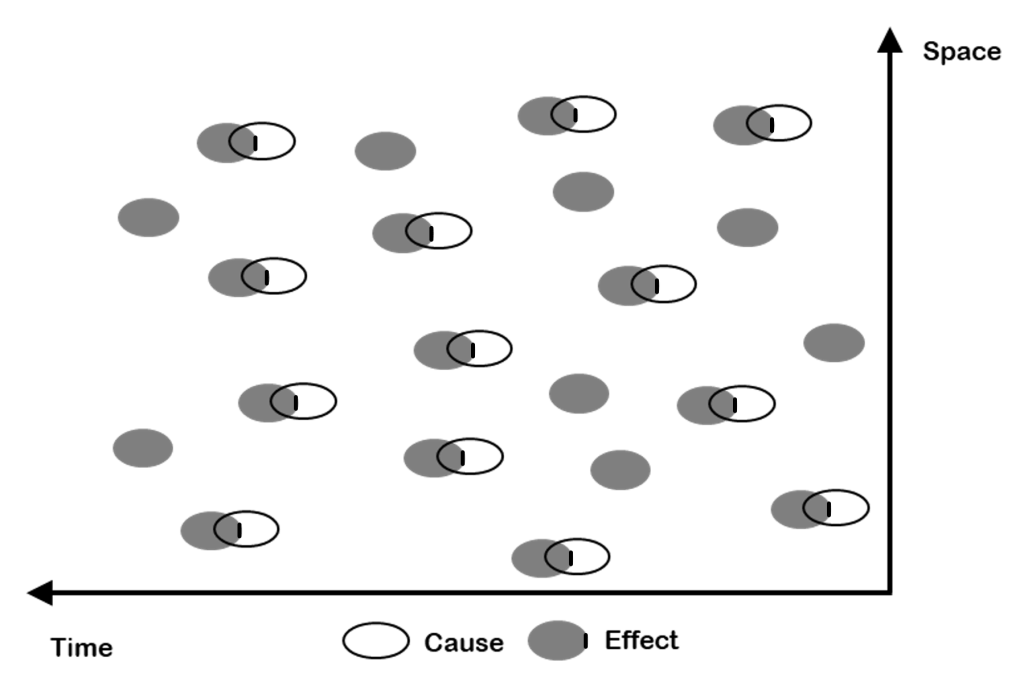
  1. If an instance of the cause is sufficient for an instance of the effect, then the region of space-time occupied by the former always contains the region of space-time occupied by the latter. Fig.1 shows this diagrammatically. In other words, an instance of the effect always takes place in the presence of an instance of the cause. However, it is not necessarily the case that every instance of the effect results from an instance of the cause.
  2. If an instance of the cause is necessary for an instance of the effect, the region of space-time occupied by the latter is always contained by the region of space-time occupied by the former. Fig.2 shows this diagrammatically. In other words, an instance of the effect cannot take place in the absence of an instance of the cause. However, it is not necessarily the case that every instance of the cause leads to an instance of the effect.
Fig.1 A space-time diagram showing instances of a sufficient cause as white ellipses, and instances of the effect as black lines at the beginning of events shown by grey ellipses.
Fig. 2 A space-time diagram showing instances of a necessary cause as white ellipses, and instances of the effect as black lines at the beginning of events shown by grey ellipses.

If an event of a particular type occurs, then these causal rules allow us to deduce, with varying degrees of certainty, what causes have taken place or what effects will take place.

Causality can be complex, with several causes combining to produce an effect. The epidemiologist, Ken Rothman, explained that, for an effect to take place, it is often the case that several necessary causes must combine to create a sufficient cause. The combination of necessary causes of type A, B and C may be sufficient to result in an effect of type D. For example, the presence of gas, oxygen and a spark are each necessary and together sufficient to cause a gas explosion. Fig.3 shows this diagrammatically.

Fig.3 A space-time diagram showing instances of three necessary causes as coloured ellipses, which together comprise sufficient cause, and instances of the effect as black lines at the beginning of events shown by grey ellipses.

One aspect of causality which is often overlooked is the existence of inhibitors. In the same way as a cause and an effect, an inhibitor is a plural collection of physical events, objects, or circumstances of a particular type. However, it is the opposite of a cause in that it prevents an effect from taking place. Depending on its type, the presence of an instance of the inhibitor can prevent an event from beginning, ending, changing state, or occurring in its entirety, irrespective of any causes which might dictate otherwise.

In the same way as causes, inhibitors can be necessary to prevent an event or sufficient to do so. If an inhibitor is necessary but not present, then the effect can occur. However, this does not necessarily mean that it will occur. This depends on what causes are present. On the other hand, if an inhibitor is sufficient and present, then the effect cannot occur. In practice, a sufficient inhibitor can be a combination of several necessary inhibitors. The region of space-time in which the effect is prevented is the overlap between them.

Causality is, of course, a physical process. This process will be described in more detail in the next article.

Categories
11. Causality and Behavioural Strategies

Causality and Behavioural Strategies

We interact with the physical world and influence events using the rules of causality. Most of us do this unconsciously, but there is advantage in understanding the process. This better enables us to verify our decisions.

Causality can be complex, with several causes combining to produce an effect. These causes can be of two types: necessary causes, in the absence of which the effect cannot occur; and sufficient causes, in the presence of which the effect must occur. The epidemiologist, Ken Rothman, explained that, for an effect to take place, it is often the case that several necessary causes must combine to create a sufficient cause. For example, the presence of gas, oxygen and a spark are each necessary and together sufficient to cause a gas explosion.

Causality also involves inhibitors, i.e., those things which always prevent an effect from taking place, even if sufficient cause is present. These inhibitors can also be of two types: sufficient inhibitors, in the presence of which the effect cannot occur; and necessary inhibitors, or those things required to prevent an effect. Again, a sufficient inhibitor may comprise one or more necessary inhibitors.

We can use this knowledge in our strategies to achieve a desired outcome. This is best demonstrated by a simple example. Suppose we know that an effect, e, occurs as a result of two necessary causes, a and b. Together, a and b are a sufficient cause.  In the absence of a, b, or both, e cannot take place. So, if we wish to prevent e, then our strategy may be to prevent one of a or b, whichever is easiest. However, the effect can also be prevented by two sufficient inhibitors, c or d. In the presence of c, d or both, e cannot occur. Thus, an alternative strategy for preventing e, is to cause one of the inhibitors c or d, whichever is the easiest.

In this example, the presence of a and b and the absence of c and d result in e. If some but not all of these conditions exist, and e is undesirable, then this is a risk. However, if e is desirable, then it is an opportunity.

Our behaviour often steers events by increasing or decreasing their likelihood, rather than directly causing or preventing them. For example, we may lack the resources to directly cause an event, and may only have sufficient to enable it. To benefit from such behaviour, we must observe our environment, identify the opportunities and risks that it presents, and intervene to our advantage.

Typical strategies are as follows.

Enablement means acting to remove any existing inhibitors. Note that sufficient cause may not be present. So, the effect may not actually occur, but only become able to occur.

Facilitation means acting to introduce necessary causes where previously they were absent. Note that not all necessary causes may be present and not all inhibitors absent. So the effect may not actually occur, but merely become more likely.

Risk Reduction means acting to reduce the likelihood of an effect. It will not yet have occurred, either because an inhibitor is present, or because not all necessary causes are present. We can reduce the risk yet further by removing more necessary causes.

Prevention means acting to introduce an inhibitor where none is present. Note that the effect will not yet have occurred because not all necessary causes were present.

Categories
01. Do We have Free Will?

Do We Have Free Will?

Introduction

Free will is the idea that we can influence the direction that our lives and those of others will take by the choices that we make. Whether we have free will or whether we live in a world in which our fate is predetermined is one of the unresolved questions of science and philosophy. What we believe to be the answer to this question has profound implications for our personal wellbeing and that of society. I will, therefore, begin this series of articles with a discussion of whether we have free will.

Causality and Determinism

Causality relies on objects and events occupying a region of space-time so that the beginning of one, the cause, precedes the beginning of another, the effect. The region of space-time occupied by the cause must also contain the beginning of the effect.

A deterministic universe is one in which everything, including events and physical objects, has a cause. This implies that everything can be traced back to one original cause, the big bang, and that everything which subsequently occurred, including our decisions, was predetermined at that time.

Acausality and Indeterminism

Not everything in the universe has a cause. Space, time, and the laws of the universe are thought to have originated with the big bang. Thus, the big bang cannot be said to have had a cause. Some other mechanism may have been in play but, although we do not know what, it was certainly not causality.

There are other events which appear to be acausal. The radioactive decay of atoms and the appearance of virtual particles seem to occur at random, without any apparent cause. It may be that these events do result from some, yet unidentified, mechanism, but if anything “beyond” space-time is involved then, in the same way as the big bang, this mechanism is acausal.

Some of these acausal events interact with existing particles creating very small changes. As time passes, these changes can propagate and become magnified to such an extent that circumstances after the interaction are fundamentally different to those which might have prevailed without it. Furthermore, there will be infinitely many consequences of acausal events propagating through the universe. If they are truly acausal, then the result will be a probabilistic and unpredictable universe.

There would be no simple rules from which the state of the universe could be derived. Rather, such rules would be at least as complex as the universe itself. This, in turn, implies either that there is some entity as complex as the universe capable of holding those rules or that the rules and the universe are one and the same thing. The latter is, of course, the simpler and more likely explanation.

So, the existence of acausal events would imply that the universe was not predetermined by the Big Bang but rather by the most recent acausal event of any significance.

Implications

Determinism suggests that, after the point in time called “now”, the state of the universe is already mapped out and may even pre-exist. Indeterminism, on the other hand, implies that the future is uncertain or probabilistic, and, as it becomes ever more remote, increasingly so. Thus, knowing the situation at any point in time, we could only predict the future with reasonable accuracy a very short time ahead.

We cannot visit the future to know whether determinism or indeterminism is correct.  However, if the former, then we are following a path already mapped out and have no free will. On the other hand, if the future is probabilistic and only becomes certain as “now” progresses through time, then it is possible that we do have free will.

There is no proof one way or the other.  However, a popular acceptance of determinism has implications for us as individuals and for society. These include a fatalist attitude and a belief that we are powerless in the face of humanity’s difficulties. They also include a denial of personal responsibility for our actions and the damage that this might cause to society.

In my next post, I will discuss the evidence in favour of free will and expand on the consequences of its denial.