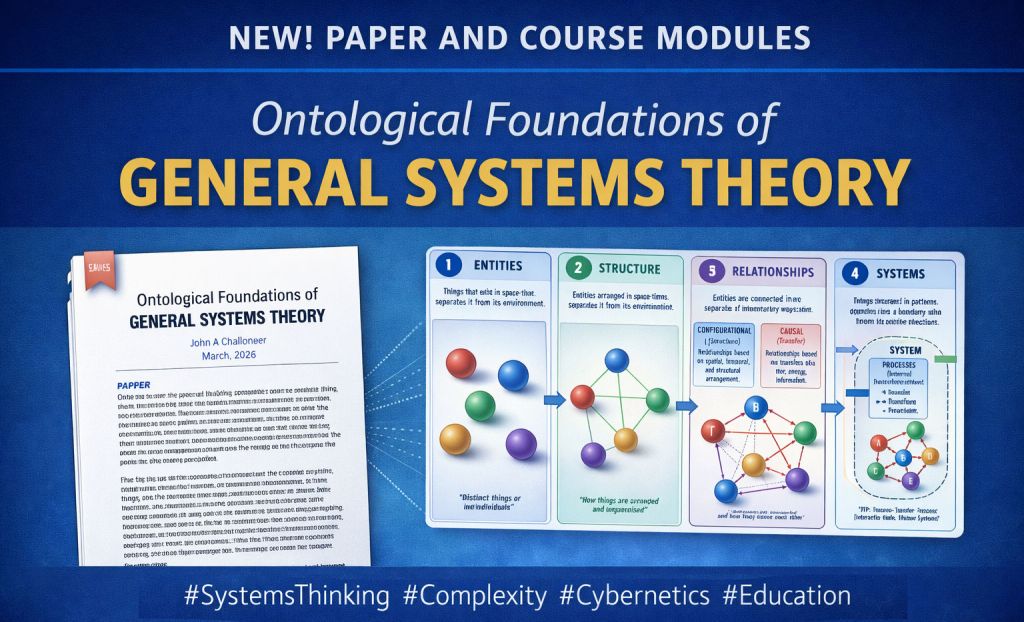
I’m pleased to share the publication of my latest paper:
Ontological Foundations of General Systems Theory
This paper is the second in a series on General Systems Theory. It sets out a clear, physically grounded framework for understanding reality in systems terms. It brings together concepts of space-time, entities, structure, relationships, causality, and change into a single coherent ontology.
The aim is not to introduce new complexity, but to clarify the foundations on which systems theory rests; providing a consistent basis for analysing systems across physical, biological, and social domains.
The paper is available via the following links:
🔗Academia: https://www.academia.edu/165495501/Ontological_Foundations_of_General_Systems_Theory
🔗Website: https://rational-understanding.com/efgst
Alongside the paper, I have also added a new set of course modules to an existing General Systems Theory (GST) course. These modules correspond to the ontological foundations developed in the paper and are designed to make the concepts accessible through plain-English explanations, diagrams, and practical exercises.
The course materials are available in two ways:
🔗Open access (self-paced): via my website https://rational-understanding.com/gst-course/
🔗Supported learning: via Google Classroom through the ISSS Student SIG.
Those in full-time or part-time education are especially encouraged to join the Student SIG, where they can benefit from guidance by experienced systems scientists, discussion with fellow learners, and access to a wider international community. To join go to : https://isss.org
I hope these resources are useful to those interested in systems theory.

 Rational-Understanding.com