Categories
02. The Relationship between National Fragility, Trust and Religion (Part 1)

The Relationship between National Fragility, Trust, and Religion.

In this article I compare data taken from the World Values Survey and the Fragile States Index which shed some light on why people follow a religion.

The World Values Survey is a global network of social scientists who study changes in people’s values and the impact that these have on social and political life. The survey began in 1981 and conducts nationally representative surveys in almost 100 countries, comprising almost 90% of the world’s population. Interviews are conducted on a five-yearly cycle and, currently, the questionnaire consists of over 300 standard questions. The World Values Survey data and methodology can be found at https://www.worldvaluessurvey.org/wvs.jsp

The Fragile States Index data is compiled by the Fund for Peace and is intended to be a measure of the likelihood that a state will erupt into mass violence due to internal conflicts. The Fund for Peace holds that “Fault lines can emerge between identity groups, defined by language, religion, race, ethnicity, nationality, class, caste, clan, or area of origin. Tensions can deteriorate into conflict through a variety of circumstances, such as competition over resources, predatory or fractured leadership, corruption, or unresolved group grievances. The reasons for state fragility are complex but not unpredictable. ” The index aggregates the following twelve indicators each of which comprises many sub-factors:

  • security threats from, for example, crime, terrorism or rebel movements;
  • fragmentation along, for example, ethnic, class, or religious lines;
  • divisions between different groups in society, particularly those based on social or political characteristics;
  • economic decline;
  • inequality within the economy;
  • human flight and brain drain;
  • the population’s level of confidence in state institutions and processes;
  • essential public services such as health, education, water, sanitation, electricity, effective policing, etc.;
  • the protection of human rights and the rule of law;
  • demographic pressures such as population pressures on resources and public services, youth or age bulges, etc.;
  • the forced displacement of large communities due to political, environmental, or other causes; and
  • the influence and impact of external actors on the functioning of a state.

Data and the method by which it is gathered can be found at https://fragilestatesindex.org/

For the 54 countries where both sets of data exist, the graph below compares their National Fragility Index for 2022 with the percentage of the population who, according to the most recent wave of the World Values Survey, believe in God (Q165).

The coefficient of correlation is an indicator of how two variables are related to one another. It varies on a scale from 0, i.e., unrelated, to 1, i.e., perfectly related. The coefficient can also be positive or negative depending on whether one of the variables increases or decreases with the other. In the example below, the coefficient of correlation is 0.70 which indicates that national fragility and belief in God, on a national scale, are moderately related.

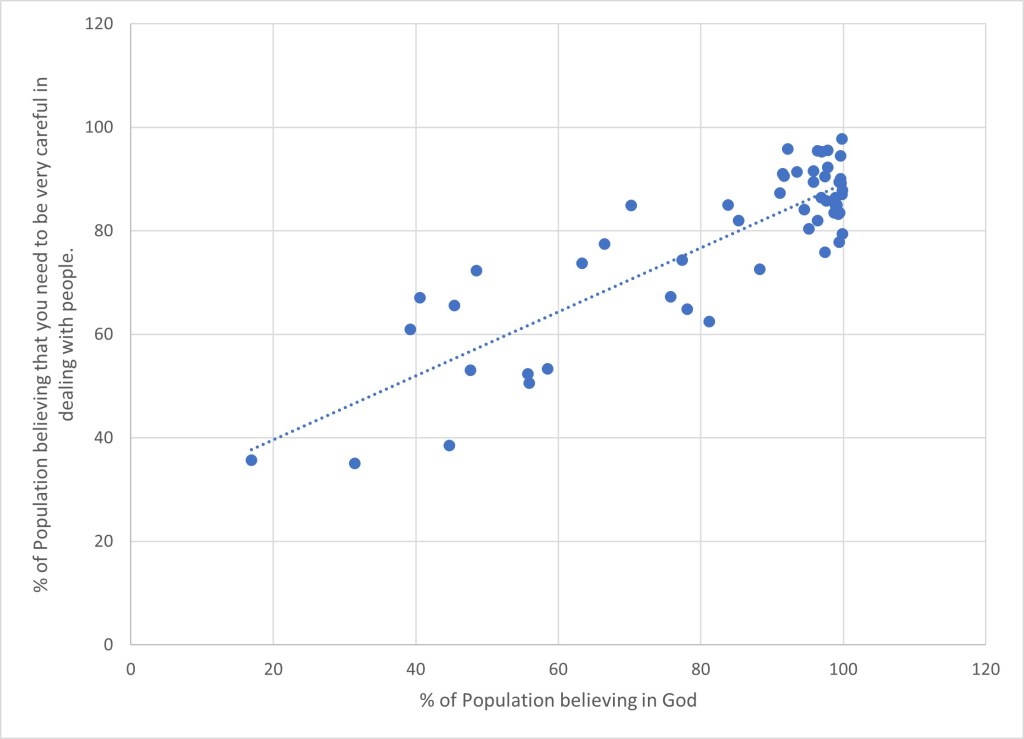
For the 54 countries where both sets of data exist, the graph below compares two sets of data from the most recent World Values Survey, i.e., the percentage of national population who believe that you need to be very careful in dealing with people (Q57), and the percentage of the population who believe in God (Q165). The coefficient of correlation here is 0.86 which indicates a strong relationship.

Correlation between two variables can indicate cause and effect, but not necessarily so. For example, the two variables may have a common cause. Thus, belief in God, fragility, and the need for care may all have a common cause. Alternatively, belief in God might be interpreted as causing fragility and the need for great care in dealing with people. These options seem unlikely, however. Firstly, because the national fragility index comprises a very wide range of variables and it is difficult to identify anything that has been overlooked which might cause both fragility and belief in God. Secondly, many religions emphasise good relationships with one’s fellow human beings, rather than distrust of them.

I would suggest, therefore, that the most likely relationship is one in which national fragility and the need for care in dealing with people are, in part at least, causes of a belief in God. If so, then this may be because people’s need for security and stability, when not provided by the state, is satisfied by believing in God. That is, belief in an infallible being with our own interest and our society’s interest at heart. Conversely, if the state does provide security and stability, then the need for a belief in God is reduced.

References

  • https://fragilestatesindex.org/
  • Haerpfer, C., Inglehart, R., Moreno, A., Welzel, C., Kizilova, K., Diez-Medrano J., M. Lagos, P. Norris, E. Ponarin & B. Puranen (eds.). 2022. World Values Survey: Round Seven – Country-Pooled Datafile Version 5.0. Madrid, Spain & Vienna, Austria: JD Systems Institute & WVSA Secretariat. doi:10.14281/18241.20
Categories
01. Organisational Pathologies

Organisational Pathologies

The fundamental entity in social systems theory is the organisation. That is, any group of people who work together for a common purpose. An organisation may be an individual, a club or society, a business, a charity, a sector, a nation, or the global community. An organisation can also exist temporarily to carry out a short-term project or it can have a longer-term function. This series of articles discusses the ways in which organisations can fail and ways of avoiding this.

The articles also approach the topic from a systems perspective. Every organisation is also a system. It comprises inputs, processes, and outputs. Everything that is not part of the system is its environment. However, for organisations this terminology translates into that of social science. Processes are the needs of the organisation. Inputs are the satisfiers and contra-satisfiers of those needs. Outputs produced by its processes are the purpose of the organisation. That is, the provision of satisfiers and contra-satisfiers for others.

Figure 1. Systems and organisations compared.

Organisations do, however, have two additional features not held by systems in general.

Firstly, outputs are traded for inputs. That is, satisfiers or contra-satisfiers for others are traded for those required by the organisation. This is what binds us together into society. The word “trade” is used in a very general sense and applies not only to businesses but all organisations. Trade is a fundamental aspect of human nature. Its basis is the search to satisfy human and organisational needs. The term is derived from economics, a branch of social science that focusses on the trade of goods, services, and money. However, many regard economics as a specialised branch of psychology. It does, therefore, provide terminology that can be usefully employed in a more general sense. For example, we trade satisfiers for other “non-economic” needs such as relationships and personal growth. We do so in a way that is no less rational than the trading of goods, services, and money.

Secondly, an essential component of an organisation is its control component, i.e., leadership or management, without which the activities of other components cannot be co-ordinated, and without which an organisation does not exist.

Many factors are necessary but only together are they sufficient for an organisation to function satisfactorily. The organisation must receive its necessary inputs, i.e., the necessary satisfiers for its needs must be present, and any contra-satisfiers absent. The control component must carry out its function satisfactorily. There must also be satisfactory communication between it and the other components. The organisation must operate and maintain its processes satisfactorily. It must deliver its outputs of satisfiers or contra-satisfiers for others. Finally, it must adapt to any changes in its environment which impact on these factors.

This means that there are many more ways for an organisation to fail than succeed. In systems theory the causes of systems failures are known as system pathologies. In social systems theory they are, therefore, referred to as social systems pathologies or organisational pathologies. These pathologies can be categorised according to the aspect of the system in which they occur. They are summarised below.  

The System’s Environment

  • The VUCA World (Volatile, Uncertain, Complex, and Ambiguous)

The Control System

  • Self-interest vs. Collective Interest
  • Leadership Competence
  • The Corrupting Effect of Power
  • Contra-Social Leadership Behaviour
  • Psychopathic Leaders
  • Narcissistic Leaders
  • Dark Empathic Leaders
  • Governance, Culture & Ethical Standards

Instability and Self-maintenance

Adaptation to Environmental Change

Vertical Communication

  • Knowledge of Processes
  • Feedback and Monitoring
  • Misinformation
  • Delayed or Absent Response

Inputs & Outputs

  • Mismanagement of Resources
  • Function & the Identification of Needs
  • Equitable Trade
  • Relationships
  • Protectionism and Blocking

Processes

  • Poor Process Design
  • Process Inflexibility
  • Unregulated Feedback

Multiple Causes

  • Extractive Institutions

The articles that follow will discuss each of these pathologies in turn. They can occur in any organisation irrespective of its size and function. However, the name used to describe the same pathology varies between types of organisation. The articles will, therefore, describe the effect of each pathology on a range of organisations of different types, from a small club to a nation.

Categories
14. How to Think Creatively and Discover the Truth

How to Think Creatively and Discover the Truth

The following skills are necessary for creative thinking and discovery of the truth:

  1. poly-perspectivism;
  2. polymathy;
  3. understanding how the brain generates potential solutions to problems;
  4. recognition that observation is the best source of information;
  5. communication;
  6. recognition that authority has no monopoly on the truth;
  7. recognition that models and other simulations of reality are always flawed; and
  8. detective skills.

Poly-perspectivism was described in the previous article “Perspectivism and Poly-perspectivism”. In summary, no-one has the mental capacity to fully understand all aspects of a problem. Each of us is only capable of a partial understanding. This concept is known as perspectivism. It is possible, however, to expand and improve our understanding by interacting with others who have a different perspective. This does not, of course, necessarily mean accepting their perspective. Rather, it can reveal aspects of a problem that we had not previously thought of.

Polymathy. A polymath is someone whose knowledge spans a wide range of subjects. This enables them to see similarities between concepts in different fields of knowledge, even though they may be expressed in different language. This in turn, enables them to transfer innovations and discoveries from one field to another. Furthermore, it enables them to identify inconsistencies between theories in different fields. This article in The Conversation describes research by Robert and Michele Root-Bernstein of the University of Michigan. They have found that Nobel Prize winners are unusually likely to be creative polymaths. The article also gives examples of two such prizewinners.

When we work in specialist silos, we can construct theories that contradict those in other silos. Unfortunately, those contradictions can go unnoticed.  So, a good method for discovering the truth is to aim for breadth of knowledge rather than depth. Try to understand the fundamental principles of several disciplines. These principles can then be combined to create theories. If the theories are inconsistent with one another or what we observe to be true, then some of the fundamental principles must be incorrect.

Understanding how the brain generates potential solutions to problems. This was described in a previous article entitled “The Creative Process and Decision Making”. In summary, we can follow a four-stage process that harnesses the ability of the unconscious mind to solve problems. Stage 1, known as saturation, comprises learning as much as we can about the relevant issue. Stage 2, known as incubation, involves resting the conscious mind and allowing the unconscious to process that information. This may involve taking a short break from our desk or PC, or it may involve one or more nights of good sleep. Stage 3, known as inspiration, occurs when the unconscious mind, without prompting, presents its potential solutions to our consciousness. It is the “aha!” or “Eureka!” moment. Finally, stage 4, known as verification, comprises consciously checking that the inspiration is correct. Unfortunately, the unconscious mind does not always get it right. So, some additional research and incubation may be necessary. Once we understand this process, we can consciously employ it to great advantage in our day-to-day efforts. It is why it is often wise not to make decisions precipitously, but rather to “sleep on them”, or think about them for a while.

Recognition that observation is the best source of information. Human senses have evolved to better enable us to survive and procreate. So, one would expect the information gained through them to be a reasonable representation of reality. On the other hand, information gained from others is not necessarily true. We can also construct theories that contradict observed reality. There are a multitude of reasons why theories may be wholly or partially false: simple error, assumptions learned from society, a wish to gain status and attention, a wish to deliberately mislead, and so on. Building theories upon theories without verifying them by observation can lead not only to the propagation of errors and falsehoods, but also to the amplification of them. It is for this reason that scientists carry out practical experiments to verify their theories, and the same should apply in our daily lives.

Communication. It is better to express complex ideas in simple language, rather than simple ideas in complex language. The former increases the likelihood that the idea will be understood. The latter is often mere pretentiousness, with the aim of gaining unwarranted status. Unfortunately, the latter can also hide simple concepts behind a cloak of mystique. Consider, for example, the words of one eminent professor commenting on the work of an eminent sociologist:

“Under the regime of self-referential systems, “self-regulation” changes sense from automatic control to autonomous self-constitution, and the polarity between open and closed systems is sublated by supplementary relation binding openness to the environment to the closure of system operations.”

These words can be translated into plain English, as follows:

“A self-referential system contains and uses a description of itself. It is, therefore, self-aware. The theory of self-referential systems states that they control their own processes, rather than working automatically. They also recognise a difference between relationships within themselves and relationships with their environment.”

I am sure that all self-aware human beings regard this statement as obvious once it is stripped of its jargon.

    Recognition that authority has no monopoly on the truth. In life, we encounter individuals who have high social status because of their work in a particular field. We have a natural tendency to accept their theories as being true. This is known as “appeal to authority”. It is a logical fallacy which suggests that high status individuals have a monopoly on the truth. However, status can be carefully cultivated as a goal. Furthermore, a strong bond can develop between an individual’s status and the theory put forward by them. So, the theory becomes resistant to change, even in the face of contradictory evidence. Those who benefit by supporting the high-status individual are similarly bound to their theories. So, we should not automatically accept theories simply because they are propounded by someone of high status.

    Recognition that models and other simulations of reality are always flawed. Because human cognition has evolved, it can be expected to be a reasonable representation of reality. However, its limitations mean that it must also be a simplification. We formalise our understanding using various models, for example, language, mathematics, diagrams, computer simulations, etc. Inevitably these models are also simplifications.

    Models can be used, to a limited degree, to predict events. However, the prevailing view is that increasing their complexity by, for example, increasing the number of variables, does not necessarily increase the accuracy of their prediction. It is more effective to identify the most significant variables and keep the model relatively simple.

    Detective Skills. To convict a criminal, the prosecution must convince the jury that the defendant had the motive, means, and opportunity to commit the crime. The motive is the reason to commit the crime, the means is the ability and necessary tools to do so, and the opportunity is the time and circumstances that make the crime possible. If any of the three are absent, then the defendant is not guilty.

    The same is true of any act, criminal or otherwise, and so, theories about social causes and effects can be tested in the same way. For example, does a government have the motive, means, and opportunity to enact environmental legislation? It certainly has the means, and if the legislative programme permits, it has the opportunity. It is, therefore, the motive that is questionable and where attention needs to be focused.

    Categories
    18. Social Systems Theory in Practice - An Example (Part 2)

    Social Systems Theory in Practice – An Example (Part2)

    Formalisation

    The example described in my previous post can be described graphically and, potentially, a mathematical or computer model can be created. A diagrammatic representation of the example is given in the figure below.

    Figure 1. Causal diagram showing increasing complexity in Western society.

    In this diagram, the coloured rectangles represent a society’s variable characteristics. These characteristics have numerical values that alter with time and can be related to one another mathematically. The variable characteristics interact causally as shown by the arrows, which point from cause to effect. In this diagram, all the arrows show the cause as being sufficient for the effect. If several sufficient causes impact on one effect, then their effect is cumulative. However, by joining arrows together after they have left their causes, it is possible to represent several necessary causes as, together, being sufficient for an effect.

    The smaller rectangles describe the nature of the causal relationship. A small up arrow indicates an increase in the variable characteristic. A small down arrow indicates a decrease. The coloured background indicates whether the small arrow refers to the cause or to the effect. Small arrows are paired horizontally. In rectangle B, for example, an increase in the cause results in a decrease in the effect.

    The diagram can be explained as follows.

    A. As the number of established organisations increases, so too does the total number of inefficiencies. The reverse is also true.

    B. As the number of inefficiencies decreases, the number of unattached individuals with unsatisfied needs increases. The reverse is also true.

    I. The number of unattached individuals also increases as the population increases. The reverse is also true. Note that population growth is the number of people entering society due to births and immigration, less the number of people leaving it due to deaths and emigration. However, not all of the population is active.

    C. As the number of inefficiencies increases, the number of trading opportunities for unattached individuals also increases. The reverse is also true.

    D & E. As the number of trading opportunities and the number of unattached individuals increases, the number of goods and services that can reduce inefficiency in established organisations also increases. However, the reverse is not true. A decrease in the number of trading opportunities or a decrease in the number of unattached individuals has no effect.

    F. As the number of goods and services provided increases, the number of inefficiencies decreases.

    J. The number of inefficiencies also reduces because of efficiencies carried out by the organisations themselves, i.e., auto-efficiencies. The reverse is also true, and organisations can cause greater inefficiency in many ways.

    G. As the number of goods and services provided increases, the satisfiers received in return also increase. The reverse is also true.

    H. As the number of satisfiers received increases, the number of established organisations increases. The reverse is also true.

    It can be seen from this diagram that the process is a positive feedback loop. With no constraints, the number of established organisations, and thus, the complexity of society can increase exponentially. However, the minor feedback loop BEF can have a damping effect if there is insufficient population growth.

    There are many other examples that would benefit from the same approach. However, they may not be independent of this model, but rather may interact with and extend it. The more examples we consider, the more questions this will raise. If common questions arise from different examples, then this may be an indication of their significance. Answers to some of these common questions may be beneficial in all cases. However, it is also possible that they will be beneficial in some and harmful in others. This is not a bad thing, however, because it would prevent ill-considered decisions, and encourage us to seek optimal solutions.

    Categories
    17. Social Systems Theory in Practice - An Example (Part 1)

    Social Systems Theory in Practice – An Example (Part1)

    Introduction

    The term “Social Systems Theory” is normally used to describe the work of the German social theorist Niklas Luhmann. However, the theory described here differs from Luhmann’s in several ways. In particular, the physicalist perspective holds that everything, including information, exists physically in space-time. This implies that the knowledge of an organisation lies in the neural connections that make up the minds of its members. Thus, contrary to Luhmann’s theory, those members must also be a part of the organisation.

    Intuitively, many of us sense that there are intangible “forces” that are beyond our individual control and that shape our society. In this article, I draw together the information provided in my previous articles on evolution, psychology, organisations, and systems theory, to show that these intangible “forces” are, in fact, tangible processes. These processes provide an understanding of why society is as it is. To a limited extent, the processes also provide an understanding of where society is heading unless we intervene.

    The social systems theory presented here is not a general theory of society. Rather it comprises an understanding of both human and systems behaviour that can be applied in different social contexts. The explanations that it provides will differ for different cultures and in different eras. Nevertheless, the approach has substantial potential value.

    Example

    To demonstrate the theory, I have chosen an example from the present-day Western world. The example provides an explanation of why the complexity of our society is increasing at an accelerating rate. Inevitably, this explanation raises many questions about where the process is heading, whether intervention is necessary, and, if so, what it should be. Some of these questions are considered at the end of this section.

    Western society comprises many interacting organisations whose number increases day by day. Here the term “organisation” is generic. It includes any group of people who work together for a common purpose. It also includes any individual person. For example, an organisation’s function may be fishing, hunting, steelmaking, takeaway meals, or government. For a new organisation to form, a group of people must share a common need and perceive an opportunity to satisfy it by working together. Alternatively, they can share a common contra-need and perceive a way of avoiding it by working together.

    In early simple societies, satisfiers for our needs were taken directly from the natural environment, for example, hunting, fishing, the gathering of vegetables, firewood, etc. To acquire these satisfiers, we formed groups or “organisations” under the leadership of experts. Other groups remained in camp to care for young children. As the size of the tribe increased, specialisation began, and some individuals spent most of their time on a particular activity. Thus, trading between specialist groups became necessary, for example, fish for childcare.

    In present day Western society, few people can take their satisfiers directly from the environment. We all trade with others to satisfy our needs, and this is often in the form of employment by an organisation. Even farmers and miners need the goods and services provided by others to carry out their function.

    This situation has arisen because of a positive feedback process which continues to this day. Because the process is cyclical and it is impossible to say what stage came first, I could begin its description at any point. So, beginning with increasing organisational efficiency, the process is as follows.

    • As the efficiency of an existing organisation increases, fewer people are required to carry out its function. The same is true of an individual, but efficiencies release the individual’s time.
    • However, these unattached individuals must still satisfy their needs and are usually unable to do so directly from the natural environment. So, they will seek opportunities to satisfy their needs by trading with established organisations. To that end, the unattached individuals will identify the needs of the established organisations. These needs may be goods or services that established organisations lack, or it may be aspects of the established organisations’ functions that could be carried out more efficiently.
    • If a group of unattached individuals share a common interest in providing goods, services, or efficiencies, then to do so more effectively they may form a new organisation and take on employees.
    • Not all new organisations are successful. The process is one of trial and error, and so, it is evolutionary.
    • The new organisation becomes established if it achieves its objective of trading with existing established organisations. This includes trading with individuals. Any efficiency that the new organisation provides results in the release of more people. Successful trading also satisfies the needs of the new organisation’s members.
    • Finally, the cycle is repeated with the new organisation as an established one.
    • Thus, the number of organisations in a society and the complexity of their interactions grows as time progresses.
    • Without any constraints, this growth would be exponential. However, constraints do exist, some of which are described below.

    One constraint is the number of unattached people available to form new organisations. In a subsistence society there are none because everyone is fully engaged in satisfying their basic needs. So, the process may never begin without external intervention such as investment. In Western society, the growth of complexity initially relied on rapid population growth during the industrial revolution. This growth has now slowed to zero, and the release of people from established organisations through increased efficiency drives the process. An additional driver is immigration. However, for unattached people to be effective in forming new organisations, support and retraining is needed. Failing that, many may find themselves unable to satisfy their basic needs without turning to crime or other anti-social activities.

    The constraints of natural resources and the problems they cause are well known. The latter include global warming, pollution, and the extinction of species. Although these issues are of enormous importance, I will not repeat here what has already been expressed very eloquently by others.

    Our ability to understand complexity may also be a constraint. The more organisations there are, and the more diverse their function, the more complex society becomes. There are limits to the level of complexity that we can comprehend, and this has implications for government, the population, and crime. Can this increasing complexity be managed through technological advances? If not, then at what stage will national governments be incapable of governing effectively? At what stage will decentralisation become desirable? At what stage will citizens cease to be effective members of society and form a counterculture? At what stage will citizens begin to seek simple solutions, and at what stage will populist politicians begin to offer them?

    As can be seen, the application of social systems theory to an issue raises many unanswered questions. However, it does begin to identify those that need to be addressed for the wellbeing of humanity and our environment.

    Categories
    05. The Role of Art

    The Role of Art

    Wiston, John A Challoner

    Individual tastes in art vary enormously. This is because we find a work of art, whether it be painting, music, poetry, or literature, beautiful when it unconsciously triggers an association with something from our lives to which positive emotions are attached. For example, if holidays in the South of France have given us pleasure, then similar pleasure can be gained from art that triggers those recollections.

    There are no absolute rules that determine what is “good” or “bad” art. Rather, they have a cultural basis. For example, in the West, music in a major key is generally perceived as happy and music in a minor key as sad. The conventional explanation is that the minor key contains more dissonance and is therefore inherently sad. However, as the research described in the link below shows, non-western cultures can have a greater preference for dissonance, can find the major key strange and foreign, and can attach different emotions to a piece of music than westerners.

    How your culture informs the emotions you feel when listening to music (theconversation.com)

    In summary, therefore, beauty in art arises from both personal and cultural associations.

    However, it is common for high status individuals to collect or sponsor art. There can, of course, be an element of personal pleasure and satisfaction in this. However, the principal reason is to gain followers and grow or maintain the hierarchy that supports their status. High status individuals must overtly appear to have something to trade in return for their followers’ support. They must also appear to have something to trade with high status peers, if alliances are to be formed. In this context, art can be a symbol of the wealth and status that is potentially available for trade.

    Art can also be a symbol of belonging to a particular culture. In the case of high-status individuals, this is a symbol of belonging to the elite. If people who aspire to high status display the symbols of the culture to which they aspire, they are more likely to be selected by their seniors as potential supporters. A taste in art is one such symbol. This creates a positive feedback loop which maintains the status of the art favoured by a culture.

    Art is, of course, often is a symbol of belonging to a sub-culture. In such cases, it often expresses rebellion against established social norms through its rebellion against established artistic norms.

    Wealthy, high-status individuals also collect art as an investment. This creates another positive feedback loop. The highest-status individuals can establish what new developments in art are accepted by their culture. Followers aspire to that culture and, thus, display its symbols. Demand for the new development in art grows among the wealthy and, thus, prices increase.

    Similar principles apply to other aspects of the elite’s culture, e.g., vehicles, clothing, homes, etc. Families who are established members of the elite pass its culture on to their children. However, the nouveau riche and those who aspire to the elite are less well “educated”. Some will, therefore, emulate wealthy and powerful role models without fully understanding how the process works. They can, therefore, seem merely brash until they gain experience. Finally, some who aspire to the elite can be duped, by advertising, into incorrectly believing that certain products signal high status and can, therefore, help them to achieve it. Watch the advertisements with this in mind.

    So, if you wish to enjoy art, then enjoy art that does give you pleasure, rather art that should give you pleasure.  

    Categories
    15. How Sectors are Interrelated and an Overview of Emerging Sectors

    How Sectors are Inter-related and an Overview of Emerging Sectors

    The diagram below shows the ways in which the various sectors, each of which is pyramidical in form, are inter-related to form the United Kingdom as a nation in the 16th and 21st Centuries. In some cases, a sector has been truncated at the top because it is controlled by the members of another sector. In the 21st Century, the relative status, in the establishment, of the top stratum of each sector differs. For example, the leaders of the trade union movement, although members of the establishment, have a lower status than the monarch. However, by virtue of changes in the influence of each sector, and of trading by its upper stratum, the relative status of the upper strata of each sector constantly changes. Their status at any particular time is debatable, and so, no attempt has been made to show it.

    16th Century Sectors

    Present Day Sectors

    Emerging Sectors

    As time progresses and technology advances, some established sectors will lose influence and new ones will emerge. The future influence of these new sectors can be predicted, to a limited extent, by observing the growth of their sector, by understanding the nature of their ability to trade, and by identifying other sectors that they may be able to control. Examples of potentially emerging sectors include the following.

    Data Analytics and Influencers. The power of this sector is its ability to influence the population in a similar manner to the media, but in a far more targeted way. It already has great influence over commercial marketing but, more recently, has begun exploring the potential to influence electorates. It has a growing influence over political parties, therefore.

    Human Rights and Environmental Groups. Historically, the power of this sector was largely limited to its ability to protest and cause disruption. However, it is now gaining significant influence over electorates and, thus, greater influence within the establishment.

    Artificial Intelligence Industry. The power of this sector is its potential to replace manual and intellectual labour in many other sectors, particularly industry and commerce. It is likely, therefore, that it will have great influence in those sectors.

    Biotechnology Industry. The power of this sector is clearly its potential for extending life and improving physical wellbeing. It seems likely therefore that, if it remains in private hands, then as its technology progresses its upper strata will become very influential within the establishment.

    Space Industry. The potential power of this sector is likely to be its access to mineral resources that are becoming scarce on earth, but that are necessary for established technologies. Other factors may be the advantages of off-planet manufacturing, military activity, and the control of communications. This sector is likely, therefore, to hold great influence over industry and commerce and, by virtue of their potential economic and security impact, with national governments.

    Categories
    14. Overview of Past and Present Sectors

    Overview of Past and Present Sectors

    The concept of a sector was described in the previous article. A brief overview of common past and present sectors is given below.

    Government. In most nations, government is a significant sector, and members of its upper strata belong to the establishment. Consequently, other members of the establishment can influence government policy and legislation in the interest of their sector. They can also influence government, either directly or indirectly, in their personal interest.

    Legal Sector. In most nations the legal sector is responsible for administering government legislation. The relationship between government and this sector tends, therefore, to be a formal one. However, the independence of the legal sector from government influence varies from nation to nation. Such independence does not preclude informal trading within the establishment which can, if necessary, be covert.

    Armed Forces and Police. The armed forces and police are sectors whose role is the protection of civilians from crime and aggression. To carry out their function they are conferred substantial power, including the use of physical force. In some nations this coercive power is restrained by government and cultural institutions, but in others the sector has used it to establish military dictatorships or police states.

    Agriculture and Land Ownership. In the past, landowners held considerable power through their control of the agricultural economy, and their ability to raise taxes and armies from within their agricultural hierarchies. In the West, the influence of land-owning families has declined substantially since the industrial revolution. However, agricultural corporations continue to hold some influence.

    Royalty. Royal families arose at a time when there were far fewer sectors, and the principal one was land ownership and agriculture. Taxes and armies could be raised from this sector, and this gave its highest status individuals much power. Those most successful in negotiation and conflict became royalty, and many nations were formed in this way. Support for royal status was maintained by trading rights to land in return.

    To this day, some nations are still ruled by absolute monarchs. In other nations, royalty has adapted to take on a constitutional role. In most, however, they have been replaced by presidential republics or dictatorships. The advantages and disadvantages of each method of governance will be discussed in future articles. However, where they continue to exist, there can be no doubt that royalty forms a very significant and influential part of the establishment.

    Religion. Historically, religions have held great power, but this is now in decline in the West. The basis of their power was their ability to control populations through an unquestioning belief in the religion’s worldview. Kingdoms and empires have also relied on the support of religions for their rise. Most kings have declared themselves to rule by divine right. Others have established themselves as leader of the state religion. In extreme cases, religions have taken the reins of governmental power and have established theocracies.

    Industry and Commerce. More recently, the power of agricultural landowners has been displaced by that of the leaders of industrial and commercial organisations. The basis of their power is, of course, the wealth that they generate from the resources they control. This can be offered to those with whom they are trading in the form of lucrative directorships, consultancies, or commercial support. In some cases, where policing is lax, trading can be in the form of simple bribes.

    Finance.  In the present day, the financial sector controls much of a nation’s capital, industry, and commerce. In the West, it has, to a very large extent, replaced the upper strata of those sectors, and exercises great influence within the establishment.

    Trade Unions. In the 20th Century, Western trade unions held significant sway over the work force, and an ability to disrupt industry and commerce. Whilst union activities were primarily in the interest of the workforce, it also gave their upper strata access to the establishment and an ability to trade within it. Government legislation and improvements in living standards have done much to reduce this influence. Nevertheless, union leaders retain a degree of influence over left wing political parties by virtue of their ability to influence parts of the electorate.

    The Media. The media sector has a significant ability to influence the population. On the positive side, it exposes wrongdoing in other sectors, particularly government. However, on the negative side, there can be a strong relationship between privately owned media organisations, and political parties. This political partisanship is still overtly expressed in many media outlets. In some nations, it has brought the media sector into conflict with governments or other sectors, resulting in the coercion, intimidation, and closure of many media organisations.

    I will discuss emerging sectors and the way that sectors interact in the next article.

    Categories
    13. Sectors

    Sectors

    A nation and, increasingly, the global community is a complex of interacting organisations. The greater the resources that an organisation controls, the greater the power of its upper stratum. A collection of similar organisations that co-operate to acquire yet greater power and status forms what is described as a sector. Sectors are also organisations and the same principles apply to them. Sectors are of particular importance as they control or influence the institutions of a nation, and thus, its general culture. When they exist in an influential nation, they can also impact on multinational or global culture and affairs. They are therefore discussed in some detail here.

    Sectors differ from nation to nation, and from era to era. The way that nations were organised in the past, are organised in the present, and, to a limited extent, how they will be organised in the future can be explained using the concept of sectors. To do so we need to understand the ways in which sectors interact. Of particular interest is their impact on government, the nation’s controlling sub-system.

    All organisations are hierarchical, and all organisations are a part of yet greater ones. Thus, high status in one organisation often confers status in a parent organisation. Within the parent organisation, the high status individuals of a child organisation can negotiate with others for yet higher status. This is done by offering support in return for status. This support often takes the form of wealth and influence. The larger a person’s status base, the more resources he controls, the greater the support he can provide, the greater his trading ability, and the higher the status he is likely to achieve in the parent organisation.

    This process is recursive. So, an individual with high status in a business can, by trading the support of that business with others, achieve high status in a sector, and by trading the support of that sector, achieve high status in the national establishment. The national establishment comprises high status members of many sectors including government. Thus, trading can take place between high status representatives of a sector and government. Of particular concern is the ability to influence government decisions. Unfortunately, this influence is often not in the interest of the nation but rather in the interest of the sector, the business, or even the individual representing them.

    To acquire status in the establishment members must overtly appear to have something to trade. This explains the very high salaries and often ostentatious lifestyles of the leaders of many organisations. The purpose of such high salaries is not to satisfy the needs of the recipient nor, as some would argue, to attract and reward those with the necessary skills and talents. Rather it is to enable the upper strata to make overt displays to their peers in the establishment and, thus, better enable them to trade for status and influence. Unfortunately, this trade within the establishment requires ever greater displays of status, particularly wealth and power, which in turn leads to ever greater income inequality.

    The interplay of sectors, through their representatives in the national establishment, plays a very large part in shaping the governance, culture, and beliefs of a nation. Each sector will carry with it a worldview suited to the needs of its members, or of its upper stratum. Through trading in the establishment, it is possible for the leaders of organisations in one sector to influence the decisions of the leaders of organisations in another. This influence includes not only decisions favouring a particular sector, but also the propagation of the latter’s worldview and the suppression of other, possibly more rational ones. In extreme cases, one sector can usurp the leadership of another, for example the takeover of the industrial commercial sector in the West by the financial sector and the imposition of a “bottom-line” ideology. A sector can also take control of government, as in the case of military dictatorships and theocracies.

    Categories
    19. Social Systems Theory and Practical Problem Solving

    Social Systems Theory and Practical Problem Solving

    This article is quite long, so I have published it in pdf format and it can be downloaded here. A summary follows.

    Many Professional Civil Engineers quickly learn that the technical and economic difficulties of implementing a project are often dwarfed by the social difficulties. Successful projects must not only be technically and economically viable, but also socially acceptable. But what is “social acceptability”, especially when some favour a project and others actively oppose it? This article addresses that question. It describes the application of Social Systems Theory to practical present-day problems to determine the social acceptability of potential solutions. Social Systems Theory combines the insights of systems science, with insights from the human sciences of psychology, sociology, political science, and economics, to form a single practical discipline. This discipline can be used to better understand why problems exist, or it can be used to understand what potential solutions are socially acceptable.

    The application Social Systems Theory to the latter is described in the article. The methodology is described in very general terms and is widely applicable.