Categories
Admin

Learn More about Systems Science

I have made much mention of Systems Science in my recent articles. If you would like to learn more on this topic, then I recommend following Shingai Thornton’s blog at: https://systemsexplorers.substack.com/

Shingai is a member of the International Society for the Systems Sciences (ISSS) and will write about the topic on a weekly basis. Each article takes about 5 to 10 minutes to read.

Initially, they will focus on making some of the core concepts in George
Mobus’ Principles of Systems Science textbook easily accessible to a
broader audience who might not have time to read the book.

Shingai is an aspiring systems scientist looking for critical feedback on his writing, and collaborations around the application of systems science to issues in the social sciences. He is receiving advice from George and other members of the ISSS education committee and together they are also developing an online course based on the book.

Categories
03. The Failure of Control Systems

The Failure of Control Systems

Introduction

Control systems are a property that emerges with life. They do not appear in non-living things, except those created by mankind. Control systems co-ordinate the activities of the various specialised parts of an organism, or group of organisms, towards a common goal. However, because all systems comprise sub-systems, and those sub-systems, in turn, have control systems, there is a control hierarchy.

Due to the VUCA nature of the world, control systems must delegate if they are to be effective. If they do so, this enables the organism or group to deal with complexity. The information on which decisions are made is progressively simplified as it ascends the control hierarchy. Conversely, as instructions descend, the components of the organism or group increasingly interpret it.

If all decisions are centralised, then the larger the system, the less and more simplified the information on which a decision is based, and the greater the risk of error. Furthermore, as explained in a previous article, if decisions are made by trial and error, then only a single decision occurs rather than several. So, there is less likelihood of decisions being successful and of the system learning from its successes and failures.

In the case of human organisations, the control systems are management or government hierarchies. If there is no control system, then there is no organisation. So, the collapse of businesses, civilisations and nations is often due to the collapse of their managing or governing system. For example, an effective centralised state is necessary for a successful economy. It provides order, laws, mechanisms for resolving disputes, and basic public goods and services. Failed states, such as South Sudan and Somalia, have no central organisation or one which has no influence outside of the nation’s capital.

The Social Contract vs. The Personal Contract

The concept of the social contract is an ancient one. It was first described in the Greek philosopher Plato’s “Republic” in about 375 BC. The social contract is an explanation of the relationship between leaders and the led. In 1762, the French philosopher, Jean-Jaques Rousseau interpreted this relationship as one in which individuals are willing to give up some of their rights in the collective interest. They will, therefore, follow the instructions of a leader who acts in that collective interest.

On the other hand, as explained in previous articles, leaders can rise to power by delegating  benefits, such as power, wealth or status, to followers who support them. Leaders then use that support to gain benefits for themselves. This is a form of personal contract and is often how a leadership hierarchy develops.

In practical human affairs, there is an interplay between the social contract and the personal one. The actual motives of both leaders and followers lie somewhere on a scale between the two. The position on the scale varies from individual to individual. An organisation is also subject to this interplay. Individuals and other organisations will interact with it if this benefits them. However, they also expect the organisation to act in the collective interest. Again, the actual motive for interaction lies somewhere on a scale between the two.

Both leader-follower interactions and inter-organisational ones are a manifestation of our eusocial nature. This, in turn, is a consequence of evolution. We have evolved to optimise the satisfaction of our needs by balancing the immediate self-interest of the personal contract with the longer-term self-interest of the social contract. A more central and less extreme position is normally the optimum.

The balance point that defines actual behaviour is a consequence, in the case of individuals, of their personality, and in the case of organisations, of their culture. However, to a very large extent, the culture of an organisation is determined by its leaders, and so, individual personality is again the principal factor.

There is a relationship between the World Values Survey’s survival values and a tendency towards the social contract. For example, those with survival values are described as: tending “to seek strong authoritarian leadership to bind the community together into its survival endeavour”; as having a “tendency towards obedience of leaders”; and as having “a tendency towards conformity to group norms”. Thus, societies of this nature influence their members to favour the social contract. However, there does not appear to be a relationship between the World Values Survey’s self-expression values and either the personal or the social contract. Thus, societies of this nature do not influence their members one way or the other.

Trust is an important factor in deciding which leaders we will follow. We assess whether the leader will deliver on the social contract or personal contract. Trust or distrust is based on experience but can be passed from one individual, group, or generation to the next.

If a leader cannot be trusted to deliver on the social contract, and there is no personal benefit for the follower, then the follower will not support that leader. If there are no leaders who can be trusted to deliver on the social contract, then the best option for a follower is to support one who can be trusted to deliver on the personal contract.

Unfortunately, leaders will often feign a focus on the social contract. This is particularly the case in democracies and pseudo-democracies where popular support is needed. Much effort is put into public relations. A follower can, therefore, find himself following a leader who provides no personal or social benefits. Press scrutiny has an important role to play in challenging such leaders. However, the press can also enter into personal contracts with the leader or be coerced into silence.

The social contract becomes more important as society grows ever more complex, and we become ever more dependent on one another. However, the personal contract is far easier to monitor and many of us have a natural leaning in that direction. In extreme cases it entirely trumps the social contract.

So, to improve leadership and avoid the failure of human organisations, it is necessary for:

a) potential followers to focus on the social contract in deciding which leaders to support and what organisations to interact with; and

b) potential leaders to focus on improving followers’ trust that they will deliver against the social contract.

Categories
02. The VUCA Environment

The VUCA Environment

VUCA is a term first coined, in 1987, by the American economists Warren Bennis and Burt Nanus. It refers to the environment as being volatile, uncertain, complex, and ambiguous.

In a volatile environment, the nature of change can quickly alter, and the speed of change can be rapid. The classical example is, of course, stock market prices, but volatility also applies in other social arenas, for example the political arena when a scandal breaks.

In an uncertain environment, events and the outcomes of actions are unpredictable, can come as a surprise, and previous experience may not apply. Weather is an example in which unexpected droughts or deluges of rainfall occur.

Complexity refers to the way in which everything in the environment is causally inter-related. There may be no single cause resulting in a single effect, but rather multiple causes and effects that defy analysis. When situations are complex, a change in one place can have unintended consequences elsewhere. Chaos theory can also apply. For example, a small change in the behaviour of one individual can propagate through a crowd to completely alter its behaviour.

Finally, ambiguity refers to a lack of understanding or a misreading of the situation. Facts are unclear and cause and effect may be confused. This typically applies to the interpretation of historical events. Different historians can give different explanations based on different interpretations of the available information. For example, the two parties in a territorial dispute may both believe that their claim is reasonable due to different historical interpretations.

VUCA is a product not only of our inability to understand complexity and our inability to precisely model it, but also a product of genuine random events at the atomic and sub-atomic level. Examples of the latter are the radioactive decay of atoms and the appearance of virtual particles. Such events interact with the physical universe, and the change that they cause is magnified as it propagates ever more widely.

The VUCA concept can be used as an excuse for inaction and a lack of forward planning. However, the advantage of accepting it as reality is that we can better identify the risks associated with our actions and have measures ready if things do not go as we had hoped.

Unfortunately, we have an optimism bias and often underestimate the difficulties and risks involved in a project or enterprise. This is particularly the case when promoting a pet project to others. However, on the other hand, a greater awareness of the VUCA nature of reality can lead to a greater understanding of the knowns and unknowns in a situation. It also leads to the identification of potential surprises, and, where appropriate, trigger action to clarify any critical unknowns. Finally, it can lead to a better understanding of the potential threats and opportunities in a situation, and, where appropriate, lead to the planning of measures to avoid those threats or seize those opportunities.

A good understanding of an organisation’s vulnerabilities will enable it to plan resilience measures which limit damage in the face of the unexpected. A good understanding of an organisation’s objectives will better enable it to seize opportunities should they arise.

Clearly, this requires an organisation to be agile, flexible, and adaptable in the face of the unexpected. It also requires it to have a range of interventions, mitigation measures, plans B and C, etc., available should a change of direction become necessary. Finally, it requires the organisation to carefully monitor situations and the outcomes of its decisions.

This also applies to us as individuals. For example: we insure our homes, cars and holidays against the unexpected; we wear safety equipment when playing sports; we maintain cash reserves in the bank to see us through difficult times; and so on.

In the absence of such measures and in a VUCA world, organisations will inevitably run into difficulties and ultimately fail. A failure to recognise the VUCA world is one of the main reasons why government projects so often fail. In 2017, PricewaterhouseCoopers AG of Switzerland investigated the reasons for this. They produced a report entitled “Are public projects doomed to failure from the start?”. They found that the complexity of such projects was often underestimated, and an overoptimistic attitude would prevail. In practice, however, the political, organisational, and technical complexity of a project could render it unmanageable. They also found that deadlines were often set for political reasons, and political agendas could lead to an unwillingness to abandon projects that no longer fitted the business case. Furthermore, it was often the case that many different organisations would need to co-operate, but their IT systems differed, and they could resist the necessary changes to their practices. PricewaterhouseCoopers did, however, find that with proper management and diligence none of these factors were insurmountable.

Similar problems arise with government policy interventions. Like everyone else, the ability of politicians to understand complexity is limited. So, in practice the process of intervention is one of innovation, trial, and error. In other arenas there may be many actors some of whom will succeed and others of whom will fail, so trial and error is acceptable. However, government differs from the rest of society in that it is the sole actor and there is just one trial. Unfortunately, it is usually inexpedient for a politician to admit to error. So, government error is often only corrected when the opposition takes power.

On the positive side, many Western governments are now recognising the VUCA world and putting measures in place to better manage their function in its light. Recent guidance on managing complexity in the UK can be found at https://www.gov.uk/government/publications/systems-thinking-for-civil-servants

Categories
02. Constitutional Monarchy or Republic?

Constitutional Monarchy or Republic?

On 6th May, 2023, at Westminster Abbey, King Charles III will be crowned as the United Kingdom’s head of state. The UK has always had a republican minority and, whilst Queen Elizabeth II was admired for her professionalism, other members of the royal family have behaved in far less admirable ways. This is unsurprising because the royal family are, after all, human and have the same frailties as the rest of us. However, as the following graph shows, there has been a recent increase in republican sentiment in the UK.

By Ralbegen – Own work, CC BY-SA 4.0, https://commons.wikimedia.org/w/index.php?curid=101419103

So, is it a good idea for the UK to become a republic? This article looks at the question from a neutral and objective standpoint.

The six main types of national government are:

  • Absolute Monarchies, e.g., Saudi Arabia and Oman;
  • Constitutional monarchies in which the monarch is executive head of state, e.g., Morocco and Jordan;
  • Constitutional monarchies in which the monarch is ceremonial head of state, e.g., the United Kingdom and Spain;
  • Republics in which the president is executive head of state, e.g., the United States and France;
  • Republics, in which the president is ceremonial head of state, e.g., Ireland and Italy; and
  • Provisional Governments with no constitutionally defined basis, e.g., Libya and Sudan.

I have compared these categories of national government, as described in https://en.wikipedia.org/wiki/List_of_countries_by_system_of_government, with the average Fragile States Index for nations in each category. The Fragile States Index is compiled by the Fund for Peace and is intended to be a measure of the likelihood that a state will erupt into mass violence due to internal conflicts. The lower the value of the index the less fragile the state. Data and the method by which it is gathered can be found at https://fragilestatesindex.org/

The results are shown in the following graph.

Clearly, on average, nations with a constitutional monarchy whose role is purely ceremonial are the most stable. They are considerably less fragile than republics whose president has an executive role. The reasons for this can be found in the UK’s history.

Unlike other nations, the UK does not have a written constitution. Rather its constitution has evolved over time and comprises numerous documents and practices. The general evolutionary trajectory has been towards the control of power. This process has, of course, faced resistance. Furthermore, it remains incomplete and, because new sources of power continue to emerge, probably always will be. The monarchy, religion, and political establishment are amongst those whose power has been constrained. However, for the purposes of this article, I will outline only the constraints placed on the monarchy and why they came about.

The monarch’s power probably reached its peak following the Norman invasion of 1066. There were several important milestones on the path from that peak to the present-day constitutional monarchy. What is notable however is that all followed the rule of a tyrannical, and sometimes inept, head of state.

The Magna Carta. In 1215, following a period in which he used his powers in an arbitrary and exploitative way, attempted to weaken his barons, and ultimately faced rebellion, King John agreed to limit his power over his subjects by signing the Magna Carta. Among the rights granted by the Magna Carta was the right to judgement by one’s peers and in accordance with the law.

The English Civil War. King Charles I had frequent conflicts with parliament over the division of power. Ultimately from 1629 to 1640, he ruled without parliament and his policies on religion and taxation created great opposition. In 1642, this led to the English Civil War between royalists and parliamentarians. Ultimately, parliament prevailed, King Charles I was executed, the monarchy overthrown, and the Commonwealth of England established.

Unfortunately, the commonwealth suffered considerable factional infighting and instability. In 1653, in the hope of restoring stability, Oliver Cromwell seized power and was declared Lord Protector. Essentially, he became a religiously inspired military dictator.

The Restoration. In 1660, following the death of Cromwell and after a brief ineffectual reign as Lord Protector by Cromwell’s son, the throne was restored to King Charles II. However, in 1681, Charles II dissolved parliament and ruled without it until his death in 1685.

The Glorious Revolution. Charles II’s son, James II, caused opposition by maintaining a large standing army, appointing Roman Catholics to high political or military office, and imprisoning Church of England clerics who opposed his decisions. Consequently, a group of influential protestants invited James’ daughter Mary and her husband William of Orange to “invade” England and depose him. An important part of the agreement with William and Mary was the Bill of Rights, 1689, which affirmed parliamentary supremacy.

Since then, royal influence over parliament has progressively declined and voting rights have been progressively extended. Today, with minor exceptions, every citizen over 18 has the right to vote for their member of parliament, and it is the convention for monarchs not to express political opinions.

So, the benefits of a constitutional monarchy can be summarized as follows. The presence of a hereditary monarch in the country’s highest status constitutional role prevents that role from being occupied by those who would misuse power in a corrupt or anti-social manner. The role is unavailable to those whose motivation may be personal power and self-interest. Furthermore, whilst providing that safeguard, the monarch’s relative lack of political power prevents them from behaving in a manner detrimental to the nation. So, for this reason, I would suggest that a constitutional monarchy probably is a good idea.

Categories
02. The Relationship between National Fragility, Trust and Religion (Part 1)

The Relationship between National Fragility, Trust, and Religion.

In this article I compare data taken from the World Values Survey and the Fragile States Index which shed some light on why people follow a religion.

The World Values Survey is a global network of social scientists who study changes in people’s values and the impact that these have on social and political life. The survey began in 1981 and conducts nationally representative surveys in almost 100 countries, comprising almost 90% of the world’s population. Interviews are conducted on a five-yearly cycle and, currently, the questionnaire consists of over 300 standard questions. The World Values Survey data and methodology can be found at https://www.worldvaluessurvey.org/wvs.jsp

The Fragile States Index data is compiled by the Fund for Peace and is intended to be a measure of the likelihood that a state will erupt into mass violence due to internal conflicts. The Fund for Peace holds that “Fault lines can emerge between identity groups, defined by language, religion, race, ethnicity, nationality, class, caste, clan, or area of origin. Tensions can deteriorate into conflict through a variety of circumstances, such as competition over resources, predatory or fractured leadership, corruption, or unresolved group grievances. The reasons for state fragility are complex but not unpredictable. ” The index aggregates the following twelve indicators each of which comprises many sub-factors:

  • security threats from, for example, crime, terrorism or rebel movements;
  • fragmentation along, for example, ethnic, class, or religious lines;
  • divisions between different groups in society, particularly those based on social or political characteristics;
  • economic decline;
  • inequality within the economy;
  • human flight and brain drain;
  • the population’s level of confidence in state institutions and processes;
  • essential public services such as health, education, water, sanitation, electricity, effective policing, etc.;
  • the protection of human rights and the rule of law;
  • demographic pressures such as population pressures on resources and public services, youth or age bulges, etc.;
  • the forced displacement of large communities due to political, environmental, or other causes; and
  • the influence and impact of external actors on the functioning of a state.

Data and the method by which it is gathered can be found at https://fragilestatesindex.org/

For the 54 countries where both sets of data exist, the graph below compares their National Fragility Index for 2022 with the percentage of the population who, according to the most recent wave of the World Values Survey, believe in God (Q165).

The coefficient of correlation is an indicator of how two variables are related to one another. It varies on a scale from 0, i.e., unrelated, to 1, i.e., perfectly related. The coefficient can also be positive or negative depending on whether one of the variables increases or decreases with the other. In the example below, the coefficient of correlation is 0.70 which indicates that national fragility and belief in God, on a national scale, are moderately related.

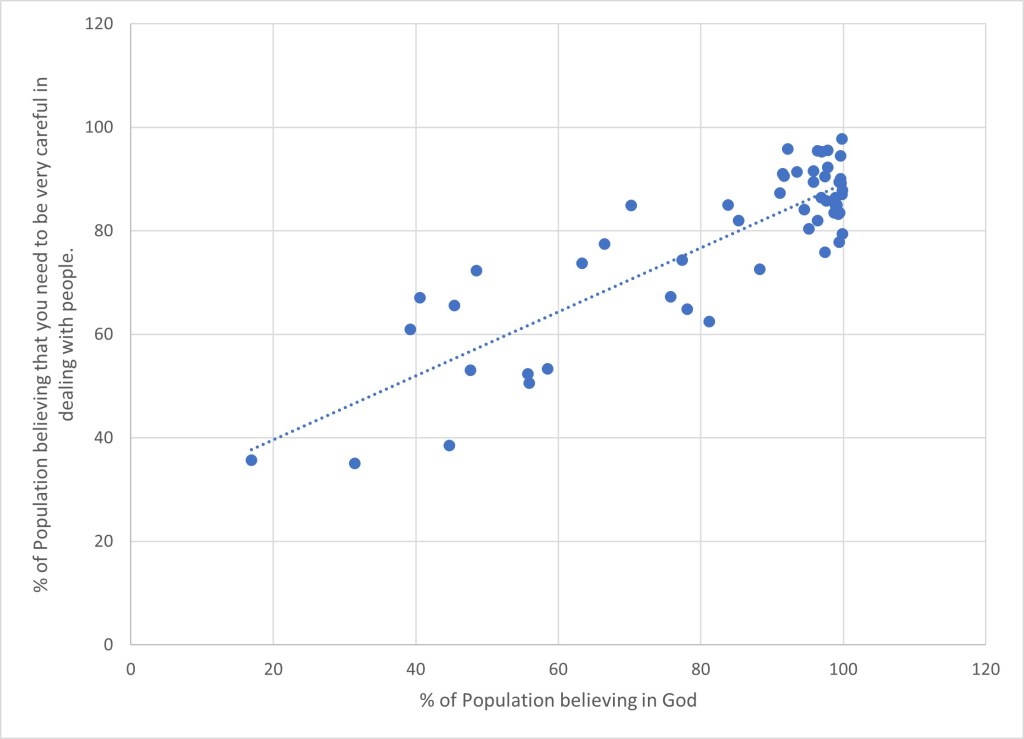
For the 54 countries where both sets of data exist, the graph below compares two sets of data from the most recent World Values Survey, i.e., the percentage of national population who believe that you need to be very careful in dealing with people (Q57), and the percentage of the population who believe in God (Q165). The coefficient of correlation here is 0.86 which indicates a strong relationship.

Correlation between two variables can indicate cause and effect, but not necessarily so. For example, the two variables may have a common cause. Thus, belief in God, fragility, and the need for care may all have a common cause. Alternatively, belief in God might be interpreted as causing fragility and the need for great care in dealing with people. These options seem unlikely, however. Firstly, because the national fragility index comprises a very wide range of variables and it is difficult to identify anything that has been overlooked which might cause both fragility and belief in God. Secondly, many religions emphasise good relationships with one’s fellow human beings, rather than distrust of them.

I would suggest, therefore, that the most likely relationship is one in which national fragility and the need for care in dealing with people are, in part at least, causes of a belief in God. If so, then this may be because people’s need for security and stability, when not provided by the state, is satisfied by believing in God. That is, belief in an infallible being with our own interest and our society’s interest at heart. Conversely, if the state does provide security and stability, then the need for a belief in God is reduced.

References

  • https://fragilestatesindex.org/
  • Haerpfer, C., Inglehart, R., Moreno, A., Welzel, C., Kizilova, K., Diez-Medrano J., M. Lagos, P. Norris, E. Ponarin & B. Puranen (eds.). 2022. World Values Survey: Round Seven – Country-Pooled Datafile Version 5.0. Madrid, Spain & Vienna, Austria: JD Systems Institute & WVSA Secretariat. doi:10.14281/18241.20
Categories
01. Organisational Pathologies

Organisational Pathologies

The fundamental entity in social systems theory is the organisation. That is, any group of people who work together for a common purpose. An organisation may be an individual, a club or society, a business, a charity, a sector, a nation, or the global community. An organisation can also exist temporarily to carry out a short-term project or it can have a longer-term function. This series of articles discusses the ways in which organisations can fail and ways of avoiding this.

The articles also approach the topic from a systems perspective. Every organisation is also a system. It comprises inputs, processes, and outputs. Everything that is not part of the system is its environment. However, for organisations this terminology translates into that of social science. Processes are the needs of the organisation. Inputs are the satisfiers and contra-satisfiers of those needs. Outputs produced by its processes are the purpose of the organisation. That is, the provision of satisfiers and contra-satisfiers for others.

Figure 1. Systems and organisations compared.

Organisations do, however, have two additional features not held by systems in general.

Firstly, outputs are traded for inputs. That is, satisfiers or contra-satisfiers for others are traded for those required by the organisation. This is what binds us together into society. The word “trade” is used in a very general sense and applies not only to businesses but all organisations. Trade is a fundamental aspect of human nature. Its basis is the search to satisfy human and organisational needs. The term is derived from economics, a branch of social science that focusses on the trade of goods, services, and money. However, many regard economics as a specialised branch of psychology. It does, therefore, provide terminology that can be usefully employed in a more general sense. For example, we trade satisfiers for other “non-economic” needs such as relationships and personal growth. We do so in a way that is no less rational than the trading of goods, services, and money.

Secondly, an essential component of an organisation is its control component, i.e., leadership or management, without which the activities of other components cannot be co-ordinated, and without which an organisation does not exist.

Many factors are necessary but only together are they sufficient for an organisation to function satisfactorily. The organisation must receive its necessary inputs, i.e., the necessary satisfiers for its needs must be present, and any contra-satisfiers absent. The control component must carry out its function satisfactorily. There must also be satisfactory communication between it and the other components. The organisation must operate and maintain its processes satisfactorily. It must deliver its outputs of satisfiers or contra-satisfiers for others. Finally, it must adapt to any changes in its environment which impact on these factors.

This means that there are many more ways for an organisation to fail than succeed. In systems theory the causes of systems failures are known as system pathologies. In social systems theory they are, therefore, referred to as social systems pathologies or organisational pathologies. These pathologies can be categorised according to the aspect of the system in which they occur. They are summarised below.  

The System’s Environment

  • The VUCA World (Volatile, Uncertain, Complex, and Ambiguous)

The Control System

  • Self-interest vs. Collective Interest
  • Leadership Competence
  • The Corrupting Effect of Power
  • Contra-Social Leadership Behaviour
  • Psychopathic Leaders
  • Narcissistic Leaders
  • Dark Empathic Leaders
  • Governance, Culture & Ethical Standards

Instability and Self-maintenance

Adaptation to Environmental Change

Vertical Communication

  • Knowledge of Processes
  • Feedback and Monitoring
  • Misinformation
  • Delayed or Absent Response

Inputs & Outputs

  • Mismanagement of Resources
  • Function & the Identification of Needs
  • Equitable Trade
  • Relationships
  • Protectionism and Blocking

Processes

  • Poor Process Design
  • Process Inflexibility
  • Unregulated Feedback

Multiple Causes

  • Extractive Institutions

The articles that follow will discuss each of these pathologies in turn. They can occur in any organisation irrespective of its size and function. However, the name used to describe the same pathology varies between types of organisation. The articles will, therefore, describe the effect of each pathology on a range of organisations of different types, from a small club to a nation.

Categories
14. How to Think Creatively and Discover the Truth

How to Think Creatively and Discover the Truth

The following skills are necessary for creative thinking and discovery of the truth:

  1. poly-perspectivism;
  2. polymathy;
  3. understanding how the brain generates potential solutions to problems;
  4. recognition that observation is the best source of information;
  5. communication;
  6. recognition that authority has no monopoly on the truth;
  7. recognition that models and other simulations of reality are always flawed; and
  8. detective skills.

Poly-perspectivism was described in the previous article “Perspectivism and Poly-perspectivism”. In summary, no-one has the mental capacity to fully understand all aspects of a problem. Each of us is only capable of a partial understanding. This concept is known as perspectivism. It is possible, however, to expand and improve our understanding by interacting with others who have a different perspective. This does not, of course, necessarily mean accepting their perspective. Rather, it can reveal aspects of a problem that we had not previously thought of.

Polymathy. A polymath is someone whose knowledge spans a wide range of subjects. This enables them to see similarities between concepts in different fields of knowledge, even though they may be expressed in different language. This in turn, enables them to transfer innovations and discoveries from one field to another. Furthermore, it enables them to identify inconsistencies between theories in different fields. This article in The Conversation describes research by Robert and Michele Root-Bernstein of the University of Michigan. They have found that Nobel Prize winners are unusually likely to be creative polymaths. The article also gives examples of two such prizewinners.

When we work in specialist silos, we can construct theories that contradict those in other silos. Unfortunately, those contradictions can go unnoticed.  So, a good method for discovering the truth is to aim for breadth of knowledge rather than depth. Try to understand the fundamental principles of several disciplines. These principles can then be combined to create theories. If the theories are inconsistent with one another or what we observe to be true, then some of the fundamental principles must be incorrect.

Understanding how the brain generates potential solutions to problems. This was described in a previous article entitled “The Creative Process and Decision Making”. In summary, we can follow a four-stage process that harnesses the ability of the unconscious mind to solve problems. Stage 1, known as saturation, comprises learning as much as we can about the relevant issue. Stage 2, known as incubation, involves resting the conscious mind and allowing the unconscious to process that information. This may involve taking a short break from our desk or PC, or it may involve one or more nights of good sleep. Stage 3, known as inspiration, occurs when the unconscious mind, without prompting, presents its potential solutions to our consciousness. It is the “aha!” or “Eureka!” moment. Finally, stage 4, known as verification, comprises consciously checking that the inspiration is correct. Unfortunately, the unconscious mind does not always get it right. So, some additional research and incubation may be necessary. Once we understand this process, we can consciously employ it to great advantage in our day-to-day efforts. It is why it is often wise not to make decisions precipitously, but rather to “sleep on them”, or think about them for a while.

Recognition that observation is the best source of information. Human senses have evolved to better enable us to survive and procreate. So, one would expect the information gained through them to be a reasonable representation of reality. On the other hand, information gained from others is not necessarily true. We can also construct theories that contradict observed reality. There are a multitude of reasons why theories may be wholly or partially false: simple error, assumptions learned from society, a wish to gain status and attention, a wish to deliberately mislead, and so on. Building theories upon theories without verifying them by observation can lead not only to the propagation of errors and falsehoods, but also to the amplification of them. It is for this reason that scientists carry out practical experiments to verify their theories, and the same should apply in our daily lives.

Communication. It is better to express complex ideas in simple language, rather than simple ideas in complex language. The former increases the likelihood that the idea will be understood. The latter is often mere pretentiousness, with the aim of gaining unwarranted status. Unfortunately, the latter can also hide simple concepts behind a cloak of mystique. Consider, for example, the words of one eminent professor commenting on the work of an eminent sociologist:

“Under the regime of self-referential systems, “self-regulation” changes sense from automatic control to autonomous self-constitution, and the polarity between open and closed systems is sublated by supplementary relation binding openness to the environment to the closure of system operations.”

These words can be translated into plain English, as follows:

“A self-referential system contains and uses a description of itself. It is, therefore, self-aware. The theory of self-referential systems states that they control their own processes, rather than working automatically. They also recognise a difference between relationships within themselves and relationships with their environment.”

I am sure that all self-aware human beings regard this statement as obvious once it is stripped of its jargon.

    Recognition that authority has no monopoly on the truth. In life, we encounter individuals who have high social status because of their work in a particular field. We have a natural tendency to accept their theories as being true. This is known as “appeal to authority”. It is a logical fallacy which suggests that high status individuals have a monopoly on the truth. However, status can be carefully cultivated as a goal. Furthermore, a strong bond can develop between an individual’s status and the theory put forward by them. So, the theory becomes resistant to change, even in the face of contradictory evidence. Those who benefit by supporting the high-status individual are similarly bound to their theories. So, we should not automatically accept theories simply because they are propounded by someone of high status.

    Recognition that models and other simulations of reality are always flawed. Because human cognition has evolved, it can be expected to be a reasonable representation of reality. However, its limitations mean that it must also be a simplification. We formalise our understanding using various models, for example, language, mathematics, diagrams, computer simulations, etc. Inevitably these models are also simplifications.

    Models can be used, to a limited degree, to predict events. However, the prevailing view is that increasing their complexity by, for example, increasing the number of variables, does not necessarily increase the accuracy of their prediction. It is more effective to identify the most significant variables and keep the model relatively simple.

    Detective Skills. To convict a criminal, the prosecution must convince the jury that the defendant had the motive, means, and opportunity to commit the crime. The motive is the reason to commit the crime, the means is the ability and necessary tools to do so, and the opportunity is the time and circumstances that make the crime possible. If any of the three are absent, then the defendant is not guilty.

    The same is true of any act, criminal or otherwise, and so, theories about social causes and effects can be tested in the same way. For example, does a government have the motive, means, and opportunity to enact environmental legislation? It certainly has the means, and if the legislative programme permits, it has the opportunity. It is, therefore, the motive that is questionable and where attention needs to be focused.

    Categories
    18. Social Systems Theory in Practice - An Example (Part 2)

    Social Systems Theory in Practice – An Example (Part2)

    Formalisation

    The example described in my previous post can be described graphically and, potentially, a mathematical or computer model can be created. A diagrammatic representation of the example is given in the figure below.

    Figure 1. Causal diagram showing increasing complexity in Western society.

    In this diagram, the coloured rectangles represent a society’s variable characteristics. These characteristics have numerical values that alter with time and can be related to one another mathematically. The variable characteristics interact causally as shown by the arrows, which point from cause to effect. In this diagram, all the arrows show the cause as being sufficient for the effect. If several sufficient causes impact on one effect, then their effect is cumulative. However, by joining arrows together after they have left their causes, it is possible to represent several necessary causes as, together, being sufficient for an effect.

    The smaller rectangles describe the nature of the causal relationship. A small up arrow indicates an increase in the variable characteristic. A small down arrow indicates a decrease. The coloured background indicates whether the small arrow refers to the cause or to the effect. Small arrows are paired horizontally. In rectangle B, for example, an increase in the cause results in a decrease in the effect.

    The diagram can be explained as follows.

    A. As the number of established organisations increases, so too does the total number of inefficiencies. The reverse is also true.

    B. As the number of inefficiencies decreases, the number of unattached individuals with unsatisfied needs increases. The reverse is also true.

    I. The number of unattached individuals also increases as the population increases. The reverse is also true. Note that population growth is the number of people entering society due to births and immigration, less the number of people leaving it due to deaths and emigration. However, not all of the population is active.

    C. As the number of inefficiencies increases, the number of trading opportunities for unattached individuals also increases. The reverse is also true.

    D & E. As the number of trading opportunities and the number of unattached individuals increases, the number of goods and services that can reduce inefficiency in established organisations also increases. However, the reverse is not true. A decrease in the number of trading opportunities or a decrease in the number of unattached individuals has no effect.

    F. As the number of goods and services provided increases, the number of inefficiencies decreases.

    J. The number of inefficiencies also reduces because of efficiencies carried out by the organisations themselves, i.e., auto-efficiencies. The reverse is also true, and organisations can cause greater inefficiency in many ways.

    G. As the number of goods and services provided increases, the satisfiers received in return also increase. The reverse is also true.

    H. As the number of satisfiers received increases, the number of established organisations increases. The reverse is also true.

    It can be seen from this diagram that the process is a positive feedback loop. With no constraints, the number of established organisations, and thus, the complexity of society can increase exponentially. However, the minor feedback loop BEF can have a damping effect if there is insufficient population growth.

    There are many other examples that would benefit from the same approach. However, they may not be independent of this model, but rather may interact with and extend it. The more examples we consider, the more questions this will raise. If common questions arise from different examples, then this may be an indication of their significance. Answers to some of these common questions may be beneficial in all cases. However, it is also possible that they will be beneficial in some and harmful in others. This is not a bad thing, however, because it would prevent ill-considered decisions, and encourage us to seek optimal solutions.

    Categories
    17. Social Systems Theory in Practice - An Example (Part 1)

    Social Systems Theory in Practice – An Example (Part1)

    Introduction

    The term “Social Systems Theory” is normally used to describe the work of the German social theorist Niklas Luhmann. However, the theory described here differs from Luhmann’s in several ways. In particular, the physicalist perspective holds that everything, including information, exists physically in space-time. This implies that the knowledge of an organisation lies in the neural connections that make up the minds of its members. Thus, contrary to Luhmann’s theory, those members must also be a part of the organisation.

    Intuitively, many of us sense that there are intangible “forces” that are beyond our individual control and that shape our society. In this article, I draw together the information provided in my previous articles on evolution, psychology, organisations, and systems theory, to show that these intangible “forces” are, in fact, tangible processes. These processes provide an understanding of why society is as it is. To a limited extent, the processes also provide an understanding of where society is heading unless we intervene.

    The social systems theory presented here is not a general theory of society. Rather it comprises an understanding of both human and systems behaviour that can be applied in different social contexts. The explanations that it provides will differ for different cultures and in different eras. Nevertheless, the approach has substantial potential value.

    Example

    To demonstrate the theory, I have chosen an example from the present-day Western world. The example provides an explanation of why the complexity of our society is increasing at an accelerating rate. Inevitably, this explanation raises many questions about where the process is heading, whether intervention is necessary, and, if so, what it should be. Some of these questions are considered at the end of this section.

    Western society comprises many interacting organisations whose number increases day by day. Here the term “organisation” is generic. It includes any group of people who work together for a common purpose. It also includes any individual person. For example, an organisation’s function may be fishing, hunting, steelmaking, takeaway meals, or government. For a new organisation to form, a group of people must share a common need and perceive an opportunity to satisfy it by working together. Alternatively, they can share a common contra-need and perceive a way of avoiding it by working together.

    In early simple societies, satisfiers for our needs were taken directly from the natural environment, for example, hunting, fishing, the gathering of vegetables, firewood, etc. To acquire these satisfiers, we formed groups or “organisations” under the leadership of experts. Other groups remained in camp to care for young children. As the size of the tribe increased, specialisation began, and some individuals spent most of their time on a particular activity. Thus, trading between specialist groups became necessary, for example, fish for childcare.

    In present day Western society, few people can take their satisfiers directly from the environment. We all trade with others to satisfy our needs, and this is often in the form of employment by an organisation. Even farmers and miners need the goods and services provided by others to carry out their function.

    This situation has arisen because of a positive feedback process which continues to this day. Because the process is cyclical and it is impossible to say what stage came first, I could begin its description at any point. So, beginning with increasing organisational efficiency, the process is as follows.

    • As the efficiency of an existing organisation increases, fewer people are required to carry out its function. The same is true of an individual, but efficiencies release the individual’s time.
    • However, these unattached individuals must still satisfy their needs and are usually unable to do so directly from the natural environment. So, they will seek opportunities to satisfy their needs by trading with established organisations. To that end, the unattached individuals will identify the needs of the established organisations. These needs may be goods or services that established organisations lack, or it may be aspects of the established organisations’ functions that could be carried out more efficiently.
    • If a group of unattached individuals share a common interest in providing goods, services, or efficiencies, then to do so more effectively they may form a new organisation and take on employees.
    • Not all new organisations are successful. The process is one of trial and error, and so, it is evolutionary.
    • The new organisation becomes established if it achieves its objective of trading with existing established organisations. This includes trading with individuals. Any efficiency that the new organisation provides results in the release of more people. Successful trading also satisfies the needs of the new organisation’s members.
    • Finally, the cycle is repeated with the new organisation as an established one.
    • Thus, the number of organisations in a society and the complexity of their interactions grows as time progresses.
    • Without any constraints, this growth would be exponential. However, constraints do exist, some of which are described below.

    One constraint is the number of unattached people available to form new organisations. In a subsistence society there are none because everyone is fully engaged in satisfying their basic needs. So, the process may never begin without external intervention such as investment. In Western society, the growth of complexity initially relied on rapid population growth during the industrial revolution. This growth has now slowed to zero, and the release of people from established organisations through increased efficiency drives the process. An additional driver is immigration. However, for unattached people to be effective in forming new organisations, support and retraining is needed. Failing that, many may find themselves unable to satisfy their basic needs without turning to crime or other anti-social activities.

    The constraints of natural resources and the problems they cause are well known. The latter include global warming, pollution, and the extinction of species. Although these issues are of enormous importance, I will not repeat here what has already been expressed very eloquently by others.

    Our ability to understand complexity may also be a constraint. The more organisations there are, and the more diverse their function, the more complex society becomes. There are limits to the level of complexity that we can comprehend, and this has implications for government, the population, and crime. Can this increasing complexity be managed through technological advances? If not, then at what stage will national governments be incapable of governing effectively? At what stage will decentralisation become desirable? At what stage will citizens cease to be effective members of society and form a counterculture? At what stage will citizens begin to seek simple solutions, and at what stage will populist politicians begin to offer them?

    As can be seen, the application of social systems theory to an issue raises many unanswered questions. However, it does begin to identify those that need to be addressed for the wellbeing of humanity and our environment.

    Categories
    05. The Role of Art

    The Role of Art

    Wiston, John A Challoner

    Individual tastes in art vary enormously. This is because we find a work of art, whether it be painting, music, poetry, or literature, beautiful when it unconsciously triggers an association with something from our lives to which positive emotions are attached. For example, if holidays in the South of France have given us pleasure, then similar pleasure can be gained from art that triggers those recollections.

    There are no absolute rules that determine what is “good” or “bad” art. Rather, they have a cultural basis. For example, in the West, music in a major key is generally perceived as happy and music in a minor key as sad. The conventional explanation is that the minor key contains more dissonance and is therefore inherently sad. However, as the research described in the link below shows, non-western cultures can have a greater preference for dissonance, can find the major key strange and foreign, and can attach different emotions to a piece of music than westerners.

    How your culture informs the emotions you feel when listening to music (theconversation.com)

    In summary, therefore, beauty in art arises from both personal and cultural associations.

    However, it is common for high status individuals to collect or sponsor art. There can, of course, be an element of personal pleasure and satisfaction in this. However, the principal reason is to gain followers and grow or maintain the hierarchy that supports their status. High status individuals must overtly appear to have something to trade in return for their followers’ support. They must also appear to have something to trade with high status peers, if alliances are to be formed. In this context, art can be a symbol of the wealth and status that is potentially available for trade.

    Art can also be a symbol of belonging to a particular culture. In the case of high-status individuals, this is a symbol of belonging to the elite. If people who aspire to high status display the symbols of the culture to which they aspire, they are more likely to be selected by their seniors as potential supporters. A taste in art is one such symbol. This creates a positive feedback loop which maintains the status of the art favoured by a culture.

    Art is, of course, often is a symbol of belonging to a sub-culture. In such cases, it often expresses rebellion against established social norms through its rebellion against established artistic norms.

    Wealthy, high-status individuals also collect art as an investment. This creates another positive feedback loop. The highest-status individuals can establish what new developments in art are accepted by their culture. Followers aspire to that culture and, thus, display its symbols. Demand for the new development in art grows among the wealthy and, thus, prices increase.

    Similar principles apply to other aspects of the elite’s culture, e.g., vehicles, clothing, homes, etc. Families who are established members of the elite pass its culture on to their children. However, the nouveau riche and those who aspire to the elite are less well “educated”. Some will, therefore, emulate wealthy and powerful role models without fully understanding how the process works. They can, therefore, seem merely brash until they gain experience. Finally, some who aspire to the elite can be duped, by advertising, into incorrectly believing that certain products signal high status and can, therefore, help them to achieve it. Watch the advertisements with this in mind.

    So, if you wish to enjoy art, then enjoy art that does give you pleasure, rather art that should give you pleasure.