Categories
41. A Theory of Society Derived form the Principles of Systems, Psychology, Ecology & Evolution Part 4

A Theory of Society Derived from the Principles of Systems, Psychology, Ecology & Evolution, Part 4

Part 4 of this series of papers is open access and can be downloaded in pdf format free of charge at https://rational-understanding.com/my-books#theory-of-society-4

Part 1 discussed the structure of society, i.e., the relationships between human holons, such as individuals, organisations or nations, the various forms these relationships can take, and how they alter with time. It notes that, with a very few exceptions, human interactions are much the same as those encountered elsewhere in the animal world. Conventionally, the structure of society is taken to mean its network of cooperative relationships. However, in this series of papers, a much broader definition is used that includes non-cooperative ones. Thus, for example, ongoing wars are also considered a part of this structure. It is also acknowledged that it is not only human needs that dictate relationships and the way that they change but also the values, norms and beliefs held by the related parties. Thus, the subsequent Parts of this series discuss the latter in more detail.

Part 2 described the work of the English philosopher of science, Roy Bhaskar (1944 – 2014), and the English sociologist, Margaret Archer (1943 – 2023). Roy Bhaskar is regarded as the founder of Critical Realism, a philosophy that holds reality to exist and to be the source of truth. It also holds that our beliefs about reality are not necessarily true. Both Roy Bhaskar and Margaret Archer described how culture affects individual agency and how individual agency alters culture. Bhaskar referred to his model as the Transformational Model of Social Activity (TMSA), and Archer to her model as the Morphogenetic Cycle. Archer also described how reflexivity, i.e., an agent’s internal conversations, can lead to cultural and structural change.

Part 3 built on the work of Margaret Archer to describe the outcomes of those internal conversations in more detail. It explains that to satisfy our needs or to avoid contra-satisfiers, we can adopt, form and propagate beliefs that are not necessarily true, but ones thought likely to satisfy our needs. Furthermore, to avoid anxiety caused by circumstances beyond our control we can adopt beliefs that act as psychological defence mechanisms. These beliefs when propagated do, of course, influence culture and structure.

Part 4 now draws on the preceding three parts to discuss the nature of culture in more detail, together with the processes of cultural evolution, stagnation, regression and speciation.

Categories
31. The Fractal Nature of Society

The Fractal Nature of Society

The fractal structure of nature was discovered by the French-American mathematician, Benoit Mandelbrot, in 1980. Many of you will be familiar with fractals and so it is not my intention to describe them in detail. Rather, if you are unfamiliar with them, I refer you to the very clear explanation given at https://math.libretexts.org/Courses/College_of_the_Canyons/Math_100%3A_Liberal_Arts_Mathematics_(Saburo_Matsumoto)/07%3A_Mathematics_and_the_Arts/7.04%3A_Fractals

Eliot Kersgaard (2019) defines a fractal as a system with similar properties at all scales. Many readers will be familiar with numerical fractals such as the Mandelbrot set or geometrical fractals such as the Sierpinski triangle. This is where most fractal research has focused. In these cases, Kersgaard’s “scale” is numerical or geometrical. However, these fractals are normally displayed using the two dimensions of a piece of paper or a video screen. So, incorrectly, their scale appears to be spatial. However, “scale” can also apply in a physical sense to features of reality, such as objects, events, or relationships, in which case “scale” is genuinely either spatial or spatio-temporal.  The leaf of a fern is, for example, a genuine spatial fractal.

The Viable Systems Model (VSM) was proposed by the British psychologist, Stafford Beer, in his 1972 book “The Brain of the Firm”. This model is used as a framework for understanding human organisations, but it is also thought to apply more broadly to other living things. Again, without going into detail, the model proposes that every organisation has a control component that coordinates the activities of other components, e.g., the brain of a human being or the manager of a team or organisation. For those unfamiliar with the model, I refer you to the explanation at https://www.toolshero.com/management/viable-system-model/.

Beer recognised that his VSM model was recursive, i.e., every model comprised components, one of which was a control component, and every component was a VSM model. However, this was before the fractal structure of nature was discovered by Benoit Mandelbrot. In fact, the VSM model is a fractal generator that applies at all scales of organisation and is comparable therefore to the simple recursive formula used to generate the Mandelbrot Set. Furthermore, control applies to a function, and there are very many functions. This means that the VSM model is likely to apply quite extensively in natural and artificial ecosystems. Choose any “organisation” and function anywhere among living things and you are likely to find that VSM applies. There is never just one “controller” therefore. Rather every living thing both controls and is controlled.

Little work has been done on the fractal nature of human society. However, the following paper raises the concept as a possibility. https://www.academia.edu/47938193/Fractals_in_Social_Sciences_an_introductory_remark

The rule that creates a fractal is known as a generator. For example, a simple recursive mathematical equation acts as the generator of the Mandelbrot set. The generator for human society is, however, more complex. It is the relationships between human holons at various scales that create society. However, these relationships are not always cooperative ones. If that were the case, then all of humanity would comprise just one organisation with a single leader. This is clearly not the case and, as an alternative, I would therefore suggest the following generator.

  • A human holon is any person, group of people, or group of groups who cooperate with a common purpose. The cooperation of more than one human holon creates another at greater scale. Thus, human holons form a nested hierarchy.
  • Every human holon has a control or management component. This, in conjunction with the principle above, results in a control or management hierarchy. For a holon of greater scale to be formed, it is not necessary that every pair of components cooperate horizontally with one another. However, they must cooperate vertically with the control component.
  • A satisfier is an external thing that satisfies a human holon’s needs. For example, it may be food for an individual person, or electricity for a manufacturing organisation. There are many such satisfiers, and they determine the function of their source. The more specialised this function, the less extensive the range of sources, and the more likely it is that two human holons with a common need will share the source of a satisfier.
  • The source of a satisfier also depends on the geographical location and culture of the holon. Sources closer to and with a similar culture to the holon tend to be used first. Thus, the closer two holons are geographically and culturally, the more likely they are to share the source of a satisfier.
  • The relationship between two human holons is neutral if the source of a common satisfier differs for both. It is also neutral if the source of a common satisfier is shared, but the satisfier is sufficient for the needs of both.
  • If the source or sources of a common satisfier are not sufficient for both when they act independently, but are sufficient if they act cooperatively, then two human holons may cooperate. However, a degree of randomness is introduced by holons not considering cooperation in these circumstances.
  • If the source or sources of a common satisfier are not sufficient for both, then two human holons will compete to satisfy their needs. Competition, unless externally controlled, can escalate into conflict.
  • Leadership roles act as a satisfier and are limited in their availability. So, they will generate competition among any human holons who aspire to them. Thus, there can be horizontal competition between the components of a holon and between discrete holons.

This generator is hypothetical, of course, but I believe it to be a good foundation for a theory of society.

References

Beer, S. 1972. “Brain Of The Firm”. Allen Lane, The Penguin Press, London, Herder and Herder, USA.

Kersgaard, E., 2019. “Life’s Universal Patterns”. Medium. https://medium.com/illumination/lifes-universal-patterns-e534475aabf6

Mandelbrot, B. B., 1982. “The Fractal Geometry of Nature”. W. H. Freeman.

Categories
15. Uncontrolled Social Feedback and How to Control It

Uncontrolled Social Feedback & How to Control It

In his 1980 paper “A Confluence of Feedback Loops in Social and Educational Structure: (in the context of developed and developing countries)”, M. M. Gupta of the Systems Science Research Laboratory, University of Saskatchewan, Canada, stated the following.

“In the case of inanimated physical systems, it is a well-known empirical fact that unrestrained increase in the degree of positive feedback between the various components of a system leads to instability, oscillations, and eventually to a failure. There is a warning in this that cannot be ignored: Our socio-economic systems, too, are likely to face an eventual catastrophic failure if the growth in the degree of interdependence within them is not accompanied by better planning, coordination, and – what might be much less palatable – restraints on our freedom… In fact, in some of the advanced societies of so-called developed countries, with libertarian traditions – in which there is an understandable aversion to planning and control – our society is already witnessing the manifestations of what might be diagnosed as the ‘crisis of undercoordination’: vehicular and air traffic congestion, deterioration in the quality of municipal services, decay of urban centers, power blackouts, air, water and other environmental pollution, shortage of energy, unemployment, strikes, inflation, recession and depression, wars, depletion of earth’s non-renewable resources, and political and other economic crisis, etc. And there may well be the precursors of far more serious stresses and strains which lie ahead – stresses which may test to the limit the endurance of our democratic institutions – both in the developing and the developed countries.”

The solution that Gupta offered lies in Social Systems Theory. This concept has two aspects. Firstly, Social Systems Science, whose aim is to identify and understand the processes at work in society, i.e., why do we behave as we do? Secondly, Gupta uses the term Social Systems Engineering to describe the practical modification of existing feedback loops and other forms of causality to achieve a stated objective. That is, how to do what needs to be done for us to behave in a more sustainable, socially friendly, and environmentally friendly way.

The term, ‘Social Systems Engineering’, was coined in the 1970s and suggests that society should be steered in a mechanistic way by technocrats aloof from the rest of society. This is not possible or desirable. We are all subject to the same virtues and shortcomings, albeit in varying degrees, and the ideal technocratic leader does not exist.

It is also important to be aware that Social Systems Engineering can also be used to satisfy the needs of one group to the detriment of another. Its objectives should, therefore, be ethical and aim for improvements in the wellbeing of the natural environment and all of humanity.

So, in practice, the rational approach to steering society needs to be built into our democratic processes, rather than entrusted to the hands of a few. A better term might therefore, be ‘rational and informed democratic intervention’.

In his paper, Gupta concludes that “The strength of social systems engineering [or rational and informed democratic intervention] lies in its willingness to confront the basic issues and problems in the present day setup of socio-economic systems, and its boldness to borrow and integrate ideas and methodologies from the disciplines such as humanities and social sciences. We need system engineering, social scientists, and economists to spend more and more of their cooperative efforts in this direction. It can make a pragmatic contribution if we can bring a stability to our socio-economic system.”

To this I would add that, in order to fully understand our social processes, we also need to consider the evolutionary and ecological principles that have formed them.

Gupta’s paper was written in 1979, during a period of trade union unrest, and in it he refers to the UK as “the sick man of Europe”. However, times have moved on. Rightly or wrongly neo-liberalism has reduced the power of trade unions, and we currently face a new set of difficulties. Nevertheless, his recommendations remain relevant, albeit in a different context.

Reference

Gupta, M.M., 1980. “A Confluence of Feedback Loops in Social and Educational Structure: (in the context of developed and developing countries)”. Editors: De Giorgio, A. & C. Roveda, C. “Criteria for Selecting Appropriate Technologies Under Different Cultural, Technical and Social Conditions”, Pages 221-229. Pergamon. ISBN 9780080244556. https://doi.org/10.1016/B978-0-08-024455-6.50031-7. https://www.sciencedirect.com/science/article/pii/B9780080244556500317

Categories
14. Suggestions for the Analysis of Social Systems

Suggestions for the Analysis of Social Systems

Causal Diagrams

Social systems can be represented using causal diagrams. An example is given below. Most interactions are two-way. That is, satisfiers and contra-satisfiers are traded between the two interacting organisations or individuals. These satisfiers and contra-satisfiers can be:

  • absent;
  • latent, i.e., potential, promised, or threatened;
  • precarious, i.e., present now but not necessarily in the future; or
  • entrenched, i.e., present now and assured for the future.

In principle at least, the diagrams can then be translated into a series of causal equations that can be combined and manipulated according to the rules of logic.

Figure: A causal diagram showing a typical co-operative trading relationship between two organisations or individuals

Societal Laws

Each level of organisation in society has a discipline or field of study associated with it, and much work has already been done to identify laws and rules for the behaviour of those organisations. Although there is considerable overlap, each discipline tends to focus on a particular level or levels of organisation. For example:

  • international relations focus on nations within the global community;
  • political science focuses on sectors and the governance of nations;
  • management focuses on the interaction of individuals, teams and departments within organisations;
  • social psychology focuses on interactions between individuals; and so on.

Furthermore, economics studies the field of money and trade, and information theory the field of communication.

It is suggested, therefore, that these disciplines be compared for isomorphisms. That is, accepted rules or laws in each discipline that are like those in others, and which can be generalized to yield societal laws. It should be noted, however, that new properties emerge with increasing complexity. Thus, whilst a law applying at one level will probably also apply in the levels above, it will not necessarily apply in the levels below.

Money

Many interactions involve a flow in one direction of real satisfiers or contra-satisfiers, i.e., materials, energy, or information, and the flow of money in the other. Money is a virtual satisfier and allows more complex interactions than direct barter.

However, not all transactions involve the trade of real satisfiers or contra-satisfiers for money. The direct barter of satisfiers for satisfiers still exists, particularly at the level of interaction between individuals, and particularly when information is the satisfier. Thus, economics cannot fully explain society.

However, because the flow of money is in a reverse direction to the flow of materials, energy, and information, where there is an economic theory there may also be a theory of real satisfiers that can be generalized to situations in which barter still takes place. In other words, there may also be a more general theory of the trade of satisfiers which includes both financial transactions and barter.  “Willingness to pay” surveys are, for example, often used to place a monetary value on satisfiers.

Care needs to be taken though. Economic theories not only partially explain society, but are often also based on a particular historical context. Any more general theory would need to be disconnected from any such context. Thus, a way forward may be the research of generally accepted economic theories to see if they can be converted into more general ones that also apply to barter and are independent of context.

Practical Modelling

Despite simplification, the volume of information needed to predict society is too great for the human mind to process. It is necessary, therefore, to build a mathematical or computer model. An outline of how we might do so is given below:

  1. Identify the organisation of interest. That is, the organisation whose behaviour needs to be understood in order to predict or alter its future. Examples include humanity as a whole, a nation, or a business.
  2. Identify the highest-level components or holons of that organisation. For example, if the organisation of interest is a nation, these will be its sectors.
  3. Identify the external interactions taking place between the organisation of interest or its components and any external organisations.
  4. Initially, assume that all horizontal internal interactions between components are ones of co-operation, and that all vertical internal interactions are in accordance with the prevailing social contract.
  5. Initially, assume that all information held or transmitted is true.
  6. Run several instances of the model with other forms of interaction randomly distributed and in proportion to their real-world prevalence. They should be distributed across both internal and external interactions. Modifications include positive or negative competition horizontally, and the personal, species, or environmental contract vertically. They can also include stored or transmitted misinformation.
  7. Assess the outcomes and identify any patterns that may emerge.
  8. Identify critical components whose interactions must be of a particular type for stability of the whole. Also, identify any critical information which must be true for the same reason.
  9. For critical components, go into more detail, model components at the next level down and repeat the above process. For example, if a sector is critical, then consider its component organisations. Continue this process until it reaches individual roles, if necessary.
  10. Establish control measures to prevent critical roles from being occupied by inappropriate individuals, and any critical information from being falsified, for example, national leaders should not engage in personal contract relationships. However, to permit cultural evolution and avoid stagnation, non-critical roles should not be controlled in this way.
Categories
12. Understanding Social Complexity

Understanding Social Complexity

Holons and Nested Hierarchies

We understand the world in terms of holons and the relationships between them. A holon is any entity that can be recognised as a whole in itself. We recognise holons because they recur in different circumstances or environments, and so, we can draw a boundary around them that distinguishes them from their environment.

Holons exist in nested hierarchies. That is, every holon comprises several lesser holons and every holon is also part of a greater one. For example, particles are components of atoms, atoms components of molecules, molecules components of planets, and so on.

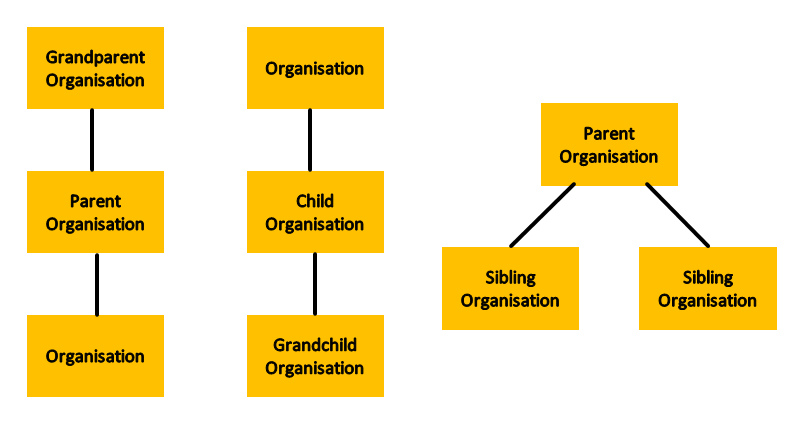
In the case of human society, the holons are individuals and organisations. Individuals are components of organisations, organisations are components of parent organisations, parent organisations are components of grandparent ones, and so on.

Figure – Family relationships between organisations in a hierarchy

As we progress downwards through this hierarchy of organisations, functional differentiation takes place. That is, the function or purpose of an organisation is broken down into the interacting component functions of child organisations. Alternatively, component functions can be carried out by other unrelated organisations through a process of trade.

Simplifying Social Complexity

In a stable society, functional differentiation naturally increases with time, and alongside it, social complexity. Up to a point, the efficiency with which any overall function is carried out also increases. However, there may be an optimum beyond which efficiency begins to decline.

If a system is complex and comprises too many components and relationships for the human mind to comprehend, then we attempt to simplify it. We do so by seeking fewer larger holons that bundle together components into recurring and recognisable patterns. Fortunately, society is structured in a way that makes it easy for us to find such holons. If we were, for example, to attempt to understand and predict the future of a nation by considering the relationships between individual citizens, then complexity would be so great that we would be unlikely to make progress. However, individual citizens form part of organisations such as sectors. If these sectors are taken as our holons and the relationships between them considered, then a far less complex model results.

In fact, this is what we do in practice. Furthermore, it is very likely that we structure society in this way to better enable us to understand it. For example, the field of international affairs uses nations as its holons, political science uses sectors, management theory organisations within parent organisations, and social psychology individuals. We do this intuitively, rather than as a consequence of any formal systems theory. However, the fact that social systems theory predicts what takes place in practice is strong support for the former’s validity.

Categories
18. Social Systems Theory in Practice - An Example (Part 2)

Social Systems Theory in Practice – An Example (Part2)

Formalisation

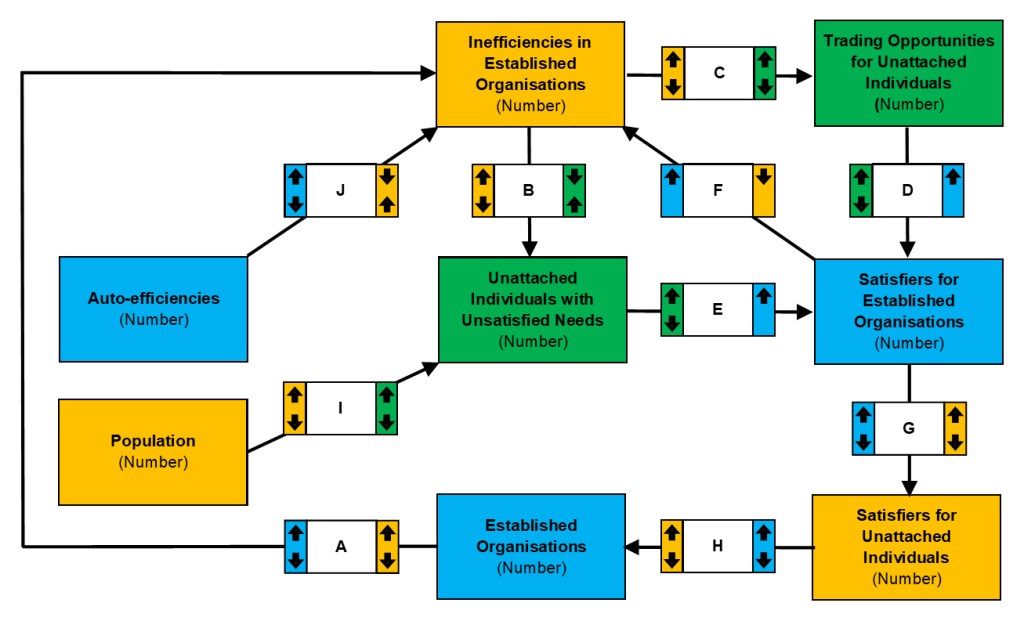
The example described in my previous post can be described graphically and, potentially, a mathematical or computer model can be created. A diagrammatic representation of the example is given in the figure below.

Figure 1. Causal diagram showing increasing complexity in Western society.

In this diagram, the coloured rectangles represent a society’s variable characteristics. These characteristics have numerical values that alter with time and can be related to one another mathematically. The variable characteristics interact causally as shown by the arrows, which point from cause to effect. In this diagram, all the arrows show the cause as being sufficient for the effect. If several sufficient causes impact on one effect, then their effect is cumulative. However, by joining arrows together after they have left their causes, it is possible to represent several necessary causes as, together, being sufficient for an effect.

The smaller rectangles describe the nature of the causal relationship. A small up arrow indicates an increase in the variable characteristic. A small down arrow indicates a decrease. The coloured background indicates whether the small arrow refers to the cause or to the effect. Small arrows are paired horizontally. In rectangle B, for example, an increase in the cause results in a decrease in the effect.

The diagram can be explained as follows.

A. As the number of established organisations increases, so too does the total number of inefficiencies. The reverse is also true.

B. As the number of inefficiencies decreases, the number of unattached individuals with unsatisfied needs increases. The reverse is also true.

I. The number of unattached individuals also increases as the population increases. The reverse is also true. Note that population growth is the number of people entering society due to births and immigration, less the number of people leaving it due to deaths and emigration. However, not all of the population is active.

C. As the number of inefficiencies increases, the number of trading opportunities for unattached individuals also increases. The reverse is also true.

D & E. As the number of trading opportunities and the number of unattached individuals increases, the number of goods and services that can reduce inefficiency in established organisations also increases. However, the reverse is not true. A decrease in the number of trading opportunities or a decrease in the number of unattached individuals has no effect.

F. As the number of goods and services provided increases, the number of inefficiencies decreases.

J. The number of inefficiencies also reduces because of efficiencies carried out by the organisations themselves, i.e., auto-efficiencies. The reverse is also true, and organisations can cause greater inefficiency in many ways.

G. As the number of goods and services provided increases, the satisfiers received in return also increase. The reverse is also true.

H. As the number of satisfiers received increases, the number of established organisations increases. The reverse is also true.

It can be seen from this diagram that the process is a positive feedback loop. With no constraints, the number of established organisations, and thus, the complexity of society can increase exponentially. However, the minor feedback loop BEF can have a damping effect if there is insufficient population growth.

There are many other examples that would benefit from the same approach. However, they may not be independent of this model, but rather may interact with and extend it. The more examples we consider, the more questions this will raise. If common questions arise from different examples, then this may be an indication of their significance. Answers to some of these common questions may be beneficial in all cases. However, it is also possible that they will be beneficial in some and harmful in others. This is not a bad thing, however, because it would prevent ill-considered decisions, and encourage us to seek optimal solutions.

Categories
17. Social Systems Theory in Practice - An Example (Part 1)

Social Systems Theory in Practice – An Example (Part1)

Introduction

The term “Social Systems Theory” is normally used to describe the work of the German social theorist Niklas Luhmann. However, the theory described here differs from Luhmann’s in several ways. In particular, the physicalist perspective holds that everything, including information, exists physically in space-time. This implies that the knowledge of an organisation lies in the neural connections that make up the minds of its members. Thus, contrary to Luhmann’s theory, those members must also be a part of the organisation.

Intuitively, many of us sense that there are intangible “forces” that are beyond our individual control and that shape our society. In this article, I draw together the information provided in my previous articles on evolution, psychology, organisations, and systems theory, to show that these intangible “forces” are, in fact, tangible processes. These processes provide an understanding of why society is as it is. To a limited extent, the processes also provide an understanding of where society is heading unless we intervene.

The social systems theory presented here is not a general theory of society. Rather it comprises an understanding of both human and systems behaviour that can be applied in different social contexts. The explanations that it provides will differ for different cultures and in different eras. Nevertheless, the approach has substantial potential value.

Example

To demonstrate the theory, I have chosen an example from the present-day Western world. The example provides an explanation of why the complexity of our society is increasing at an accelerating rate. Inevitably, this explanation raises many questions about where the process is heading, whether intervention is necessary, and, if so, what it should be. Some of these questions are considered at the end of this section.

Western society comprises many interacting organisations whose number increases day by day. Here the term “organisation” is generic. It includes any group of people who work together for a common purpose. It also includes any individual person. For example, an organisation’s function may be fishing, hunting, steelmaking, takeaway meals, or government. For a new organisation to form, a group of people must share a common need and perceive an opportunity to satisfy it by working together. Alternatively, they can share a common contra-need and perceive a way of avoiding it by working together.

In early simple societies, satisfiers for our needs were taken directly from the natural environment, for example, hunting, fishing, the gathering of vegetables, firewood, etc. To acquire these satisfiers, we formed groups or “organisations” under the leadership of experts. Other groups remained in camp to care for young children. As the size of the tribe increased, specialisation began, and some individuals spent most of their time on a particular activity. Thus, trading between specialist groups became necessary, for example, fish for childcare.

In present day Western society, few people can take their satisfiers directly from the environment. We all trade with others to satisfy our needs, and this is often in the form of employment by an organisation. Even farmers and miners need the goods and services provided by others to carry out their function.

This situation has arisen because of a positive feedback process which continues to this day. Because the process is cyclical and it is impossible to say what stage came first, I could begin its description at any point. So, beginning with increasing organisational efficiency, the process is as follows.

  • As the efficiency of an existing organisation increases, fewer people are required to carry out its function. The same is true of an individual, but efficiencies release the individual’s time.
  • However, these unattached individuals must still satisfy their needs and are usually unable to do so directly from the natural environment. So, they will seek opportunities to satisfy their needs by trading with established organisations. To that end, the unattached individuals will identify the needs of the established organisations. These needs may be goods or services that established organisations lack, or it may be aspects of the established organisations’ functions that could be carried out more efficiently.
  • If a group of unattached individuals share a common interest in providing goods, services, or efficiencies, then to do so more effectively they may form a new organisation and take on employees.
  • Not all new organisations are successful. The process is one of trial and error, and so, it is evolutionary.
  • The new organisation becomes established if it achieves its objective of trading with existing established organisations. This includes trading with individuals. Any efficiency that the new organisation provides results in the release of more people. Successful trading also satisfies the needs of the new organisation’s members.
  • Finally, the cycle is repeated with the new organisation as an established one.
  • Thus, the number of organisations in a society and the complexity of their interactions grows as time progresses.
  • Without any constraints, this growth would be exponential. However, constraints do exist, some of which are described below.

One constraint is the number of unattached people available to form new organisations. In a subsistence society there are none because everyone is fully engaged in satisfying their basic needs. So, the process may never begin without external intervention such as investment. In Western society, the growth of complexity initially relied on rapid population growth during the industrial revolution. This growth has now slowed to zero, and the release of people from established organisations through increased efficiency drives the process. An additional driver is immigration. However, for unattached people to be effective in forming new organisations, support and retraining is needed. Failing that, many may find themselves unable to satisfy their basic needs without turning to crime or other anti-social activities.

The constraints of natural resources and the problems they cause are well known. The latter include global warming, pollution, and the extinction of species. Although these issues are of enormous importance, I will not repeat here what has already been expressed very eloquently by others.

Our ability to understand complexity may also be a constraint. The more organisations there are, and the more diverse their function, the more complex society becomes. There are limits to the level of complexity that we can comprehend, and this has implications for government, the population, and crime. Can this increasing complexity be managed through technological advances? If not, then at what stage will national governments be incapable of governing effectively? At what stage will decentralisation become desirable? At what stage will citizens cease to be effective members of society and form a counterculture? At what stage will citizens begin to seek simple solutions, and at what stage will populist politicians begin to offer them?

As can be seen, the application of social systems theory to an issue raises many unanswered questions. However, it does begin to identify those that need to be addressed for the wellbeing of humanity and our environment.

Categories
01. A Systems Model of Human Organisation (Part 1)

A Systems Model of Human Organisation (Part 1)

Introduction

I will now use the principles of general systems theory to describe the nature of human society. Due to its length, I have split this article down into three posts, but if you would like to read it in one sitting a copy can be downloaded here https://rational-understanding.com/my-books#systems-model.

The model is generic and applies to human organisation at all scales. It can only be fully understood if this is borne in mind. Some of the terms used are borrowed from particular aspects of human organisation, such as international affairs. However, here they are used generically. Examples are also given from various branches of human organisation, but again the concept described can be applied generically.

The Structure of Society

Human society is a hierarchy of organisations. In this context, the word “organisations” has a general meaning which includes not only formal organisations, such as those found in business or government, but any group of people who work together for a common purpose. It also includes any individual person. The hierarchy typically comprises the following levels. Level 6 is the highest, and level 1 the lowest.

6. Global System

5. National Groupings

4. Nations

3. Sectors

2. Organisations

1. Individuals

There is, of course, only one global system. However, the other levels each comprise several systems each of which is an organisation. Each organisation, except individual people, comprises several component sub-systems which are also organisations. Thus: the global system comprises several national groupings; each national grouping comprises several nations; each nation has several sectors; and so on. From the perspective of any organisation, the levels above it are its environment. If an organisation is a part of a more extensive organisation at a higher level, then the latter is referred to as a parent or grandparent organisation.

This structure is recursive, i.e., the same principles apply to organisations at every level. This helps to simplify what would otherwise be a very complex social structure.

Progressive Mechanisation & Centralisation

According the biologist, Ludwig von Bertalanffy, it is common for “progressive mechanisation” to occur in biological systems. That is a system whose components initially carry out all the functions of the organism begin to diversify and take on specific roles depending on their location within it. Thus, for example, an embryo initially comprises identical cells but, as it grows, they diversify to form organs, each with a different purpose.

On the other hand, “progressive centralisation” also occurs, i.e., controls such as the nervous system develop to direct the behaviour of those specialised organs, and co-ordinate their activity.

These processes, by specialising and co-ordinating the activities of the components, enable systems to behave in more complex ways than would otherwise be possible. The resulting behaviour is, of course, subject to natural selection and, thus, evolution.

Similar processes take place in social systems. For example, the members of a small tribe will all be capable of carrying out every function of the tribe. However, as it grows into a larger social group, individuals will begin to specialise, and a leader will emerge to organise their activities. Thus, one can expect people who live a relatively isolated and self-reliant rural life to be multi-skilled and individualistic in attitude. Those who live in cities, on the other hand, can be expected to be more specialised and collectivist in attitude.

Requisite Hierarchy

Every human organisation is a self-maintaining system, comprising inputs, processes, and outputs. It also has goals which act as motivators for its behaviour. In an individual human being, our motivators are the satisfaction of our needs, i.e., states that we are motivated to attain. We are also motivated to avoid negative states which I refer to as contra-needs. More generally however, the motivators of an organisation are those things, including its goals, changes to its inputs, etc., which influence its behaviour. In part, this behaviour is the production of outputs, and in part, it is action to sustain the organisation’s continued existence. A significant proportion of a self-maintaining organisation’s inputs can be spent on the latter.

In accordance with the systems principle of requisite hierarchy, every human organisation has a command component. This component is also an organisation. It has a particular role in coordinating the activities of subordinate components, but, in addition, obeys all the general principles of organisations. In the case of an individual person, the command component is the brain. In the case of groups of individuals, it is a high-status individual or sub-group. However, command sub-groups are also organisations with a command component, and recursion occurs until command is ultimately by a single individual. For example, government is the command component of a nation, and in the UK, the Prime Minister is the command component of government. This also helps to simplify what would otherwise be a very complex social structure.

Self-Maintenance

An organisation requires inputs from its environment to carry out its function. Given no changes to the organisation’s internal processes, certain rates of inflow are necessary to sustain certain rates of outflow. For example, the harder a person works, the more food he or she must consume. In the case of a nation, energy, often in the form of oil, is necessary for a certain level of economic output.

All organisations aim to function efficiently, i.e., to maintain themselves and produce their outputs with the least inputs possible. A form of risk/benefit/cost analysis takes place. In individuals and smaller organisations this has an informal and emotional basis, but in larger organisations it can be more formal and have a financial basis.

If inputs alter, or need to be altered, then the command component must decide whether to:

  1. adapt the organisations internal processes. If so, then, initially at least, increased inputs will be necessary if outputs are not to be reduced.
  2. influence the organisation’s environment to gain the necessary supply of inputs. This entails use of the organisation’s outputs.
  3. carry out a combination of the two.

This article will continue with part 2 next week.