How do societies adapt to change? Why do some institutions reform successfully while others persist in arrangements that no longer work?
These questions sit at the heart of sociology and systems science. Margaret Archer’s Morphogenetic Approach has long provided a powerful way of analysing them by separating structure, culture, and agency and examining how their interaction over time produces stability or transformation.
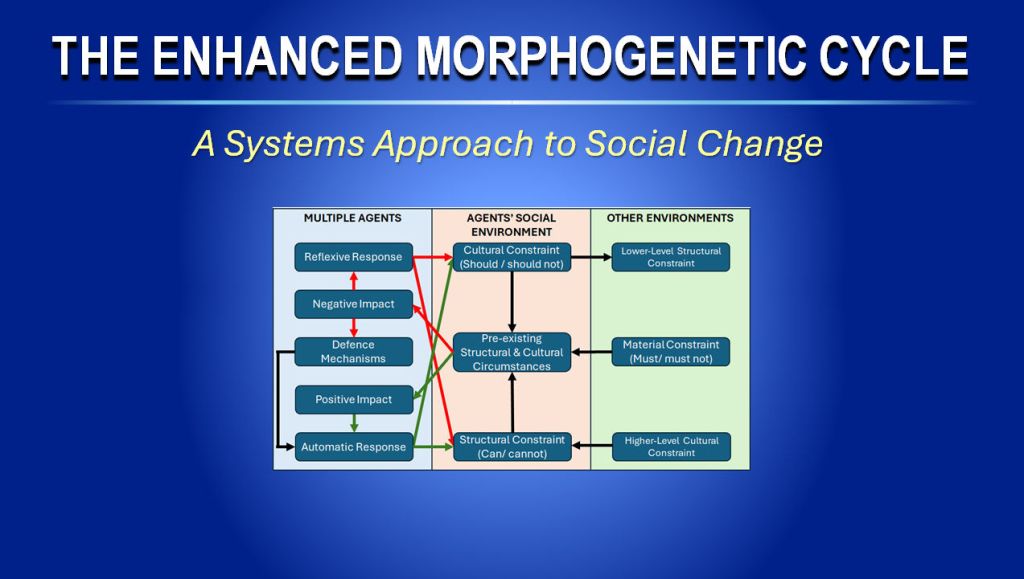
A new paper introduces the Enhanced Morphogenetic Cycle (EMC), a systems-based refinement of the morphogenetic framework designed to clarify the mechanisms through which social systems reproduce or transform.
The enhanced framework introduces several key ideas:
• Three domains of constraint, material, relational, and cultural, which together define the conditions within which social interaction occurs.
• Needs, satisfiers, and contra-satisfiers, which explain how interactions provide feedback that stabilises or destabilises social processes.
• Defensive filtering and needs-driven beliefs, which help explain why individuals and institutions sometimes ignore signals that change is necessary.
• Recognition that social systems are overlapping, hierarchical, and multi-scalar, with agency operating not only at the level of individuals but also through organisations and institutions.
One of the most interesting implications of the model is that the morphogenetic cycle can also be interpreted as a learning process. Individuals, organisations, and societies all receive feedback from their interactions with the environment. When that feedback is interpreted reflexively, systems can adapt. When it is filtered or ignored, instability may accumulate.
The Enhanced Morphogenetic Cycle therefore provides a systems perspective on social adaptation, linking individual learning, organisational decision-making, and broader societal transformation.
This paper serves as the foundation for a series of studies that will explore these ideas in greater detail, including topics such as organisational learning, institutional capture, political dynamics, and social responses to environmental challenges. You can read the full paper here:
 Rational-Understanding.com