Psychopathic personalities can have a major influence on human society, and it is sensible therefore to understand their nature and be able to identify them. The Society for the Scientific Study of Psychopathy says that “the psychopathic personality is NOT equivalent to: violence, serial killing, psychosis, mental illness, psychopathology in general, or antisocial personality disorder.” Rather, it is a collection of traits. These traits were identified by Scott Lilienfeld and Brian Andrewsin their Psychopathic Personality Inventory as:
A lack of empathy and a sense of detachment from others for the sake of achieving one’s own goals.
The ability to charm and influence others.
A distinct lack of emotion, guilt, or regard for others’ feelings.
A difficulty in planning ahead and considering the consequences of actions.
An eagerness for risk-seeking behaviours and a lack of the fear that normally goes with them.
Inability to take responsibility for one’s actions and instead blaming others or rationalising one’s behaviour.
A disregard for social norms and culturally acceptable behaviours. This includes dishonesty and manipulativeness.
A lack of typical marked reactions to traumatic or otherwise stress inducing events.
Recent research which will be described in a future article has, however, cast doubt on the view that all psychopaths lack empathy.
The Society for the Scientific Study of Psychopathy goes on to say that “Although psychopathy is a risk factor for physical aggression, it is by no means synonymous with it. In contrast to individuals with psychotic disorders, most psychopaths are in touch with reality and seemingly rational. Psychopathic individuals are found at elevated rates in prisons and jails but can be found in community settings as well.”
They appear to lack the instinct which enables us to form co-operative groups, and the conscience which enables these groups to function successfully. Thus, they do not suffer the mental conflicts and stress experienced by others in attempting to balance the interests of the group with the shorter-term interests of the self. This lack of a group forming instinct means that normal social rules do not apply when interacting with them.
Nevertheless, a psychopathic personality can gain power for several reasons.
The traits that they display can be mistaken for those of an ideal leader. For example, their manipulative traits can be mistaken for the ability of successful leaders to influence others. Their lack of emotional connection and empathy can be mistaken for a leader’s ability to make tough decisions. Their grandiose behaviour can be mistaken for the confidence expressed by successful leaders.
Their charm, calm demeanour, tolerance of uncertainty and apparent confidence makes them seem to be an ideal charismatic leader in times of disruption and uncertainty. However, if an organisation lacks rules or structure, they can take advantage of this.
Finally, Selfish psychopathic traits will not stand out and may be rewarded in an organisation where competition, individualism, profit, and short-termism prevail.
So, status has a part to play in where psychopathic personalities can be found. Research has shown that the higher in an organisation a person is, the more likely they are to have psychopathic traits or to have had experience of someone with them. Researchers have found high levels of psychopathic traits in British CEOs and US presidents.
Workplace culture also has a part to play. Workplace psychopaths can be found more often in banking, finance, commerce, business, the civil service, the law, the police, and the fire service, and less often in the caring professions.
Gender may also have a part to play. There appears to be a greater risk when an organisation is largely male. However, this does not necessarily mean that women are less likely to be psychopathic than men. Rather, women are more likely to work in the caring professions. So, it may be that their workplace culture is less likely to accept such people in leadership roles.
Finally, there appears to be a greater risk of a workplace psychopath being appointed if the organisation is under pressure and change is necessary.
References
Lilienfeld, S. O., & Andrews, B. P. (1996). “Development and preliminary validation of a self-report measure of psychopathic personality traits in noncriminal population.” Journal of Personality Assessment.
I must admit that, because they trigger unhappy memories, I have been putting off writing the following set of articles. It is reassuring to believe that all human beings are social creatures, but unfortunately that is not the case. Some individuals with dark personalities place self-interest above all else. People of a more social nature who have had the misfortune to meet or interact with a dark individual will, as a minimum, have suffered disillusionment or a sense of injustice. They may also have suffered more material harm.
There are many reasons why we may not like to talk about dark individuals, or believe that they exist. We may blame ourselves for our misfortune or be embarrassed by it. Like me, we may wish to avoid the emotional pain of recalling it. We may prefer to maintain an illusion that such individuals do not exist and, finally, we may fear being labelled as cynics or false accusers. However, there is much objective evidence that such people do exist and can cause considerable social harm. Only if we acknowledge this can something be done about it.
The Dark Factor
The dark factor is a set of human personality traits. It is defined by the psychologists Moshagen, Hilbig, and Zettler, in their 2018 paper, “The dark core of personality”, as the tendency to maximise one’s individual utility – disregarding, accepting, or malevolently provoking dis-utility for others. In other words, looking after oneself, without concern for others, at their expense, or even whilst causing them harm.
Egoism. Excessive concern with one’s own pleasure or advantage, at the expense of community well-being.
Machiavellianism. Manipulativeness, callousness and a strategic-calculating orientation.
Moral Disengagement. A generalized cognitive orientation to the world that differentiates one’s thinking from that of others in a way that leads to unethical behaviour.
Narcissism. An all-consuming need for ego reinforcement.
Psychological Entitlement. A stable and pervasive sense that one deserves more, and is entitled to more, than others.
Psychopathy. Callousness, impulsivity, and deficits in feelings and self-control.
Sadism. Intentionally inflicting physical, sexual, or psychological pain or suffering on others in order to assert power and dominance, or for pleasure and enjoyment.
Self-Interest. The pursuit of gains in socially valued domains, including material goods, social status, recognition, academic or occupational achievement, and happiness.
Spitefulness. A preference that would harm another but that would also entail harm to oneself. This harm could be social, financial, physical or an inconvenience.
The British psychologist, Steve Taylor prefers the concept of “a “dark triad” of three personality traits that belong together: psychopathy, narcissism and Machiavellianism. This makes sense because these traits almost always overlap and are difficult to distinguish from one another. The traits exist on a continuum and are more pronounced in some people than others.”
Unfortunately, there are more ways in which something can “go wrong” than “go right”. For something to “go right” it must be ordered or structured in some way. For it to “go wrong” that order must have failed, and there are many ways in which it can do so. Thus, mental ill-health, for example, takes many forms. The same is true of the dark factor. Individuals with the above traits will have them in varying proportions. Nevertheless, we endeavour to categorise dark behaviours by their similarities. An emphasis on one will cause us to place an individual in that category. However, the correlation between these traits suggests that there is something more fundamental that unites them.
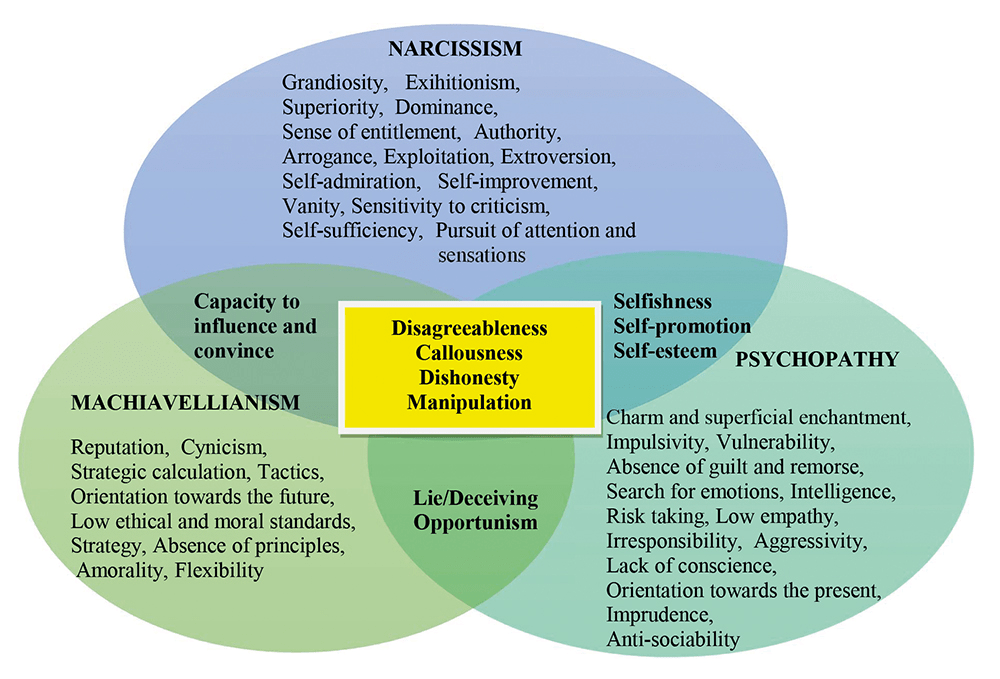
The three personality types have common features as well as their own distinct ones, as described in the Venn-Euler diagram below.
Source: D’Souza, M. F. (2016). Manobras financeiras e o dark triad: o despertar do lado sombrio na gestão (Doctoral Dissertation). São Paulo: Universidade de São Paulo. (Financial manoeuvres and the dark triad: the awakening of the dark side in management)
A notable feature of the three personality types is that some of their characteristics can be desirable in leaders, for example, the vision and charisma of narcissistists, the strategy and tactics of Machiavellians, and the creativity and good strategic thinking of psychopaths. Furthermore, there is evidence that people with dark personality traits are attracted to leadership positions (Furnham 2010). The psychologist Oliver James has identified the prevalence of these personality traits in the workplace (James 2013), and they have been found to be fairly well represented in senior management and chief executive officers (Alernic et al, 2010). Finally, the dark triad traits have been found to be associated with knowledge sabotage, i.e., the deliberate hiding of information or provision of misinformation (Serenko & Choo 2020).
There is disagreement among specialists as to whether dark behaviours are evolutionary traits or psychological disorders. However, significant research evidence suggests that they may be approximately 50% inherited in the form of a predisposition and 50% acquired. There are, for example, genes known to be linked with some of the psychopathic traits. However, psychopathy is also known to be associated with factors such as drug taking and upbringing. Irrespective of the cause, the children of people with the disorder do have a higher risk of suffering it themselves.
The evolutionary explanation for dark factors is unclear. Most evolutionary psychologists speculate that with 90% of the population interacting co-operatively, there has been scope for the evolution of free-riders, i.e., predatory individuals who will take advantage of the normal functioning of human society to meet their needs with minimum effort. However, this explanation seems unsatisfactory as it would require human beings first to evolve social traits and then a small proportion of them to revert to non-social ones.
I would therefore offer the following alternative hypothesis, which has the benefit of greater simplicity. Social behaviour in animals, including humans, has evolved. A focus on personal survival must necessarily have evolved first. Only then could survival be enhanced by social behaviour. The genes involved in social behaviour will have emerged via random mutation and then propagated through the population via natural selection. So, it seems likely, therefore, that these dark traits are a genetic hang-over from ancestor species, rather than mutations in an essentially social species. This hang-over may be because there has been a role in society for such traits that has enabled them to persist.
There are three possible reasons for this persistence, all of which may apply to some degree. Firstly, because, as mentioned above, it may have conferred an advantage on a small number of individuals in what was otherwise a social population. Two contradictory selective processes may have been in play: individual selection for non-social people and group selection for social ones, resulting in a mixed population. Secondly, dark traits may have had a role to play in group selection. Due to their lack of conscience, dark personalities can rise more easily in the social hierarchy to become leaders. Once in that position, they can enforce group cohesion by coercion. In the early stages of human society, when groups were in competition with one another, a dark leader may have improved the chances of group survival, and thus their own, through greater aggression towards other groups. It is surely no coincidence that the world is plagued by despots who gain power by appealing to tribalism and nationalism. Finally, dark personalities also tend to move from partner to partner and have a greater number of offspring whom they then abandon.
It is important to note that evolution cannot predict the future. Life evolves in response to the pressures of the present. Thus, whilst dark traits may have helped humanity to become the dominant species in the past, this is not necessarily the case for the future. Today our species is faced with several existential threats that can only be overcome through a very high level of co-operation, and this is undermined by dark behaviour.
Leaders with dark personality traits can gain power for the following reasons:
their behaviour is less constrained by concern for others;
they can be charismatic, their dark side only emerging when they are under pressure;
they can enjoy and be good at impression management;
some people are willing to follow them due to errors of judgement, self-interest, or fear; and
their environment may lack the controls to prevent such behaviour.
There is also evidence that dark personalities can be attracted to and flourish in particular types of organisation.
Once in a leadership position, they can “derail” the organisation. Organisations are usually co-operative ventures, i.e., people working together with a common aim. However, leaders with dark traits can steer the organisation in a direction more suited to their personal interest. Note that failure due to derailment and failure due to incompetence are two very different things.
Dark personalities also tend to generate a culture of negative competition. I liken this to a running race in which the competitors attempt to kick the feet out from under one another rather than trying to be first over the finish line. Obviously, this can end up in a brawl on the racetrack to the advantage of neither. In smaller relatively independent societies that competed with one another this may have been beneficial to one party, but in a larger global society it generally harms both competitors. We may once have needed dark personalities, but today they present serious risks, for example, nuclear war because of events in Ukraine, an inability to tackle climate change, and so on.
Ultimately, however, these factors lead to the ostracism or demise of an organisation with a dark leadership and associated culture.
Although much of the research on these personality types has been associated with business organisations, the same is true of organisations of all types including nations.
References
Alernic, J.H. & Craig, R.J. (2010) “Accounting as a Facilitator of Extreme Narcissism”. Journal of Business Ethics 96 (1): 79-93. doi:10.1007/s10551-010-0450-0.
Furnham, A., Richards, S.C., Paulhus, D.L. (2013). “The Dark Triad of Personality: A 10 Year Review: Dark Triad of Personality”. Social and Personality Psychology Compass 7 (3): 199-216. doi:10.1111/spc3.12018.
James, O. (2014) “Office Politics: How to Thrive in a World of Lying, Backstabbing and Dirty Tricks”. London, Vermillion. ISBN 978-1-4090-0557-5.
Serenko, A. & Choo, C.W. (2020). “Knowledge sabotage as an extreme form of counterproductive knowledge behaviour: The role of narcissism, Machiavellianism, psychopathy, and competitiveness.” Journal of Knowledge Management. 24 (9) 2299-2325. doi:10.1108/JKM-06-2020-0416.
Our normal needs have an evolutionary basis and are those which, in the past, best enabled us to survive and procreate. They are the result of order brought about by life’s struggle against entropy and can be likened to the sandcastle described in my first article “Schrodinger’s Other Paradox”. They have a basis in both genetic and cultural evolution.
Unfortunately, due to the same evolutionary processes, some individuals have anti-social needs which cause behaviour that is a contra-satisfier resulting in harm to others. Note that I do not regard simple differences of opinion or personality as being anti-social. Nor do I regard outrage or disapproval as a harm. There must be a genuine impact on the contra-needs of others. Anti-social needs are the inevitable effect of entropy both on society and on the human genome, and can take many forms, most of which are harmful. Their existence can be likened to the many ways in which the sandcastle can begin to decay into a random heap of sand.
In practice, both normal needs, anti-social needs, and the behaviour they cause are defined by laws, norms, and consensus. These differ from nation to nation, culture to culture, and time to time. Generally, however, crime is subject to laws and punishment by the state, for example, imprisonment for theft. Violation of moral and religious codes has been regarded as punishable by God. Historically, for example, hell has been the ultimate fate of sinners. In some highly religious societies, the state can also intervene and, for example, impose punishment for blasphemy. Violation of social norms is punishable by the community by, for example, shunning. However, acts that cause mental stress or psychological damage to the victim often receive no censure.
Our contra-needs, or those harms that we wish to avoid, also have an evolutionary basis and are largely universal. Any behaviour which impinges on them will, therefore, be regarded by the recipient as unacceptable. If social controls favour normal needs, then the tendency will be towards orderly and healthy societies. However, if religious dogmas, political ideologies, corruption, or any combination of the three gain undue influence, especially control of the state, then incompatibilities can occur. This results in a society which can only be sustained through force, coercion, and repression.
Although normal needs are relatively universal and based on what has best enabled human beings to survive and procreate, disorder can occur in infinite ways. The causes of anti-social needs are, therefore, boundless. Examples include heredity, biological disfunction, drugs, upbringing, poverty, social, political, and economic factors, and so on. Criminologists recognise, for example, that the causes of crime are unique to each individual and that a combination of several factors may be in play.
It is impossible, therefore, to categorise anti-social needs. Furthermore, because an actor with anti-social needs will usually disguise them to avoid social controls, and will not be forthcoming with researchers, it is also extremely difficult to assess the priority that he or she gives to them and to anticipate when anti-social behaviour will occur.
Anti-social needs do, however, lie on a scale of type, which can vary from extreme psychological disorder, to exaggerated normal needs. Once a need is adequately satisfied, we usually move on to the satisfaction of others. However, for a variety of reasons, such as social influences, force of habit, or personality traits, it is possible to become trapped in the satisfaction of a particular need, to the extent that it is indulged in to harmful excess. For example, the pursuit of excessive wealth, power, or celebrity.
Anti-social needs also lie on a scale of harmful intent. At one extreme lie psychopathy, paedophilia, narcissism, etc., where the need is only satisfied by deliberately causing harm to others. At the other extreme lie antisocial behaviour and Schadenfreude or pleasure at the misfortune of others. Anti-social behaviour, as we presently understand it, is inconsiderate behaviour. It incudes, for example, vandalism, graffiti, littering, and dumping rubbish.
Finally, anti-social needs lie on a scale of effect which depends on the priority given by the victim to the relevant contra-need. Death, for example, would be high in the list of a victim’s contra-needs.
Life is a struggle against entropy, and it is inevitable, therefore, that we will always be faced with anti-social needs. However, this does not mean that we should just accept them. They are entropic in nature, and we are compelled by evolution to fight against them.
Most criminologists recognise that the best predictor of future behaviour is past behaviour. It is also the case that people are attracted to institutions, organisations, and individuals who they feel will satisfy their needs. Knowing this, risk assessment, deterrence, prevention, and mitigation, based on the priority of the relevant contra-needs and the number of people affected, could be a practical approach. This would, for example, involve assessing the risk of an institution being steered in a harmful direction, and taking measures to reduce the risk that an individual with relevant anti-social needs can take its reins.
 Rational-Understanding.com