Categories
13. Pattern and Process: Two Modes of Causal Reasoning in Human and Artificial Cognition

Pattern and Process: Two Modes of Causal Reasoning in Human and Artificial Cognition

Introduction

This article explores two fundamental modes of causal reasoning: TPT (Transfer-Process-Transfer) and PTP (Process-Transfer-Process) structures. These structures help clarify how humans and artificial intelligences like large language models reason about cause and effect, why both are susceptible to error, and why combining them is essential for a robust understanding.

A pdf verion of the article can be downloaded free of charge from: https://rational-understanding.com/my-books#TPTandPTP

The two forms of reasoning derive from the following:

  • Causal transfers take time and travelling through any causal network in the direction of the arrow of time will yield a chain of alternating processes and transfers, i.e.:       … P – T – P – T – P …
  • Causes are effects, and effects are causes.
  • Every system or event in a causal chain shares a component with its predecessor and successor.
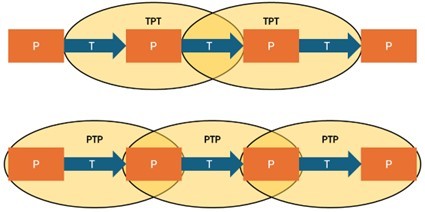
The PTP structure equates to an event in which something does something to something else. The TPT structure equates to a system with its inputs, processes and outputs. 

TPT Reasoning: Pattern Recognition and Unconscious Inference

TPT causality refers to a structure in which two processes are linked by an inferred or unknown transfer, i.e. each cause and effect has the structure TPT and the two are linked by a common T. In human cognition, this reflects pattern recognition: we notice that two processes frequently co-occur, and infer a causal link, even if we cannot identify what mediates the connection.

This form of reasoning is fast, intuitive, and largely unconscious. It allows us to make rapid inferences from experience, often without awareness of the intermediate mechanisms. However, it is error-prone. TPT reasoning is vulnerable to spurious associations and errors caused by unseen common causes. In these cases, the inferred causal link is false, despite the pattern appearing consistent.

Large language models also rely heavily on TPT-type reasoning. They identify recurring associations in their training data and reproduce those patterns in response. This allows them to answer questions, complete prompts, and simulate explanations even when they do not possess internal models of the causal transfers involved.

PTP Reasoning: Explicit Inference and Conscious Verification

In PTP causality, by contrast, causes and effects consist of a process, a known transfer, and another process. Each cause or effect has a PTP structure and the two are linked by a common P. This represents structured reasoning in which a clearly identified mechanism links cause and effect. In human cognition, this kind of reasoning is associated with conscious, reflective thinking. It is slow, deliberate, and effortful, but less prone to error.

Verification through PTP reasoning is essential when pattern-based inferences (TPT) are in doubt. It allows us to examine whether a supposed cause-effect relationship is supported by identifiable transfers. In systems theory terms, it confirms that the output of one process is indeed the input to another.

Error and Verification in Human and AI Cognition

Both humans and artificial intelligences are vulnerable to error when relying solely on TPT reasoning. A classic example is the post hoc fallacy: assuming that because B follows A, A caused B. Without identifying the actual transfer, such reasoning remains speculative.

AI systems, too, may generate plausible but incorrect answers when their training data contains coincidental patterns. They may infer connections that resemble PTP structures but are not grounded in causality.

This is why PTP reasoning is vital for verification. It distinguishes genuine causal chains from coincidental associations by demanding an explicit causal transfer.

A Unified Framework of Reasoning

A key insight from systems theory is that these two modes of reasoning are not exclusive. In fact, they are complementary. TPT reasoning allows for quick hypothesis generation and intuitive understanding. PTP reasoning provides a structure for verification, deeper analysis, and error correction.

Understanding and integrating both types of causal reasoning is central to building a theory of cognition, both biological and artificial. It also has direct implications for epistemology, systems modelling, and the future of AI development.

Conclusion

TPT and PTP causality offer a powerful lens for interpreting human and artificial thought. TPT supports rapid pattern recognition; PTP ensures that those patterns are grounded in real causal mechanisms. Awareness of this dual structure is essential for improving reasoning, communication, and the development of intelligent systems.

Future work may involve identifying when to trust each mode, and how to better integrate them in education, epistemology, and machine reasoning architectures.

Categories
08. How to Gain Understanding

How to Gain Understanding

Introduction

People understand the world through pattern recognition. Recurring patterns of events attract our attention, we remember them, attach meaning to them, and later use them as an aid to predicting the world. This trait has evolved to help our survival and the propagation of our genome. Non-recurring events are of lesser interest as they do not permit prediction. We are, therefore, less likely to remember and attach meaning to them.

Causality as a basis

Such recurring patterns of events have their basis in causality. It is likely that our perception of the latter has a hereditary basis. Certainly, other animals seem to understand causality, as evidenced by Pavlov’s famous behavioural experiments. Also, we have probably all experienced a young child repeating the question “why?”. This is probably him or her exercising hereditary skills in the recognition of causality.

Recognition

Noticing these patterns is highly tentative at first. We merely notice similarities between events and feel an intangible sense of order. We do not have the words to describe what we notice, and it is not integrated into our general worldview. However, as our brains absorb the new information and make the necessary connections our understanding grows, and we can find words to communicate the insights. A general rule forms that we can use predictively. Unfortunately, this can be a slow process often involving several nights of good sleep and some research into the topic. This is effectively the same as the creative process of saturation, incubation, inspiration, and verification described in an earlier article, but with saturation replaced by experience.

We can also seek the fundamental origins of the recurring patterns that we observe. For example, the very concept of causality was discovered in this way. Patterns were recognised and causality was recognised as another pattern within them.

Limitations

When we seek meaning we are essentially attempting to understand a pattern that describes the universe in its entirety. Unfortunately, however, pattern recognition is limited by our cognitive abilities. The principle of darkness applies, and our minds are simply not complex enough to model such a pattern. We can only recognise relatively simple ones such as causal relationships and feedback loops, and even those with difficulty. If there is any meaning to the universe, then it is certainly beyond our ability to perceive it. It would be more sensible to recognise this, rather than invent simplistic or mystical explanations. In practice, we must satisfy ourselves with understanding small parts of the world around us. For example, the purpose of this blog, is to convey an understanding of human nature and society.

Explanation

As explained above, to understand a recurring pattern, it must be integrated into our general worldview. Obviously, if our worldview is a mystical or religious one, then we may give those patterns an explanation of that type. On the other hand, we will give the patterns a scientific explanation if our worldview is of that nature.

Feedforward

The process of predicting events and acting proactively is known in systems science as feedforward. This term is also used in personnel management to describe the training of staff to meet future business needs. The term feedforward suggests that it is the negative of feedback. However, this is only so in the sense that feedback is reactive to past events, whilst feedforward is predictive of future events. Feedforward relies on a knowledge of causal patterns. It is, therefore, a feature of agents or of systems created by agents.

How to Use this Process

We can reverse this recognition process. This involves designing a causal pattern and then looking for it in the world around us. Another approach is to generalise theories from specialised fields into general causal patterns. Once a pattern, for example the replication of information, has been created, we can then look for manifestations of it in the real world. In this way we may, for example, notice cellular division, the viral spread of misinformation on the internet, and so on. As explained in the previous article, there are many ways in which information can be altered during replication. So, two copies of the same information can contain contradictions. This in turn can lead to competition regarding which is correct, and, as will be described in a future article, to conflict. From this model it is possible to suggest reasons for real world events such as conflicts between closely related religious factions, etc.

In different fields and specialities, different words are often used for similar concepts. This tends to obscure similarities between the causal processes involved. However, once we have a pattern in mind, its recognition in the real world or in another field of expertise becomes much easier.