Categories
12. The Risks to Nations of Leaders with Dark Pesonality Traits

The Risks to Nations of Leaders with Dark Personality Traits

Sectors can influence the general culture of a nation. Ronald Inglehart and the World Values Survey have identified two independent variables that define national culture: firstly, traditional vs. secular rational values, and secondly, survival vs. self-expression values (Inglehart, 2018). According to this perspective, the starting point for the cultural evolution of a nation comprises traditional values based largely on religion, and survival values due to the nation’s relative lack of wealth. At this starting point, the religious sector is the main influence on national culture, and this is still the case in many parts of the world. With industrialisation, the industrial and science sectors replaced religion as the main influence, and this resulted in a shift from traditional to secular rational values. More recently, in the West at least, there has been a shift from survival to self-expression values, with their emphasis on individuality as opposed to group cohesion. This is thought to have been brought about by the commercial and finance sectors and their concern for a lively consumer economy. Finally, we are on the cusp of another significant cultural change which will be brought about by the information technology sector, particularly with the introduction of artificial intelligence. There is much debate about where this will take us but, in practice, the destination is unknown.

Clearly, if influential sectors are led by individuals with dark personality traits, then there will be little concern for the wellbeing of society or the environment. Among the risks are the following.

  1. The risk of one sector holding undue influence over another, through its upper stratum’s membership of the establishment. For example, the ability of the religious and commercial sectors to influence the education of children in their own interest.
  2. The risk of one sector usurping the leadership of another and imposing its own ideology, e.g., the finance sector usurping the leadership of the industrial and commercial sector and imposing bottom line capitalism.
  3. The influence of a sector over government via its upper stratum’s membership of the establishment. This enables a sector to promote its own ideology and to influence government decisions in its interest. This can result in the promotion of the ideologies of powerful sectors and the suppression of more rational views. Examples include the gun lobby in the USA and the international oil lobby. Another example is the economic brinkmanship pervasive in the West today. This is evidenced by the steadily increasing wealth gap and levels of poverty, despite economic growth. This brinkmanship allows low wages and poverty to proliferate to a point where they begin to destabilise the consumer economy, but no further. However, because this leaves no resilience, economic shocks, such as the bank failures of 2008 and the COVID epidemic of 2020, do then impact on the economy.
  4. The potential for a sector to usurp democratic government, e.g., the replacement of a democratically elected government with the upper stratum of a military or religious sector, leading to a military dictatorship or theocracy.
  5. Competition and conflict arising from alliances between sectors and political parties. For example, the Spanish civil war was the consequence of an alliance of the catholic church, right-wing political parties, and the military on the one hand, and left-wing groups and parties on the other.
  6. Governments that suspend or create a false impression of democracy, engage in imperialism, and are corrupt.

These problems are rife throughout the world and, in the next article, I will offer some suggestions as to how to end them.

References

Inglehart, R., 2018. “Cultural Evolution”. Cambridge: Cambridge University Press. doi:10.1017/9781108613880

Categories
11. Dark Strategies for Maintaining Hierachies

Dark Strategies for Maintaining Hierarchies

Introduction

In this series of articles “organisation” is a generic term meaning any group of people who work together towards a common goal, for example, small clubs, businesses, and nations. This article describes several dark strategies that are used to maintain the hierarchy in an organisation. If they are used, then:

  • they tend to go hand in hand with authoritarian and highly stratified organisations rather than more egalitarian and democratic ones;
  • they are indicators of dark personality traits in the organisation’s leadership; and
  • they are significant contributors to the formation of a toxic culture with little regard for the wellbeing of sub-ordinate members, stakeholders, the broader community, or the natural environment.

Coercion

Coercion lies on a scale. In most organisations there is an understanding that if one does not carry out one’s role or function, then one will be dismissed or excluded. This is a part of the normal human socialisation process, and a part of the social contract that one enters into when joining an organisation.

However, more extreme forms of coercion are often used in highly authoritarian organisations, in those that are highly stratified, or in those with a toxic culture. This involves the use of resources controlled by leaders to deny the satisfaction of sub-ordinates’, stakeholders’, or competitors’ needs. It can also involve the use of those resources to threaten or impose harmful contra-satisfiers. Thus, coercion can vary on a scale from minor implied threats to imprisonment or torture. As a rule, the more extreme the coercion, then the more authoritarian and stratified the organisation, the darker the personality traits of the leadership, the more toxic the organisation’s culture, and the less regard it has for the wellbeing of the broader community or natural environment.

However, coercion is inefficient. It involves an expenditure of resources that might otherwise be employed to benefit the organisation. Thus, coercion is normally progressive, escalating, for example, from minor implied threats to more severe action, until compliance is achieved.

Fortunately, the more extreme forms of coercion are now illegal in Western democracies. Nevertheless, it continues up to the point of legality and social acceptability. It remains possible for leaders to optimise the benefits for themselves or their organisation by engaging in a form of brinkmanship. The more stratified an organisation, the less benefit the lower strata gain by comparison with the higher ones. Thus, the less likely the lower strata are to give their voluntary support. Brinkmanship involves concentrating benefits in the higher strata to a point where voluntary cooperation begins to break down, and may need to be replaced by illegal coercion, but no further. Coercion can then, for example, include making an example of some individuals as an implied threat to others. Were stratification to be taken further, then negative competition between the strata would ensue, beginning with non-compliance, through legal and political challenge, and ultimately, in less stable nations, to violence.

Behaviour Shaping

This involves controlling the behaviour of sub-ordinates through operant conditioning, i.e., rewarding the desired behaviours and punishing the undesired ones. A particularly unpleasant example was, and in some places still is, the promise by the Christian church of heavenly reward for good behaviour and the threat of hell for bad. Whilst being a very effective means of control for many centuries, this has caused considerable distress and anxiety among believers.

Bullying

This is a combination of coercion and credible deniability. Members of the lower strata are coerced into complying with the wishes of members of the higher strata in a way which can be denied by the latter. “It was just a joke”.

Divide and Rule

This is a strategy allegedly used by the British in India and hinted at in an earlier article entitled “How hierarchies form”. Where two or more individuals or groups are perceived as a threat to the power of a higher stratum, the latter will encourage the former to compete negatively with one another, thereby diminishing their resources, and thus, the threat that they may pose.

Removal from Power

Where the power of an individual or group appears to be a threat to a higher stratum, the latter will remove the power of the former. A range of techniques exist, assassination, character assassination, imprisonment on false charges, dismissal, etc. Fortunately, the more extreme techniques are now illegal in Western democracies. However, they continue to be used by dictatorships.

Categories
24. Systems Thinking and the Elephant in the Room

Systems Thinking and The Elephant in the Room

Introduction

Systems thinking can be defined as a conscious rational approach to the analysis of events and the design of interventions, combined with a knowledge of systems theory. The role of the conscious mind is to check and verify decisions presented to it by the unconscious mind before we act on them. So, systems thinking does not preclude unconscious creativity. However, if practiced regularly, it can train the unconscious mind to make better informed decisions.

Systems thinking is not new. Only the term used to describe it is new. We have practiced systems thinking for millennia but only recently has it become a formal discipline. Although it applies to systems of all types, the present-day focus is on information and management systems because a living can be earned from expertise in those areas. However, there are two problems associated with this focus. Firstly, it can be assumed, incorrectly, that systems rules applicable to human organisation also apply more generally. Secondly, social pressures mean that practitioners can ignore the elephant in the room, i.e., organisational leaders with dark personality traits.

Proto-Systems-Thinking

In the late 1970s and early 1980s, as a young professional civil engineer, my more experienced seniors taught me that every design, or solution to a problem, had both benefits and disbenefits. Clearly, the benefits related to the problem to be solved, e.g., how to move water, people, or vehicles from A to B. However, the disbenefits often applied to apparently unrelated things. So, it was necessary to identify those disbenefits by thinking of the proposed design in its environment and at all stages in its lifecycle, i.e., construction, operation, maintenance, and decommissioning. For example, a reservoir might improve water supply, but increase the risk of people drowning. Safety is an obvious area of potential disbenefit, but there were many other areas to consider: maintenance, environmental impact, public nuisance, and so on. Those potential disbenefits had to be identified and their risk assessed. This was done largely by group critique and the exercise of imagination. The process required us to be honest with ourselves and others about the potential disbenefits of our designs before they were built. If necessary, these disbenefits then had to be treated as problems requiring solutions in their own right. For example, the reservoir might need to be fenced to mitigate the risk of drowning. However, the fence might create its own disbenefits, and so, the process was an iterative one. Obviously, if the mitigation of a significant disbenefit was impractical, then we would have to backtrack and try another potential solution.

At the time, this process was something that practicing professional engineers passed on to one another; not something that we learnt through formal training. The process is probably familiar because it is a form of systems thinking that we carry out almost intuitively, and that was practiced long before the term was coined, and long before it became a formal discipline.

Systems Thinking Formalised

The main advantages of systems thinking becoming a formal discipline are that it can identify good practices, such as the one described above, help to train new practitioners, and help to disseminate the practices to others who might benefit. However, it would be wrong to think that professional systems thinkers have invented it.

The term “Systems Thinking” was originally coined in 1994, by Barry Richmond, and is now widely used. Richmond defined systems thinking as “the art and science of making reliable inferences about behavior by developing an increasingly deep understanding of underlying structure”. Importantly, he went on to say that “people embracing Systems Thinking position themselves such that they can see both the forest and the trees; one eye on each” (Richmond 1994).

To expand on this definition, systems thinking is a cognitive perspective in which everything is seen as comprising interconnected systems, i.e., processes with inputs and outputs, the outputs of every process acting as inputs to others. Properties can emerge from the whole which do not apply to the parts.

According to this definition, systems thinking can be applied wherever systems are encountered, that is, everywhere and in every discipline. I refer to this perspective as “Pure systems thinking”, therefore.

However, because properties emerge with increasing complexity, the rules of human organisation do not necessarily apply in less complex arenas.

Pure and Applied Organisational Systems Thinking

In a letter to the Editor of Systemist, Frank Stowell, then of DeMontfort University, Milton Keynes, UK, said that “If we consider the situation within current systems thinking and practice, we find that systems have been hijacked. Management and Information Systems dominate most of our activities.” (Stowell, 1998). Clearly, the most important systems to us are human ones. This is, therefore, where systems thinking has since focussed; particularly on business organisations. Thus, whilst the basic definition of systems thinking has remained much the same, as time has moved on, the concept has increasingly become associated with organisational problems and improvement. To distinguish this highly coloured form of systems thinking from the pure one, I refer to it as “Applied organisational systems thinking”.

So, why has this change taken place, and why have applied organisational systems thinkers ignored the elephant in the room?

The Influence of Industry on Applied Organisational Systems Thinking

Unfortunately, scientists, especially those acting as consultants, can become beholden to business. A full list of strategies that industry uses to control science is given in a 2021 paper by Legg, Hatchard, & Gilmour, referred to below. In particular, strategies include: funding “safe” research; controlling the reporting and supressing the publication of unfavourable science; and monitoring and attacking scientists and organisations. Clearly therefore, industry can control scientific funding, reputations, and career advancement. So, to make themselves useful to business leaders, and thus earn a living, consultants may conform to industry requirements.

I can confirm from personal experience that such industry influence does exist. In one example, scientific research contrary to the commercial interests of a US company was driven off the internet. In another example, a consultant in the employ of a US company succeeded in changing the policy of a professional society to align with his employer’s interests, despite much objective evidence to the contrary.

The Elephant in the Room

The elephant in the room is the existence of toxic business cultures and the leaders with dark personality traits (Narcissism, Psychopathy and Machiavellianism) who establish them. These toxic cultures are a major cause of organisational failure and the adverse impact of organisations on their social and natural environment. In the search for organisational and even personal benefits, potential disbenefits to these environments are, either deliberately or inadvertently, ignored. Yet, in general, applied organisational systems thinking fails to address this issue. No consultant can expect to earn a living and avoid retribution if they do encounter a toxic culture or a dark leader and address the problem head on. Instead, they may respond in a similar way to an environmental consultant I once met. Over drinks, he openly admitted to me that he “tells the client what he wants to hear”. Unfortunately, he was employed to advise on work in a part of the Amazon rainforest, so I am not entirely sure how he managed to reconcile that approach with his conscience.

The Risk of Anthropomorphism

Frank Stowell goes on to say that “If we look at the past three UKSS conferences, the major streams have been either Business/Management or Information Systems. There has been very little contribution towards [pure] systems thinking as opposed to the development of existing ideas in any of the past conferences.” He goes on to ask “Has Peter Checkland said it all, i.e., that a system can be characterised by emergence, communication, and control – and [is that] a fact? Is anyone critically evaluating this assertion?” This is a good question, to which the answer is “No, it is not a fact.” Not all systems are characterised by communication and control. Systems can be categorised as: non-living, living, or artifacts, i.e., products of living things. (Korn, 2023).  Communication and control emerged with life, and so, apply only to living things and the artifacts they produce. They do not apply to other non-living systems. (Challoner, 2023). Clearly, therefore, applied organisational systems thinking and its focus on human organisation may be leading pure systems thinking astray.

Summary

In summary therefore, applied organisational systems thinking seems to have pushed pure systems thinking into the background. This is: a) because living systems are of particular significance to us; and b) because scientists can obtain funding and consultants can earn a living by making themselves useful to industry. Unfortunately, this gives industry power over the direction that applied organisational systems thinking takes. In particular, it means that it ignores the elephant in the room, i.e., leaders with dark personality traits and the cultures they create.

Furthermore, applied systems thinking can pollute pure systems thinking with the assumption that what applies to life and its artifacts applies to everything. A form of anthropomorphism can take place. For example, information is organised matter or energy. It is recognised and transmitted only by living things and their artifacts. However, despite a lack of evidence, systems practitioners sometimes regard information as being metaphysical, and thus, as applying to everything. The same is true of concepts such as control, requisite hierarchy, purpose, and so on.

Solutions

To address the dominance of applied organisational systems thinking, Mr Stowell suggests “the promotion of [pure] systems research as a distinct entity”. In a Facebook article dated 3rd February, 2021, Christopher Chase says that after teaching systems thinking to classes at Kyushu University, Japan, “many of these Japanese University students said understanding how all the sciences fit together as a unified whole was the most interesting thing they had learned, and that they felt it should be included as part of a formal Science education for children (and young people) in Japan and elsewhere. That the compartmentalisation of topics in education hampered their ability to fully understand how in reality all the sciences are connected to each other, and also to the arts, history, economics, everything.” (Chase, 2021). Unfortunately, the examples given at the end of this quote are, once again, drawn from human society. Nevertheless, the argument is a good one. Clearly, there is an appetite for, and benefit to be gained from pure systems thinking, as opposed to the applied organisational version.

To address the problem of the elephant in the room, I would suggest that applied organisational systems thinkers:

  • recognise that they are a part of the system on which they are advising;
  • recognise that all interventions have both benefits for the problem to hand, and associated disbenefits that must be mitigated. As in the case of AI and the atomic bomb, it is not sufficient to pursue the benefits and, only when a solution has been implemented, hope to mitigate its disbenefits; and
  • develop a professional code of ethics for their consultancy work. See (Institution of Civil Engineers, 2015) for an example.

References

Challoner, J.A., (2023). “Systems Theory from a Cognitive and Physicalist Perspective”. https://www.academia.edu/95027266/Systems_Theory_from_a_Cognitive_and_Physicalist_Perspective

Chase, C., (2021). “The Need for a Unified Systems Science Education”. https://www.facebook.com/groups/2391509563/permalink/10158720702184564/

Institution of Civil Engineers (2015), “Civil Engineering Ethics Toolkit: ‘say no’” https://www.ice.org.uk/engineering-resources/best-practice/civil-engineering-ethics-toolkit-say-no

Korn, J., (2023). “Existence as a Web of Problem Solving Systems”. https://www.academia.edu/100451240/EXISTENCE_AS_A_WEB_OF_PROBLEM_SOLVING_SYSTEMS

Legg, T., Hatchard, J., & Gilmour, A.B. (2021). “The Science for Profit Model—How and why corporations influence science and the use of science in policy and practice”. https://journals.plos.org/plosone/article?id=10.1371/journal.pone.0253272

Richmond, B. (1994). “Systems Dynamics/Systems Thinking: Let’s Just Get On With It”. In International Systems Dynamics Conference. Sterling, Scotland.

Stowell, F., (1998). “Opinion; systems is a spent force”. Systemist, Journal of the UK Systems Society, v20 n4, 1998.

Categories
10. Machiavellianism and Dark Empathy

Machiavellianism & Dark Empathy

Machiavellianism

Machiavellianism is a personality type first described by the psychologists Richard Christie and Florence L. Geis (Christie & Geiss 2013). Although the name for this personality type is derived from that of Niccolo Machiavelli, the infamous author of “The Prince”, it is not related to his political doctrine. Rather, his work was used by Christie and Geiss as a source of ideas about those who manipulate others.

Typical features of a Machiavellian personality, as described by Sanjana Gupta in Very Well Mind, are:

  • “Focusing only on their own goals and interests.
  • Prioritizing success, power, money, and fame above all else.
  • Manipulating or exploiting others for their own gain.
  • Having no qualms about deceiving or lying to others.
  • Being charming and using flattery to their advantage.
  • Believing the end result justifies the means.
  • Having a cynical view of human nature.
  • Having a negative attitude toward everything.
  • Believing themselves to be superior to others.
  • Not being able to empathize with others.
  • Having difficulty trusting other people.
  • Being disconnected from their own emotions.
  • Struggling to identify and express their feelings.
  • Staying aloof and lacking genuine warmth in social interactions.
  • Avoiding emotional attachments with others.
  • Being able to read people and social situations, and using this insight to their advantage.”

Machiavellianism is one of the three personality types that form the “Dark Triad” described by the psychologists Delroy L. Paulhus and Kevin M. Williams in 2002 (Paulhus & Williams, 2002). All three personality types are a consequence of both inheritance and environment, but Machiavellianism is thought to be influenced slightly more by environment than is the case for narcissism and psychopathy.

Dark Empathy

Empathy is an ability to understand the minds of others and to share feelings with them. According to psychologists who advocate the classification of personality using the dark triad, i.e., narcissism, psychopathy and Machiavellianism, these personality types are characterised by a lack of empathy.

In practice however, all the traits the go up to make these personality types vary on a scale, sometimes independently and sometimes in a way that correlates with other traits. The pattern of divergence from the average for each trait is very diverse and probably unique for each individual. So, the three personality types that comprise the dark triad are broad categories that overlap and share common features.

Researchers have found that empathy also varies independently of other traits, and thus, that it is possible for people who are broadly narcissistic, psychopathic, or Machiavellian to have empathy. These personality types are known as dark empaths. (Heym & Sumich, 2022)

Heym and Sumich assessed the personality traits of one thousand people from the general population. They were testing for elevated or lowered personality traits rather than psychological disorders. They found that 67% were low in dark traits and 33% high. 53% were high in empathy and 47% low. The distribution is shown in the following diagram.

They also found that dark empaths were not as aggressive as those in the traditional dark triad group. However, they were more socially aggressive than both the typicals and the empaths. That is, they were more willing to hurt or manipulate others using social exclusion, malicious humour, or by inducing guilt.

Unsurprisingly, they also found that empaths were the most agreeable, followed by typicals, then dark empaths. Those in the traditional dark triad group were the least agreeable, i.e., exhibited the least “niceness” and friendliness.

Heym and Sumich conclude that “Though the aggression reported by the dark empaths was not as high as the traditional dark triad group, the danger of this personality profile is that their empathy, and likely resulting social skills, make their darkness harder to spot. We believe that dark empaths have the capacity to be callous and ruthless, but are able to limit such aggression.”

References

Christie, R. & Geis, F.L. (2013). “Studies in Machievellianism” Academic Press. ISBN 978-1-4832-6060-0.

Heym, N. & Sumich, A., 2022. “Dark empaths: how dangerous are psychopaths and narcissists with empathy?”. The Conversation 16/3/2022. https://theconversation.com/dark-empaths-how-dangerous-are-psychopaths-and-narcissists-with-empathy-178715

Paulhus, D.L. & Williams, K.M. (2002). “The Dark Triad of personality: Narcissism, Machiavellianism, and Psychopathy”. Journal of Research in Personality. 36 (6): 556–563. doi:10.1016/S0092-6566(02)00505-6.

https://www.verywellmind.com/machiavellianism-origins-signs-scale-and-coping-7377514

Categories
09. The Narcissist Politician

The Narcissist Politician

Introduction

This article is a summary of one by Rosenthal, S. and Pittinsky, T.L., entitled “Narcissistic Leadership”, published in 2006, in The Leadership Quarterly. The latter article is a thorough review of the literature on the subject. The full article can be downloaded at:

https://www.researchgate.net/publication/223046510_Narcissistic_Leadership

It can be difficult, at first, to distinguish a narcissistic leader from one who simply has power, motivation, or charisma. An individual suffering Narcissistic Personality Disorder must, according to the American Psychiatric Association, show a “pervasive pattern of grandiosity”, “a need for admiration” and a “lack of empathy”. Their diagnostic criteria include:

  1. a grandiose sense of self-importance;
  2. a preoccupation with fantasies of unlimited success or power;
  3. a belief in “special” or unique status (including fixation on associating with high-status people or institutions);
  4. a requirement for excessive admiration;
  5. an unreasonable sense and expectation of entitlement;
  6. interpersonal exploitativeness;
  7. a lack of empathy;
  8. envy; and
  9. arrogant behaviours or attitudes.

They can also display hostility and fragility of self-esteem. Clearly, such characteristics do not equip a leader to make rational strategic decisions and, when a narcissist is an adversary, they can be dangerous.

The root cause of Narcissistic Personality Disorder is thought to be associated with childhood upbringing, for example indifferent or aggressively rejecting parents. This leads to deep seated feelings of emptiness and inferiority and to a desire for revenge. Narcissists did not have their need for positive regard satisfied as a child, and so, pursue that need through their actions in later life. The need may also be amplified by a negative regard for oneself.

Psychological Defences

Narcissistic leaders resort to the following psychological defences against these deep seated feelings.

  1. An insatiable need for recognition and excessive admiration. This isone of the main ways of coping with deep feelings of inferiority. However, even when regularly flattered by sycophants and in a position of unquestionable authority, narcissists are still unable to sustain positive feelings about themselves.
  2. An insatiable need for superiority and fantasies of unlimited success or power. Another main way of coping with feelings of inferiority is a constant quest to prove their superiority over others.
  3. A belief in their own special or unique status. They tend to have inflated views of themselves in respect of leadership performance, task performance, personality traits, expected academic performance, behavioural acts, intelligence, and/or physical attractiveness. However, these inflated assessments are not accompanied by greater actual ability.
  4. A grandiose sense of self-importance.
  5. An unreasonable sense and expectation of entitlement.

These characteristics explain the attraction of politics to a narcissist. However, pathological narcissists are unable to integrate these idealised beliefs about themselves with their actual inadequacies, and this results in fragility of self-esteem.

Attitudes and Behaviour

These defensive strategies and fragility of self-esteem lead to the following typical attitudes and forms of behaviour:

  1. Arrogance, i.e., an attitude of superiority, self-importance, and pride, together with an overbearing manner.
  2. Seeking leadership positions. The need for recognition causes narcissists to self-promote and self-nominate more than others. The desire to structure the external world in a manner which supports their grandiose needs is also a key motivator, and they will often seek power, therefore. Even when seemingly at the pinnacle of power, they crave yet more, often putting themselves and their followers at great risk. However, their leadership is motivated by their own personal, egotistical needs for power, recognition, and admiration.
  3. Visionary leadership. Because they are inspired by power, glory, and legacy, they often embark on grandiose projects and can see the big picture. However, they tend to leave the analysis and detail to others.
  4. Presentation. There is near unanimous agreement that charisma is key to the popularity and rise of such leaders. Their rhetoric tends to be that which will generate impact and recognition rather than meaning.
  5. Amorality. Narcissistic leaders are likely to employ deception, manipulation, and intimidation to aid their rise to positions of power, including those for which they are not qualified. They are prone to lapses in personal conduct and can ignore or alter rules that do not suit them.
  6. Taking excessive credit for successes whilst blaming others for failures. This is the case even when the successes are due to the efforts of others and the failures due to their own shortcomings. However, this strategy only temporarily alleviates and never entirely eliminates narcissistic leaders’ negative feelings about themselves.
  7. Envy and a fixation on associating with high status people or institutions. This is due to a belief in their special or unique status and the tendency to seek recognition from idealised parent substitutes. In can also be a strategy to gain power through trading favours.
  8. Conspicuous lifestyle. They engage in conspicuous consumption as a symbol of status.
  9. Lack of empathy. Narcissistic leaders are lacking in empathy, i.e., they are incapable of understanding the perspectives of others. Thus, they are not driven by an empathic concern for those that they lead.
  10. Interpersonal exploitativeness. Narcissistic leaders are not only likely to abuse their power but can also use their charisma to convince followers to buy into the abuse and take the blame for it.
  11. Intimidatory behaviour. Followers who are not swayed by the narcissistic leaders’ charisma are often intimidated into subordination.
  12. A demand for loyalty. Because narcissists have an insatiable need for recognition and superiority, they demand unquestioning loyalty from their followers.
  13. Paranoia, hypersensitivity, and anger. It is rational to be wary of the true intentions of sycophantic followers, but narcissists go beyond rationality and distrust, reject, or destroy even their most loyal supporters. In this way they create enemies where there may have been none. Narcissists are hypersensitive to anything which might threaten their psychological defences of superiority and grandiosity, and the slightest misstep by a follower can result in a dangerously exaggerated reaction.
  14. Hostility. Narcissistic leaders can be vengefully hostile in response to an insult and can commit horrific atrocities. They can demand the impossible from supporters and, when they do not get everything that they have asked for, can turn on them. Such behaviour can also be used strategically to gain and hold power.
  15. Failure to recognise reality, complacency, inflexibility, and short-sightedness. Narcissistic leaders often resist adviser’s suggestions, ignore wise counsel, changes in circumstances, and new threats. This is thought to have their arrogant attitude as its root cause.
  16. Irrationality. The transient fears and wishes of narcissists are a poor basis for rational decisions and they are prone to lapses in professional judgement. However, because of their drive and grandiosity, narcissists make poor judgements with greater certainty and confidence than others, and thus, have greater influence.

Consequences for society

These attitudes and forms of behaviour, in turn, have implications for society. Depending on the particular circumstances, these consequences can be neutral, negative, or positive. They can include:

  1. Signifying a need for change. Narcissistic leaders tend to emerge in times that call for a new order to be established. Although such leaders may fail to effect the desired change their rise may signify that change is needed.
  2. Ability to attract followers. The narcissist’s air of confidence, dominance, charisma, and grand vision causes them to appear leader-like and attract followers who may perceive them as super-human, may blindly believe them, and may follow them unconditionally. In turn, these followers fulfil the narcissistic leader’s need for admiration thereby bolstering his confidence and conviction in his visions. Some followers may themselves be narcissistic and feel worthwhile only when they relate to others that they can admire for their prestige, power, beauty, intelligence, or moral stature.
  3. Abuses of power. Because they are driven by personal, egotistical motives, narcissists often use their power to satisfy personal needs rather than those of their followers. They can, however, do better in situations where their personal goals are the same as those of their followers.
  4. Poor, overinvolved, and abusive management. Narcissists are notoriously poor, overinvolved, and abusive managers. They are also unable or unwilling to mentor subordinates.
  5. Difficulties with interpersonal relationships. These are often caused by their arrogant behaviour, lack of empathy, poor management style, and unwillingness to heed advice.
  6. Failures. Narcissistic leaders are more likely to make decisions based on an idiosyncratic, self-centred view of the world and to ignore advice which conflicts with their view. They also suffer from complacency, inflexibility short-sightedness and a failure to recognise reality. Finally, they make riskier decisions and are less interested in low-risk decisions than non-narcissists. These factors combine to result in a high incidence of failure.
  7. Longer Term Sustainability of Leadership. The qualities needed to form a group differ from those needed to sustain it and, whilst a narcissistic leader may readily be able to form a group, the difficulties with interpersonal relationships, the poor talent for management and the failures which ultimately emerge cannot sustain it. Research has shown that narcissists receive higher initial leadership ratings because they are more outgoing and entertaining than non-narcissists, but that this positive effect wanes over time.
  8. Conflict. Paranoia, hypersensitivity, and anger are, of course, dangerous characteristics in a world leader and, in a foreign policy context, particularly in times of crisis, may lead to a desire for revenge, aggressive behaviour, or war.
  9. Downfall. Less rational and amoral behaviours, e.g., engaging in cruelties with no political purpose, undermining their power base by challenging conventional morality, over-reach in foreign engagements, etc., often place narcissistic leaders in a vulnerable position and ultimately result in their downfall.
  10. Damaged Institutions. Even at their best, narcissistic leaders are bound to leave damaged systems and relationships in their wake.

Avoiding the negative consequences of narcissistic leaders

Suggestions that the narcissist is supported by an advisor who is rooted in reality, or that the leader submits to psychotherapy seem doomed to failure as a consequence of the very nature of narcissism. Organisational checks and balances, honest feedback, and the training of sub-ordinates to keep the leader under control are unlikely to be successful for the same reason.

Rather, it is suggested that the problem of narcissistic leaders is avoided by reducing their influence, moving them out of harms way, and keeping inexperienced and insecure subordinates out of their reach.

Further reading

An analysis of US presidents for narcissistic tendencies, published in 2013,  can be found at:

https://scottlilienfeld.com/wp-content/uploads/2021/01/Wattsetal.2013narcissismpresidents.pdf

Categories
08. The Workplace Psychopath

The Workplace Psychopath

Psychopathic personalities can have a major influence on human society, and it is sensible therefore to understand their nature and be able to identify them. The Society for the Scientific Study of Psychopathy says that “the psychopathic personality is NOT equivalent to: violence, serial killing, psychosis, mental illness, psychopathology in general, or antisocial personality disorder.” Rather, it is a collection of traits. These traits were identified by Scott Lilienfeld and Brian Andrewsin their Psychopathic Personality Inventory as:

  1. A lack of empathy and a sense of detachment from others for the sake of achieving one’s own goals.
  2. The ability to charm and influence others.
  3. A distinct lack of emotion, guilt, or regard for others’ feelings.
  4. A difficulty in planning ahead and considering the consequences of actions.
  5. An eagerness for risk-seeking behaviours and a lack of the fear that normally goes with them.
  6. Inability to take responsibility for one’s actions and instead blaming others or rationalising one’s behaviour.
  7. A disregard for social norms and culturally acceptable behaviours. This includes dishonesty and manipulativeness.
  8. A lack of typical marked reactions to traumatic or otherwise stress inducing events.

Recent research which will be described in a future article has, however, cast doubt on the view that all psychopaths lack empathy.

The Society for the Scientific Study of Psychopathy goes on to say that “Although psychopathy is a risk factor for physical aggression, it is by no means synonymous with it. In contrast to individuals with psychotic disorders, most psychopaths are in touch with reality and seemingly rational. Psychopathic individuals are found at elevated rates in prisons and jails but can be found in community settings as well.”

They appear to lack the instinct which enables us to form co-operative groups, and the conscience which enables these groups to function successfully. Thus, they do not suffer the mental conflicts and stress experienced by others in attempting to balance the interests of the group with the shorter-term interests of the self. This lack of a group forming instinct means that normal social rules do not apply when interacting with them.

Nevertheless, a psychopathic personality can gain power for several reasons.

The traits that they display can be mistaken for those of an ideal leader. For example, their manipulative traits can be mistaken for the ability of successful leaders to influence others. Their lack of emotional connection and empathy can be mistaken for a leader’s ability to make tough decisions. Their grandiose behaviour can be mistaken for the confidence expressed by successful leaders.

Their charm, calm demeanour, tolerance of uncertainty and apparent confidence makes them seem to be an ideal charismatic leader in times of disruption and uncertainty. However, if an organisation lacks rules or structure, they can take advantage of this.

Finally, Selfish psychopathic traits will not stand out and may be rewarded in an organisation where competition, individualism, profit, and short-termism prevail.

So, status has a part to play in where psychopathic personalities can be found. Research has shown that the higher in an organisation a person is, the more likely they are to have psychopathic traits or to have had experience of someone with them. Researchers have found high levels of psychopathic traits in British CEOs and US presidents.

Workplace culture also has a part to play. Workplace psychopaths can be found more often in banking, finance, commerce, business, the civil service, the law, the police, and the fire service, and less often in the caring professions.

Gender may also have a part to play. There appears to be a greater risk when an organisation is largely male. However, this does not necessarily mean that women are less likely to be psychopathic than men. Rather, women are more likely to work in the caring professions. So, it may be that their workplace culture is less likely to accept such people in leadership roles.

Finally, there appears to be a greater risk of a workplace psychopath being appointed if the organisation is under pressure and change is necessary.

References

Lilienfeld, S. O., & Andrews, B. P. (1996). “Development and preliminary validation of a self-report measure of psychopathic personality traits in noncriminal population.” Journal of Personality Assessment.

The Society for the Scientific Study of Psychopathy (2018). http://psychopathysociety.org/en/ (18/7/2018).

Categories
09. Cultural Speciation (Part 2)

Cultural Speciation 2

Introduction

This article comprises the posts that I made in Facebook’s Cultural Speciation chat from 11/9/23 to 25/9/23.

During my work on social systems theory, I have been struck by similarities between the behaviour of individuals, organisations, and nations, i.e., by the isomorphisms. An example is, personal denial vs. cultural denial. The latter is also known as co-denial or conspiracy of silence. Because of these isomorphisms, I now treat the organisation, in in its most general sense, as the fundamental holon in social systems theory.

The phrase “cultural evolution” is often thought of as being merely metaphorical. However, very real isomorphisms do appear to exist between biological evolution and cultural evolution. Examples include cultural speciation, cultural co-evolution, sub-cultures vs. sub-species, and so on. As cultural evolutionary principles appear to explain much of what is going on in the world today, I would like to begin a discussion with a view to developing the concept further.

More on this topic can be found at: the World values Surveys website at https://www.worldvaluessurvey.org/ ; and in the excellent book “Cultural Evolution” by Ronald Inglehart.

Cognitive Physicalist Philosophy.

I developed this philosophy during my 23 years of work on mathematical logic. It was the only approach that enabled me to join up the various branches of logic into a single, consistent, and relatively simple system. This philosophy underpins the steps that will follow.

The cognitive perspective holds that we are our minds and cannot escape the constraints imposed by their biology and evolutionary history. Nevertheless, human cognition is a reasonably accurate representation of reality. If it were not, then it is unlikely that our species would have survived to be as successful as it is. Physicalism holds that space-time comprises the whole of reality and that everything, including abstract concepts and information, exists within it. Nothing transcends the laws of nature or occupies somewhere other than space-time.

The Nature of Information.

Information is physical in nature. It is not merely conveyed by matter and energy; it is integral to it in the form of order and structure. Information exists at source i.e., within the original physical entity. It is formed of meaningful component parts within that entity and the relationships between them. For an entity to be meaningful it must be structured in a way that recurs. This is an evolutionary trait that enables us to recognise recurring entities and, when we encounter them in the future, predict their behaviour, including any opportunities or threats. If an entity is meaningful, we associate the information that it contains with a sense image (icon) and in a symbolic form compatible with our minds. This enables us to remember entities and the associations between them. Finally, we translate information in that form into a symbolic form that can be communicated to others, e.g., words, thereby sharing our knowledge of an entity’s behaviour. In this latter form information can be replicated.

The ability to recognise and process information in this way is a property that emerges with life. This property applies only to living beings and some of their artifacts. It does not apply to other non-living physical entities.

Information at source is, by definition, always true. However, there are many ways in which mentally processed and communicated information can become false.

Basic Biological Evolution.

There are two main features of an organism: its genotype, i.e., the genetic constitution of the organism, and its phenotype, i.e., the manifestation of that design and the observable characteristics of the organism. The organism’s genotype is information that can be replicated and translated. It is the organism’s design. The phenotype is a consequence of this design as influenced by environmental circumstances.

Biological evolution has two main components, random mutation, and natural selection. Random mutation acts on an organism’s genotype and can, for example, be caused by radiation, viruses or copying errors during replication. Most random mutations are harmful, many are neutral and a few beneficial.

Natural selection operates on the phenotype. Under selective pressures from the environment organisms with harmful mutations often expire or fail to reproduce whilst those with beneficial mutations tend to propagate. Neutral mutations can persist in a population’s variable genome and can manifest themselves in the form of sub-species. Later, if the organism’s environment changes, they may prove beneficial or harmful and either propagate or expire.

Isomorphism between Biological and Cultural Evolution.

Society has two main features which are very similar in nature to those of the organism. Firstly, there is its culture. This includes values or those things that we hold good or bad; norms or codes of acceptable and unacceptable behaviour; and beliefs. They are all information held in the mind and socially propagated. They comprise a society’s design and are the equivalent of the biological genome.

Secondly, there is the practical manifestation of culture, in the form of society itself. This manifestation is a consequence of both culture and environmental circumstances. So, the manifestation of society can be regarded as the equivalent of the biological phenotype.

Culture is also subject to mutation. This can be caused by new knowledge, ideas and understanding; changes in the social and natural environment; communication errors; and even deliberate interventions such as propaganda and advertising.

Again, some of these mutations are harmful, some neutral and others beneficial. Theoretically, social processes should tend to cause those that are beneficial to propagate, those that are harmful to expire, and those that are neutral to remain as variations. However, deliberate intervention can propagate harmful cultural mutations. It is noteworthy that our interventions have also been biological. We have deliberately intervened in the genome of some organisms via selective breeding and, more recently, direct genetic modification has become possible.

In some circles culture is known as a memeplex with individual parts known as memes. However, the meaning of the word meme has changed with the advent of the internet, so I now avoid using it.

Biological and Cultural Speciation.

Biological speciation is the formation of new and distinct species through the process of evolution. Two main factors are involved, the accumulation of viable genetic mutations and geographical or environmental separation. In the case of geographical separation, members of a species come to occupy different parts of the world and can no longer interbreed. In the case of environmental separation, they come to occupy different environments, e.g., the trunk or branches of a tree, and again can no longer interbreed. This allows different mutations to accumulate in each group.

Initially this can result in a sub-species. That is, a group of organisms with identifiable differences from the parent species, but which nevertheless hold most of their genome in common with it and remain able to interbreed with it. If separation ceases a sub-species may be absorbed into the parent species. If separation continues it may diverge from the parent species as genetic differences accumulate, and ultimately may be unable to interbreed with it, thus forming a separate species.

A similar process can occur in society. Geographical separation is the same but environmental separation can be social as well as physical. Initially, a sub-culture can form with its own distinct cultural features but nonetheless holding much in common with the parent culture. If geographical or social separation ceases, then the sub-culture can be re-absorbed into the parent culture, but if separation persists, cultural speciation can occur such that it becomes difficult for the two cultures to interact. Differences in language, values, and norms form the basis for these difficulties.

Other Support for Cultural Speciation

Another interesting parallel is as follows. Culture is held in the minds of individual people. Together these people form society. The genome is held within individual cells. Together these cells form the organism.

Cultural speciation is thought to precede biological speciation and to have occurred in early hominids. The Italian scientist, Fiorenzo Facchini suggests that “Culture probably played a double role in the process of human speciation: (1) in isolation and differentiation from other groups of hominids that did not have such behaviour; and (2) in adaptation to the environment and in communication between groups that had the same cultural behaviour, thus slowing down or preventing the conditions of isolation that lead to new species.” (Facchini, 2006)

Application of The Biological Evolution/ Cultural Evolution Isomorphism.

At present (Sept 2023) I am working on interactions in the natural world, both human and non-human. This is going well, and I am finding strong isomorphisms. The same small range of interactions exist between: different species; groups within a species, including human organisations and cultures; and individuals within a species, including people. These interactions, which include co-operation, are both consequences and drivers of the evolutionary process. So, it does appear possible to unite the social and biological sciences in a way that allows knowledge to be transferred between disciplines.

Regarding cultural evolution, this is often thought to be merely a metaphor. However, biological evolution and cultural evolution are so similar in nature that they are almost certainly the same process. So, it is likely that the knowledge that we have gained of biological evolution can be applied to society.

Finally, I should perhaps mention that, although humanity comprises different cultures, this is merely an observation. I make no value judgements as to which culture is better. In fact, such value judgements are themselves cultural.

Categories
07. The Dark Factor - An Introduction to Anti-social Personality Types

The Dark Factor – An Introduction to Anti-social Personality Types

Introduction

I must admit that, because they trigger unhappy memories, I have been putting off writing the following set of articles. It is reassuring to believe that all human beings are social creatures, but unfortunately that is not the case. Some individuals with dark personalities place self-interest above all else. People of a more social nature who have had the misfortune to meet or interact with a dark individual will, as a minimum, have suffered disillusionment or a sense of injustice. They may also have suffered more material harm.

There are many reasons why we may not like to talk about dark individuals, or believe that they exist. We may blame ourselves for our misfortune or be embarrassed by it. Like me, we may wish to avoid the emotional pain of recalling it. We may prefer to maintain an illusion that such individuals do not exist and, finally, we may fear being labelled as cynics or false accusers. However, there is much objective evidence that such people do exist and can cause considerable social harm. Only if we acknowledge this can something be done about it.

The Dark Factor

The dark factor is a set of human personality traits. It is defined by the psychologists Moshagen, Hilbig, and Zettler, in their 2018 paper, “The dark core of personality”, as the tendency to maximise one’s individual utility – disregarding, accepting, or malevolently provoking dis-utility for others. In other words, looking after oneself, without concern for others, at their expense, or even whilst causing them harm.

Moshagen, Hilbig, and Zettler carried out four studies measuring the following nine well studied personality traits, and found that they were all significantly positively related to one another. As stated in https://blogs.scientificamerican.com/beautiful-minds/the-dark-core-of-personality/ they are:

  1. Egoism. Excessive concern with one’s own pleasure or advantage, at the expense of community well-being.
  2. Machiavellianism. Manipulativeness, callousness and a strategic-calculating orientation.
  3. Moral Disengagement. A generalized cognitive orientation to the world that differentiates one’s thinking from that of others in a way that leads to unethical behaviour.
  4. Narcissism. An all-consuming need for ego reinforcement.
  5. Psychological Entitlement. A stable and pervasive sense that one deserves more, and is entitled to more, than others.
  6. Psychopathy. Callousness, impulsivity, and deficits in feelings and self-control.
  7. Sadism. Intentionally inflicting physical, sexual, or psychological pain or suffering on others in order to assert power and dominance, or for pleasure and enjoyment.
  8. Self-Interest. The pursuit of gains in socially valued domains, including material goods, social status, recognition, academic or occupational achievement, and happiness.
  9. Spitefulness. A preference that would harm another but that would also entail harm to oneself. This harm could be social, financial, physical or an inconvenience.

The British psychologist, Steve Taylor prefers the concept of “a “dark triad” of three personality traits that belong together: psychopathy, narcissism and Machiavellianism. This makes sense because these traits almost always overlap and are difficult to distinguish from one another. The traits exist on a continuum and are more pronounced in some people than others.”

Unfortunately, there are more ways in which something can “go wrong” than “go right”. For something to “go right” it must be ordered or structured in some way. For it to “go wrong” that order must have failed, and there are many ways in which it can do so. Thus, mental ill-health, for example, takes many forms. The same is true of the dark factor. Individuals with the above traits will have them in varying proportions. Nevertheless, we endeavour to categorise dark behaviours by their similarities. An emphasis on one will cause us to place an individual in that category. However, the correlation between these traits suggests that there is something more fundamental that unites them.

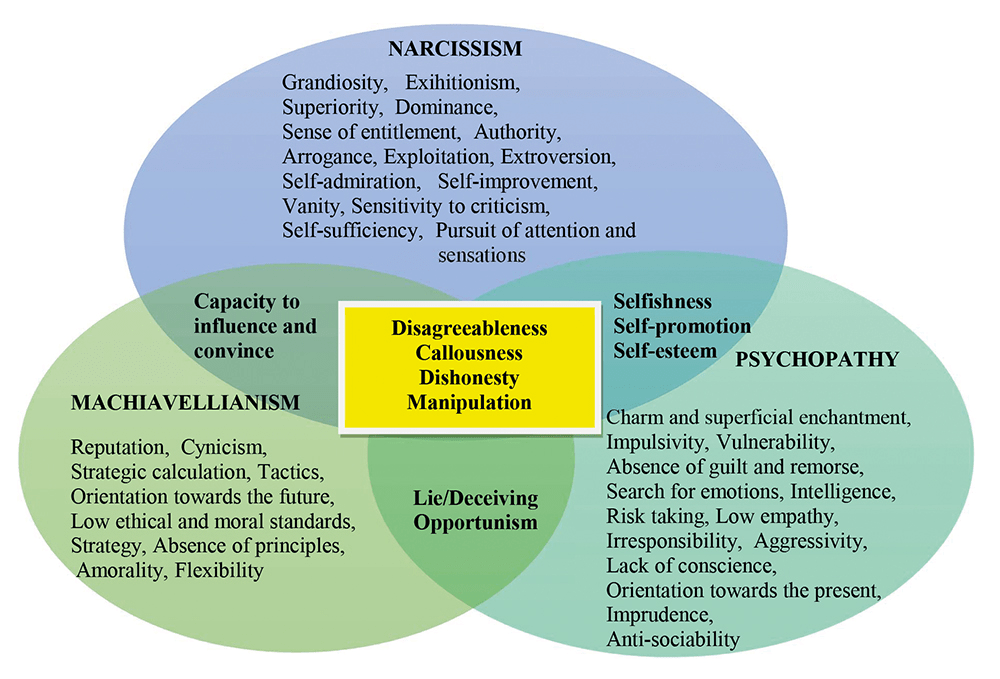
The three personality types have common features as well as their own distinct ones, as described in the Venn-Euler diagram below.

Source: D’Souza, M. F. (2016). Manobras financeiras e o dark triad: o despertar do lado sombrio na gestão (Doctoral Dissertation). São Paulo: Universidade de São Paulo. (Financial manoeuvres and the dark triad: the awakening of the dark side in management)

A notable feature of the three personality types is that some of their characteristics can be desirable in leaders, for example, the vision and charisma of narcissistists, the strategy and tactics of Machiavellians, and the creativity and good strategic thinking of psychopaths. Furthermore, there is evidence that people with dark personality traits are attracted to leadership positions (Furnham 2010). The psychologist Oliver James has identified the prevalence of these personality traits in the workplace (James 2013), and they have been found to be fairly well represented in senior management and chief executive officers (Alernic et al, 2010). Finally, the dark triad traits have been found to be associated with knowledge sabotage, i.e., the deliberate hiding of information or provision of misinformation (Serenko & Choo 2020).

There is disagreement among specialists as to whether dark behaviours are evolutionary traits or psychological disorders. However, significant research evidence suggests that they may be approximately 50% inherited in the form of a predisposition and 50% acquired. There are, for example, genes known to be linked with some of the psychopathic traits. However, psychopathy is also known to be associated with factors such as drug taking and upbringing. Irrespective of the cause, the children of people with the disorder do have a higher risk of suffering it themselves.

The evolutionary explanation for dark factors is unclear. Most evolutionary psychologists speculate that with 90% of the population interacting co-operatively, there has been scope for the evolution of free-riders, i.e., predatory individuals who will take advantage of the normal functioning of human society to meet their needs with minimum effort. However, this explanation seems unsatisfactory as it would require human beings first to evolve social traits and then a small proportion of them to revert to non-social ones.

I would therefore offer the following alternative hypothesis, which has the benefit of greater simplicity. Social behaviour in animals, including humans, has evolved. A focus on personal survival must necessarily have evolved first. Only then could survival be enhanced by social behaviour. The genes involved in social behaviour will have emerged via random mutation and then propagated through the population via natural selection. So, it seems likely, therefore, that these dark traits are a genetic hang-over from ancestor species, rather than mutations in an essentially social species. This hang-over may be because there has been a role in society for such traits that has enabled them to persist.

There are three possible reasons for this persistence, all of which may apply to some degree. Firstly, because, as mentioned above, it may have conferred an advantage on a small number of individuals in what was otherwise a social population. Two contradictory selective processes may have been in play: individual selection for non-social people and group selection for social ones, resulting in a mixed population. Secondly, dark traits may have had a role to play in group selection. Due to their lack of conscience, dark personalities can rise more easily in the social hierarchy to become leaders. Once in that position, they can enforce group cohesion by coercion. In the early stages of human society, when groups were in competition with one another, a dark leader may have improved the chances of group survival, and thus their own, through greater aggression towards other groups. It is surely no coincidence that the world is plagued by despots who gain power by appealing to tribalism and nationalism. Finally, dark personalities also tend to move from partner to partner and have a greater number of offspring whom they then abandon.

It is important to note that evolution cannot predict the future. Life evolves in response to the pressures of the present. Thus, whilst dark traits may have helped humanity to become the dominant species in the past, this is not necessarily the case for the future. Today our species is faced with several existential threats that can only be overcome through a very high level of co-operation, and this is undermined by dark behaviour.

Leaders with dark personality traits can gain power for the following reasons:

  • their behaviour is less constrained by concern for others;
  • they can be charismatic, their dark side only emerging when they are under pressure;
  • they can enjoy and be good at impression management;
  • some people are willing to follow them due to errors of judgement, self-interest, or fear; and
  • their environment may lack the controls to prevent such behaviour.

There is also evidence that dark personalities can be attracted to and flourish in particular types of organisation.

Once in a leadership position, they can “derail” the organisation. Organisations are usually co-operative ventures, i.e., people working together with a common aim. However, leaders with dark traits can steer the organisation in a direction more suited to their personal interest. Note that failure due to derailment and failure due to incompetence are two very different things.

Dark personalities also tend to generate a culture of negative competition. I liken this to a running race in which the competitors attempt to kick the feet out from under one another rather than trying to be first over the finish line. Obviously, this can end up in a brawl on the racetrack to the advantage of neither. In smaller relatively independent societies that competed with one another this may have been beneficial to one party, but in a larger global society it generally harms both competitors. We may once have needed dark personalities, but today they present serious risks, for example, nuclear war because of events in Ukraine, an inability to tackle climate change, and so on.

Ultimately, however, these factors lead to the ostracism or demise of an organisation with a dark leadership and associated culture.

Although much of the research on these personality types has been associated with business organisations, the same is true of organisations of all types including nations.

References

Alernic, J.H. & Craig, R.J. (2010) “Accounting as a Facilitator of Extreme Narcissism”. Journal of Business Ethics 96 (1): 79-93. doi:10.1007/s10551-010-0450-0.

https://www.researchgate.net/figure/Main-characteristics-of-the-Dark-Triad-personality-traits-Source-DSouza-2016_fig1_328146608

Furnham, A., Richards, S.C., Paulhus, D.L. (2013). “The Dark Triad of Personality: A 10 Year Review: Dark Triad of Personality”. Social and Personality Psychology Compass 7 (3): 199-216. doi:10.1111/spc3.12018.

James, O. (2014) “Office Politics: How to Thrive in a World of Lying, Backstabbing and Dirty Tricks”. London, Vermillion. ISBN 978-1-4090-0557-5.

Jones, D.N. & Figueredo, A.J. (2013). “The Core of Darkness: Uncovering the Heart of the Dark Triad”, European Journal of Personality 27(6). DOI:10.1002/per.1893 https://www.researchgate.net/publication/259541545_The_Core_of_Darkness_Uncovering_the_Heart_of_the_Dark_Triad.

Moshagen, M., Hilbig, B. & Zettler, I. (2018). “The dark core of personality”. Psychological Review,2018,v125 p 656-688. https://api.semanticscholar.org/CorpusID:51621079

Serenko, A. & Choo, C.W. (2020). “Knowledge sabotage as an extreme form of counterproductive knowledge behaviour: The role of narcissism, Machiavellianism, psychopathy, and competitiveness.” Journal of Knowledge Management. 24 (9) 2299-2325. doi:10.1108/JKM-06-2020-0416.

Taylor, S. (2022). “The Darkness of Boris Johnson: a psychologist on the prime minister’s unpalatable personality traits”. The Conversation, 16/5/2022. https://theconversation.com/the-darkness-of-boris-johnson-a-psychologist-on-the-prime-ministers-unpalatable-personality-traits-177662

Categories
06. Power Corrupts

Power Corrupts

Consensual and authoritarian hierarchies

As discussed in previous articles, hierarchies are necessary for the co-ordination of the activities of any group of people. They appear in all organisations from a small club, through a business, to a nation. Hierarchies can take one of two extreme forms, consensual or authoritarian, but most lie somewhere on a scale between the two.

Consensual hierarchies are those in which higher-status individuals display leadership qualities, compete positively for status, and are concerned for the welfare of subordinates and other stakeholders. Such higher status-individuals are voluntarily supported by the latter and able to direct the resources of the organisation with their co-operation.

Authoritarian hierarchies are those in which higher-status individuals display autocratic qualities, compete negatively for status, are self-interested rather than concerned for the welfare of subordinates and stakeholders, and if necessary use coercion to direct the use of the organisation’s resources.

Transition from a consensual to an authoritarian hierarchy

Authoritarian hierarchies can exist from day one if they are established by self-interested individuals who negotiate the support of self-interested followers. However, most hierarchies begin as consensual ones established to organise us in a common and worthwhile endeavour. For example, charities, essential services such as healthcare, food supply, water supply, and even some religions.

However, it is possible for consensual hierarchies to morph into authoritarian ones. This is not necessarily because the higher status members have a dark personality. Rather it is due to the fundamental human trait of trying to achieve our objectives efficiently, i.e., with a minimum use of personal resources. As the British historian, Lord Acton 1834 – 1902, said, “All power tends to corrupt; absolute power corrupts absolutely”.

Even in entirely altruistic organisations, higher status members generally enjoy greater benefits in the form of salaries, bonuses, and perks than lower status ones. They also have greater control over and access to the resources of the organisation. Once a degree of power is obtained, then, if an organisation’s institutions and culture permit, it can become easier to acquire personal resources by simply taking them rather than trading with others for them. However, the potential benefits do not end there. Once established as the leader of an organisation an individual can use the hierarchy they control, together with techniques such as rationalisation, to direct its resources towards the satisfaction of his, her, or their associates’ needs. Power can be misused in many ways depending on the needs of the individual who wields it. For example, in nations where there is little control over corruption, power held within an organisation can literally be sold for personal financial gain. It can also be used to trade for further advancement.

The transition from a consensual to an authoritarian hierarchy is caused by a vicious circle or feedback loop. Initially, higher status individuals may be supported voluntarily by lower status ones. However, the former can become dependent on the rewards that their status brings. Furthermore, they are in a stronger position to exploit the resources of the organisation for personal gain, and can become dependent on that too. This leads to a loss of voluntary support. In turn, this leads to the use of coercive power to maintain the hierarchy on which the leader depends. Also, if the culture and institutions of the organisation permit, it is easier to impose commands rather than negotiate the co-operation of subordinates. Thus, those in power begin to find themselves in a trap of their own making. They cannot give up power, initially because of their dependency on its rewards, but ultimately for fear of being held to account for their misdemeanors by those who replace them. So, to retain their power, they become ever more autocratic and corrupt, and thus, ever more trapped.

Once autocratic leadership is established, it becomes self-sustaining and difficult to rectify. This is because of the following:

  1. The culture of an organisation is established by its leadership, and lower status individuals who wish to remain a part of it must comply. So, the organisation’s members become “trained” to accept autocracy as the norm.
  2. Individuals are attracted to established organisations that appear to satisfy their needs, and so, those who pursue power, or any other benefits offered by autocracy, will be attracted to an authoritarian organisation.
  3. Those who do give an autocratic leader their voluntary support are likely to be those who would gain similar benefits by doing so. For example, when leadership changes, they are in a position to assume the mantle.
  4. The institutions established by an autocrat remain after their departure and can act as temptations even to a replacement with good intentions.
  5. There is a feedback process in which authoritarian leaders alter culture and culture makes authoritarian leadership more acceptable. Russia, which has a history of authoritarian leadership including the Tsars, communism, and present day Putinism, is an example.

Strategies to disguise the transition to an authoritarian hierarchy

As the transition to autocracy takes place, those involved tend, at first, to disguise it using the following strategies.

  1. Propaganda. This comprises lies, misinformation, and the denial of access to more reliable sources. Its purpose is to persuade followers that the leader is acting in the communal interest, when this is not necessarily the case.
  2. Credible deniability. If pressure is applied to subordinates by, for example, suggesting potential promotion, setting targets, etc., then the more competitive among them will often “cheat” by breaking social norms or laws to achieve an outcome desired by the higher strata. Cheating can take the form of the manipulation of statistics, the misreporting of accounts, behaving unethically, etc. Often, those in the higher strata are aware that this will occur and use it as a way of achieving their ends whilst avoiding personal liability. If no records of the pressure exist, then they will be able to claim that they did not instruct their subordinates or know of their activities.
  3. Secrecy can be used to keep the knowledge of any disproportionately high benefits from other stakeholders. Also, a strategy for acquiring and maintaining power in an organisation is to acquire valuable knowledge and keep it to oneself rather than share it. Data protection legislation and commercial sensitivity are examples of rationales used to justify this practice. Secrecy can hide many misdeeds, and a high level of secrecy by an individual or organisation is an indicator that this may be the case.
Categories
22. Cultural Denial or Conspiracy of Silence

Cultural Denial or Conspiracy of Silence

Our normal understanding of “denial” is of something practiced by an individual. In this context it was first proposed by Sigmund Freud in the 1890s. His daughter Anna Freud then went on to develop it and other related concepts in the 1930s. Personal denial is a psychological defence mechanism that protects us from suffering anxiety. People who practice denial will not accept the truth despite objective evidence and this can, for example, occur when we have a cheating partner, an addiction, or a mental health problem such as narcissism. Denial of this nature is not always a bad thing. It gives us time to psychologically adapt to a distressing situation. However, it can also cause us to fail to seek help when, for example, we are faced with a health or addiction problem.

What is less well known is that denial can also be practiced by a group of people who face a common threat that would otherwise cause them to suffer anxiety. For example, to talk about the holocaust, death or climate change is traumatic, therefore we can practice denial. Such denial by a group of people is commonly known as a “conspiracy of silence” or co-denial. However, because norms and beliefs are involved, I prefer to refer to it as “cultural denial”. The concept is explored in the excellent little book “The Elephant in the Room: Silence and Denial in Everyday Life” by the American sociologist, Eviatar Zerubavel. (Zerubavel, E. 2006)

Zerubavel argues that the reason cultural denial is not well known (and also, I would argue, his book) is that cultural denial is itself the subject of cultural denial. That is, we do not accept that cultural denial exists, do not wish to talk about it, and do not wish to hear about it, lest it cause us anxiety. There are also difficulties in identifying the existence of denial. As Zerubavel says “As one might expect, what we ignore or avoid socially is often also ignored academically, and conspiracies of silence are therefore still a somewhat under-theorised as well as under-studied phenomenon. Furthermore, they typically consist of non-occurrences, which, by definition, are rather difficult to observe. After all, it is much easier to study what people do than what they do not (not to mention the difficulty of telling the difference between simply not talking about something and specifically avoiding it.)”

Cultural denial can be extremely powerful because it is reinforced by the process of socialisation. Through this process, which can be exercised unconsciously, we learn social norms, that is, the rules of acceptable and unacceptable behaviour. If we do not follow those norms, then we are punished by our peers, by for example shunning, expressions of disgust and so on. If we do follow them then we are rewarded, by inclusion, expressions of pleasure, etc. So, if one person raises an issue which the other prefers to deny, they will experience an adverse reaction and eventually learn not to raise the matter.

Cultural denial is also reinforced by the simple fact that others are practicing it. If everyone around us appears not to recognise a problem, then we can begin to doubt the evidence before our eyes and wonder whether it is our own perception, memory, or reasoning abilities that are at fault.

Cultural denial is also linked to cultural speciation. Zerubavel observes that cultural denial can lead to us becoming distrustful of one another and is morally corrosive. There will be those who acknowledge a situation even though it causes anxiety, and those who do not even though the evidence is clear. The two groups will socialise their members and divergent cultures will begin to form. These cultures can be regarded as threats to one another, and so, their relative power is important. If one group holds much greater power, then the tendency will be for the other to be silenced. However, if the two groups are relatively equal in power, then competition will occur. This competition can increase the threat felt by both groups and can steadily escalate through a process of positive feedback. The greater the threat perceived by a group, the more effort they will put into social cohesion, and thus, the greater the threat perceived by the other group. This is similar to the evolutionary arms race between a predator and its prey, known in biology as coevolution. In the social context, it can therefore be referred to as “cultural coevolution”.

Climate change exemplifies cultural denial. Four main “denials” are involved.

Denial that climate change is taking place. This has been the situation for over a century now and denial is caused by anxiety that climate change will end our standards of living and even our lives. The Selma Morning Times reported on the 15th October, 1902, that “A Swedish Professor, Svend Arrhenius, has evolved a new theory of the extinction of the human race. He holds that the combustion of coal by civilized man is gradually warming the atmosphere so that in the course of a few cycles of 10,000 years the earth will be baked in a temperature close to the boiling point. He bases his theory on the accumulation of carbonic acid in the atmosphere, which acts as a glass in concentrating and refracting the heat of the sun.” Sufficient evidence has now accumulated for most of us to accept that climate change exists but influential deniers remain. This denial has been extensively researched for the World Bank by the American Sociologist, Kari Marie Norgaard, and she concludes with several suggestions for tackling the problem.  (Norgaard, K.M., 2010)

Denial that climate change has an economic cause. This denial also still persists. It is based on the anxiety that altering the economy will lower our standards of living. The economic causes are therefore largely ignored, and, where they are not, are the topic of heated debate. To date we have used fossil fuels to power our economy. This has resulted in exponential growth. However, we now have other technologies that can do a similar job. There are also social reasons for believing that perpetual growth is unsustainable. So, this anxiety can be reduced by focussing on the positives of alternative sources of energy and planning for a more socially and environmentally friendly economy; one that involves an attitude of custodianship rather than exploitation.

Denial that many of our norms, values, and beliefs are the consequence of cultural manipulation. Culture, like the biological genome, is subject to random mutation. However, an emergent property of human beings is the ability to manipulate the values, norms, and beliefs that comprise our culture, using advertising, propaganda, etc. This is referred to as cultural manipulation. To date, this ability has been used mainly by vested interests such as businesses, politicians, and religious leaders.

The denial of cultural manipulation exists because we value free will and it would cause us anxiety to believe that our values and beliefs are not necessarily our own. Although we may be aware of cultural manipulation, its denial takes the form of believing that it is only others and not ourselves who are subject to it. This is incorrect. To give an example from personal experience, a few years ago I took part in some marketing research and watched two adverts promoting gym equipment. To say that I am unenthusiastic about physical exercise is putting it mildly. However, I was astonished to find that, after watching the adverts, I quite strongly “wanted” the equipment. Fortunately, I recognised the source of this irrational want and was able to dismiss it. So, to test for these implanted “wants” and “objectives”, I now take a minute to examine them, ask myself if they are rational, and question their source.

Examples of cultural manipulation include:

  • the belief among some religious groups, i.e., creationists, that, contrary to all the evidence, evolution does not exist;
  • the belief that evolution is purely tooth and claw competition, a view thought to have been promoted in the early and mid-20th Century to justify commercial competition, political conservatism, imperialism, and racism; and
  • the shift towards a consumer society, largely brought about by TV, and now smartphone advertising.

Cultural manipulation can, however, be used in a positive way to establish values and norms that are consistent with the long-term wellbeing of humanity and the ecosystem in which we live. It is not necessary to specify these values in detail. Rather, we should choose sensible fundamental ones and allow society to work out the details by the usual evolutionary process of trial and error.

The more co-operative we are, the less we are prone to negative cultural manipulation by selfish sort term vested interests, and the more successful a society is. We should therefore make negative cultural manipulation socially and legally unacceptable and use positive cultural manipulation to instil values and norms conducive to our long-term survival. However, a better understanding of the processes involved is first needed.

Denial that many of our leaders have dark personality traits. I will discuss this problem in future articles, but it is an unfortunate fact that people with dark personality traits have less empathy and fewer ethical constraints. So, they are more likely to ascend to leadership positions than others. Once in such a position, they will act in their own interest rather than in the interest of society and the environment. They will also act in the interest of the organisation from which they derive their power, by for example, prioritising profitability above all else. The anxiety associated with this denial is fear of retribution if leaders with dark traits are challenged. Retribution can, for example, be loss of employment, status, reputation, and, in some countries, even the loss of life. So, almost unanimously, we dismiss this situation as normal.

Furthermore, people with dark personality traits can be good at impression management. So, it can be difficult to recognise them and, even when we do, we run the risk of being deemed a false accuser. For example, in the recent case of the nurse and serial baby killer, Lucy Letby, senior doctors were instructed to write a letter of apology to her for repeatedly raising concerns about her. (Halliday, J. 2023)

Only when a crisis occurs, such as the Russia/Ukraine war or the invasion of the Capitol Building, do we seem to recognise a leader with dark personality traits. However, despite a vast amount of objective evidence, there is barely any recognition of this as a more general problem.

There is, of course, a causal relationship between these three denials. The dark personality traits of many leaders are responsible for the nature of our economy, and that, in turn, is the cause of climate change. It is notable that we appear to be slowly overcoming these denials, starting with the effect, and working back towards the root cause.

References

Halliday, Josh., North of England correspondent, The Guardian, Sat 19 Aug 2023 07.00 BST. https://www.theguardian.com/uk-news/2023/aug/19/doctors-were-forced-to-apologise-for-raising-alarm-over-lucy-letby-and-baby-deaths?ref=upstract.com

Norgaard, Kari Marie, (2010). “Cognitive and Behavioral Challenges in Responding to Climate Change.” © Washington, DC: World Bank. http://hdl.handle.net/10986/9066 License: CC BY 3.0 IGO. https://openknowledge.worldbank.org/entities/publication/e13ec434-dd37-5dc7-8ca8-ddfaa9187fec

Zerubavel, Eviatar, (2006). “The Elephant in the Room: Silence and Denial in Everyday Life” New York: Oxford University Press.

Acknowledgements

My thanks go to Matthew Shapiro for the Selma Morning Times reference.