This article explores two fundamental modes of causal reasoning: TPT (Transfer-Process-Transfer) and PTP (Process-Transfer-Process) structures. These structures help clarify how humans and artificial intelligences like large language models reason about cause and effect, why both are susceptible to error, and why combining them is essential for a robust understanding.
The two forms of reasoning derive from the following:
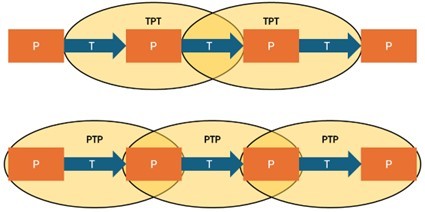
Causal transfers take time and travelling through any causal network in the direction of the arrow of time will yield a chain of alternating processes and transfers, i.e.: … P – T – P – T – P …
Causes are effects, and effects are causes.
Every system or event in a causal chain shares a component with its predecessor and successor.
The PTP structure equates to an event in which something does something to something else. The TPT structure equates to a system with its inputs, processes and outputs.
TPT Reasoning: Pattern Recognition and Unconscious Inference
TPT causality refers to a structure in which two processes are linked by an inferred or unknown transfer, i.e. each cause and effect has the structure TPT and the two are linked by a common T. In human cognition, this reflects pattern recognition: we notice that two processes frequently co-occur, and infer a causal link, even if we cannot identify what mediates the connection.
This form of reasoning is fast, intuitive, and largely unconscious. It allows us to make rapid inferences from experience, often without awareness of the intermediate mechanisms. However, it is error-prone. TPT reasoning is vulnerable to spurious associations and errors caused by unseen common causes. In these cases, the inferred causal link is false, despite the pattern appearing consistent.
Large language models also rely heavily on TPT-type reasoning. They identify recurring associations in their training data and reproduce those patterns in response. This allows them to answer questions, complete prompts, and simulate explanations even when they do not possess internal models of the causal transfers involved.
PTP Reasoning: Explicit Inference and Conscious Verification
In PTP causality, by contrast, causes and effects consist of a process, a known transfer, and another process. Each cause or effect has a PTP structure and the two are linked by a common P. This represents structured reasoning in which a clearly identified mechanism links cause and effect. In human cognition, this kind of reasoning is associated with conscious, reflective thinking. It is slow, deliberate, and effortful, but less prone to error.
Verification through PTP reasoning is essential when pattern-based inferences (TPT) are in doubt. It allows us to examine whether a supposed cause-effect relationship is supported by identifiable transfers. In systems theory terms, it confirms that the output of one process is indeed the input to another.
Error and Verification in Human and AI Cognition
Both humans and artificial intelligences are vulnerable to error when relying solely on TPT reasoning. A classic example is the post hoc fallacy: assuming that because B follows A, A caused B. Without identifying the actual transfer, such reasoning remains speculative.
AI systems, too, may generate plausible but incorrect answers when their training data contains coincidental patterns. They may infer connections that resemble PTP structures but are not grounded in causality.
This is why PTP reasoning is vital for verification. It distinguishes genuine causal chains from coincidental associations by demanding an explicit causal transfer.
A Unified Framework of Reasoning
A key insight from systems theory is that these two modes of reasoning are not exclusive. In fact, they are complementary. TPT reasoning allows for quick hypothesis generation and intuitive understanding. PTP reasoning provides a structure for verification, deeper analysis, and error correction.
Understanding and integrating both types of causal reasoning is central to building a theory of cognition, both biological and artificial. It also has direct implications for epistemology, systems modelling, and the future of AI development.
Conclusion
TPT and PTP causality offer a powerful lens for interpreting human and artificial thought. TPT supports rapid pattern recognition; PTP ensures that those patterns are grounded in real causal mechanisms. Awareness of this dual structure is essential for improving reasoning, communication, and the development of intelligent systems.
Future work may involve identifying when to trust each mode, and how to better integrate them in education, epistemology, and machine reasoning architectures.
Every system, from molecules to minds to markets, changes over time. These changes are not random. Systems tend to follow patterns: settling into stability, reacting to shocks, and sometimes undergoing deep transformations. One of the most powerful ways to understand this behaviour is through the medium of energy landscapes, a concept that is well established and widely used in physics.
Systems undergo phase transitions, a term borrowed from physics. When water freezes to ice, it experiences a type 1 phase transition; the change occurs almost instantaneously across the entire system. More complex systems, however, typically undergo a type 2 phase transition; one that requires them to traverse an energy landscape, moving step by step between stable states. Over geological time, for example, the Earth has shifted through such a landscape from a predominantly mineral state to a living one and may now be transitioning toward an informational one.
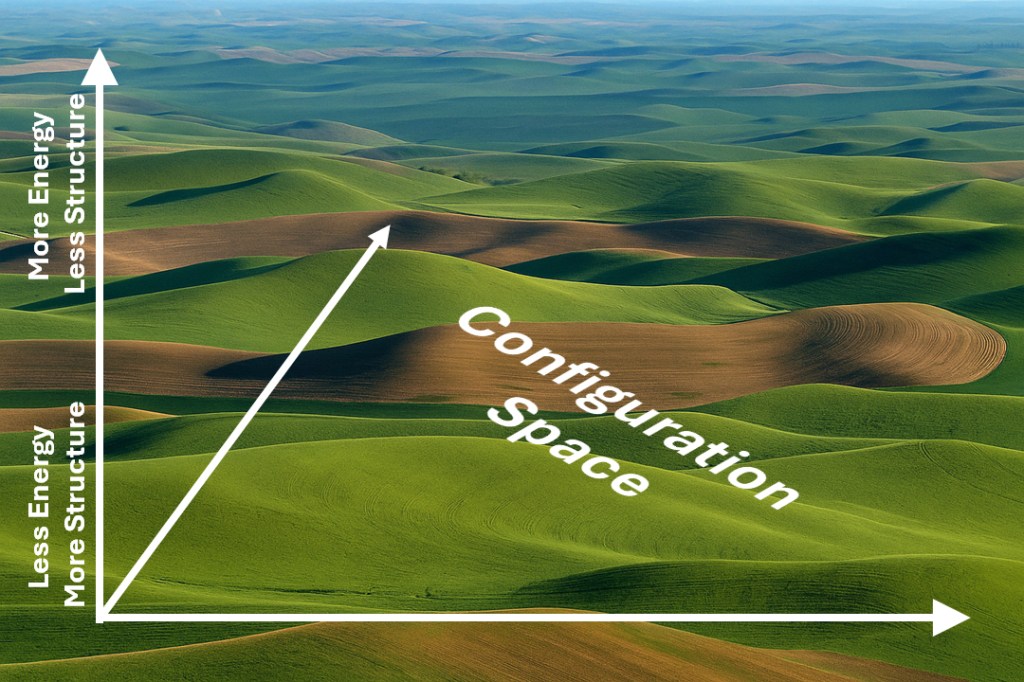
An energy landscape is a conceptual tool that maps all the possible configurations a system can take and shows how stable each of those configurations is. It is not a feature of the system itself, which at any given time exists in just one of those configurations. Instead, it is a representation of the system’s entire configuration space, i.e., the set of all possible arrangements of its components, whether or not those arrangements actually exist. While it is helpful to imagine this landscape in two dimensions, in practice it may have hundreds, thousands, or even millions of dimensions.
A system can be closed; that is, no energy or matter enters or leaves it; open to energy; or open to both energy and matter. The nature of the landscape differs for each. This is explained in more detail in the paper “Framework for a General System Theory” (Challoner, 2025) available at https://rational-understanding.com/2025/05/12/framework-for-a-general-system-theory/.
In the open systems encountered in nature, valleys in the energy landscape represent stable, low-energy states (also called attractors) where systems tend to settle. Hills or peaks are unstable, high-energy states where systems rarely remain for long. Over time, systems “move” across this landscape in response to internal dynamics and external influences.
In this context, internal dynamics refers to changes that arise from within the system itself, without major external shocks. In physical systems, this might be thermal fluctuations or ongoing chemical reactions; in biological systems, metabolic processes or genetic variation; in social systems, demographic shifts, gradual changes in norms and institutions, or structured cycles of change such as Margaret Archer’s Morphogenetic Cycle. Over time, these small, cumulative adjustments can alter the system’s configuration, nudging it toward a new position in its energy landscape.
If left undisturbed, however, most systems drift toward the lowest nearby valley; the most stable state available.
The Structure of Systems and Their Landscapes
To understand what defines a system’s configuration space, we need to know what the system’s components are. Systems theory describes reality as a nested hierarchy; each system is made of subsystems, which are themselves made of smaller subsystems, and so on. Assembly theory offers a compatible view from another angle; it sees every system as built from previously assembled components that themselves have been assembled from simpler, previously assembled parts.
Assembly theory assigns levels of assembly. The simplest structures occupy level 1. Assemblies made from level 1 components occupy level 2, and so on, increasing in complexity. Thus, any system can be described as level n, and composed of level n–1 components. The latter are, in turn, made of level n–2 sub-components, and so on.
The configuration space of a system of level n is defined by the degrees of freedom of its level n–1 components, that is, the independent ways in which they can vary.
Open System Energy Landscapes
An open system energy landscape maps the total energy of a system onto the configuration space of its components. In the simplified three-dimensional visualisation, valleys (low total energy) correspond to stable attractors. They are typically associated with high organisation and high “information at source”. Peaks, on the other hand, are unstable configurations, typically associated with high total energy, low organisation, and low “information at source”.
Figure 1 – An energy landscape visualised as hills and valleys in a two dimensional terrain.
In this framework, “information at source” is equivalent to Schrödinger’s negentropy, i.e., the degree to which a system’s entropy is less than its maximum possible value. Thus, in an open system energy landscape, valleys correspond to high-negentropy states, while peaks correspond to high-entropy states.
Static and Dynamic Landscapes
In open systems that are closed to mass but open to energy the landscape is relatively static. As energy enters or leaves a system its energy landscape moves up or down whilst retaining the same overall profile. An example that approximates to such a system is the Earth as a whole, which receives energy from the Sun but gains little matter.
However, not all energy landscapes are equally stable. Systems open to both energy and mass have landscapes that are dynamic, shifting like the surface of a storm-driven ocean. In such systems, attractors can deepen, vanish, or be replaced as new matter and energy flow in or out.
Natural systems such as coastal estuaries, and social systems such as globalised manufacturing, both illustrate how being open to energy and mass makes a landscape dynamic. In an estuary, tides, storms, and seasonal floods bring new sediment, nutrients, and species, reshaping which ecological communities dominate. In manufacturing, new technologies, raw materials, and workforce movements can build new industrial hubs or undermine existing ones. In both cases, stable configurations, ecological communities or production networks are attractors, but these can deepen, vanish, or be replaced entirely as continual flows of matter and energy reshape the landscape.
How Systems Traverse a Landscape
Over their lifecycles, open systems tend to shift into progressively deeper valleys, i.e., more complex and stable forms of organisation, until they are constrained by internal limits such as resource shortages or diverted by external shocks. Initially, a collection of components is only a subcritical structure; it lacks the emergent properties necessary for the novel functions and outputs lacked by its parts. As organisation increases, it may become a sub-optimal system, i.e., one that has an emergent function, but not yet enough structure to deliver outputs efficiently. Further organisation can lead to an optimal state, where the energy used for structural maintenance and the energy used for output are balanced to maximise performance. Beyond this point, the system becomes super-optimal; any additional complexity may draw too much energy into self-maintenance, reducing output and eventually leading to collapse if maintenance demands outstrip available energy.
Systems can also oscillate around an attractor, making continual small adjustments to remain stable. In real-world settings, such oscillations often produce repeating cycles, e.g., periods of growth followed by contraction, tension followed by resolution, or stability punctuated by brief disruptions. Over time, these cycles can reinforce the system’s current organisation, allowing it to return to the same attractor after each disturbance, a tendency known in systems theory as equifinality. However, if the oscillations amplify or are combined with large external shocks, the system may break from its cycle and transition into a different valley entirely, reorganising around a new attractor, a process referred to as multifinality. In social and ecological systems, such transitions may take the form of reorganisations, revolutions, or collapses.
Fractality in Energy Landscapes
Energy landscapes are often fractal. That is, similar patterns appear at different locations and scales. This arises because many configurations are variations of others. For example, components may be identical, allowing them to be interchanged without altering the whole, so different areas of the landscape share the same pattern. In addition, systems frequently assemble recursively, meaning that smaller subsystems are built in the same way as the larger system they belong to. This repetition of assembly patterns across levels produces repeating structures in the landscape itself: the routes to forming a subsystem resemble the routes to forming the whole, creating self-similar pathways and clusters of attractors at multiple scales.
This fractal nature means that, as a system traverses its energy landscape, patterns of change it has followed before may reappear later in its life, and often at different scales. Because similar configurations and pathways exist in multiple locations across the landscape, the system can encounter familiar transitions in new contexts. This is why history can sometimes guide our expectations, although the self-similarity of the landscape never guarantees identical outcomes. For example, in ecology, the process by which vegetation colonises bare ground after a small landslide can resemble the much larger-scale succession that occurs after a volcanic eruption. The sequence of pioneer species, intermediate communities, and mature forest repeats the same general pattern, even though the scale, timing, and specific species differ. Similarly, in economics, a localised boom-and-bust cycle in a single industry can follow the same trajectory as a national economic cycle, but on a smaller scale and over a shorter period.
This fractal nature also means that systems can become trapped in “valleys within hilltops”. That is, zones of local stability nested inside larger instabilities. In such cases, a system may appear stable in the short term while, in reality, the broader configuration it occupies is unstable and heading toward change or collapse. For example, a government may maintain political stability through a fragile coalition, yet the entire national system faces deepening economic and environmental crises that will eventually destabilise it. Similarly, a supercooled liquid can remain in a seemingly stable state until the slightest disturbance triggers a complete and irreversible phase change.
From Physics to Society
The concept of energy landscapes is not limited to physics or chemistry. Social systems, such as international relations, also move across landscapes defined by stability and change. These systems are open to new energy in the form of ideas, movements, and crises, but largely closed to new matter, since nations rarely appear or disappear. Like physical systems, they experience periods of self-maintenance, oscillation, disruption, and transformation. And just as in natural systems, their landscapes can be reshaped by sustained flows of energy or sudden shocks.
Conclusion
Energy landscapes offer a way to see not just where a system is, but how it might change. They explain why systems settle into certain patterns, why some shocks cause sudden transitions while others do not, and why some paths are easier to follow than others. They also show how patterns can repeat, recombine, and evolve over time. By viewing systems through this lens, and by recognising that landscapes themselves can shift, we gain a powerful method for thinking about change in everything from molecules to markets.
I was pleased to present my paper “Exploring Poly-Perspectivism: Using Multiple Perspectives for a More Comprehensive Understanding of Reality” at the ISSS 2025 Conference.
The work explores how we can engage with diverse perspectives more productively without collapsing them into a single truth or drifting into relativism. It introduces a new meta-framework that evaluates perspectives by the human needs they satisfy or the harms they help prevent, offering a human-centred complement to systems science.
If you’re interested in interdisciplinary collaboration, epistemic coordination, or the cognitive dynamics behind complex decision-making, this work may be of interest. You can download the following:
The full paper
A glossary of key terms
A list of key propositions
Guidance on overcoming personal blind spots
A summary of Motivated Symbolic Interpretation Theory
Across a century of psychology, communication theory, and leadership research, the same insight keeps re-emerging: human cognition is triadic. Freud called it the Id, Ego, and Superego. Eric Berne described Child, Parent, and Adult ego states. More recently, systems thinkers speak of Ego, Eco, and Intuitive Intelligence.
Each of these frameworks highlights a different aspect of a common truth: the human mind is a layered system shaped by evolution, motivation, and reflexivity. We are driven by instinct, shaped by society, and guided by reflection. Understanding how these layers work can help us communicate better, make peace with ourselves, and grow as individuals and communities.
In my new article, I explore this recurring cognitive triad and its evolutionary foundations. I show how it maps onto brain structures, motivational needs (via Alderfer’s ERG theory), and modes of interpersonal communication. It also shows us how reflexivity and observation give us the tools to navigate these inner voices constructively.
Why do some words open doors while others close them? Why do some images attract and others repel? Why are some ideas welcomed and others dismissed; not because of their merit, but because of how they’re framed?
Over the past few months, I’ve been developing a theory that helps explain exactly that. It’s called Motivated Symbolic Interpretation Theory (MSIT). It explores how certain words, phrases, images, and symbols may, in the past, have become associated with satisfying or frustrating experiences, and how these associations shape our responses to new information, often before we’re even aware of it.
The theory is easily understood, and is outlined in a concise summary document that introduces its core definitions and propositions. It’s a practical, cross-disciplinary idea with applications in communication, education, psychology, therapy, and personal relationships.
This is just the beginning. I’m working on a fuller explanation, with examples and practical tools to help people use the theory to improve clarity, trust, and understanding in everyday life.
This paper, freely downloadable at https://rational-understanding.com/UUDH#framework, presents a comprehensive framework for understanding systems across all domains of complexity: physical, biological, cognitive, and social. The framework builds upon, unifies, and extends classical systems science by grounding systemic behaviour in open system thermodynamics, energy landscapes, systems causality, and recursive emergence. At its core lies the concept of information at source: a measure of internal recursively structured order, and its dynamic relationship with energy and entropy.
Systems are defined by the emergence of properties absent from their components, and their operation depends on the balance between energy available for maintaining internal structure and that required for exercising function. The framework explains how systems form, persist, collapse, or evolve by stabilising in attractor basins within energy landscapes, scaling recursively through fractal architecture.
Sets of formal definitions and propositions, whose provenance is given, underpin the theory, offering a structured, logically coherent, and cross-disciplinary model. The framework unifies foundational work by von Bertalanffy, Ashby, Beer, Bateson, Prigogine, Rosen, and others. It also incorporates more recent developments by Bhaskar, Cronin and Walker, Parisi, and the author.
This paper entitled “Systems Causality, Assembly Theory and the Discrete Accumulation of Negentropy” explains why, despite the prevalence of entropy, decay and disorganisation, the universe is essentially creative. It also gives meaning and purpose to human existence from a scientific perspective, and so, challenges existential nihilism. It is deliberately written in plain English, and I have explained and defined any unavoidable technical terms. You can download a pdf free of charge via the following links:
The paper was written to help the International Society for the Systems Sciences in their search for a General System Theory. So, it draws together many systems related concepts , i.e., basic systems theory, causality, information, entropy, negentropy, emergence, Big History, why multiple scientific disciplines employing different laws are necessary and, and so on.
I see these concepts as applying to us in our day-to-day lives and this work will therefore help me a in developing social systems theory. So, that is what I plan to return to now.
Abstract
The Second Law of Thermodynamics states that entropy, or disorder, increases in closed systems. However, the observable universe has, over time, produced increasingly complex structured entities, from atoms and molecules to living organisms and civilisations. This paper explores the mechanisms behind this phenomenon, known as the accumulation of negentropy. That is, the growth of order despite the natural tendency toward disorder.
It is proposed that the accumulation of negentropy is not a separate force but rather a consequence of causal interactions whose structured complexity has increased over time. These interactions follow the principles of Systems Causality, where cause-and-effect relationships are shaped by the transfer of matter, energy, and information. Assembly Theory provides an explanation for the step-by-step emergence of ever more complex structured entities, including causal relationships, within the constraints of prior structures. It also explains the emergence of new laws and scientific disciplines as complexity increases.
Using this framework, the paper analyses how causality has driven the emergence of increasingly complex structured entities throughout Big History, from quantum fluctuations and chemical selection to biological evolution and human civilisation. It also examines the implications for humanity today.
Systems theory, causality, natural language, and logic have traditionally been pursued as separate disciplines. However, underlying each of these domains are fundamental structures that suggest a deeper, unified framework. The way we structure our understanding of these disciplines is not arbitrary. Rather, it is dictated by principles that govern perception and cognition. It may also be dictated by principles that govern reality.
The Unified Universal Disciplines Hypothesis (UUDH) proposed in this paper posits that Fundamental systems theory, causality, natural language, and logic are different manifestations of the same underlying structure in the way that human beings perceive reality and reason. Each of these domains encodes and processes causal interactions in ways that reflect the level of complexity and perspective employed by the observer.
This paper presents the argument and describes the methodology for unifying these disciplines into a cohesive model that enables more precise reasoning across them. Symbolic Reasoning, an enhancement of traditional set theory, provides a formal tool to facilitate this unification.
UUDH has considerable and diverse explanatory power from quantum theory to human society. The unification of systems, causality, natural language, and logic represents a promising approach to developing a more comprehensive understanding of human cognition and external reality. By integrating these traditionally separate fields, we can enhance our ability to reason about complex systems in a coherent and structured manner. Symbolic Reasoning offers a powerful tool for this integration. However, the approach is hypothetical, and empirical testing is needed to verify it.
In systems theory, an emergent property is a characteristic that arises at the level of a system but is absent in its individual components. This is commonly seen in nature, physics, and social systems. The classic example of an emergent property is, of course, consciousness. The human mind is conscious, but its component neurons are not.
Much has been written about emergent properties and the concept is a keystone in systems science. They are generally thought to have a causal basis and to be a consequence of interactions between the component parts. For example, there is much scientific evidence that consciousness is due to feedback through our sensory processing centres thereby making us aware of our own thoughts. Some of this evidence is discussed at https://rational-understanding.com/2021/10/22/consciousness/
Vanishing Properties
But what of the complementary concept: disappearing or vanishing properties? There appears to be little, if any, awareness or discussion around this concept in the systems community. Yet the concept not only exists but also has a significant impact on the reality that we experience. Perhaps, it is because vanishing properties are often more easily explained than emergent ones, which to this day, seem to have a mystical aura around them? Vanishing properties are crucial for understanding why large-scale social and environmental problems persist despite widespread individual concern.
Vanishing properties occur when attributes present in individual components fail to manifest at the system level. For example, atoms consist of positively charged protons and negatively charged electrons. While the individual components have a charge, a neutral atom as a whole exhibits no net charge, effectively “cancelling out” this property.
While emergent properties have long been studied in systems science, the concept of vanishing properties remains underexplored. Yet, understanding how responsibility, action, and ethical concern can disappear in collective settings is crucial for tackling today’s most pressing social challenges from climate change to political engagement.
Before discussing practical examples of vanishing properties in society, I would first like to mention the work of two important figures in the field: Floyd Allport and Albert Bandura.
Floyd Allport
Floyd Allport (1890–1978) was a pioneering figure in social psychology, known for emphasising the importance of individual behaviour in social contexts. His work is highly relevant to the concept of vanishing properties in the social context, particularly in understanding how individual behaviours fail to manifest at the collective level. His rejection of the “group mind” aligns with the idea that societal patterns arise from the actions (or inactions) of individuals, rather than from some mystical or autonomous group entity. This perspective is crucial in explaining why individual responsibility or intention can disappear in collective settings, a key characteristic of vanishing properties.
For example, Allport’s research on social facilitation and inhibition provides insight into how people’s behaviour changes when they are part of a group. In some cases, the presence of others enhances individual performance (social facilitation), but in more complex or high-pressure situations, individuals may withhold action, assuming that others will take the lead (similar to the bystander effect). This can explain why personal responsibility for addressing issues like climate change, political activism, or poverty may vanish in large social settings. Individuals assume that their contributions are insignificant or that others will step in.
Allport’s emphasis on individual responsibility in collective settings influenced later research on diffusion of responsibility, groupthink, and social loafing, phenomena where action diminishes as group size increases.
Albert Bandura
Albert Bandura (1925–2021) was a pioneering psychologist best known for his work on social learning theory, self-efficacy, and moral disengagement. Later in his career, Bandura developed the theory of moral disengagement. This concept, which has been applied to understanding everything from corporate misconduct to social and environmental inaction, explains how individuals rationalise harmful or unethical behaviour, allowing them to detach from personal responsibility in a collective setting. It helps to explain why moral responsibility can vanish at the group level, even when individuals personally recognise an issue as wrong. Bandura identified several ways in which moral disengagement operates, including diffusion of responsibility, dehumanisation of victims, and euphemistic labelling, where harmful actions are framed in neutral or positive terms.
An example of the latter is Russia’s “special military operation” in Ukraine. By using this term, the Russian government avoided the more negative connotations of “war” or “aggression,” which could trigger stronger domestic and international opposition. This euphemistic language helped to justify the military action, downplay its severity, and align public perception with the government’s narrative, making it easier for individuals to morally disengage from the real human suffering and destruction involved.
Another example of euphemistic labelling is found in corporate ‘greenwashing,’ where companies reframe environmentally harmful practices in misleadingly positive terms. For instance, airlines advertising ‘carbon-neutral flights’ often rely on questionable carbon offset schemes rather than reducing emissions.
Vanishing Properties in Society and Their Impact
In sociology, vanishing properties explain why problems arise with collective action. Despite individual awareness and concern, collective action often fails to materialise. Some examples of this effect are given below.
1. Climate Change and the Diffusion of Responsibility (The Bystander Effect)
The bystander effect is a psychological phenomenon where individuals are less likely to help someone in distress when others are present. They assume that someone else will take responsibility. The term was coined by John Darley and Bibb Latané in 1968 after their research on the murder of Kitty Genovese, where multiple witnesses reportedly failed to intervene. Their studies demonstrated that the presence of others leads to diffusion of responsibility, reducing the likelihood of individual action.
In the case of climate change, many individuals recognise it as a major issue and take small actions, e.g., recycling or reducing plastic use. However, many also believe their personal contributions are insignificant in the grand scheme, leading to widespread inaction. This results in what Garrett Hardin referred to in his 1968 essay as “The Tragedy of the Commons”. Resources become depleted because individuals have no incentive to limit their consumption and assume that others should take responsibility.
2. Political Apathy and Pluralistic Ignorance
Many individuals may privately disagree with an unjust policy or social norm but assume that others support it. Since no one openly challenges the status quo, it remains unchallenged, even if many oppose it internally. The result can be that policies and social structures persist even when the majority oppose them, as seen in past civil rights struggles and modern political apathy.
3. Voting and the Perceived Irrelevance of One Vote
A single individual’s vote has a small chance of changing the outcome of an election. However, if many people believe their vote does not matter, turnout decreases, affecting the result. The consequence can be low voter participation, the weakening of democracy, and unrepresentative governance.
4. Poverty and Compassion Fatigue
The concept of vanishing properties can also apply to the effect of group, as opposed to individual, issues on people. For example, when we hear about one specific person in need, we often feel empathy and a desire to help. However, large scale poverty can feel overwhelming, leading to a sense of powerlessness and disengagement. The consequence can be “compassion fatigue,” where we shut down emotionally in response to large-scale suffering.
Countering Vanishing Properties: Strategies for Social Change
While vanishing properties explain societal inertia, history has shown that effective strategies can counter this. Some examples of successful strategies are given below.
1. Climate Change: Social Norms and Behavioural Nudging
Sweden combined policy (carbon taxes) with visible social norms, such as increased bicycle lanes and renewable energy promotions. As people saw others adopting eco-friendly behaviours, individual actions reinforced collective responsibility rather than it vanishing.
While some argue that climate solutions require systemic action rather than individual behaviour changes, research shows that visible shifts in social norms can influence both policymakers and industries to adopt stronger regulations.
2. Political Activism: Breaking Pluralistic Ignorance
In early 20th-century Britain, many women privately supported suffrage but hesitated to voice their views due to societal norms. The Suffragettes’ public demonstrations, hunger strikes, and acts of civil disobedience helped break pluralistic ignorance. As more women openly demanded the right to vote, it became clear that widespread support existed, leading to legislative change with the 1918 Representation of the People Act.
3. Voting and Civic Engagement: Social Accountability
Studies have shown that making voting visible, e.g., posting about it online or wearing “I Voted” stickers, increases participation. Public visibility shifts voting from an isolated act to a socially expected norm, preventing individual effort from disappearing.
Sustained collective identity is crucial in overcoming vanishing properties. Social movements succeed when individuals feel part of a shared cause, reinforcing participation over time.
4. Poverty: Personalising the Narrative
Research has shown that people are more likely to donate or act when shown a single individual’s story rather than abstract statistics. Charities like Save the Children highlight personal narratives, making people feel that their actions have a direct impact.
Conclusion: Transforming Individual Concern into Collective Action
The concept of vanishing properties provides a powerful lens for understanding why major societal problems persist despite widespread concern. By recognising these dynamics, we can design interventions that restore personal responsibility at the collective level rather than letting it disappear.
Key takeaways:
Make action visible: Seeing others act reinforces personal responsibility.
Encourage small commitments: Micro-actions, like public pledges, create momentum.
Break the silence: When individuals speak out, they empower others to do the same.
Personalise large issues: Framing problems around individual stories makes them more relatable.
Understanding vanishing properties not only explains why change is hard, but also offers clear strategies to turn awareness into action. The challenge lies not in whether people care, but in ensuring that care translates into meaningful collective impact.
In a world increasingly defined by cultural and ethical diversity, how do we create a cohesive and practical moral framework? This question is deeply personal for me, as I have grappled with cognitive dissonance arising from my upbringing in a Western culture heavily influenced by Christian values such as care, altruism, and compassion. While spiritually uplifting, these values often felt disconnected from the practicalities of improving society.
Through my exploration, I found two traditions, Confucianism and Ubuntu, that framed these values as transactional and interdependent, emphasising their role in fostering societal harmony and mutual benefit. Yet, neither fully addressed the complexities of Western society or the pressing challenge of leaders who exploit power for personal gain, disrupting collective well-being.
This article examines Confucianism and Ubuntu as distinct but complementary ethical systems, highlights the challenges posed by dark leadership, and proposes a fusion of these traditions into a practical framework. This ethical code aims to balance individual rights, values regarding relationships, societal responsibilities, and collective well-being, offering a roadmap for a more harmonious society.
Ubuntu
Ubuntu is an African philosophical concept originating from the Bantu-speaking peoples of sub-Saharan Africa. The term “Ubuntu” is often translated as “humanity” or “humaneness,” encapsulated in the phrase Umuntu ngumuntu ngabantu, meaning “A person is a person through other people.”
Rooted in communal societies, Ubuntu emphasises interconnectedness, mutual aid, and collective well-being. It shaped how people resolved conflicts, managed resources, and interacted socially. Colonialism disrupted these principles, introducing hierarchy and individualism. Yet Ubuntu endured, particularly during the liberation struggles in South Africa. Leaders like Nelson Mandela and Desmond Tutu invoked Ubuntu to promote reconciliation and justice, guiding initiatives like the Truth and Reconciliation Commission.
Ubuntu teaches that humanity is built through relationships. A person’s identity and well-being are tied to their community. Celebrations and shared meals highlight collective joy, while communal farming and child-rearing ensure no one is left behind.
Compassion and kindness are central to Ubuntu. Helping others and sharing resources strengthen the community and reflect shared humanity. The philosophy upholds dignity and fairness, ensuring every voice is heard and respected.
Ubuntu prioritises healing over punishment, advocating forgiveness to restore harmony. This principle was vital in South Africa’s post-apartheid reconciliation process. Ubuntu also emphasises harmony with nature, advocating for sustainable living to benefit future generations.
Today, Ubuntu’s values of connection, mutual aid, and collective well-being offer a counterbalance to individualism and provide solutions to challenges like social inequality, environmental sustainability, and cultural fragmentation.
Confucianism
Confucianism is a philosophical and ethical system rooted in the teachings of Confucius (Kong Fuzi), a Chinese philosopher who lived during the politically unstable Spring and Autumn Period (551–479 BCE). Confucius sought to restore order by emphasising moral conduct, proper governance, and harmonious relationships.
His teachings, recorded in the Analects, form the foundation of Confucian thought. Over millennia, Confucianism evolved, shaping Chinese culture and much of East Asia. Institutionalised during the Han Dynasty, it influenced education, governance, and societal organisation. Despite challenges during modernisation and political upheavals, Confucianism has resurged in recent decades as a source of moral philosophy and cultural identity.
The core teachings of Confucianism revolve around harmonious relationships, often described as the “Five Key Relationships”:
Ruler and subject.
Parent and child.
Husband and wife.
Older sibling and younger sibling.
Friend and friend.
These relationships are hierarchical but reciprocal, with mutual responsibilities. Filial piety (xiao), or honouring one’s parents and ancestors, is central to Confucianism, reflecting gratitude and ensuring family harmony.
Confucius emphasised cultivating virtues to live a good life and contribute to society, such as:
Compassion and putting others first.
Respecting traditions and social customs to maintain order.
Acting morally, even when it is challenging.
Pursuing lifelong learning and self-improvement.
Confucius also advocated for ethical leadership. A virtuous leader inspires others through fairness and wisdom, fostering harmony. His version of the Golden Rule, “Do not do to others what you do not want done to yourself”, promotes empathy and consideration in interactions.
Confucianism’s focus on relationships, ethical leadership, and moral cultivation offers insights into strengthening family ties, promoting just governance, and encouraging personal growth for societal betterment.
Dark Leadership
Approximately 13% of the population is estimated to exhibit dark personality traits such as narcissism, psychopathy, or Machiavellianism. These traits are not pathologies but rather personality characteristics within the range of normal behaviour. However, individuals with these traits often have reduced moral standards and heightened self-interest, making them more likely to rise to positions of power. Unfortunately, this means many leaders in society exhibit such traits.
People are often reluctant to challenge those in power due to fear of reprisal. Responses vary: some support these leaders for personal gain, others seek refuge elsewhere, but the most common reaction is denial. Many refuse to acknowledge the presence of dark leaders until their actions cause significant harm, such as war or societal collapse.
The persistence of dark leaders in cooperative societies has multiple explanations. Some theories point to brain dysfunction or traumatic childhood experiences, while others attribute their success to their wealth, power, or charisma. Evolutionary perspectives suggest they thrive as defectors in systems reliant on cooperation, exploiting others without destabilising the system entirely.
These leaders rely on transactional relationships. Their power is sustained by followers who anticipate personal gains, such as wealth or influence. Followers with similar traits may support such leaders, hoping to benefit or even inherit their status. This dynamic can create a vicious cycle, perpetuating leadership that prioritises self-interest over collective well-being.
Recognising and addressing the influence of dark leaders is crucial. Education, awareness, and systemic changes are necessary to ensure leadership serves humanity rather than personal ambition.
Ethical Code
The following ethical code integrates the best elements of Confucianism and Ubuntu, addressing the challenges posed by dark leadership. Designed for Western contexts, it balances individual rights, relational values, structural responsibilities, and collective well-being.
Core Principles
Relational Humanity: Treat all people with compassion, dignity, and respect, understanding that personal fulfilment is inseparable from communal well-being.
Moral Leadership: Lead with integrity, fairness, and compassion. Prioritise the welfare of those you serve and inspire trust through ethical behaviour.
Balance of Individual and Collective Good: Uphold individual rights while recognising responsibilities to the community. Foster solutions that benefit both individuals and society.
Responsibility to Others: Strengthen relationships by fulfilling duties to family, friends, colleagues, and society. Value reciprocity and mutual aid.
Education and Self-Cultivation: Pursue lifelong learning and foster moral development in others, emphasising respect, empathy, and responsibility.
Harmony Through Justice and Fairness: Promote fairness and resolve conflicts constructively. Prioritise reconciliation and peace over retribution.
Sustainability and Stewardship: Protect the environment for future generations. Act as stewards of nature, balancing resource use with ecological care.
Forgiveness and Reconciliation: Heal relationships through forgiveness and mutual understanding. Take meaningful steps toward justice and harmony.
Responsible Followership: Educate yourself to recognise harmful leaders. Withhold support from those who act against the common good and oppose harmful actions responsibly.
Practical Applications
Leadership: Leaders must act transparently and ethically, prioritising inclusivity and fairness.
Followership: Followers should recognise harmful leaders, withhold support, and oppose harmful actions responsibly.
Education: Teach moral values alongside academic excellence to foster responsibility and compassion.
Business: Companies should balance profitability with social responsibility and environmental sustainability.
Community: Build inclusive, supportive communities and promote civic engagement.
Personal Life: Align personal actions with shared values and invest in self-reflection and moral growth.
Conclusion
This ethical code respects Western individualism while introducing Ubuntu’s relational ethos and Confucianism’s structured responsibilities. By offering guidance across personal, professional, and civic spheres, it draws on universally relevant values like compassion, fairness, and sustainability. Ultimately, this framework empowers individuals and communities to navigate ethical challenges, fostering a more harmonious and just society.
 Rational-Understanding.com