Categories
03. The Tree of Needs

The Tree of Needs

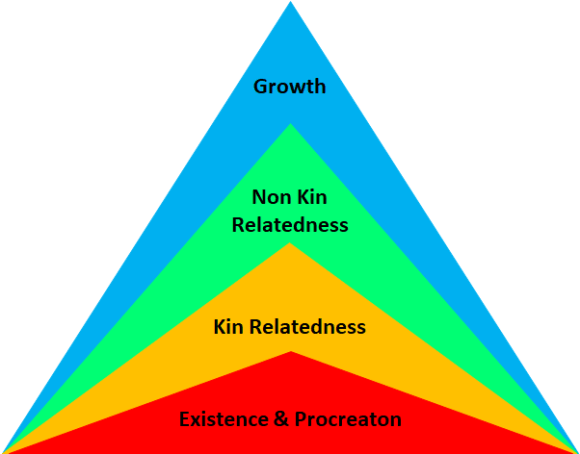
Although Maslow did not describe it in this way, the hierarchy of needs is usually represented by a pyramid. However, in my view, a tree may be more appropriate.

The trunk represents the existence and procreation needs or contra-needs that we all share. The branches and twigs represent our higher needs and contra-needs. Satisfying our needs can be likened to climbing this tree. As we ascend, from the trunk to its outermost twigs, our needs become higher. The highest needs are those at the outer twigs and the lowest those nearest the trunk. The higher the need the more branches or twigs there will be. It is this diversity which gives us our own unique personalities and motivations.

Representing needs and contra-needs in this way helps us to understand several things:

  1. Initially, we must satisfy our existence and procreation needs. We begin climbing at the trunk therefore, and, as we ascend to satisfy higher needs, they become ever more personal and diverse.
  2. We must continue to maintain the trunk and branches that we have already ascended if we are not to fall from the tree. This means that we must regularly attend to our lower and more basic needs even whilst focussing on higher ones.
  3. The diversity of higher needs has implications for empathy. We all share common existence and procreation needs. It is, therefore, relatively easy to understand these needs in others and to empathise with any difficulties they have in satisfying them. However, as we climb higher and choose branches which satisfy our own more personal needs, our understanding of the branches occupied by others begins to diminish. Thus, we have less empathy for people who are having difficulty in satisfying their higher needs. Rather, it is easy to behave in a manner which restricts diversity and to believe that others should be like oneself.
  4. As one ascends the tree there become fewer people on each branch and it becomes harder to find others with whom to share an interest. Thus, the risk of feeling isolated becomes greater.
  5. We must have aims to be motivated and as we ascend the tree it becomes ever more difficult to find and settle on these. The tendency is, therefore, to do more of the same. For example, wealthy people may seek ever more wealth, and politicians ever more power.
  6. Representing needs in the form of a tree also has implications for diversity. The diversity within the branches of the tree reflects the diversity within societies. Societies in which people can satisfy their higher needs are more diverse than those in which they cannot.

In my next post I will describe Manfred Max-Neef’s theory of how we satisfy our needs and some of the ways in which this may not succeed.

Categories
02. Contra-needs and Existentialism

Contra-needs and Existentialism

For every human need there is a contra-need. I have coined this word because the English language has no suitable opposite to “need”. Contra-needs are physical and psychological states that we wish to avoid, such as injuries or illnesses. In the same way that we are motivated to satisfy our needs, we avoid anything that causes a contra-need.

Maslow incorporated our physiological or existence contra-needs into his hierarchy by referring to the need for safety and security. This list, however, is incomplete. To describe all of our contra-needs, I will use the modified ERG model from the previous article.

  1. Existence and procreation contra-needs. These provide the strongest behavioural predispositions. They include the opposites of Maslow’s safety needs. For example, diseases, illnesses, addictions, physical harm, assault, torture, pain, and death. They are caused by various threats in our environment. These contra-needs also include the opposites of Maslow’s security needs. For example, fear for one’s material wellbeing, which can be caused by crime, unemployment, war, or social instability.
  2. Kin relatedness contra-needs. These provide the second strongest predispositions. They include the opposites of Maslow’s love and belonging needs, but only insofar as they refer to our kin or lack of kin. For example, a feeling of isolation, which can be caused by rejection, conflict, or enmity. They also include the opposite of Maslow’s self-esteem needs. For example, despising oneself as a result of failed endeavours or the contempt of others.
  3. Non-kin relatedness contra-needs. These provide the third strongest predispositions. They are the same as the kin-relatedness contra-needs but apply to non-kin-relationships.
  4. Growth contra-needs. These are the opposites of Maslow’s self-actualisation needs. For example, a feeling of not being in control of one’s life; that one’s personality is suppressed; one’s existence purposeless, or feeling just “one of the crowd”, rather than an individual. They can be caused by a lack of freedom of choice regarding how to live one’s life, which, in turn, can be caused by the effort required to satisfy lower needs, by overly oppressive social norms, or by an authoritarian society.

If a contra-need is sufficiently pressing, we may plan to avoid it. However, like needs, contra-needs often result in behavioural predispositions which are only acted upon when a threat arises. Some behavioural predispositions, such as the “fight or flight” reflex, are strong enough to be inherited. Others are learned.

It is not usually the case that a single need or contra-need motivates a single action. Normally, several needs or contra-needs acting together result in an action.

A longstanding predisposition to avoid a contra-need can have an adverse effect on our sense of wellbeing and mental health. It is not good for us to live in fear. In recognition of this, existential philosophy focuses on how to cope with contra-needs, such as death, that, ultimately, are unavoidable. It recognises that life is not fully satisfying and is a journey in search of meaning. This philosophy was developed in the mid 20th Century from the writings of Kierkegaard, Nietzsche, Sartre, and Camus. Their writings followed the Great Depression and the two world wars when the world turned from a sense of optimism to one of despair. In the late 20th Century, it was developed into a psychotherapy by the American psychotherapist, Irvin D. Yalom, and others.

In Yalom’s view, we must learn to accept and manage four which cannot be avoided. These are:

  1. Death. Yalom regards death as being the most pressing of our concerns. One’s death is inevitable and the knowledge of it pervades the conscious and unconscious mind. This leads, at times, to great anxiety. He suggests that the recognition and acceptance of death leads to a better appreciation of life and encourages us to make the most of it. Grief at the death of a loved one is another inevitable fact of life. It is a consequence of our connections to others and is often managed through the same connections. Death, however, is the ultimate expression of entropy in our lives. There are other inevitable effects that we also need to come to terms with, such as illness and aging.
  2. Freedom (lack of guidance). In the existential sense, freedom does not mean social and political liberty. Rather it means fear arising from a lack of guidance in our lives. Awareness of this and accepting responsibility for our own guiding principles is important for an emotionally healthy life.
  3. Isolation (separateness). Existential isolation is not the same as loneliness. The latter arises from the physical absence of other human beings with whom to interact. Existential isolation refers to the unbridgeable gap between oneself as an individual, others, and the world that we inhabit. It means that, inevitably, we are apart from others and cannot merge ourselves with them. There is no solution to this form of isolation. It is a part of our existence that we must face up to and come to terms with.
  4. Meaninglessness. Yalom argues that we need meaning in our lives and its absence can lead to distress and even suicide. Ultimately, however, meaning is a human concept which does not exist in the external world. We inhabit a universe that has no inherent meaning and so must create it for ourselves.

Duality pervades human understanding. There are two sides to every coin, but we often focus on one side, whilst neglecting the other. The theory of human needs appears to have neglected those things that we are motivated to avoid. The “existential givens” are the unavoidable contra-needs that we must come to terms with. Needs, contra-needs and “existential givens” all form part of the human psyche. There are no apparent inconsistencies between them, which implies that they are each part of a complex structure seen from a different perspective, as shown in the table below.

Modified ERG NeedsExistential Given or Unavoidable Contra-Need
Existence and procreationDeath (personal)
Kin Relatedness
Non-kin Relatedness
Death (grief)
Freedom (lack of guidance)
Isolation (separateness)
GrowthMeaninglessness

Needs and contra-needs motivate our physical behaviour and interactions. Reconciling “existential givens” is about personal, mental, and emotional wellbeing.

In the next post, some of the implications of these needs and contra-needs will be discussed.

Categories
01. The Hierarchy of Needs Reviewed

The Hierarchy of Needs Reviewed

Human needs are internal physiological or psychological states which can be satisfied by interaction with our environment. They form the basis of our behaviour. For example, if we are hungry, then we try to find food. In his 1943 paper, “A Theory of Human Motivation”, the humanist psychologist, Abraham H. Maslow was the first to formally identify our needs and his suggestions are listed below.

  1. Physiological Needs. These are health and physical wellbeing and are satisfied by air, food, water, shelter, clothing, sleep, sex, etc.
  2. Safety and Security. A feeling of safety and security includes freedom from fear and can be satisfied by employment, social support networks, insurance, property ownership, financial security, family, and social stability.
  3. Love and Belonging. A sense of connection with others which can be satisfied by being accepted as a group or family member, by friendship, and by intimacy.
  4. Self-Esteem, i.e., possessing a sense of personal value, confidence, self-regard, mastery and the feeling of being unique. It can be satisfied by achievement, recognition by others and the respect of others.
  5. Self-Actualisation. This means being fully oneself and possessing morality, creativity, spontaneity, acceptance, experience, purpose, meaning, and inner potential. Self-actualisers can appear in any field, for example Einstein in the field of science, Roger Federer in sport, Michelangelo in art and, if the myths are true, the Buddha in spirituality.

Maslow explained that human behaviour is motivated by a requirement to satisfy these needs. Without them behaviour would not exist, and we would be unable to function.

According to Maslow, these needs form a hierarchy with physiological needs at the bottom and self-actualisation at the top. People must satisfy needs lower in the hierarchy and ensure that this satisfaction is sustained before effort is expended on higher needs. He does, however, qualify this by referring to degrees of relative satisfaction. It is not the case, he argues, that a need only emerges when those lower in the hierarchy have all been fully satisfied. Rather people are usually in a state where all their needs are, to a greater or lesser degree, only partially satisfied. Furthermore, the level of satisfaction of their needs tends to decrease as we ascend the hierarchy. A higher need may not be apparent at all if lower needs are not adequately satisfied. However, it will emerge by degrees as their level of satisfaction increases. The diagram below represents an analogy in the form of a drinking glass. Our needs are represented by the bands around it. Water, which represents the effort put into satisfying our needs, steadily fills the glass. At first, all the effort goes into satisfying physiological needs. However, as these are close to being fully satisfied, some of the effort goes into safety and security needs. As these begin to be fully satisfied, some goes into love and belonging, and so on. Once a need is satisfied, however, we do not ignore it but continually return to it to ensure that it remains so.

Maslow’s paper was instrumental in changing the focus of psychologists from aberrant to normal behaviour. Unfortunately, it was largely speculative and based on personal observation. Furthermore, subsequent research does not support the position of each need in a hierarchy. Not all psychologists agree with his theory, therefore. It is probably too detailed and fails to recognise inherited and learned individual differences and those arising from culture.

Several alternative models have been suggested, for example, the ERG (existence, relatedness, and growth) model proposed in 1972 by Clayton Alderfer. Alderfer’s existence needs correspond to Maslow’s physiological and safety needs, his relatedness needs to social belonging and self-esteem, and his growth needs to self-actualisation. He proposed that individuals can be motivated by several levels of need at any one time, but that their relative priority can change according to circumstances and the individual’s way of thinking.

Based on the evolutionary theory discussed in my previous articles, I would, however, suggest that the following modified version of the ERG model more accurately reflects reality. In this model I refer to “behavioural predispositions”. These are states of mind which do not necessarily lead to immediate action, but which prepare us to act when the opportunity to satisfy a need arises. They are like bowstrings; drawn by a need and released by an opportunity. However, if a need is sufficiently pressing, we will attempt to create those opportunities.

  1. Existence and procreation needs, i.e., Unsatisfied physiological and safety needs, provide the strongest behavioural pre-dispositions. All living things, since they first appeared, have physiological needs. These needs have the longest history, the most firmly established presence and are responsible for our strongest behavioural predispositions. This means that there is a hierarchical relationship between existence needs and all other needs and that they must be adequately satisfied before we attend to other needs.
  2. Kin relatedness needs, if unsatisfied, provide the second strongest predispositions. Kin level selection is shared only by animals with the cognitive ability to recognise their kin and apply to the family part of our relatedness needs. They emerged more recently in evolutionary history, and the predispositions they endow are, therefore, somewhat weaker, than those for individual level selection. Family members capable of procreation, i.e., the younger members, tend to be favoured, but elders are also valued for the support they give. The predispositions provided by relatedness needs vary in strength among humans. In extreme cases, individuals, such as those with anti-social personality disorder (ASPD), may have no predisposition to family relationships at all.
  3. Non-kin relatedness needs, if unsatisfied, provide the third strongest predispositions. Group level selection is limited to just a few eusocial species, including humans, and is very recent in evolutionary terms. The predispositions arising from group relatedness needs are, therefore, weaker than those from kin relatedness and existence needs. Again, their strength varies from individual to individual.
  4. Growth needs, or self-actualisation needs, if unsatisfied, provide behavioural predispositions of different strengths. The evolution of our large brains in parallel with our emerging eusociality has given us cognitive and physical skills together with the need to employ them. In satisfying our relatedness and growth needs, we face the dilemma of whether our chances of survival and procreation and those of our kin are best served by attending to growth needs or relatedness needs. Our choice does, of course, depend on our circumstances and way of thinking. Depending on these, the priority given to growth needs can, therefore, be greater than or less than those of kin or non-kin relatedness.

These priorities are supported by evidence from four decades of extensive international research carried out by the World Values Survey. A summary is given in Ronald Inglehart’s book “Cultural Evolution”. When people are unable to take basic survival needs for granted, the focus is on those needs plus social connections. That is, we focus on our existence, procreation, and relatedness needs. However, when people do take basic survival needs for granted, as is the case for most of us in the West, the focus moves on to social connections and self-expression. In other words, we focus on our relatedness and growth needs.

In summary, therefore, the pyramid traditionally used to describe the hierarchy of needs is probably better represented as follows.

Categories
09. Is Mankind Still Evolving? A Summary.

Is Mankind still Evolving? A Summary.

The question of whether we are still evolving can be answered if we look at multi-level selection theory. Our continued evolution relies on there being long-standing, not merely transitory, selection pressures which cause individuals with certain mutations to better survive and procreate than others. Because of our large population, any changes will take far more time to predominate than was the case when we numbered in the tens of thousands. Even when accelerated by feedback between cultural and biological evolution, biological change will still be very slow.

Individual Level Selection. In recent years, social values, and norms, e.g., “thou shalt not kill”, have reduced individual level competition. Improved medical, agricultural, and economic practices have significantly reduced the external selective pressures on mankind. On the other hand, globalisation and increasing population density is leading to an increased risk from pandemic diseases. These are highly significant factors in natural selection at the individual level and, together with our reliance on vaccination and other medical technology, they are likely to lead to changes in our immune systems. An example of recent selection at individual level is the predominance of sickle cell anaemia in populations exposed to malaria. When the genes causing this disease are inherited from only one parent, they act as a defence against malaria but, when they are inherited from both, they result in anaemia.

On balance, therefore, it seems likely that natural selection at individual level does still exist but to a much lesser extent than in the past. If so, then natural selection may have shifted more towards the higher levels described below.

Kin Level Selection. We do of course continue to favour our kin, but it is notable that, in the West, the large extended families of the past are in decline and that families are now largely nuclear, i.e., parents and children. There have been several experiments involving raising children outside of nuclear families, e.g., Israeli Kibbutzim, but all have failed. Nuclear families exist throughout the animal world and are strongly established in our genetic inheritance. It is unlikely, therefore, that there will be any change in the future which might lead to genetic adaptation.

Group Level Selection. Global society is moving towards one in which destructive competition between groups is ever more unacceptable. Unfortunately, wars and the abuse of one group by another continue to take place. There also remains an element of cultural competition. However, due to increasing global organisation and centralisation, despite the existence of cultural differences between groups, based primarily and belief, there is also a process of convergence towards a monoculture taking place. We may still be evolving slowly due to group level selection, but again, not at the pace experienced in the past.

An example of human evolution due to group level selection is the gene that controls lactase production. This enables us to consume milk into adulthood. It emerged among tribes with a long history of cattle herding, and appears to be spreading through the global population alongside the consumption of dairy products.

Species Level Selection. Although species level selection may, in the past, have taken place between hominins, Homo Sapiens is now the only one remaining. Our closest relatives are the chimpanzees and bonobos, and we face no interspecies competition for our ecological niche. Different ethnic groups are currently experiencing different growth rates. However, they are all members of one species. Due to globalisation, the finite size of the planet, and ease of travel, there is ever less separation between them. We are almost certainly no longer speciating and, therefore, not subject to species level selection.

Eco-system Level Selection. The human economy is evolving culturally at a very rapid pace and competition between it and the natural eco-systems is fierce. However, it is only enduring changes that will lead to human genetic evolution. An example may be our ability to communicate using technology. Currently, this seems to be the strongest selection pressure on human evolution. Our economy or artificial eco-system is altering the natural environment and we, in turn, are adapting, first culturally, but ultimately genetically, to these changes.

Of course, if an existential catastrophe were to occur, then this situation would change. Those best suited, by random mutation, to the post catastrophic circumstances may survive and continue to procreate. Group separation, and thus speciation, would re-emerge and biological evolution would pick up speed due to new, stronger pressures and the dramatically reduced population. Individual level selection is also likely to come to the fore, once more. We do not know the future nor the genetic mutations that we carry, and so, cannot predict the outcome. However, some of the risks that we face are clear. Climate change and failure of food supply are two examples. It would, therefore, be sensible to act now to eliminate these risks.

This is my final post on evolution. I hope that you have found it interesting. In my next post, I will begin a series on human needs and how they motivate our behaviour. This next series is underpinned by the evolutionary theory discussed so far.

Categories
08. The Human Economy

The Human Economy

When we speak of competition and ecosystems we speak of “competition within ecosystems” rather than “competition between ecosystems”. In this post, I will argue that competition between the human economy and natural ecosystems can be regarded as an example of ecosystem level natural selection. I would like to emphasise, however, that this is purely speculation on my part, based on human history and anthropology.

  • Historically, human society has progressed through the following stages:
  1. Hunter/gatherers: small tribes which gather food and other materials from the natural environment to satisfy their needs. They may migrate permanently as resources become depleted or relocate temporarily to exploit locations of known seasonal abundance. Apart from their hunting and gathering activities, they do not greatly alter their environment. Such people can, therefore, be regarded as a part of the natural ecosystem.
  2. Pastoral communities: small tribes or groups that acquire their food and materials from a particular species of animal, usually flocks or herds of herbivores. Reindeer, for example, provide not only a source of meat but also pelts for clothing and shelter. Pastoral communities usually migrate with the herd and help to defend it from other predators. This stage sees the emergence of the human economy and, to a limited extent, modification the natural ecosystem.
  3. Agricultural communities: larger settled groups who cultivate selected species of plants and domesticate certain animals. In doing so, they significantly modify the natural ecosystem. Examples of modification include land clearance, and the selective breeding of favoured animals and crops. An agricultural community must also defend and protect these animals and crops from natural predators. Such communities have significant effects on the natural ecosystem, e.g., the depletion of soil fertility, overgrazing, etc.
  4. Industrial communities: these have undergone substantial reorganisation to enable them to meet their needs by manufacturing goods from non-living materials. In doing so they have, in part at least, bypassed the natural ecosystems upon which the satisfaction of their needs previously relied. Examples include stone and concrete building materials, the use of technology, and energy from fossil fuels.

This process has taken place over many millennia leaving very few truly natural, as opposed to human dominated, ecosystems. As this development progressed the following features have emerged:

  1. What might be described as “elimination of the natural middleman”. Resources previously supplied by a natural ecosystem are being replaced by those acquired directly from the habitat. For example, the pelts, leaves and timber previously used for shelter are now replaced by industrially manufactured bricks and plastics.
  2. The hunting down and elimination of natural predators such as wolves, etc.
  3. Pollution and over-exploitation leading to a high rate of species extinction.
  4. Larger human group sizes together with increasing specialisation and complexity of organisation.
  5. Increasing population.
  6. Centralisation of the population in ever larger communities. The industrial revolution, for example, caused a significant movement of people from the countryside to the cities. This process is continuing as industrialisation spreads across the world. The UN World Cities Report of 2016 stated that the number of mega-cities, i.e., cities with more than 10 million inhabitants, increased from 14 in 1995 to 29 in 2016.

There are similarities between the present human economic system and a natural ecosystem. This is reflected in the language we use, such as “niches” and “competition”, to describe both. Like natural ecosystems, our economy also has “specialists” acting as producers, consumers and decomposers and there is a complex interdependence between them.

There also exist significant differences. Energy flow in a natural ecosystem is uni-directional but in the human economy it is bi-directional. All groups are composed of human beings whose needs are fulfilled by the economy as a whole. Some organisations provide the energy and materials needed by others but there is also a reverse flow to satisfy the needs of the people who operate them. We also put effort into caring for our animals and crops. In that sense, the human economy is more co-operative and less exploitative than a natural ecosystem.

In natural ecosystems, population growth goes through a lag phase, a growth phase and a stable phase. This is dictated by the availability of resources. The same is true of the human economy. At each stage in our social development there was an initial spurt in population growth followed by a levelling off as constraints on resources came into play. However, a new growth phase has always been initiated by our ability to innovate and improve our access to resources.

Our economic system, although fraught with imperfections, is now essential for the survival of our large population and has priority in our psyche. Some elements of this economy function independently of natural ecosystems but inflict considerable pressure on them. Others comprise modified and subsumed natural ecosystems. The remaining elements are entirely reliant on natural ecosystems, for example, the air we breathe, gut bacteria to digest our food and the ability of natural ecosystems to regulate the climate.

Our present economy may be a transition between a natural ecosystem and something yet unclear. However, there is a need to place less burden on the natural ecosystems which gave birth to us and for greater co-operation within our economy. Recently, we have begun to speak of the “value” of ecological “goods and services” and it seems that the endpoint may be to subsume natural ecosystems into a highly co-operative economic system managed and controlled by humanity. The questions are, of course, whether the nature of evolution makes this inevitable or whether it is a peculiarity of the human species. Are we confident that we can make such a transition? If not, how can we ensure that sufficient natural ecosystems remain as insurance against failure?

In my next post, I ask the question “Is mankind still evolving?” and provide a summary of multi-level selection theory.

Categories
07. Species and Ecosystem Level Natural Selection

Species and Ecosystem Level Natural Selection

Species Level Natural Selection

Natural selection at species level relies on there being a geographical separation between groups within a species so that they can follow their own independent evolutionary path. Eventually, the genomes of two groups will become so different that they have difficulty interbreeding. For example, a male donkey and a female horse will produce a sterile mule. Ultimately, they will become separate “child” species and incapable of interbreeding. This process is known as speciation.

Population pressure among successful “child” species can cause them to migrate and come into contact with “sibling” species. There can only be one species in each ecological niche. If there are more, then competition for the niche will result in the fittest species, normally the migratory one, prospering and the least fit one becoming extinct. It is theoretically possible for this process to take place but, because millions of years would be required and there is, therefore, relatively little evidence of it, not all evolutionary biologists believe that it does. It may, however, have occurred among hominins.

Hominins are human-like species that evolved after our predecessors and those of the chimpanzees speciated between 12 and 5 million years ago. Since then, there are believed to have been 15 to 20 species of hominins, all of which, apart from our own, have become extinct. The migration of homo sapiens from Africa, where we originated, into Asia may have resulted in the demise of Homo Erectus, and our migration into Europe in the demise of the Neanderthals. Neanderthals were a sub-species, and some are known to have been subsumed by modern humans through interbreeding. This is confirmed by the existence of part of the Neanderthal genome in non-African branches of our species. However, most were probably outcompeted by modern humans. It is unclear whether Homo Erectus was an entirely separate species and became extinct or whether it too was subsumed in a similar way.

Presently, it is difficult to identify any behavioural traits which may have evolved in modern humans as a result of species level selection as this would require a comparison with other, now extinct, hominin species.

Ecosystem Level Natural Selection

The final level in the organisation of life comprises the world’s ecosystems. These are the final, and largest, Russian dolls on which individual organisms depend for their survival and ability to procreate.

A natural ecosystem comprises all the non-living ingredients for life, e.g., a source of energy, water, minerals, atmospheric gases and so on. It also comprises numerous species, each of which has its own niche or role to play, and each of which interacts with other species to form a complex system. Each ecosystem is adapted to its own habitat, and these can be highly variable to include, for example, freshwater, marine, tropical, mountainous, and desert habitats.

The roles played by species are classified using the food chain. Generally, there are only up to 4 or 5 levels, which typically comprise:

  1. Producers: organisms that produce food for all other species in the ecosystem, e.g., green plants which convert inorganic substances into organic material through photosynthesis.
  2. Primary consumers or herbivores: animals that consume plants, e.g., sheep and goats.
  3. Secondary consumers or carnivores: animals that feed on others, e.g., the big cats and sharks.
  4. Tertiary Consumers. These are also carnivores but ones that consume other carnivores, e.g., polar bears and crocodiles.
  5. Decomposers: organisms which feed on dead organic material and help in the recycling of nutrients, e.g., fungi and earthworms.

The flow of energy in a natural ecosystem is largely unidirectional. Plants, which take their energy from sunlight, were the first to evolve and altered the environment, thereby permitting the evolution of herbivores, which take their energy from plants, followed by carnivores, which take their energy from herbivores.

Some species do not fit neatly into these classes. For example, humans are omnivorous, consuming both animals and plants. There are also parasites which feed on a living host. Nevertheless, the above classification is a helpful guide.

All levels of natural selection exist within an ecosystem: individual, kin, group, and species. However, for ecosystem level selection to be possible, there must be more than one ecosystem competing to control the same habitat. This is not apparent in the natural world. Rather, it appears to have been introduced by mankind, as will be discussed in the next post.

Categories
06. The Influence of Group Level Natural Selection on Humanity

The Influence of Group Level Natural Selection on Humanity

One of the main criticisms of group level natural selection has been that we know relatively few examples in which group behaviour has led to biological evolution. However, among them is one now regarded as being a rare and significant evolutionary transition: the evolution of the human brain. Another objection has been that groups reproduce and die off at a far slower rate than individuals and, thus, biological evolution driven by group behaviour will take place at a similarly slow rate. However, this is contradicted by the relatively rapid evolution of our brain.

The human brain differs from that of our ancestors not only in size but also in attitudes and skills. Examples of the latter include our relative docility and reduced aggression, our language, the cognitive skills necessary for socialisation, and the ability to internalise norms. Traits associated with human morality are automatic and emotional rather than conscious and deliberative and so are also likely to be inherited. All cultures enjoy artistic expression, and this has all the hallmarks of a genetically evolved adaptation. Finally, Wilson, Timmel and Miller, in their study of cognitive co-operation found that groups perform better at problem solving tasks than individuals, and that the gap increases with the difficulty of the task. In other words, groups perform better than individuals when solving complex problems.

Large brains consume a great deal of energy, approximately 20% in humans. Their growth probably began approximately 2.6 million years ago, when our previously vegetarian ancestors shifted to a higher reliance on meat. At the same time, it became more efficient to occupy a campsite and send out hunters than for the entire tribe to hunt. In return, the hunters benefitted from the protection of the campsite in which their young were raised. Family based social groups did exist prior to the shift to meat eating but the changes brought about by meat consumption began a process of increasing co-operation between families, initiating a shift to less kin-reliant groups.

An important factor in whether a group forms is its ability to benefit its members. Unlike kin selection, each member requires reassurance that the others have a similar outlook and takes their reciprocal support as evidence. Co-operation requires the individual to have an understanding of other group members and their motives together with considerable negotiating skills. It also requires an ability to recognise exploitation of the group by individual members; this necessitates moral systems, and processes for dealing with intransigence. It is important to mention that competition between individual group members and families is not extinguished but merely suppressed.

Within groups a culture develops comprising several memes, i.e., agreed values, norms, beliefs, and symbols. Values are those things that we hold “good”, norms are forms of behaviour expected from group members, beliefs those things that we hold true, and symbols are ceremonies, ornamentation, etc., which identify us as being members of the group. Memes are subject to a process like that of gene selection. They will survive and propagate if they are fit for their environment or fall into disuse if they are not. It is not necessary, however, for a group to become extinct for a culture to expire. Nor is a culture necessarily linked to an ethnic group as multi-ethnic cultures are also possible.

Culture propagates from generation to generation but, unlike biological inheritance, it can also propagate from group to group through socialisation. If a culture is successful, it can be transferred by imitataion or by coercion. Thus, cultural evolution takes place through the exchange of ideas and practices, with the most successful cultures surviving and propagating whilst the less successful ones expire. This process is far more rapid and adaptive to changing circumstances than biological evolution. Significant changes can occur within a few generations or less. This has, for example, allowed us to populate different environmental niches, from the arctic to the desert.

The evolution of our large brains has been very rapid and is thought to have been brought about by a process of positive feedback between cultural evolution and biological evolution with the former taking the lead. As groups became more complex and effective, they needed the greater skills and pro-social tendencies provided by larger brains. These, in turn, enabled groups to become yet more complex and effective. Because groups that co-operated well were more successful than those that did not, the individuals with the brains, skills, and attitudes needed to facilitate this were subject to natural selection and, thus, came to predominate. Although this process is speculative, mathematical modelling by Luke Rendell et al., of the University of St. Andrews, has shown it to be capable of producing strong selection pressures and the rapid evolution of biological traits.

Successful group co-operation relies on individuals knowing one another and limits on an organism’s ability to do so mean that there is a maximum group size which varies from species to species. In the 1990s, the anthropologist and evolutionary psychologist, Robin Dunbar, found a correlation, in primates, between brain size and social group size. From this he proposed a maximum social group size for humans of about 150.

In the last 5000 years, human society has become more complex. It now comprises numerous inter-dependent groups, each with its own specific purpose. They are not necessarily kin groups and are often based entirely on mutual co-operation. Some even prohibit nepotism. Most of us now occupy cities whose populations can be in the tens of millions. Cities are co-operative groups on a very large scale. We even describe them as organisms, using phrases such as “the beating heart” or “the veins and arteries”. There is no doubt that urbanisation, and the greater specialisation and co-operation that it brings, have resulted in an explosion in our population. Although this is probably a result of cultural evolution, in time, biological adaptations may follow.

Most of the changes arising from group behaviour that we can observe This raises many questions about our future, of course, such as “Is the process accelerating?” and “Where will it ultimately lead?”.

Categories
05. Group Level Natural Selection

Group Level Natural Selection

There has been much academic debate between evolutionary biologists, such as John Maynard Smith, W. D. Hamilton, George C. Williams, and Richard Dawkins, who advocate individual level selection plus rare cases of kin selection, and others, such as David Sloan Wilson, Elliott Sober and E.O. Wilson, who advocate multi-level selection. However, a consensus is beginning to emerge that a process of natural selection occurs at each biological level, i.e.: the genome, cell, organism, family, group, species, and ecosystem. Due to emergent properties, i.e., properties held by systems which are not held by their component parts, the process of natural selection at each level can differ. However, the process at each level tends to be undermined by stronger selection processes at lower levels.

E.O. Wilson described multi-level selection using the analogy of Russian dolls. The various biological levels can be likened to nested containers for competing genes. To varying degrees, the genes rely on each container for their survival and propagation. Thus, higher level selection can be a significant factor in some species and has probably played a part in human evolution.

Selection at cell level does occur within an organism. For example, recent research has shown that, in certain circumstances, cancer cells can evolve from healthy cells under pressure from the organism’s immune system. However, this form of evolution is normally a dead end. The cells act together to form the organism which is a container that they rely on for their continued existence. There may be billions of cells acting together over thousands of cell generations. However, evolution has shaped their genome to behave altruistically and, ultimately, the vast majority die out with the organism. Typically, only two or three carry the organism’s genes forward through reproduction. Thus, natural selection operates at the level of the organism rather than at the level of the cell.

Group selection forms part of the theory of multi-level selection. It is a natural selection process whereby traits evolve due to the fitness of a group of organisms, who are not necessarily kin, to their environment. The theory of group level natural selection proposes that groups which co-operate are more likely to be successful than those which do not. An individual will see it as beneficial to its own survival and ability to reproduce if it supports the group through co-operation. The concept has a long history. Darwin wrote on how groups can, but do not necessarily, evolve into adaptive units. This view was generally accepted until the mid-1960s. It was then criticised in favour of the view that evolution was based solely on the fitness of the individual. However, with advances in the science of multi-level selection, it is now returning to acceptability.

Both kin selection and group selection have, in a complex and inter-related way, had a part to play in governing human evolution. Kin selection has had a stronger influence on us than group selection. We will, for example, tend to favour a brother over an unrelated colleague. However, it is not the only factor which has determined our social behaviour. Charles Goodnight, in comparing the two, concludes that kin selection and multi-level selection should be considered complementary approaches which, when used together, give a clearer picture of our evolution than either can alone.

Together, kin and group selection explain some of the moral dilemmas that we face and how we handle them. There is often a conflict between the immediate interest of the individual, those of the individual’s kin, and the interests of the individual and its kin via the group. These interests, all of which are inherited, manifest themselves both in the form of competition between members of a group, and in the form of competition between groups. The individual must balance individual level competition and group level co-operation in a way which optimises their survival and the propagation of their genes. The way that we do so is explained by Freud’s model of the human psyche, i.e., the id, which is concerned with immediate personal interest, the super-ego which is concerned with group interest, and the ego which moderates between the two. However, because group selection is relatively recent, the super-ego is probably an inherited pre-disposition whose detailed contents are acquired through socialisation. Freud’s model is relatively universal in human beings and is probably an innate consequence of multi-level selection, therefore.

Politics provides another example which demonstrates the existence of multi-level selection in humanity. The ideology of right-wing parties is one of individualism whilst that of left-wing parties is one of collectivism. Thus, we have the same dilemma in our political institutions both at a national level and at international level. Multi-level selection pervades humanity, therefore, from our individual psyche to our highest institutions.

In my next post I will give further examples of the influence of kin and group level natural selection on humanity.

Categories
04. Kin Level Natural Selection

Kin Level Natural Selection

An early precursor to kin selection was the theory of inclusive fitness. This was proposed by J.B.S. Haldane in 1932 but developed and named by William Donald Hamilton in 1964. Hamilton’s theory is the basis of Richard Dawkins famous book, “The Selfish Gene” and argues that it is the survival and reproduction of genes, rather than organisms, that is the principal driver behind evolution. As a result, an organism can display altruism if this leads to a greater propagation of the genes it holds than would be the case if it acted solely out of personal self-interest. This relies on the individual organism being able to identify those genes in others. There are two main ways of doing so. Firstly, by knowing its kin or related family members and, secondly, by recognising external characteristics displayed by others with the relevant gene. However, there are several difficulties with the latter, for example whether the gene does in fact express itself in the form of recognisable traits and whether the organism can see those traits. Because such traits are often only skin deep, there is the potential for imposters to display them to benefit from altruistic behaviour.

The more specific theory of kin selection developed from Hamilton’s work. This theory states that an organism can behave in a way which maximises the propagation of its genes by behaving in an altruistic manner towards close relatives likely to hold the same genes.

Individuals in a species have approximately 99% of their genes in common. The remaining 1% constitutes their variable genome which accounts for physical variation within the species. The fitness of the 99% is well established and, thus, only genes in the variable genome, including any mutations, compete to propagate themselves. 50% of the variable genome is inherited from each parent. On average, therefore, an individual will share 50% with each parent, child, and sibling and, on average, 25% with each grandparent, uncle, aunt, nephew, niece, or grandchild. The theory of kin selection proposes, therefore, that it is advantageous in terms of the propagation of the variable genome to favour the survival and reproduction of three siblings over that of the self. Thus, genetically driven behaviour which facilitates this will propagate within the species.

Kin selection behaviour relies on the ability of an individual to recognise its kin. Nurture kinship, i.e., having raised, been raised by, or having been raised with another nuclear family member, is clearly an important factor, and can be observed in other species. However, the recognition of more remotely related kin, e.g., aunts, uncles, and other members of the extended family, requires considerable cognitive skill and, so, is probably limited to the more intelligent species.

As individuals become more remotely related, it only becomes possible to recognise kinship through physical appearance and, in the case of humans, cues such as language, dress, beliefs, etc. Thus, kin selection suggests that an individual is more likely to behave altruistically towards others of similar appearance and culture because these factors also suggest a similar variable genome.

Intuitively, kin selection operates within humanity. There is also a great deal of objective evidence for its presence. For example, research has shown that non-reciprocal help is far more likely to occur in kin relationships than non-kin relationships. It has also been shown that, when wills are written, there is a close correlation between kinship and the proportion of wealth passed on.

A small number of species can be described as eusocial. These species co-operatively rear their young across multiple generations. They also divide labour through the surrender, by some members, of all or part of their personal reproductive success to increase the reproductive success of others. In this way they benefit the overall reproductive success of the group. Eusociality arose late in the history of life and is extremely rare. Only nineteen species are known to display this characteristic: two species of mole rat, some species of brine shrimp, insects such as wasps, bees, and ants and, of course, mankind. In eusocial species, group level natural selection takes place due to competition between groups. In the case of the eusocial insects, the group is the nest or hive. Individual workers will lose their lives in the interest of the hive as a whole. It can be argued that this form of behaviour in insects is entirely altruistic and an inherited form of kin selection. However, in the case of humanity, this argument does not hold true because human groups display both kin altruism and non-kin co-operation.

However, there remain doubts whether individual and kin selection fully explain natural selection and human social behaviour since natural selection may also occur at higher biological levels. This will be explored further in subsequent posts.

Categories
03. Individual Level Natural Selection

Individual Level Natural Selection

An understanding of natural selection is important to dispel the myth of Social Darwinism. This unfortunately named myth, which flourished in the late 19 and early 20th Centuries, was applied to human society. It held that the strong prosper whilst the weak founder.

Natural selection may occur at several biological levels: the level of the individual organism; the level of the kin group, i.e., a family of organisms related through reproduction; the level of the social group; at species level, or even at ecosystem level. These biological levels form a hierarchy with individual organisms at the bottom and ecosystems at the top.

Selection at each of these levels can be understood as competition between organisms, kin groups, social groups, species, or ecosystems for the resources in a particular environment. The one which best fits that environment is the one which will survive, propagate and, ultimately, predominate.

There are two main theories of natural selection. Firstly, that selection only occurs at the individual and kin levels. Secondly, that selection occurs at multiple levels. All theories accept that natural selection occurs primarily at the level of the individual organism, but opinions differ over whether it can also occur at higher biological levels and where the cut-off point is as we rise up through those levels.

Because the subject is complex, it will be split over five posts, one for each biological level beginning with individual level selection.

Darwin believed that natural selection occurred primarily at the level of the individual organism, i.e., that a trait in an individual organism which made it fitter in the context of its environment would enable it to survive and reproduce better than others without that trait.

An organism’s environment comprises not only the physical world but also other members of its own species and members of other species. This can lead to more complex selection processes such as sexual selection and co-evolution. These processes take place at the level of the individual organism, nevertheless.

Sexual selection can occur in organisms which reproduce sexually. Generally, partners in procreation are chosen based on their appearance of health and success. This appearance suggests that they do not carry adverse genes which may prejudice the survival of any joint offspring. In many species this has led to the evolution of traits which overtly demonstrate health and success, for example the plumage of birds. Clearly, successful partner selection will propagate the genes on which an organism relies for its survival and will eventually become a species trait, therefore.

There are, of course, many other traits and ways of displaying them which improve an organism’s likelihood of mating, an example is the support that one parent provides for the other while offspring are being reared.

The environment of any species includes other species with which it interacts. Thus, new traits in one species can evolve in response to new traits in another and vice versa. This effect is known as co-evolution, a concept first proposed by ecologists P.R. Erlich and P.H.Raven in 1964. One example is the evolutionary arms race between a predator, in the form of improving predatory skills, and its prey, in the form of increasing ability to avoid predation. Similarly, a plant and its pollinator can co-evolve traits to the point that there is a clear interdependence between the two species. Examples of co-evolution are widespread in all natural ecosystems.