Categories
04. Regret

Regret

Before moving on from decision making, I would like to say something about regret. We all experience regret over decisions we have made or failed to make. “I wish I had done this”, “I shouldn’t have done that”, “If only I had done something else instead…” and so on. This is especially the case when an opportunity seems to have been missed or a risk was not avoided.

We should admit to mistakes because this enables us to correct them or mitigate their impact. However, there are several reasons for not feeling the emotion of regret.

  1. The most obvious one is, of course, that what is done cannot be undone. The past cannot be changed. We can only act in the present and the future to mitigate the effect of any seemingly poor decisions.
  2. Decisions often have multiple outcomes, some of which are positive and others negative. In a chaotic world, these outcomes can rarely be predicted. So, although an alternative decision may have yielded the benefit we desire, it may also have yielded unanticipated disbenefits. Furthermore, the latter might outweigh the former.
  3. Most people have an optimism bias. This leads us to believe that we are more likely to be successful and less likely to suffer misfortune than reality would suggest. So, when we miss an opportunity or suffer a risk, we tend to believe, often incorrectly, that an alternative decision would have avoided this.
  4. In reality, the future is probabilistic. After an initial decision if we wish to achieve the desired outcome, then we often must make ongoing adjustments in the face of the unexpected. In practice, we often manage our way to desired outcomes over a period of time.
  5. Focusing on what might have been uses mental resources. There are benefits to be had in learning from “mistakes”. However, there is also a danger that, if we focus on them too much, we will suffer depression, neglect future decisions, or begin to lack the confidence to make them.

I recommend the novel, “The Midnight Library” by Matt Haig, which illustrates this beautifully.

In conclusion, life should be lived as it is, and not as it might have been. However, we must remain at the steering wheel and make constant adjustments if we want it to take the direction we would wish.

When one door closes another door opens; but we so often look so long and so regretfully upon the closed door, that we do not see the ones which open for us.”

Alexander Graham Bell
Categories
15. Maintaining Independence of Mind

Maintaining Independence of Mind

To maintain our independence of mind it is necessary to avoid unconscious beliefs and attitudes that we would prefer not to have. Suggestions as to how we might do so are listed below.

  • Question the motives of charismatic leaders and role models.
  • Avoid following authoritarian leaders or being managed by authoritarian managers. They will insist that we adopt their point of view if we wish to remain in the group that they lead. Inclusive leaders and managers, on the other hand, respect, and value independence of mind.
  • Avoid following populist leaders. They will often place the blame for any difficult circumstances we find ourselves in on an “outgroup” rather than address the true reasons.
  • Avoid ideologies. If we need to join a group to socialize, then we should join one whose members have a wide range of views rather than a particular ideology. This can be checked by adding “ism” to words in a group’s name.
  • Practice awareness of our own emotions and those of others with whom we interact. Emotional contagion and emotional carry-over from previous decisions can both affect our current decisions. Furthermore, our emotions can be deliberately manipulated by others to achieve their desired ends.
  • Our conscious skills can be strengthened by practicing highly focused mental and, possibly, physical activities, e.g., a personal project or Sudoku puzzles.
  • Develop a clear personal ethic and set of values. It may need to evolve over time as circumstances alter it, but that is normal.
  • Consciously rehearsing our ethics and values can strengthen them. A strongly held ethic makes it more difficult for contradictory unconscious beliefs and attitudes to gain a foothold.
  • Acquaint ourselves with the verifiable facts around an issue before making decisions associated with it.
  • Consciously criticise our decisions, especially apparently spontaneous ones. Judge them against our personal ethic and values. If necessary, veto them and think again.
  • Avoid watching unsolicited advertising. For example, watch advertisement free channels or mute the TV when they are on. Cover the advertisements on the back of seats of buses and aircraft. If we need something we can search for it on the internet or consult a shopkeeper.
  • It is particularly important to avoid watching the same advert repetitively. In the UK it is illegal for an ad. to repeat the same message more than three times as this subliminally reinforces it. So how do advertisers get around this? By frequently repeating their ad.
  • Lobby government for greater controls over advertising. It should be factual, unintrusive, not personally targeted, not excessively repetitive, and not imply that the product has false benefits.
Categories
13. Perspectivism and Poly-perspectivism

Perspectivism and Poly-perspectivism

No-one has the mental capacity to fully understand the world. Each of us is only capable of a partial understanding. This concept is known as perspectivism. It is possible, however, to expand and improve our worldview through interaction with those of others. This is known as poly-perspectivism. To give an analogy, when we look at a statue, we see only one side or perspective. Two people at diametrically opposite positions see entirely different perspectives. However, each is a part of the truth. Walking around the statue enables us to see all perspectives and, thus, the whole truth. Individually, we lack the mental capacity to do this for the whole of reality, of course, but it can be done for relatively limited topics.

Poly-perspectivism means understanding other perspectives. It does not mean abandoning our own, but rather building on it and correcting it where necessary. Unfortunately, each worldview is partially true and partially false. The proportion varies from individual to individual, and from worldview to worldview. Thus, other perspectives will almost certainly include beliefs which are objectively false. Furthermore, beliefs can deliberately be falsified in the interest of their proponents. This means that the techniques for identifying truth, described in my previous article, must be used when considering other perspectives.

Advice on how to engage with other perspectives is given in Paul Graham’s hierarchy of disagreement here and, diagrammatically, here. As a rule, the lower a person’s behaviour is on Graham’s Hierarchy of Disagreement, the more defensive they are of their worldview.

One major advantage of poly-perspectivism is associated with “holism”. This term was coined by the South African statesman, Jan Smuts, in 1926, and means that the whole is more than the sum of its parts. Holism is another way of describing emergent properties, i.e., properties which are not held by the individual parts of a system, but only by the system acting together as a whole. Our personal perspective may enable us to see part of what emerges from the whole, but it is unlikely that we will see all of it, or understand how and why it emerges. However, the more we adopt truths from other perspectives, the more we can:

  1. see the relevant topic as a whole;
  2. see errors in our own perspective of it;
  3. see fully what emerges from it; and
  4. understand how and why those things emerge.
Categories
12. Worldviews and Objective Reality

Worldviews and Objective Reality

Most philosophers subscribe to the correspondence theory of truth. This theory holds that there is a world external to individual human beings and that it is accessible to us. We create internal representations of this world which are deemed to be true when they correspond with it. In other words, there is an objective reality external to us, and we form beliefs about it which may or may not be true. Some philosophers have expressed doubts about objective reality, but very few would be willing to put it to the test with their lives or wellbeing.

Each of us holds a personal worldview. This is a set of beliefs about the external world which influence our perspective, values, and actions. It is established in our childhood and youth, and is received mainly from others via upbringing and culture. However, as we age, we gain ever greater personal experience through contact with reality and with other worldviews. This can challenge our own worldview and, in response, we either modify it or adopt strategies to avoid doing so.

Unfortunately, objective truth is surprisingly difficult to know. In practice, most of our beliefs lie at intermediate points on a scale from certainly true to certainly false. Our level of confidence in a belief can be assessed by asking ourselves how “comfortable” we are to make decisions assuming it to be true. “Comfort” is the absence of fear, grief, and other negative emotions. This means that the more confident we are in a belief, the fewer negative emotions we will experience when making decisions based upon it. The implication is, of course, that to improve our overall emotional state we will seek certainty in our beliefs. However, how we go about this varies from individual to individual.

We may seek certainty by defending our worldview. There are many reasons for this: changes require effort; can cause confusion and psychological difficulties; or may alienate us from our family, friends, or society. Defensive strategies include forgetting, altering, or belittling any contradictory information, rationalisation, being selective about our social contacts, etc. Thus, our worldview tends to have an inertia, and often only changes when it can no longer be defended.

There are, however, significant benefits to be had from a worldview which corresponds with objective reality. Firstly, the closer it is to reality, the better we can predict events. This, in turn, helps us to survive, prosper and procreate. Secondly, the closer our worldview is to reality, the fewer the inconsistencies that arise when we interact with the world. This, in turn, means less effort in defending or adapting it, less confusion, less distress, and a lower likelihood of mental ill health. On the other hand, cultural and peer group pressures attach to particular worldviews. The closer our own is to that of others, the fewer the inconsistencies that arise when faced with their opinions and expectations. So, the less effort we must put into defending or adapting it.  Thus, even when we are very confident in a truth, we may find difficulty in continuing to hold it.

Except in the simplest of cases, total certainty is impossible. However, some beliefs can be judged more likely true than false, or vice versa. This depends on personal experience, supporting or refuting evidence, our confidence in its source, and consistency with other information judged more likely true than false.

Looking at these in more detail:

  1. Personal experience includes day-to-day experiences as well as scientific procedures such as repeatable experiments, etc. We perceive the external world with our senses and though these are fallible, they provide us with our most reliable source of information.
  2. The universe is consistent and does not contradict itself. So, if two beliefs do contradict one another, then one must be false. It is possible for two falsehoods to be consistent with one another, but as the number of falsehoods grows so too does the likelihood of inconsistencies. The greater the body of consistent information, therefore, the more likely it is to be true.
  3. Supporting evidence is any information that is consistent with a belief. Refuting evidence is any information which contradicts it. However, it can be unclear whether our original belief or the contradictory information is false. Much depends on our confidence in the source, but to add to the complexity, this itself is a belief.

In my next post, I will describe the risks and benefits of interacting with the worldviews of others.

Categories
11. Causality and Behavioural Strategies

Causality and Behavioural Strategies

We interact with the physical world and influence events using the rules of causality. Most of us do this unconsciously, but there is advantage in understanding the process. This better enables us to verify our decisions.

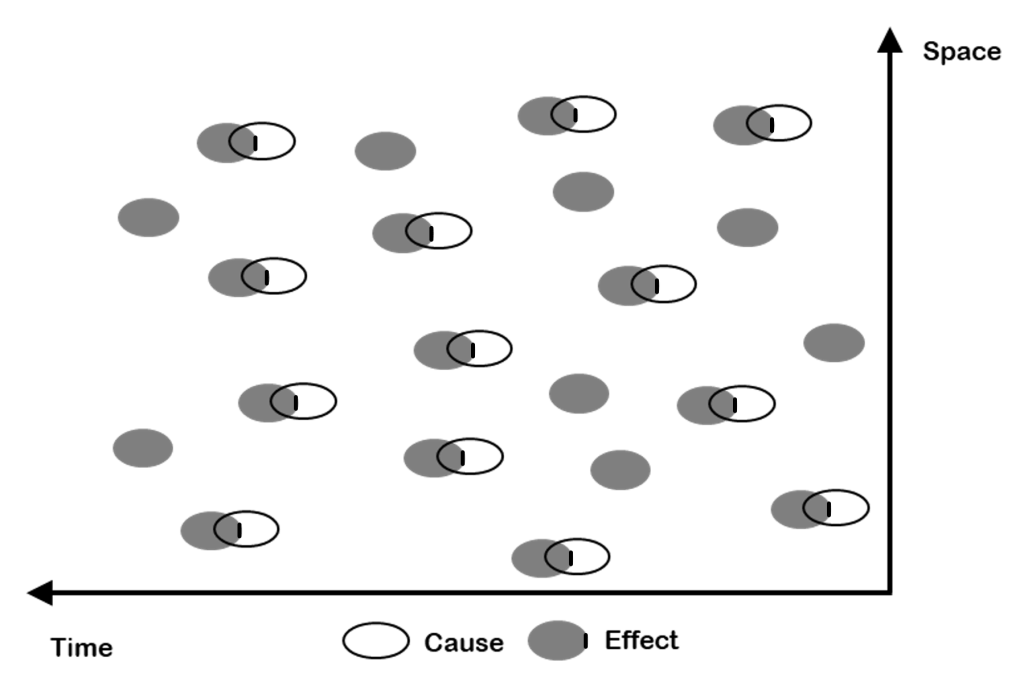
Causality can be complex, with several causes combining to produce an effect. These causes can be of two types: necessary causes, in the absence of which the effect cannot occur; and sufficient causes, in the presence of which the effect must occur. The epidemiologist, Ken Rothman, explained that, for an effect to take place, it is often the case that several necessary causes must combine to create a sufficient cause. For example, the presence of gas, oxygen and a spark are each necessary and together sufficient to cause a gas explosion.

Causality also involves inhibitors, i.e., those things which always prevent an effect from taking place, even if sufficient cause is present. These inhibitors can also be of two types: sufficient inhibitors, in the presence of which the effect cannot occur; and necessary inhibitors, or those things required to prevent an effect. Again, a sufficient inhibitor may comprise one or more necessary inhibitors.

We can use this knowledge in our strategies to achieve a desired outcome. This is best demonstrated by a simple example. Suppose we know that an effect, e, occurs as a result of two necessary causes, a and b. Together, a and b are a sufficient cause.  In the absence of a, b, or both, e cannot take place. So, if we wish to prevent e, then our strategy may be to prevent one of a or b, whichever is easiest. However, the effect can also be prevented by two sufficient inhibitors, c or d. In the presence of c, d or both, e cannot occur. Thus, an alternative strategy for preventing e, is to cause one of the inhibitors c or d, whichever is the easiest.

In this example, the presence of a and b and the absence of c and d result in e. If some but not all of these conditions exist, and e is undesirable, then this is a risk. However, if e is desirable, then it is an opportunity.

Our behaviour often steers events by increasing or decreasing their likelihood, rather than directly causing or preventing them. For example, we may lack the resources to directly cause an event, and may only have sufficient to enable it. To benefit from such behaviour, we must observe our environment, identify the opportunities and risks that it presents, and intervene to our advantage.

Typical strategies are as follows.

Enablement means acting to remove any existing inhibitors. Note that sufficient cause may not be present. So, the effect may not actually occur, but only become able to occur.

Facilitation means acting to introduce necessary causes where previously they were absent. Note that not all necessary causes may be present and not all inhibitors absent. So the effect may not actually occur, but merely become more likely.

Risk Reduction means acting to reduce the likelihood of an effect. It will not yet have occurred, either because an inhibitor is present, or because not all necessary causes are present. We can reduce the risk yet further by removing more necessary causes.

Prevention means acting to introduce an inhibitor where none is present. Note that the effect will not yet have occurred because not all necessary causes were present.

Categories
10. The Creative Process and Decision Making

The Creative Process and Decision Making

To fully understand this article, it is recommended that the reader refers to my previous articles on feedback loops and consciousness.

The Creative Process

In the 19th Century, the German physicist Hermann Helmholtz identified three stages in the creative process: saturation, incubation, and illumination. The French mathematician Henri Poincarre later added a fourth stage: verification.

Saturation means consciously researching and learning as much as we can about the issue under consideration. Consciousness allows us to rehearse the skills and knowledge gained, thereby storing it in long term memory and reinforcing it.

Incubation means allowing the unconscious mind to process that information with a view to seeking some output. In the case of decision making, for example, the emotional evaluation of our options is carried out unconsciously. Our conscious and unconscious minds employ the same resources. However, consciousness regulates those used by the unconscious mind and focuses them on the topic in hand. When we relax consciousness, e.g., by sleeping, the unconscious mind operates more freely. This allows it to access knowledge and skills stored in long term memory more freely, compare it for similarities more readily, and make associations more easily. Thus, it is necessary for us to reduce our levels of consciousness to allow the unconscious to function effectively.

Illumination occurs when the unconscious mind delivers the result of its ruminations to the conscious mind. This often occurs in the form of an inspiration, e.g., a potential solution to a problem, and can be accompanied by a surge of positive emotion. These inspirations can be original because of the quantity of information that they draw on. However, inspirations can be unreliable for several reasons. For example, we may simply have the facts wrong; there may be mistakes or cognitive biases in the unconscious process; or there may be unconscious beliefs and attitudes that we have picked up from advertising, our peers, etc.

Verification, therefore, is the final stage in which we consciously check that the inspiration is valid and ethically acceptable. This is done by awakening consciousness and using logic, reason, the known facts, and our ethical schema. However, the incubation process is opaque to the conscious mind. We can only deduce what it may have been, and so, must often rationalise.

Application of the Creative Process

This process is fundamental to the way we think, and can be used in many different ways, for example:

Decisions. When making decisions we may use just one or several iterations, i.e., we may repeat the process several times. Risk/benefit/cost assessments are carried out subconsciously and then verified consciously. After each iteration we may or may not carry out further saturation.

Problem Solving. When solving a particular formal problem, e.g., a mathematical one, we may use just one iteration if it achieves a satisfactory outcome. Solving a more complex problem may require several iterations.

New Knowledge. When seeking new knowledge and understanding, we consciously research what is known by others, use the incubation process to compare it with what we already know, and unconsciously identify connections and similarities. This often gives us a hypothesis that can be tested consciously. This process often involves several iterations. The knowledge gained in one iteration may stimulate further research and it can also be compared with what we already know to gain greater insight.

Artistic Creativity. The process can be used in artistic creativity of all types, whether it be painting, music or writing, for example. However, the verification stage is often omitted, and we go directly to implementation by keeping consciousness at a low level. Any feedback is external, and we physically see or hear what has been produced. Note, however, that this applies only to artistic creativity. Rational creative processes do not omit verification.

This does not mean that we can all become artists simply by implementing our ideas without conscious verification. All artists first go through a long period of consciously learning and rehearsing their skills so that they are fully internalised and can be exercised unconsciously.

Categories
09. The Behavioural Loop or Cycle

The Behavioural Loop or Cycle

Our behaviour is always ongoing. When one need is satisfied or contra-need avoided, we move on to another. In every case, we make our decisions in a similar way, and there is, therefore, a behavioural loop or cycle as follows.

  1. Our most pressing needs or contra-needs are identified through their impact on our emotions. That is, we identify the greatest cause of dis-satisfaction.
  2. Potential options for acquiring satisfiers and avoiding contra-satisfiers are identified, drawing on individual or group knowledge and experience.
  3. The resources needed to acquire those satisfiers or avoid those contra-satisfiers are assessed, again drawing on individual or group knowledge and experience.
  4. The resources that we control are assessed. These resources may be our own or those of others.
  5. Possible courses of action are assessed for their potential impact on our emotional state, taking into account the following:
    • All affected personal needs and contra-needs.
    • All affected needs and contra-needs of significant others.
    • Whether we will receive positive or negative regard, and what is needed to enhance the former or mitigate the latter.
    • Whether we will feel psychological satisfaction or guilt, and what is needed to enhance the former or mitigate the latter.
    • If the likelihood of achieving the desired result is uncertain, we also assess the impact of not achieving it. Whether we proceed with a course of action will depend on the benefit we hope to achieve, the likelihood and consequences of failure, and our personality.  Most people, for example, will not use all their available resources in a single high risk, high return activity.
  6. Generally, when seeking a satisfier, we have two potential routes. We may wait until an opportunity arises by chance or attempt to create one. Similarly, when seeking to avoid a contra-satisfier we have the options of waiting until it arises or seeking to pre-empt it. Which route we choose depends on the net emotional benefit gained. This in turn depends heavily on the resources required to create an opportunity or pre-empt a contra-satisfier.
  7. Those actions that are within the resources available to us and which have an emotional benefit are implemented. We do not normally seek to optimise our choices, because this, in itself, requires substantial resources. Rather, we choose an option which is both satisfactory and sufficient and reject options which have an overall disbenefit. This is known as “satisficing”, a term coined by the American political scientist, Herbert A. Simon, in 1956.
  8. The outcome of the action is observed and remembered for the future. If it has been successful, then this will reinforce the behaviour, i.e., we are more likely to repeat it in similar circumstances. If it has failed, then the behaviour involved is less likely to be repeated. Repetitive failure will cause it to become extinguished.
  9. The entire process is then repeated indefinitely. However, as time progresses our needs and contra-needs alter, and different ones come to the fore. For example, the physiological needs for food and sleep increase in priority if not satisfied. We can also learn from experience and become more adept at choosing efficient and successful forms of behaviour.

Research has shown that emotions can carry over from one decision to the next without us being aware of it. These incidental emotions can be difficult to detach and can influence subsequent decisions. For example, people who previously experienced anger are more prone to blame others in subsequent decisions, and people who previously experienced sadness are more prone to blame general circumstances. Fearful people make more pessimistic judgements about the future, and angry people are more optimistic. It is thought that the best way to avoid this emotional carry over is to develop greater emotional awareness.

Categories
08. The Evaluation of Resources and Risk/Benefit/Cost Analysis

The Evaluation of Resources and Risk/Benefit/Cost Assessment

The Evaluation of Resources

Resources are those things that we employ to gain satisfiers for our needs or to avoid contra-satisfiers. For example, time, physical and mental effort, money, etc. The effort involved consumes resources that we control, whether they belong to us or to others.

It is important to distinguish between resources and satisfiers. For example, although we are used to thinking of air as a resource, this is incorrect because no-one experiences, owns, or controls it. However, without it we would die. It is therefore a satisfier of an important existence need.

Like satisfiers and contra-satisfiers, resources are evaluated emotionally. Their value derives from the value of the changes to satisfiers and contra-satisfiers that their use causes. The latter, in turn, derive from the changes in our emotional state that they achieve.  However, it can be extremely difficult to predict what resources will be needed and whether the desired effect will be achieved. For example, we cannot predict how long a hunting expedition will take or whether it will be successful. To add a further level of complexity, several resources may be needed to acquire a satisfier or avoid a contra-satisfier.

It may be that there is an objective and logical method of deriving the value of resources from the value of changes to satisfiers and contra-satisfiers. However, this would be a very complex process and not something that we could do in our heads, especially when under pressure to make a decision. In practice, therefore, resources are valued as follows:

  1. Via socialisation. For example, if a group of people find that dried cow dung burns, will provide warmth at night, and will cook food, then they will attach an emotional value to it. When raising children, they will educate them in that value. However, a modern person may not attach the same value, especially if he steps in it.
  2. From experience. For example, if spending an hour carefully choosing the ingredients for a meal results in praise for one’s cooking, then the emotional value attached to that hour (a resource) derives from the emotional value of achieving that praise (a satisfier). Over time, as we make more such assessments, we will allocate an average emotional value to an hour of our time.

Inevitably, each person places a different emotional value on each resource, and these values can alter with changing circumstances and experience.

Risk/Benefit/Cost Assessment

Rarely do we control sufficient resources to fully satisfy all our needs and avoid all our contra-needs. So, we try to apply those resources that we do control to best effect. The decision on how best to apply them uses a risk/benefit/cost assessment.

All changes to a satisfier or contra-satisfier which may be caused by an act are assessed for their overall effect on our emotional state. For each satisfier or contra-satisfier this depends on four things: the priority we give to the relevant need or contra-need; the extent to which it is already impacted upon by other satisfiers and contra-satisfiers; the anticipated change to the relevant satisfier or contra-satisfier; and the likelihood that our behaviour will make that change.

The resources that we employ also have an emotional value and their use reduces our overall emotional state. When deciding to act, we take into account both our likely use of resources and the likely changes they will make to our satisfiers and contra-satisfiers. If the net change to our emotional state is positive, then this is a benefit, and, given a choice, we would normally choose the option with the highest benefit. However, if the net change is negative, this is a dis-benefit and we would not normally adopt that option.

The Value of a Gain or Loss

It is notable that people are more averse to losing a satisfier than failing to gain it. This is known as a cognitive bias and sometimes, incorrectly, regarded as irrational. The main reason for this bias is associated with the effort involved in creating and altering our schemata. Much mental effort is put into building schemata, and mental effort is, of course, a finite resource. For example, if we own a car then we also need to incorporate this fact into our schemata for shopping, travelling to work, holidays, and so on. We also need driving skills, knowledge of road traffic law, etc.

The assessment involved is relatively simple and can, therefore, be explained by mathematical analogy. If we gain a car then we gain the net benefit of a car, (a), less the effort involved in constructing the schemata that go with it, (b). The value of gaining a car is therefore (a – b). However, if we lose a car we lose the net benefit of the car, (a), and added to this is the effort involved in revising our schemata, (c). The loss is therefore (a + c) which is, of course, greater than the gain (a – b).

Categories
07. The Evaluation of Satisfiers and Contra-satisfiers

The Evaluation of Satisfiers and Contra-satisfiers

Positive emotions attach to satisfiers and, thus, to our needs. We wish to satisfy our needs and so make decisions intended to increase our positive emotional state. Negative emotions, on the other hand, attach to contra-satisfiers which in turn attach to our contra-needs. We wish to avoid the latter, and so, make decisions intended to decrease our negative emotional state.

Before we act, we make decisions about behaviour based on a form of risk/benefit/cost assessment. In this article I will describe the benefit part of this assessment in more detail. The terminology used is explained in the images below.

Satisfiers and contra-satisfiers are evaluated based on the changes that they make to our emotional state. In every situation, our emotional state depends on the extent to which our needs and those of others are satisfied. It also depends on the extent to which our contra-needs and those of others are avoided. This emotional state comprises the sum of the values associated with each existing satisfier and contra-satisfier. Both our behaviour and changes in our situation alter the status of these satisfiers and contra-satisfiers. This, in turn, results in changes to our emotional state. We regard such changes as benefits if our emotional state is improved, or dis-benefits if it is worsened.

MaxNeef recognised that satisfiers can be “synergic”*, and satisfy several needs, or singular, and satisfy just one. Furthermore, what can act as a satisfier for one person or need may, at the same time, act as a contra-satisfier for another. Thus, the emotional value of a satisfier or contra-satisfier may depend on several needs or contra-needs and those of several people. When the impact of a possible action is assessed, its impact on all needs and contra-needs is, therefore, considered. (*Note that this term is given as a quote because, if taken literally, it would mean several satisfiers working together to satisfy a need, rather than the definition given.)

When making decisions about behaviour we also consult our group ethical schema, i.e., our understanding of acceptable social behaviour, to determine whether we will receive positive or negative regard from others. Regard is, of course, a satisfier for a relatedness need. Ways of enhancing the positive regard or mitigating negative regard are identified, and the overall benefit or dis-benefit considered.

We also consult our personal ethical schema for psychological acceptability, i.e., the psychological satisfaction or pain we will experience because of the proposed behaviour. Again, ways of enhancing the former or mitigating the latter are identified and the overall benefit or dis-benefit considered.

The emotional value of each satisfier or contra-satisfier depends on its status, i.e., whether it is absent, latent (capable of manifesting), precarious (present but insecure), or entrenched (present, solidly established, and unchangeable).

It also depends on our beliefs. There are several ways in which we come to believe that a satisfier or contra-satisfier will influence our needs or contra-needs. Examples include: experience; learning from parents and other members of our community; observation of role models; advertising; and so on. These beliefs may be correct, or they may not. Nevertheless, they are what influences our decision making.

Finally, the emotional value of a satisfier or contra-satisfier depends on various factors associated with the needs and contra-needs that it affects. Among the latter are:

  1. Relative Priority, i.e., the importance to the individual of a need or contra-need in comparison with all others. The greater its relative priority the greater the emotional value of its satisfier or contra-satisfier. For example, if we are hungry and, also, wish to socialise, then we may regard sustenance as having a higher value than a visit to friends.
  2. Extent. Some satisfiers only partially satisfy a need. The less satisfied a need, the greater the value we will place on an additional satisfier. For example, if we are very hungry but only have one sandwich, then we will place a greater value on more food than if we have two. Conversely, some contra-satisfiers only partially impact on a contra-need. The lower this impact the greater the negative value we place on other contra-satisfiers.
  3. Relatedness. People care not only about their own needs and contra-needs, but also about those of others. The extent to which we value satisfiers and contra-satisfiers for others, depends on how closely related they are to us. Richard Dawkins, in his book “The Selfish Gene”, postulates that we value them according to the percentage of the variable human genome we believe those others to share with us. However, our support depends not only on genetic relatedness, but also on shared culture. This is because we rely on the support of other members of our culture for the satisfaction of our own needs. In general, relatedness decreases in the following order: ourselves, a member of our nuclear family, a member of our extended family, a friend, colleague or other ingroup member, a member of our society, a more distant person, an animal. This can, however, vary from individual to individual.
  4. Levels of Altruism and Co-operation. In general, the needs and contra-needs of others are less significant for us than our own. However, the difference depends on our personal levels of altruism or co-operation. If we have high levels, the difference will be less than if we have relatively low levels.

These factors introduce considerable complexity. It may be that the benefits and dis-benefits of satisfiers and contra-satisfiers could be modelled mathematically, to a certain extent, but this is clearly not something we can do in our heads. Thus, we rely on emotion.

Categories
06. Emotions and Decision Making

Emotions and Decision Making

For the following discussion, I will define a “positive situation” as one in which a need is addressed by a latent, precarious, or entrenched satisfier, and contra-satisfiers are absent. A “negative situation”, on the other hand, is one in which a need is not addressed by a satisfier or there is a latent, precarious, or entrenched contra-satisfier.

If a need is important to us, then negative situations cause negative feelings, for example, dis-satisfaction, frustration, anxiety, and fear. Conversely, positive situations cause positive emotions, for example, satisfaction, pleasure, and exhilaration. However, the latter are only felt when positive situations are first attained, and they last for a limited time. To motivate our behaviour, we must have satisfiers to seek and contra-satisfiers to avoid. Without these we would be inactive. The short duration of positive emotions ensures, therefore, that we attend to other needs once more pressing ones have been satisfied and secured. We can, therefore, only feel fully satisfied for a relatively short time.

Positive emotions do however reinforce our desire to behave or act in a way that generates that emotion. Conversely, negative emotions make us less likely to do so.

Knowledge has a part to play in our emotional state. What we perceive to be positive or negative situations are based on unconscious attitudes and beliefs. Many of these attitudes and beliefs are gained from our society, peers, advertising, etc., and we may not be consciously aware of them.

The feedback loop which causes us to be conscious has a part to play in our decisions and behaviour. For example, our unconscious mind may conclude that saying something potentially hurtful to another person will satisfy our needs. If so, then before acting we may consciously attempt to predict that person’s reaction via empathy or our knowledge of them. This may have an emotional effect on us which might cause us to reject or modify our unconscious mind’s conclusion.

What we perceive as satisfiers or contra-satisfiers, and thus, what we perceive as positive or negative situations, has a bearing on our level of stress. Stress has an emotional component, which can be positive or negative, and a biological component. The emotional component is negative when we experience feelings of frustration, anxiety, or fear, in a negative situation. It is positive when, for example, we experience exhilaration on first acquiring a satisfier. The biological component of stress is arousal, or a heightening of the physical ability to seize opportunities and avoid threats. It will occur when a situation is significant.

What we perceive as satisfiers and contra-satisfiers, and the value that we place on them, are important in valuing social institutions. Satisfiers and contra-satisfiers have a value to the individual, and the value that society places on its institutions is the aggregate of the value that each individual places on them. For example, the UK’s National Health Service has a very high social value because it is a satisfier of the existence and procreation needs of so many. This will be explored further when I discuss politics.

The value that we place on satisfiers and contra-satisfiers also has a bearing on what we hold to be good or bad, our morals, and ethics. For example, the aggregate impact of our behaviour on others, in terms of the satisfiers and contra-satisfiers that it invokes, forms the basis of utilitarianism. This will be explored further when I discuss ethics.

In the next article, I will describe how place a value on satisfiers and contra-satisfiers and in the following article how we use this to make our decisions.