Why do capable, well-intentioned teams so often fall into frustration, competition, or subtle conflict?
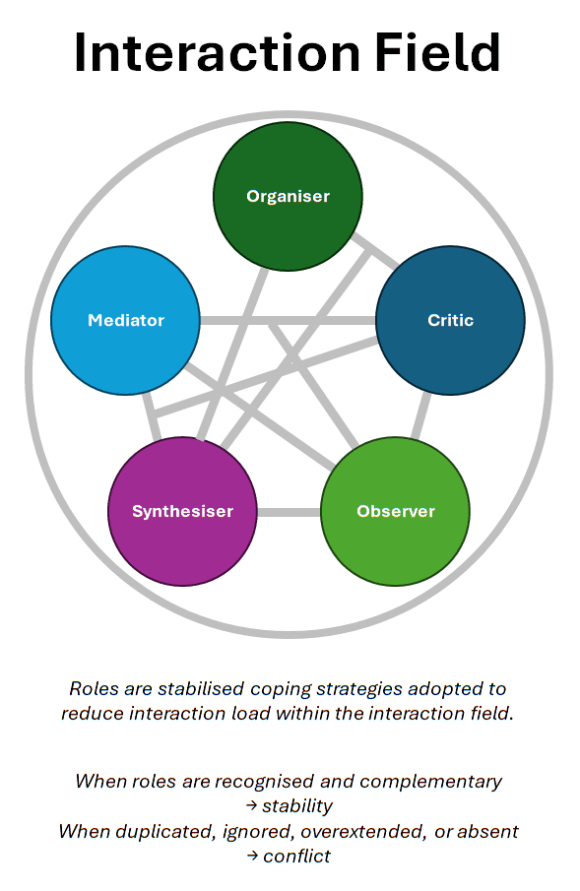
This article proposes a different way of understanding what is happening beneath the surface of group behaviour. It suggests that what we commonly call “roles” are not job titles or personality traits, but stabilised coping strategies that people adopt in order to manage the rising complexity of interacting within a group.
When these roles are recognised and complementary, teams work smoothly. When they are duplicated, ignored, overextended, or absent, tension and dysfunction appear, often without anyone understanding why.
The article also shows how the same pattern repeats across levels of systems: what appears as roles in teams appears as departments in organisations and as specialisations in economies and nations.
This provides not only a practical explanation for many common forms of team conflict, but a systems perspective on how cooperation can be improved within and between groups at every scale.
Read the full article here: https://rational-understanding.com/sst
 Rational-Understanding.com