Categories
07. Functional Differentiation

Functional Differentiation

In sociology, the term “functional differentiation” describes progressive specialisation within a society. This concept has long been well understood, but was brought to prominence by the American sociologist, Talcott Parsons, and the German one, Niklas Luhmann. Functional differentiation is a major contributor to increasing social complexity, and a feature of Western society today. When a society is relatively stable, ever-increasing knowledge and population leads to ever more specialisation, and organisations to carry out specialised activities. Up to a point, functional differentiation generally leads to increased efficiency, and is therefore beneficial to society. Unfortunately, however, it also leads to increasing communication distances, and thus, an increased risk of miscommunication. It also leads to ever more complex functional dependencies, i.e., reliance on a greater number of other organisations for the inputs needed to carry out one’s own function. This leads to an increasing risk of organisational failure. Functional differentiation can also lead to a reduced understanding of the roles of others, and thus, to potential conflict, and potential failure of the parent organisation. Finally, as will be discussed a future article, it can lead to an increasing risk of mental ill-health.

So, unless these disbenefits can be reduced, by for example improving information technology, there may be an optimum level of functional differentiation beyond which the benefits begin to decline.

The academic sector provides an example of functional differentiation. This is summarised in the diagram below.
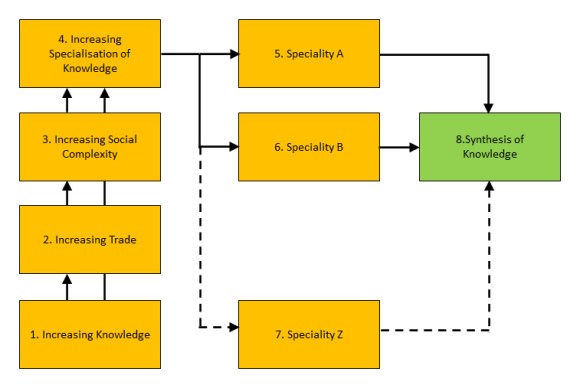
Our increasing knowledge has led to an increasing number of goods and services, and thus, to greater trade. This, in turn, has led to increasing social complexity which, alongside greater knowledge, has led to the formation of academic silos. Specialists now share knowledge mainly only with other specialists in the same discipline. There is a relative lack of cross-disciplinary sharing. This has developed to the point where the knowledge in one field can be incomprehensible to those working in another. As a consequence, our ability to identify inconsistencies between different branches of knowledge has reduced. Furthermore, our ability to draw on knowledge from one field to enhance that of another has also declined.

Specialisation will always be necessary. However, there is also now a pressing need for generalists, i.e., people with the knowledge and understanding of more than one speciality to carry our this cross-disciplinary work. Whilst the latter is now widely understood, the academic world has become highly institutionalised and is difficult to change. Limited moves are being made to introduce cross-disciplinary courses, but these are often little more than a year spent in another department. The following article in The Guardian provides further information: https://www.theguardian.com/higher-education-network/2018/jan/24/the-university-of-the-future-will-be-interdisciplinary

To date, however, relatively little work is being done to develop cross-disciplinary comparison techniques or to train students in their use, and this needs to change. Ironically, cross-disciplinary comparison is itself is a speciality and includes, for example, logic, epistemology or the theory of knowledge, causality, systems science, and poly-perspectivism.

So, there are ways to tackle the downsides of functional differentiation in the academic world. Similar techniques can be applied elsewhere.

Categories
09. Improving our Knowledge of Human Nature

Improving Our Knowledge of Human Nature

By “our knowledge of human nature”, I mean our communal knowledge rather than our individual knowledge. Most communal knowledge is now held on the internet and provided, by specialists in a particular field, for individuals to learn, if they so wish.

However, the problem with specialisation is, perhaps, best described by the following irreverent, but amusing, adage:

“Q. What is the difference between a scientist and an engineer? A. A scientist knows a lot about a little, and learns more and more about less and less, until he knows everything about nothing. An engineer knows a little about a lot, and learns less and less about more and more, until he knows nothing about everything.”

Research has shown that there may be some truth in this adage. When writing papers, scientists refer to supporting information from other papers, i.e., they make citations. The Eigenfactor Project at the University of Washington, (http://eigenfactor.org/about.php), has carried out research showing the extent to which researchers in one discipline cite work from those in another. The results can be seen as an elegant diagram at http://well-formed.eigenfactor.org/radial.html. Each line represents a citation and, where it is between two fields, it is cross disciplinary. This diagram shows little cross disciplinary citation by researchers in the fields of psychology and economics. If true, this does not bode well for our understanding of human nature, as I will attempt to explain below.

The ancient Indian religion, Jainism, holds that physical objects and events are infinite in their qualities and, so, cannot be fully understood by the finite human mind. Thus, any individual’s understanding of an object or event is from his perspective or point of view. The latter is limited, and he cannot, therefore, have a full understanding. Today we refer to this concept as “perspectivism”.

Consider, for example, a helix. When viewed from an end-on perspective it appears to be a circle. When viewed from a side-on perspective it appears to be a wave. This is demonstrated by the diagram below.

Courtesy: Commons.wikimedia.org

Only the helix can generate both the circle and the wave. Now imagine that the circle and wave are both theories in different fields of knowledge. When the two theories are compared, they may appear to be contradictory or unrelated unless one is able to recognise that both are special examples of a third more general theory.

Knowledge helps us to survive and procreate. We use it to avoid threats and to seize opportunities. It is likely, therefore, that it is a pragmatic representation of reality. As the science of physics competently demonstrates, reality has structure. By “structure”, I do not mean the way in which things can be categorised like books in a library, e.g., history, geography, thrillers, etc. Rather, I mean “governed by the laws of nature”. However, just like the helix, these laws present themselves to us in different ways depending on the viewpoint of the observer.

I would argue that, to improve our knowledge of human nature, we need more generalists, that is, people who can research existing knowledge in several specialist disciplines, who can perceive the underlying truths that unite them, and who can propose new hypotheses for specialists to investigate. As both the arts and science are human activities, it may even be possible to draw cross references between subjects as diverse as these. This more general approach would have the following advantages.

It is well established that all knowledge which is true is also consistent. One item of true knowledge cannot contradict any other. If we do not consider multiple disciplines, then the risk is that specialists may pursue hypotheses which contradict theories well proven elsewhere.

By theorising from a single perspective, the opportunity to identify more fundamental truths of human nature can be missed. In previous articles, I have shown that the second law of thermodynamics has a very significant bearing on our behaviour. I have also shown that feedback loops have a major part to play. Both are concepts from the science of physics.

An understanding of the way that fundamental truths are structured can also reveal new knowledge. From my work in epistemology and symbolic logic, it appears that our knowledge has a binary structure but that we often overlook one side of the coin. For example, we have needs and their opposite, contra-needs. Although we are intuitively aware of the latter they have not previously been formally recognised. Try “contra-needs” and “opposite of human needs” and “needs antonym” in your search engine.

This concludes the series of articles on knowledge, beliefs, and predispositions. In my next post, I begin a series on human decision making and behaviour.