Categories
20. Interaction, Prejudice and Discrimination

Interaction, Prejudice, & Discrimination

Introduction

In this article I summarize previous ones on human interaction, explain that this is based on our perception of others, and introduce the topics of prejudice and discrimination. The latter topics are very emotive, particularly for those who have experienced them. However, I have endeavored to describe the social and psychological processes behind them objectively.

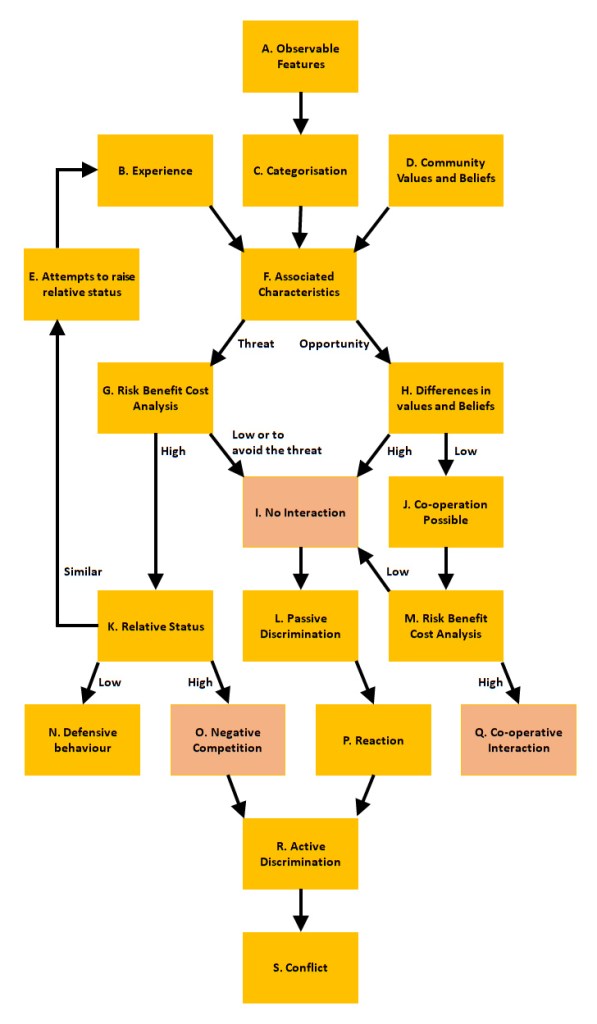
These processes are complex, and the discussion relatively long. So, to assist the reader, I have provided a diagram. Letters in the text, e.g., (A), refer to relevant parts of the diagram.

Although the discussion focusses on interactions between individuals, the same principles also apply to organisations of all types, including nations.

The nature of interaction

Interaction is a form of trade, and thus, reciprocal. We cannot interact with someone who ignores us. However, it is not merely the trade of material goods and services for money, but rather a more general trade of satisfiers and/or contra-satisfiers. That is, anything that satisfies our needs, e.g., food and shelter, or helps us to avoid contra-needs or harms such as social exclusion or illness. This can include intangible satisfiers such as friendship, inclusion, information, advice, emotional support, and so on. It can also include intangible contra-satisfiers such as threats, exclusion, violence, etc.

Priorities & the thresholds for interaction

There are three forms of interaction: co-operation, negative competition, i.e., attempting to harm the other party or prevent them from attaining their goals, and no interaction.

The Goldilocks Zone hypothesis for interaction has a part to play in our decision whether to interact with another party or not (H). It acts as a first filter. As a rule, although there are exceptions, we tend to favour co-operative interaction and to avoid negative competition. If the values and beliefs of someone with whom we might interact are thought to be the same as or like our own, then co-operation may be possible (J). If their values and beliefs are thought to differ greatly from ours, then it may not. However, rather than engaging in negative competition, we will usually try to avoid interaction (I).

All interaction consumes resources, particularly time. However, our resources are limited and so too, therefore, is the number of people with whom we can interact. The British anthropologist, Robin Dunbar, estimates that the number of stable relationships an individual can maintain is approximately 150. So, like any other activity, we prioritise our interactions using a subjective form of risk, benefit, cost analysis (M). This acts as a second filter.

Those with whom we choose to interact co-operatively, are those we perceive as being likely to provide the greatest benefit for the least effort. In this context, benefit is the satisfaction of our needs or the avoidance of our contra-needs. Because our resources are limited, there is a cutoff point in the risk, benefit, cost analysis below which we will not interact (I). For example, if someone offers low payment for a day’s work then we may not consider it worth the effort.

If we do wish to interact, then the benefits that the other party anticipates by reciprocating must also exceed their risk, benefit, cost threshold. If it does, then interaction and the trading of benefits can proceed (Q). Reciprocation does not always occur, of course, and this can lead to some frustration.

In some cases, the other party will be thought to pose a threat. Again, a form of risk cost benefit analysis is carried out (G). If the threat falls below our threshold, we will not interact (I).

In summary, therefore, we will not interact with others:

  • whose perceived values and beliefs are so different from ours that we believe co-operative interaction to be difficult or impossible, or
  • who are thought to offer insufficient benefit, or
  • who fail to reciprocate, or
  • who are thought to pose an insufficient threat.

The categorization of people and the nature of prejudice

All human beings lack the mental capacity to know everything in detail, including the vast majority of people in the world. So, we place everything, including people, organisations, and nations, into types or categories (C). In the case of people and groups of people, this is based on their physical appearance, and the culture, values, beliefs, and behaviours that they outwardly display (A).

We then associate certain characteristics and behaviours, including threats and opportunities, with these categories (F). We learn these associations not only from experience (B) but also from information provided by our community (D). Unfortunately, the latter can include errors, misinformation and propaganda.

Everyone, without exception, must categorise others in this way, and associate behaviours with those categories. This simplification is necessary because of our limited mental capacity. It is an evolved trait that enables us to make a first order approximation of the likely behaviour of someone or something. This includes any threats or opportunities that they may pose.

It is important to note, however, that it is not the external symbols used to create categories that are the cause of our reactions to their members, but rather the characteristics and behaviours that we associate with those categories. Unfortunately, those associations can be false, particularly when they have been acquired from others.

When our categorization of people would, if it influenced our behaviour, result in harm to them, then we refer to this as prejudice. This is particularly, but not exclusively, the case when we categorise less powerful minorities.

Power, hierarchies, & how relative position in a hierarchy affects interaction

Those who hold a particular set of values or beliefs form a group, and the power held by that group is the aggregate of the power held by its members. This power is based on the control of resources, for example wealth, influence, and the control of satisfiers such as jobs. It is also based on the ability to provide satisfiers such as food, housing, or education, and to inflict contra-satisfiers such as the denial of those things, threatening behaviour or acts of violence.

Hierarchies exist based on the magnitude of the benefits or disbenefits that individuals can offer to or inflict on one another. Furthermore, different hierarchies exist for different benefits. For example, there is a hierarchy of wealth, with an elite at its peak. There is one of knowledge, also with an elite at its peak. Finally, there is one of violence with the most violent, least restrained, and most well-armed people at its peak. Generally, because of the potential benefits, people will endeavour to interact, and so, trade benefits with those at a similar or higher level in a hierarchy, or at similar or higher levels in parallel ones. They will normally only interact with those below them to maintain the hierarchy.

Deciding how to interact, active discrimination and passive discrimination

The category into which we place people determines whether and how we interact with them. If someone is placed in a category associated with an opportunity to benefit, then, providing the risk, benefit, cost assessment exceeds our threshold (M), we will be predisposed to interact co-operatively with them (Q).

If, on the other hand, they are associated with a threat, then, depending on the circumstances, we will either not interact with them (I), or will engage in negative competition (O). We will not interact with someone perceived as posing a threat if this avoids the threat. Nor will we interact if the perceived threat is less than our threshold (I). If failure to interact results in harm to the other party, such as the denial of rights and opportunities afforded to others, then we refer to this as passive discrimination (L).

However, if the perceived threat exceeds our threshold, or if we are obliged to interact for any other reason, then the relative position of that person in the hierarchy, and thus, their relative power, becomes important (K). If they are lower in the hierarchy, then we will usually act aggressively, i.e., engage in negative competition (O). Harms such as social exclusion, financial harm, or violence, will almost certainly result, and we refer to this as active discrimination or persecution (R). On the other hand, if they are higher, then we will usually act defensively, i.e., behave in a manner that avoids the threat (N).

Finally, if two people or groups regard one another as a threat and have similar status in a hierarchy, then negative competition will be reciprocal. Both parties will attempt to gain higher status in order to prevail, and this can increase the perception of a threat (E). So, positive feedback can occur and can ultimately lead to violent conflict (S).

Passive discrimination can lead to active discrimination and social unrest in the following way. If people lower in a hierarchy experience passive discrimination (L) and are denied the opportunities of others, then they will feel resentment towards the perpetrators and experience anomie. That is, a breakdown of those values and beliefs that they previously shared with society. Thus, they may engage in criminality or other anti-social activities (P). This, in turn, can create apparent justification for the original categorization of those people and lead to active discrimination (R). So, the original prophecy becomes self-fulfilling. When active discrimination occurs, the victims may seek to retaliate via some other hierarchy in which they hold greater power (R). This can often take the form of aggression or violence (S).

Summary

  • Interaction is the reciprocal trade of satisfiers and/or contra-satisfiers.
  • There are three forms of interaction: co-operation (Q), negative competition (O), and no interaction (I).
  • As a first filter, we believe that we can interact with people whose values and beliefs (H) are thought to be like our own (J), but not with those whose values and beliefs differ significantly (I).
  • As a second filter, we prioritise possible interactions using risk, benefit, cost analysis (G & M), where “benefit” means the satisfaction of our needs and the avoidance of our contra-needs or harms.
  • Finite resources limit our ability to interact. So, if a perceived benefit or threat is below our risk, benefit, cost threshold, then we will not interact (I).
  • We interact with other people based on perceived opportunities to benefit and perceived threats (F).
  • Our perception of these opportunities and threats is based on the categorization of people (C) and the association of benefits or threats with that category (F). This association is gained from experience (B) or learnt from others (D). However, the latter can comprise misinformation or propaganda.
  • Prejudice is when categorisation, if it were to influence our behaviour, would lead to the other party being harmed.
  • Power is the aggregate of the power held by members of a group with a shared set of values. It is based on their control of the resources that can provide satisfiers or contra-satisfiers to others.
  • Hierarchies exist based on the magnitude of the satisfiers and contra-satisfiers that people can offer to one another (K).
  • We tend to interact with those higher in a hierarchy and only interact with others if this  maintains a hierarchy to which we belong.
  • We will attempt to avoid interaction with others perceived as posing a threat if this avoids the threat (G & I).
  • Passive discrimination is an absence of interaction that leads to the other party being harmed (L).
  • If obliged to interact with someone thought to pose a threat and higher than us in a hierarchy, then we will behave defensively to avoid the threat (N). If they are below us in the hierarchy, then we will engage in negative competition, i.e., behave aggressively (O).
  • If we interact with someone of similar status in a hierarchy and thought to pose a threat, then both parties will engage in negative competition and attempt to raise their status (E). This causes a feedback loop which raises the apparent threat for both and can ultimately lead to conflict (S).
  • Active discrimination is negative competition that leads to the other party being harmed (R).
  • Passive discrimination leads to criminality and resentment (L&P). This appears to justify the initial categorization, and so, leads to active discrimination (R). People may respond to active discrimination by retaliating in a hierarchy where they have greater power. This can take the form of violence (S).

Tackling Discrimination

Tackling discrimination requires an understanding of its causes. Firstly, prejudice is inevitable. None of us can avoid it and it is futile to attempt to eliminate it. However, we should understand why it exists and how to prevent it from leading to discrimination. Education and our upbringing have a critical role to play in this.

We should also question our assumptions about the threats and opportunities associated with the categories into which we place people, especially if those assumptions have been received from others. Are the assumptions true? The best way to find out is to interact on common ground with people in that category. Generally, we will find the assumptions to be false, or to be a reaction to discrimination that they have already experienced. We should also ask ourselves “what is the source of these assumptions? Who benefits from them and how?”. Often, it will be found that they have been deliberately exaggerated to satisfy some political, financial, or economic need.

Active discrimination is clearly unethical. It can lead to conflict, thereby causing harm to both parties and to bystanders. It is an utter waste of the effort and of the resources that might otherwise go into improving the lives of all affected. There is a strong case for legislation to make active discrimination illegal, therefore, and for calling it out whenever it is encountered. However, education on the subject is also important. This is now accepted by many nations, but a few do not treat it sufficiently seriously.

There is much evidence that passive discrimination can ultimately erupt into civil dissent, causing active discrimination, and thus, have the same impact on society. Initially, however, it can slip under the radar. It is less obvious, and so, we are less aware of it. If we do become aware of it, then it is more readily deniable. Finally, it is difficult not to behave in a passively discriminatory manner or even to be aware that we are. This is because to do otherwise may conflict with deeply and unconsciously held beliefs about people. So, recognising and questioning those beliefs is important. However, solutions tend to be cultural ones. This is because it is the aggregate of individual passive discrimination that results in harm. So, civic education and awareness have important roles to play.

Where discrimination exists, the damage can be repaired by: encouraging interaction on common ground, i.e., in an arena where values and beliefs do not conflict; by emphasising the benefits of co-operative interaction; and by encouraging this to take place at whatever pace permits the steady reconciliation of differences. However, any disbenefits of co-operative interaction should not be ignored, but rather mitigated.

Categories
05. A Summary of Social Systems Theory

A Summary of Social Systems Theory

In this short series of articles, I will summarise the basic principles of Social Systems Theory. Full details are given in previous or subsequent articles.

The fundamental component of society or holon

The term holon was coined by Arthur Koestler in his 1967 book, The Ghost in The Machine. It refers to any entity that can be recognised as a whole in itself and which constitutes part of a larger whole. In social systems theory the fundamental component or holon of society is the organisation, that is, any group of people who work together with a common purpose. Organisations can be of any type and can range in size and extent from an individual, through clubs, businesses, sectors, political parties, governments, nations, and groups of nations, to the global community.

Family relationships between organisations

All organisations form a nested hierarchy. The structural relationships between them are similar to those in a family and the same names can be used. Thus, for example, child organisations are components of a parent one, and parent organisations are components of a grandparent one. Two organisations that are components of the same parent are known as sibling organisations. This nested hierarchy continues upwards until an isolated organisation or the global community is reached.

Every organisation comprises a number of component or child organisations, and this nested hierarchy continues downwards until individual people are reached.

Recursion

Recursion means that similar rules and principles can explain the behaviour of organisations irrespective of their size. Thus, for example, a department in a government agency has a leader, and so too does the entire agency.

The control component

All organisations have a control component, e.g., leadership or management, to co-ordinate their activities. Due to recursion, control components have their own control components until we arrive at the individual person. This creates a leadership or management hierarchy comprising individuals. It is natural to select leaders using a bottom-up process, i.e., followers choose a leader thought to be best qualified to co-ordinate their activities. However, managers are also frequently chosen by a top-down process whereby senior managers select junior ones thought to be best suited to the role.

Needs, satisfiers, and contra-satisfiers

All organisations have needs similar to those of individuals. These needs are prioritised using the same categories for individuals identified by Abraham Maslow and Clayton Alderfer, i.e., ERG or existence, followed by relatedness, in particular family relatedness, followed by growth. These priorities are consistent with the multilevel selection theory of evolution. This holds that we place greatest weight on personal survival and reproduction, followed by that of the community upon which we depend, followed by people more remote.

Satisfiers are those external things that increase the level of satisfaction of our needs, for example, food for hunger, or resources for manufacturing. Both individuals and larger organisations endeavour to gain satisfiers as efficiently as possible. Contra-satisfiers, on the other hand, are those external things that reduce the level of satisfaction of our needs and which we endeavour to avoid.

The applicability of systems science, function, and causality to organisations

All organisations are systems and comprise inputs, processes, and outputs. The fundamental principles of systems science apply to them, therefore.

Causality also applies to organisations. The combination of an input and the process is equivalent to a cause. The combination of the process and an output is equivalent to an effect. An organisation’s processes and outputs are also referred to as its function. Because causality applies to organisations we can, for example, say that a number of necessary causes or inputs are together sufficient for an effect in which the organisation carries out its function of producing outputs.

Matter, energy, or information is transferred from every organisation’s inputs to its outputs. This takes place within the region of space-time defined by the organisation’s process. Thus, the latter provides the overlap in space-time needed for a cause to be related to an effect.

All organisations comprise a group of people who work together with a common purpose. This purpose is also the organisation’s function, and the ability to carry out its function is an organisational need.

The applicability of motivation theory to organisations

All interactions between individuals, organisations, and parts of them comprise an exchange of satisfiers or contra-satisfiers for each other’s needs. These satisfiers and contra-satisfiers also take the form of matter, energy, or information. A satisfier or contra-satisfier received is an input, and one provided is an output. Thus, motivation theory also plays a key role in social systems theory.

The applicability of information theory to organisations

Information passes between organisations and flows within any organisation’s processes. Thus, information theory plays an essential role in social systems theory. Fundamentally, information is organised or structured matter or energy that we recognise due to its recurrence. It can exist “at source”, i.e., as the original structure perceived in the physical universe. It can also be translated into various symbolic forms capable of being transmitted, stored, or remembered. Importantly, information at source is, by definition, always true. However, information acquired in other ways, for example, from another organisation, can be false.

Direct interaction can only take place if two organisations are aware of one another, and for this to be the case, information must pass between them. However, organisations can be aware of one another but not interact. These criteria simplify the web of interactions in a social system.

Culture & interaction style

The ways in which individuals and organisations interact are determined by their culture and interaction style. These topics will be covered in a forthcoming article.

Categories
18. Social Systems Theory in Practice - An Example (Part 2)

Social Systems Theory in Practice – An Example (Part2)

Formalisation

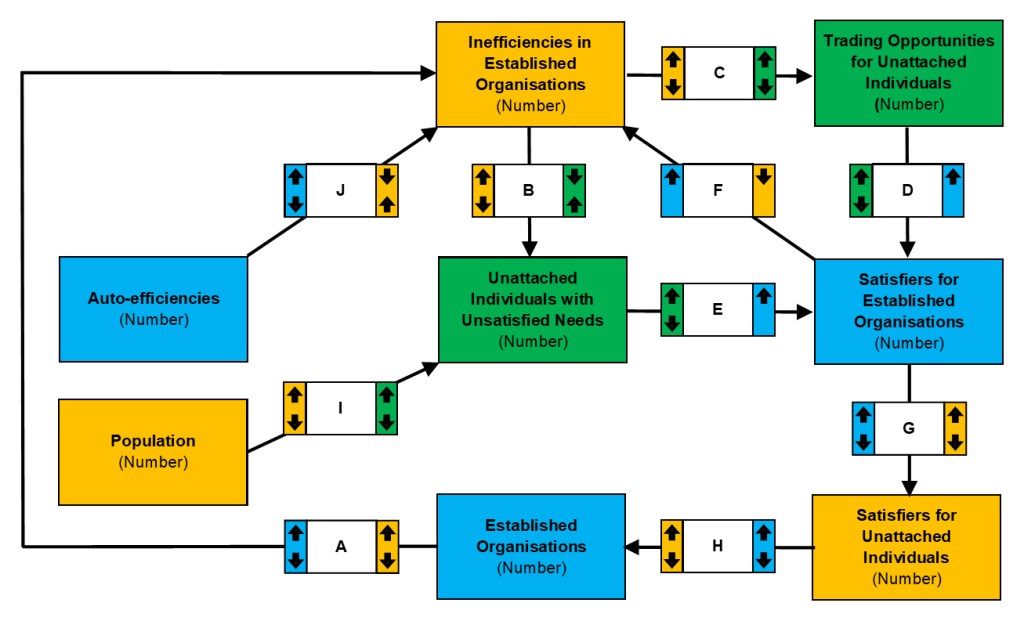
The example described in my previous post can be described graphically and, potentially, a mathematical or computer model can be created. A diagrammatic representation of the example is given in the figure below.

Figure 1. Causal diagram showing increasing complexity in Western society.

In this diagram, the coloured rectangles represent a society’s variable characteristics. These characteristics have numerical values that alter with time and can be related to one another mathematically. The variable characteristics interact causally as shown by the arrows, which point from cause to effect. In this diagram, all the arrows show the cause as being sufficient for the effect. If several sufficient causes impact on one effect, then their effect is cumulative. However, by joining arrows together after they have left their causes, it is possible to represent several necessary causes as, together, being sufficient for an effect.

The smaller rectangles describe the nature of the causal relationship. A small up arrow indicates an increase in the variable characteristic. A small down arrow indicates a decrease. The coloured background indicates whether the small arrow refers to the cause or to the effect. Small arrows are paired horizontally. In rectangle B, for example, an increase in the cause results in a decrease in the effect.

The diagram can be explained as follows.

A. As the number of established organisations increases, so too does the total number of inefficiencies. The reverse is also true.

B. As the number of inefficiencies decreases, the number of unattached individuals with unsatisfied needs increases. The reverse is also true.

I. The number of unattached individuals also increases as the population increases. The reverse is also true. Note that population growth is the number of people entering society due to births and immigration, less the number of people leaving it due to deaths and emigration. However, not all of the population is active.

C. As the number of inefficiencies increases, the number of trading opportunities for unattached individuals also increases. The reverse is also true.

D & E. As the number of trading opportunities and the number of unattached individuals increases, the number of goods and services that can reduce inefficiency in established organisations also increases. However, the reverse is not true. A decrease in the number of trading opportunities or a decrease in the number of unattached individuals has no effect.

F. As the number of goods and services provided increases, the number of inefficiencies decreases.

J. The number of inefficiencies also reduces because of efficiencies carried out by the organisations themselves, i.e., auto-efficiencies. The reverse is also true, and organisations can cause greater inefficiency in many ways.

G. As the number of goods and services provided increases, the satisfiers received in return also increase. The reverse is also true.

H. As the number of satisfiers received increases, the number of established organisations increases. The reverse is also true.

It can be seen from this diagram that the process is a positive feedback loop. With no constraints, the number of established organisations, and thus, the complexity of society can increase exponentially. However, the minor feedback loop BEF can have a damping effect if there is insufficient population growth.

There are many other examples that would benefit from the same approach. However, they may not be independent of this model, but rather may interact with and extend it. The more examples we consider, the more questions this will raise. If common questions arise from different examples, then this may be an indication of their significance. Answers to some of these common questions may be beneficial in all cases. However, it is also possible that they will be beneficial in some and harmful in others. This is not a bad thing, however, because it would prevent ill-considered decisions, and encourage us to seek optimal solutions.

Categories
17. Social Systems Theory in Practice - An Example (Part 1)

Social Systems Theory in Practice – An Example (Part1)

Introduction

The term “Social Systems Theory” is normally used to describe the work of the German social theorist Niklas Luhmann. However, the theory described here differs from Luhmann’s in several ways. In particular, the physicalist perspective holds that everything, including information, exists physically in space-time. This implies that the knowledge of an organisation lies in the neural connections that make up the minds of its members. Thus, contrary to Luhmann’s theory, those members must also be a part of the organisation.

Intuitively, many of us sense that there are intangible “forces” that are beyond our individual control and that shape our society. In this article, I draw together the information provided in my previous articles on evolution, psychology, organisations, and systems theory, to show that these intangible “forces” are, in fact, tangible processes. These processes provide an understanding of why society is as it is. To a limited extent, the processes also provide an understanding of where society is heading unless we intervene.

The social systems theory presented here is not a general theory of society. Rather it comprises an understanding of both human and systems behaviour that can be applied in different social contexts. The explanations that it provides will differ for different cultures and in different eras. Nevertheless, the approach has substantial potential value.

Example

To demonstrate the theory, I have chosen an example from the present-day Western world. The example provides an explanation of why the complexity of our society is increasing at an accelerating rate. Inevitably, this explanation raises many questions about where the process is heading, whether intervention is necessary, and, if so, what it should be. Some of these questions are considered at the end of this section.

Western society comprises many interacting organisations whose number increases day by day. Here the term “organisation” is generic. It includes any group of people who work together for a common purpose. It also includes any individual person. For example, an organisation’s function may be fishing, hunting, steelmaking, takeaway meals, or government. For a new organisation to form, a group of people must share a common need and perceive an opportunity to satisfy it by working together. Alternatively, they can share a common contra-need and perceive a way of avoiding it by working together.

In early simple societies, satisfiers for our needs were taken directly from the natural environment, for example, hunting, fishing, the gathering of vegetables, firewood, etc. To acquire these satisfiers, we formed groups or “organisations” under the leadership of experts. Other groups remained in camp to care for young children. As the size of the tribe increased, specialisation began, and some individuals spent most of their time on a particular activity. Thus, trading between specialist groups became necessary, for example, fish for childcare.

In present day Western society, few people can take their satisfiers directly from the environment. We all trade with others to satisfy our needs, and this is often in the form of employment by an organisation. Even farmers and miners need the goods and services provided by others to carry out their function.

This situation has arisen because of a positive feedback process which continues to this day. Because the process is cyclical and it is impossible to say what stage came first, I could begin its description at any point. So, beginning with increasing organisational efficiency, the process is as follows.

  • As the efficiency of an existing organisation increases, fewer people are required to carry out its function. The same is true of an individual, but efficiencies release the individual’s time.
  • However, these unattached individuals must still satisfy their needs and are usually unable to do so directly from the natural environment. So, they will seek opportunities to satisfy their needs by trading with established organisations. To that end, the unattached individuals will identify the needs of the established organisations. These needs may be goods or services that established organisations lack, or it may be aspects of the established organisations’ functions that could be carried out more efficiently.
  • If a group of unattached individuals share a common interest in providing goods, services, or efficiencies, then to do so more effectively they may form a new organisation and take on employees.
  • Not all new organisations are successful. The process is one of trial and error, and so, it is evolutionary.
  • The new organisation becomes established if it achieves its objective of trading with existing established organisations. This includes trading with individuals. Any efficiency that the new organisation provides results in the release of more people. Successful trading also satisfies the needs of the new organisation’s members.
  • Finally, the cycle is repeated with the new organisation as an established one.
  • Thus, the number of organisations in a society and the complexity of their interactions grows as time progresses.
  • Without any constraints, this growth would be exponential. However, constraints do exist, some of which are described below.

One constraint is the number of unattached people available to form new organisations. In a subsistence society there are none because everyone is fully engaged in satisfying their basic needs. So, the process may never begin without external intervention such as investment. In Western society, the growth of complexity initially relied on rapid population growth during the industrial revolution. This growth has now slowed to zero, and the release of people from established organisations through increased efficiency drives the process. An additional driver is immigration. However, for unattached people to be effective in forming new organisations, support and retraining is needed. Failing that, many may find themselves unable to satisfy their basic needs without turning to crime or other anti-social activities.

The constraints of natural resources and the problems they cause are well known. The latter include global warming, pollution, and the extinction of species. Although these issues are of enormous importance, I will not repeat here what has already been expressed very eloquently by others.

Our ability to understand complexity may also be a constraint. The more organisations there are, and the more diverse their function, the more complex society becomes. There are limits to the level of complexity that we can comprehend, and this has implications for government, the population, and crime. Can this increasing complexity be managed through technological advances? If not, then at what stage will national governments be incapable of governing effectively? At what stage will decentralisation become desirable? At what stage will citizens cease to be effective members of society and form a counterculture? At what stage will citizens begin to seek simple solutions, and at what stage will populist politicians begin to offer them?

As can be seen, the application of social systems theory to an issue raises many unanswered questions. However, it does begin to identify those that need to be addressed for the wellbeing of humanity and our environment.

Categories
15. Social Interactions (Part 1)

Social Interactions (Part 1)

Introduction

Any organisation, when treated as a system, comprises inputs, internal processes, and outputs. Inputs are external interactions that comprise the passing of space/place, matter, energy, and information from some unspecified source to the organisation. It is a causal relationship, but the cause is not specified. Outputs comprise the passage of the same from the organisation to an unspecified recipient. It is a causal relationship in which the effect is not stated. Finally, the organisation’s processes comprise internal systems, some of which are child organisations such as departments, others of which are physical processes such as production machinery, and the relationships between them. The latter are also causal relationships.

Although this system concept is helpful in focusing on the internal behaviour of an organisation, it does have its drawbacks. Typically, for example, it can result in the effects of an organisation’s outputs being neglected, resulting, for example, in social or environmental harms. It can also result in the sources of its inputs not being fully appreciated, resulting, for example, in their loss. A more wholistic approach to the management of an organisation is suggested in the section entitled “Distance” in my next article.

The functioning of an organisation can therefore be regarded as a matter of complex causality. Several inputs, i.e., causes, may be necessary, but only together may they be sufficient for the organisation to function, and thus, persist. If there is only one source of a necessary input, then the organisation is dependent on that source, and the one producing it has power over the one receiving it. A topical example is Europe’s current dependence on Russian gas. However, if there are several sources, then this power is much diminished.

Likewise, an organisation’s outputs can form the inputs of just one organisation, or of several. Clearly, if there is just one, and if the inputs are unnecessary or if there are several suppliers, then the customer has power over the supplier.

Interactions

Organisations, in a very general sense and including individuals, are the elementary entities in social systems. However, it is their interactions that are important for social systems theory. They are what forms society. These interactions are of three types:

  1. Intra-organisational Interactions or Processes, i.e., interactions between an organisation and a familial organisation. These interactions can be vertical, i.e., parent/child, or horizontal, i.e., sibling/sibling.
  2. Inter-organisational Interactions, i.e., interactions between separate organisations.
  3. Extra-organisational Interactions or Environmental Impacts, i.e.,interactions between organisations and the non-human environment.

They all pass space/place, matter, energy, or information from one place to another and are, therefore, causal relationships.

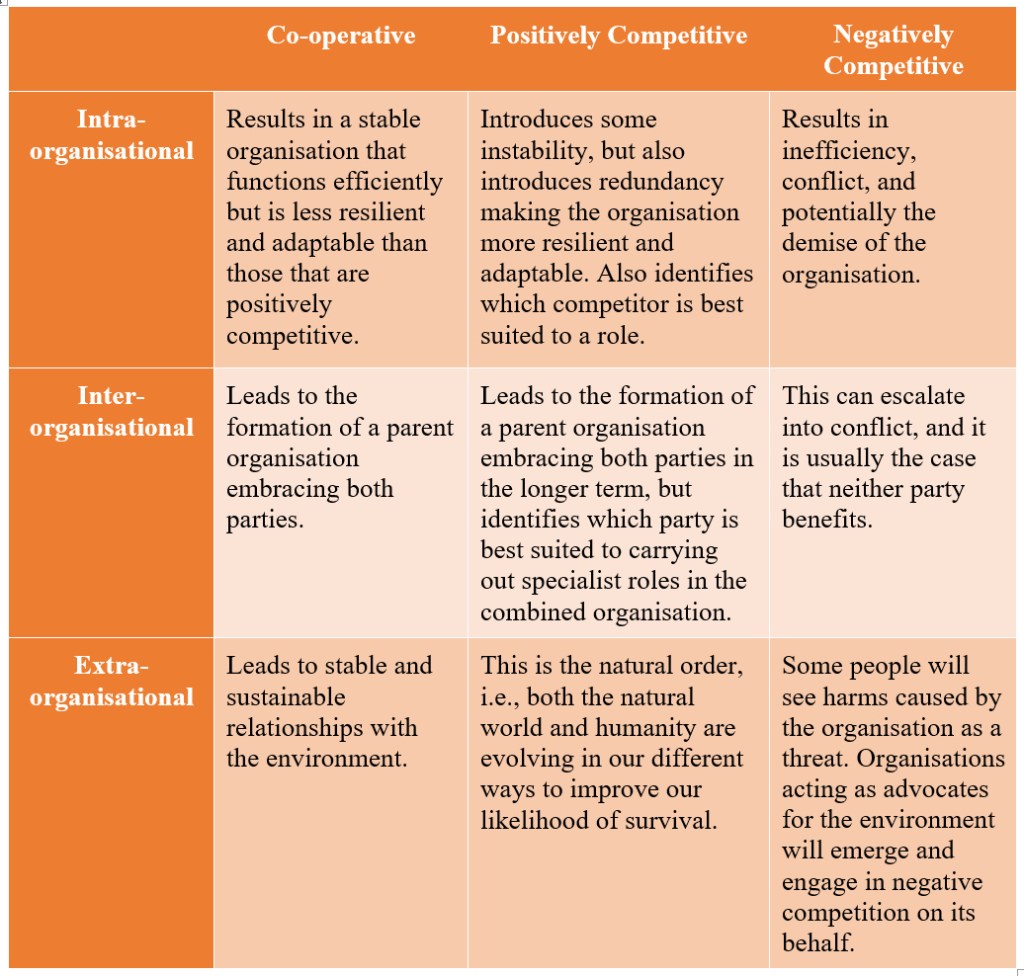
In a previous article it was explained that organisations can interact with others in their environment in one of three ways: co-operation, positive competition in which each competitor strives to excel, and negative competition in which each competitor strives to prevent the other from achieving their aims. Thus, interactions are two dimensional as follows:

Asymmetrical Interactions

The discussion above assumes that all interactions are symmetrical, i.e., that the attitude of both parties is either co-operative, positively competitive, or negatively competitive. However, asymmetrical interactions are also possible, in the short term at least.

Co-operation or positive competition can deteriorate and become negative via asymmetrical interaction. If one party to co-operation feels under threat, or if one party engaging in positive competition feels they will lose, they may begin to engage in negative competition. If this is overt, then, unless the other party has ethical objections, they will reciprocate. Negative competition can, of course, be carried out covertly, whilst maintaining a façade of co-operation or positive competition. If so, then the interaction becomes asymmetrical, i.e., one party engaging in negative competition and the other in genuine co-operation or positive competition. Usually, however, the interaction becomes symmetrically negative when the deceit is discovered.

Theoretically, the reverse is also possible, i.e., negative competition can become positive or cooperative, but this requires reciprocal de-escalation, whilst the interaction remains symmetrical. If one party de-escalates unilaterally, they will lose.

Organisational Inputs and Outputs

The basis for inter- and intra-organisational interactions is the reciprocal trading of satisfiers, or in some cases contra-satisfiers. Such satisfiers or contra-satisfiers comprise outputs from one organisation, in the form of space/place, matter, energy or information, and inputs to the other.

In a co-operative interaction, satisfiers are exchanged by mutual agreement to the benefit of both parties. In a positively competitive interaction, there is no trade between the two. However, space/place, matter, energy, or information can be passed, inadvertently, from one to the other. Finally, negatively competitive interactions involve the provision of contra-satisfiers by one to the other and vice versa, as in the case of war. This is to the detriment of both, although one party may ultimately prevail. Negatively competitive interactions can also involve the extraction of satisfiers without reciprocation or with the threat of contra-satisfiers, e.g., robbery at gunpoint.

Clearly, feedback loops are involved. For example, organisation A may provide a satisfier for organisation B, which in turn provides a satisfier for organisation A. However, in the modern world, organisational distance is a significant factor. For example, if organisation A provides a satisfier to organisation B, then the latter may be unable to reciprocate with physical satisfiers. A much larger and more complex arrangement of feedback loops, comprising many organisations, may be necessary for the equitable satisfaction of all parties. Clearly, such complexity can become unmanageable, and so, money has been introduced as a token of exchange in markets, thereby forming the basis of economics.

Categories
02. Basic Social Systems Theory

Basic Social Systems Theory

Introduction

The term “Social Systems Theory” has been used to describe the sociologist, Niklas Luhmann’s theory, but the one presented here differs in important respects. In this article I will describe its core principles.

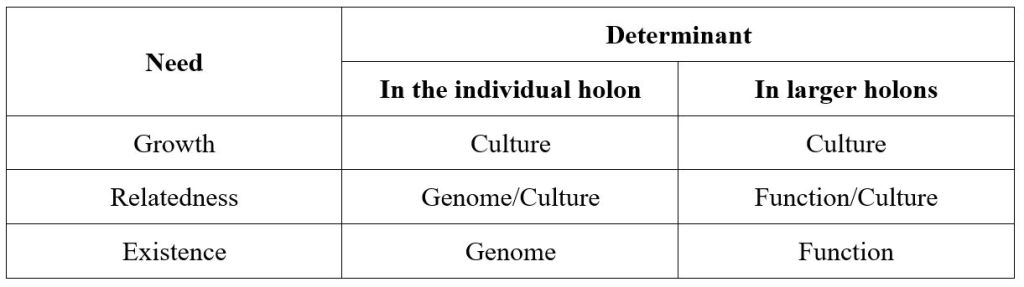
Firstly, we use different terminology in different fields of study, but as can be seen from the table below it is all the same thing really. So, please refer to this table if in any doubt about the meaning of a term.

The Social Systems Concept

The basic framework of social systems theory can be described as follows:

  1. A general system comprises inputs, processes, and outputs. Processes, in turn, comprise components and their interactions. These components are also systems.
  2. Humanity is a social system which follows the same structure and rules as a general system. Its components are organisations. The reader may recall that, in these articles, an organisation is defined as any group of people who work together for a common purpose. Thus, an organisation may be a single individual, a club, a nation, or all of humanity.
  3. The interactions between organisations are the trade of satisfiers and contra-satisfiers between them. The satisfiers and contra-satisfiers traded take the form of information, matter, and energy. In more familiar terms, they comprise raw materials, products or artifacts, services and, as a general token of exchange, money.
  4. The satisfiers exchanged are related to the needs of the organisations concerned which, in general terms, are existence, relatedness and growth.

So, organisations are the elementary entities in social systems theory. At the next level of complexity up, i.e., ecology, the elementary entity is the species. Humanity is one such species and its inputs and outputs are those things that it takes from and gives to the natural ecosystem.  At the next level of complexity down, i.e., biology, the elementary entity it is the organ. The domain of social systems theory lies between these two boundaries.

The most notable aspect of organisational behaviour is its similarity to that of individual people. This is not because organisations have a “group mind”, but rather because every organisation is ultimately led by a single individual, and its specialist activities are also carried out by individuals. There are, however, important variations in the behaviour of both individuals and organisations which depend on their time, place, and size. These common features and the ways in which they vary are summarised below.

Theory

The following core principles apply to all organisations no matter what their size, location, or era. They are therefore universal and constant. They will be explained in more detail in future articles and only a simplified summary is given below.

  • Agency. All organisations have agency. They have choices available to them, they process information and act on it.
  • Purpose. All organisations have a purpose or function.
  • Needs. All organisations have needs which when prioritised form a hierarchy.
  • Satisfiers, Contra-satisfiers, and Motivators. Every organisation is affected by these and, together with its knowledge and needs, they influence its behaviour.
  • Inputs, Processes and Outputs. All organisations require inputs to carry out their function, which is to produce outputs. These inputs and outputs comprise materials, services, and/or information. However, information must always form a part.
  • Self-maintenance. All organisations are self-maintaining, i.e., they use a proportion of their inputs in self-maintenance as opposed to producing outputs.
  • Recursiveness. All organisations are recursive. Every organisation, except an individual person, comprises a number of component organisations and is a component of larger organisations.
  • Specialisation. All organisations comprise specialised sub-organisations or individuals. This is commonly known as a division of labour.
  • Co-ordination. All organisations require a control component, i.e., leaders, to co-ordinate specialised activities. This is carried out via an internal feedback loop with information passing upwards and instructions downwards.
  • Culture. Every organisation has a culture comprising values, norms, beliefs, operational knowledge, and symbols.
  • Schemata. Every organisation holds knowledge in schemata which are resistant to change. These include a schema for worldview/purpose, an internal ethical schema, external ethical schema, operating schemata, self-image, etc.
  • Misinformation. All organisations are capable of concealing information from others or supplying misinformation to them.
  • Adaptation. In response to both internal and external change, all organisations adapt their processes, attempt to adapt their environment, or both. Without adaptation, an organisation will eventually fail.
  • Evolution. The laws of evolution apply to organisations of all sizes, i.e., random mutation occurs within them, and natural selection occurs through the way in which they and their environment interact.
  • Inter-organisational Distance. Ultimately, every organisation interacts with every other. In some cases, they interact directly. In others there is no direct interaction. Rather any interaction is via a chain of direct connections.
  • Competition/Co-operation. The choice between co-operation, positive competition and negative competition always applies when one organisation interacts with another.

Some relationships between organisations, and thus, social systems theories, change with size, time, and place. These changes are due to:

  • Availability of Resources. The availability of resources varies from time to time and from place to place. This affects culture, which also then varies in the same way. Culture in turn affects knowledge, the relative priorities of needs, satisfiers, motivators, and attitudes towards relationships, i.e., whether co-operation, positive competition, or negative competition is favoured.
  • Knowledge. This, including knowledge of social systems, is part of an organisation’s culture. Because knowledge is one component affecting behaviour, the latter also alters from place to place. Knowledge can also be gained or lost, and so varies with time. If new knowledge is gained this can alter culture, and thus, social theory. However, progress is not inevitable, shocks can occur, and knowledge can be lost, e.g., the collapse of the Roman Empire and the subsequent Dark Ages. Loss of knowledge can cause an organisation or society to revert to behaviours similar to those of earlier years.
  • Redundancy. The amount of redundancy, i.e., duplicated capability, in an organisation, and thus its resilience, varies depending on factors such as whether an organisation has been designed or has evolved. This includes redundancy of potential command.
  • Size. As organisations increase in size the following characteristics alter and affect their efficiency. The interaction of efficiencies and inefficiencies of scale usually results in an optimum organisational size.
    • Specialisation, Departmentalisation, and the Formalisation of roles generally increase. Departmentalisation is the collection of specialised tasks into groups under a leader. Formalisation is the specification of tasks and the introduction of rules and regulations regarding the way in which they are carried out.
    • Informal Innovation generally decreases.
    • Hierarchy, i.e., the number of levels of command, generally increases.
    • Distance of Intra-organisational Communication, including Leadership Distance and Peer Distance, i.e., the lengths of chains of communication, generally increase, and along with them, the likelihood of communication errors.
    • Decentralisation, i.e., the delegation of power and control, generally becomes increasingly necessary.
    • The relative amount of Self-maintenance or Administration generally increases.
    • Speed of Decision-making generally decreases.
    • Cultural Entrenchment, i.e., the unchangeability or otherwise of an organisation’s culture, generally increases.
    • Cultural Homogeneity, i.e., whether all members of an organisation share a common culture, generally decreases.
    • Frequency of Restructuring, i.e., reorganisation, generally decreases.
    • Social Traffic, i.e., irrelevant communication, generally increases.

Explanation/Prediction/Design

The theory of social systems can be used to explain society, but not to predict it with certainty or to design an ideal system. This is because there are approximately seven and a half billion people in the world. So, the vast number of relationships between organisations, including individuals, leads to great complexity. Added to this is the vast number of relationships with the non-human environment. We do not have the mental capacity to understand such complexity. Even if we were able to model the human social system, then our understanding of it would change, and so too would its behaviour. Furthermore, predictability would diminish due to a build-up of un-anticipatable random events. The best we can do, therefore, is imagine relatively small, closed, sections of society, and make predictions about them, with reasonable confidence but no certainty, a short distance into the future.