Categories
10. Culture and Interaction Style

Culture and Interaction Style

Culture

Culture is learned and comprises values, norms, beliefs, knowledge, and symbols. It is, therefore, information. A culture can be shared by the members of any organisation small or large. Culture, especially values, along with inherited predispositions affect a person’s behaviour, and thus, the “style” of interactions between and within organisations. The style of interaction also affects the culture of an organisation and there is, therefore, a degree of feedback between the two.

The social environment in which an organisation operates has a strong bearing on its culture. However, not all organisations operate within a single environment. Some, for example, operate globally. Furthermore, not all individuals or organisations concur with the culture that prevails in their environment. Leaders of an organisation also have a strong influence over its culture. These factors can result in conflicting values, the consequences of which will be discussed in a future article.

Interaction style

Organisations are predisposed to interact in one of three basic styles: co-operation, for example, helping one another over the finish line in a race; positive competition, for example, running as fast as we can to be first over the line; and negative competition, for example, kicking the legs out from one another on our way to it. This predisposition is based on past experience and  learning from others in the community but actual interaction style also depends on circumstances.. In the case of co-operation and negative competition, the two organisations interact directly with one another. Co-operation involves an equitable exchange of satisfiers; negative competition involves an exchange of contra-satisfiers. However, in the case of positive competition, the two organisations do not interact directly, but rather with a third party. This is usually a precursor to co-operation between the third party and the successful competitor.

In practice, the predispositions of organisations are often a mix of the three interaction styles, each predominating in different circumstances, as shown in the diagram below.

The style of interaction is usually, but not necessarily, defined by the attitudes of the component organisations or individuals directly involved in the interaction and te circumstances. However, more senior leaders can have an influence through their leadership style, the culture they promote within the organisation, and their distance from the interaction.

Interactions can be vertical, i.e., between individuals or organisations above and below one another in a hierarchy. They can also be horizontal, i.e., between individuals or organisations at similar levels, but on different branches, of a hierarchy. Thus, for example, the interaction between a manager and a junior member of staff is vertical, and the trade between nations horizontal.

Vertical Interaction Style

Vertical interaction is a special case of interaction in general. True leadership and followership are co-operative, but this form of interaction does not always exist between senior and junior individuals or the components of organisations. A leader must be accepted by followers to gain their willing support. If the leader is appointed by a bottom-up process, i.e., if followers agree their leader, then co-operation will normally ensue. However, if a leader is appointed by a top-down process, then co-operation is not inevitable, and positive or negative competition may occur. Examples of top-down appointments include not only appointments made by senior managers, but also business takeovers and the invasion of nations.

In positive competition, the two parties do not interact with one another but compete for satisfiers from a third party. An appointed leader and an unwilling follower may, for example, both compete for recognition by a more senior person.

In negative competition, contra-satisfiers are exchanged but the leader or parent organisation is normally in a more powerful position, and thus, able to coerce the follower with threats of contra-satisfiers. Fortunately, extreme examples of such behaviour are now largely illegal, but mild versions persist in many organisations.

The style of vertical co-operative interaction varies on a scale. At one end is the personal contract, i.e., trading of personal benefits, such as power, wealth, and influence for support. At the other end of the scale is Rousseau’s social contract, which states that followers are willing to give up some of their rights in the communal interest. However, the definition of communal interest can vary, and so the social contract can be defined in several ways. Thus, this definition should be revised as follows: people are willing to support a leader, and thus, give up certain rights if that leader acts in a way that delivers benefits to:

  • the individual supporter (personal contract);
  • the supporting team (team contract);
  • the sub-organisation (sub-organisational contract);
  • the organisation (organisational contract);
  • the super-organisation (super-organisational contract);
  • the nation (national contract);
  • humanity (species contract); or
  • the ecosystem (environmental contract).

The style of contract sought and offered will depend on the follower’s and leader’s attitudes. In general, the weight given to each type of contract, i.e., its relative influence on their interaction style, generally decreases from personal, to social, to species, to environmental. This decrease is consistent with the multilevel selection theory of evolution. We place greatest weight on immediate personal interest, but do not neglect our longer-term interests gained communally. The actual weights applied by an individual or organisation depend on their attitude. Generally, those with a right-wing attitude will place greater weight on the personal contract, and less weight on other contracts, than those with a left-wing attitude.
Categories
15. Social Interactions (Part 1)

Social Interactions (Part 1)

Introduction

Any organisation, when treated as a system, comprises inputs, internal processes, and outputs. Inputs are external interactions that comprise the passing of space/place, matter, energy, and information from some unspecified source to the organisation. It is a causal relationship, but the cause is not specified. Outputs comprise the passage of the same from the organisation to an unspecified recipient. It is a causal relationship in which the effect is not stated. Finally, the organisation’s processes comprise internal systems, some of which are child organisations such as departments, others of which are physical processes such as production machinery, and the relationships between them. The latter are also causal relationships.

Although this system concept is helpful in focusing on the internal behaviour of an organisation, it does have its drawbacks. Typically, for example, it can result in the effects of an organisation’s outputs being neglected, resulting, for example, in social or environmental harms. It can also result in the sources of its inputs not being fully appreciated, resulting, for example, in their loss. A more wholistic approach to the management of an organisation is suggested in the section entitled “Distance” in my next article.

The functioning of an organisation can therefore be regarded as a matter of complex causality. Several inputs, i.e., causes, may be necessary, but only together may they be sufficient for the organisation to function, and thus, persist. If there is only one source of a necessary input, then the organisation is dependent on that source, and the one producing it has power over the one receiving it. A topical example is Europe’s current dependence on Russian gas. However, if there are several sources, then this power is much diminished.

Likewise, an organisation’s outputs can form the inputs of just one organisation, or of several. Clearly, if there is just one, and if the inputs are unnecessary or if there are several suppliers, then the customer has power over the supplier.

Interactions

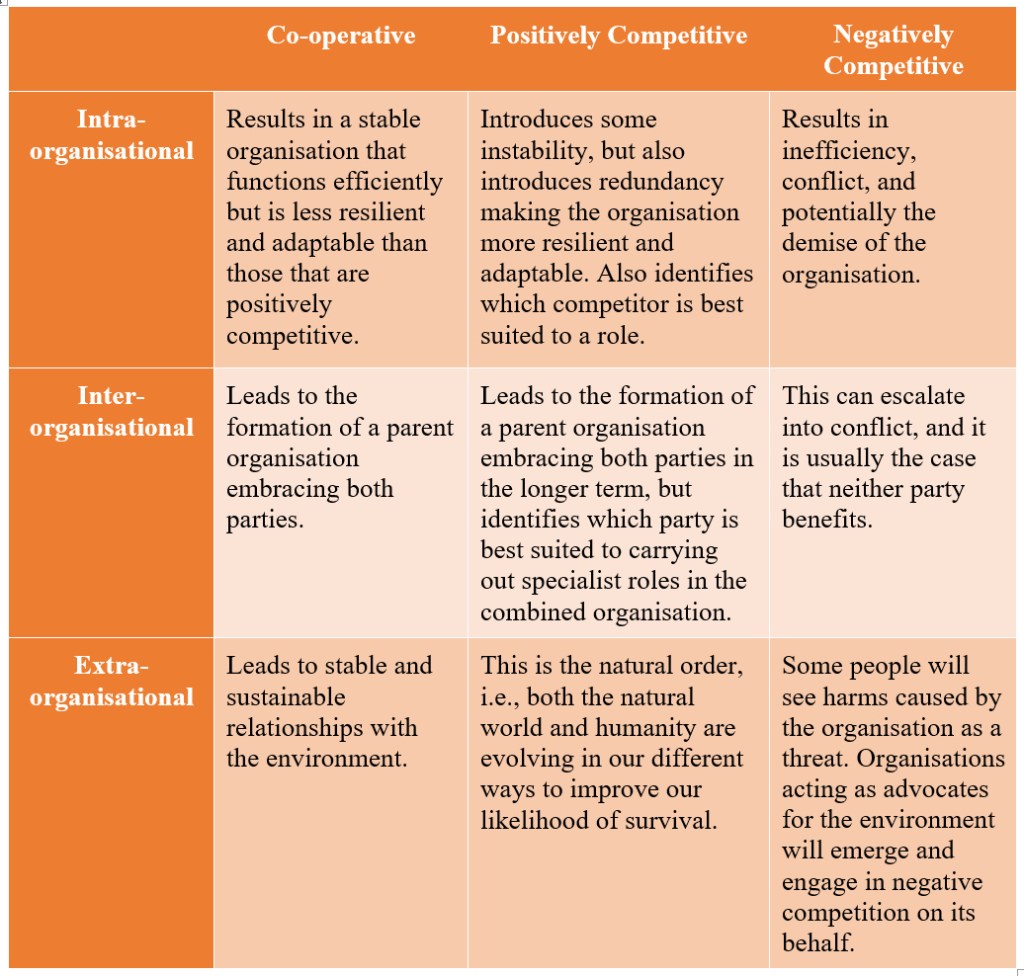
Organisations, in a very general sense and including individuals, are the elementary entities in social systems. However, it is their interactions that are important for social systems theory. They are what forms society. These interactions are of three types:

  1. Intra-organisational Interactions or Processes, i.e., interactions between an organisation and a familial organisation. These interactions can be vertical, i.e., parent/child, or horizontal, i.e., sibling/sibling.
  2. Inter-organisational Interactions, i.e., interactions between separate organisations.
  3. Extra-organisational Interactions or Environmental Impacts, i.e.,interactions between organisations and the non-human environment.

They all pass space/place, matter, energy, or information from one place to another and are, therefore, causal relationships.

In a previous article it was explained that organisations can interact with others in their environment in one of three ways: co-operation, positive competition in which each competitor strives to excel, and negative competition in which each competitor strives to prevent the other from achieving their aims. Thus, interactions are two dimensional as follows:

Asymmetrical Interactions

The discussion above assumes that all interactions are symmetrical, i.e., that the attitude of both parties is either co-operative, positively competitive, or negatively competitive. However, asymmetrical interactions are also possible, in the short term at least.

Co-operation or positive competition can deteriorate and become negative via asymmetrical interaction. If one party to co-operation feels under threat, or if one party engaging in positive competition feels they will lose, they may begin to engage in negative competition. If this is overt, then, unless the other party has ethical objections, they will reciprocate. Negative competition can, of course, be carried out covertly, whilst maintaining a façade of co-operation or positive competition. If so, then the interaction becomes asymmetrical, i.e., one party engaging in negative competition and the other in genuine co-operation or positive competition. Usually, however, the interaction becomes symmetrically negative when the deceit is discovered.

Theoretically, the reverse is also possible, i.e., negative competition can become positive or cooperative, but this requires reciprocal de-escalation, whilst the interaction remains symmetrical. If one party de-escalates unilaterally, they will lose.

Organisational Inputs and Outputs

The basis for inter- and intra-organisational interactions is the reciprocal trading of satisfiers, or in some cases contra-satisfiers. Such satisfiers or contra-satisfiers comprise outputs from one organisation, in the form of space/place, matter, energy or information, and inputs to the other.

In a co-operative interaction, satisfiers are exchanged by mutual agreement to the benefit of both parties. In a positively competitive interaction, there is no trade between the two. However, space/place, matter, energy, or information can be passed, inadvertently, from one to the other. Finally, negatively competitive interactions involve the provision of contra-satisfiers by one to the other and vice versa, as in the case of war. This is to the detriment of both, although one party may ultimately prevail. Negatively competitive interactions can also involve the extraction of satisfiers without reciprocation or with the threat of contra-satisfiers, e.g., robbery at gunpoint.

Clearly, feedback loops are involved. For example, organisation A may provide a satisfier for organisation B, which in turn provides a satisfier for organisation A. However, in the modern world, organisational distance is a significant factor. For example, if organisation A provides a satisfier to organisation B, then the latter may be unable to reciprocate with physical satisfiers. A much larger and more complex arrangement of feedback loops, comprising many organisations, may be necessary for the equitable satisfaction of all parties. Clearly, such complexity can become unmanageable, and so, money has been introduced as a token of exchange in markets, thereby forming the basis of economics.