Categories
27. How Cooperation Can Fail (Part 2)

How Cooperation Can Fail Part 2

A colleague in LinkedIn has posted the following comment on my previous article: “Co-operation fails when the demands of the goal are put ahead of the needs of the relationships involved in the cooperative”. Although this comment uses different language to mine, I agree with it, and my reasons are given in this article. The comment also has some interesting implications that I will also explore here: why the needs of cooperative groups are so similar to the needs of individuals, and how cooperation can become coercion.

My explanation begins with cognitive physicalist philosophy, one of the key principles of social systems theory. The cognitive component of this philosophy holds that the universe is infinitely complex, but our minds are not. Therefore, to understand the universe we are obliged to mentally represent it in a simplified way. One of the ways we do this is by using holons. These are things whose structure we recognise due to its recurrence. Holons enable us to recognise threats and opportunities from experience or from knowledge passed on by others. We respond to holons in a way conducive to our survival and procreation, and so our ability to recognise them has an evolutionary source.

The physicalist component of cognitive physicalist philosophy holds that everything is physical, and nothing metaphysical. In other words, everything comprises matter or energy in space-time, and there is nothing other than that. If we also accept Einstein’s proposition that matter is organised energy, then this simplifies, yet further, to the premise that everything is energy in space-time.

There are two outputs from this philosophy of significance for social systems theory.

Firstly, information is physical in nature. It exists at source, i.e., in the original physical thing that we are thinking of or communicating about. Information at source is the structure or organisation that we recognise in that thing. Information at source can be translated into a simplified form capable of being held in and manipulated by our minds. This simplified form can be an icon or image, or it can be a symbol or word. This icon or symbol is also organised matter or energy that represents a holon in the physical universe. We can also create external representations of these internal ones in the form of drawings, words, etc. This enables us to communicate information to others. Both translations are fraught with difficulties, of course, but I will not expand on that here.

Secondly, even abstract things such as relationships and characteristics are physical in nature, rather than metaphysical. For example, a characteristic is the aggregate of all physical things that can be said to have it. Justice, for example, is the aggregate of all just acts. To cite another example, a relationship between two things is the aggregate of those two things. It exists only for as long as the characteristic that defines the relationship applies to those things. This implies that co-operation is physical in nature. A relationship does not exist independently of the two parties who, for example, co-operate. Rather, it IS those two parties for so long as they have the characteristic of cooperating with one another.

We recognise cooperative groups because they occur frequently in society. Parties who cooperate form a larger holon comprising several smaller ones. These smaller ones are the individuals who cooperate, plus any other living things, such as horses, and any artifacts, such as computers, necessary for the co-operative endeavour. Even individual people rely on other living things and artifacts. Examples include guide dogs for the blind and heart pacemakers. So, the needs of these things must be included with those of the individual person.

Another principle of social systems theory is that holons comprising more than one person have much the same range of needs as those of a single individual. This is because the needs of these larger holons comprise an aggregate of the needs of its component parts, i.e., the individuals concerned, and any other living things or artifacts necessary for cooperation. When the needs of these components are aggregated, they yield those of the cooperative group and no new needs emerge.

In summary, individuals have needs, relationships between them have needs, and groups of individuals have needs. They are all much the same as the needs of individuals.

Our growing reliance on artifacts, and where this may be leading is, of course, a significant topic in its own right. However, this will be discussed in a future article.

Evolution has resulted in people who carry out a form of risk-benefit-cost analysis when translating their needs into behaviour. Emotion plays a part in this. If a situation lowers the level of satisfaction of our needs, then we will experience negative emotions, e.g., grief. On the other hand, if the situation increases the level of satisfaction of our needs, then our emotions will be positive, e.g., happiness. These emotions affect our behaviour. If we believe that the effort involved in satisfying a need will outweigh the benefit to be gained, then we will wish to avoid negative emotions and will not voluntarily behave in that way.

Because larger holons have much the same needs, albeit aggregates, they follow the same rule. If the aggregate effort of the cooperative outweighs the aggregate benefit to be gained, then some parties in the cooperative endeavour will inevitably suffer a net disbenefit. They will, therefore, no longer cooperate voluntarily. So, co-operation fails when the aggregate cost of pursuing the mutual goal exceeds the benefits to be gained.

This has an interesting implication. If unsatisfiable needs exist, then cooperation with people who pursue them without restraint is impossible. An example of an unsatisfiable need is absolute power. No matter how much we have, there will always be someone or some group with more. The same is true of wealth. If we have people who prioritise their need for wealth or power and pursue it without restraint, then this will consume endless resources. However, the satisfiers that any cooperative can generate are finite. So, if co-operation were attempted with such people, then ultimately, we would face a situation in which the costs to us outweigh the benefits. Thus, any cooperation would fail.

In practice, for cooperation to be sustained, it is necessary to work within the constraints of the benefits that can be gained from it. Furthermore, the benefits generated by co-operation must be shared reasonably equitably so that all parties experience a net benefit. In practice, this is what good leaders do. It is also what dark leaders do – up to a point.

Once sufficient wealth and power is gained via cooperative means, then coercion becomes possible. Indeed, in the case of people who pursue power or wealth without constraint, it becomes inevitable. Once coercion becomes common practice, what may previously have been a democratic society becomes an authoritarian one, with extremes of wealth and power and extremes of powerlessness and poverty.

To avoid such a society, it is necessary to place constraints on the pursuit of wealth and power. These must be built into our governmental and democratic processes. Not everyone seems to realise this, unfortunately.

Categories
26. How Cooperation Can Fail (Part 1)

How Cooperation Can Fail

In this article, I use social systems theory to explain how cooperative arrangements can fail. I will use the topical example of labour relations in business to illustrate this, although there are many other examples such as cooperative relationships in families, between friends, and between nations. The example that I have chosen reveals little that we do not already know from experience. However, this is not the purpose of the article. Rather, its purpose is to demonstrate how the underlying principles of social systems theory result in a model that reflects reality.

The example began as a series of equations, each of which, drew on the principles of ecology to describe a relationship between two unspecified parties. The principles of evolution were then used to link the equations and demonstrate how these relationships could change over time. Finally, the series of equations was translated into the text below.

The example is limited to a discussion of relationships within the private business sector. This sector interacts with many others such as education, healthcare, government, the legal sector, and so on. For the purposes of this article, only a brief discussion of interactions with government is included. Interactions with other sectors have not.

Cooperation, or as it is known in ecology, mutualism, occurs when two parties work together with a common purpose. The parties involved can be individuals or organisations of any type or size, including families, businesses, voluntary organisations, governments, and nations. Their purpose is usually to gain satisfiers or avoid contra-satisfiers for their mutual benefit. The source of these satisfiers or contra-satisfiers is a third party or the general environment. Satisfiers are those external things that satisfy the needs of an individual organism, group of organisms or species. Contra-satisfiers on the other hand are external things that reduce the level of satisfaction of those needs. For example, the employees and employers in a business cooperate to manufacture and sell goods to their market for a profit. This profit is a satisfier for the needs of both parties and is shared between them for their mutual benefit.

Initially, two parties in a cooperative arrangement may be relatively equal in power. However, as time progresses, one invariably gains greater power, and so, the benefits of the arrangement are shared less equitably. In a business, for example, employers typically come to hold greater power. However, there have been cases in which, through trade union organisation, employees have come to do so instead.

Two things can then occur. Those with greatest power can seek ever greater power, and thus, ever more inequitable distribution of the benefits of cooperation. Alternatively, or additionally, a shortage of the mutual satisfier can occur. For example, the market for the business’s product may decline.

There is a threshold above which parties will voluntarily cooperate, and below which they will not. For example, if employees are to co-operate with employers, then the wages gained from employment must be sufficient to satisfy their needs. Employers, on the other hand, must be able to satisfy their own personal needs and those of the business. If one party takes too much of the benefits and/or if the market for their product fails, then the other party may find the benefits of co-operation insufficient. The owners may no longer be able or willing to pay enough to make employment worthwhile, or the returns for the employers may no longer be sufficient to make the business worthwhile. So, one party may find itself cooperating involuntarily with the other. For example, the employer may, in effect, be taking the employees’ labour against their will, although the reverse is also possible.

When one party takes a satisfier from another and the other party a) needs it to satisfy their needs and b) has no resilience or rainy-day surplus such as savings or capital, then the former party is, in effect, imposing a contra-satisfier on the latter. As a consequence, there is a risk of conflict, and three courses of action are possible.

To avoid conflict, the weaker party can move elsewhere. For example, employees can resign and look for alternative employment, or employers can close the business. Cooperation then ceases. In ecology, this is known as neutralism.

Alternatively, because the imposition of a contra-satisfier by one party on another normally results in reciprocation, the two parties can engage in conflict. The purpose of reciprocation is, of course, to coerce the employer or employees into a more equitable apportionment of the business’s benefits.

Finally, the one party can accept harmful exploitation by the other. It is an objective fact that, in ecology, harmful exploitation is known as predation or parasitism. These terms are not intended to be disparaging.

Much depends on the relative power of the two parties. If the harmful exploitation of employees is widespread, there may be nowhere for employees to move to. If general employee power is too great, there may be no alternative business opportunity for the employers. In these circumstances, the only options that remain are conflict or the acceptance of exploitation. If either party has so much power that conflict with them will inevitably fail, then only the final option, an acceptance of exploitation, remains.

Co-operation can, of course, fail even when the parties are relatively equal in power and the benefits of a business are shared reasonably equitably. If these benefits should fail for any reason, e.g., market collapse, competition, etc., then, providing they have reserves of the necessary satisfiers, both employers and employees may find themselves in the position of being harmlessly exploited for a while. A reasonable degree of resilience by both parties is, therefore, needed to retain co-operative arrangements during short term market downturns, etc. However, if these reserves become exhausted, then harmless exploitation becomes harmful, i.e., a contra-satisfier, and so, co-operation fails.

The following conclusions can be drawn from this example. If employers gain too much power and are unwilling to share the benefits of businesses sufficiently equitably to satisfy the needs of their employees, then they will fail to gain the latter’s voluntary cooperation. Conflict can then become widespread and lead to economic failure with disbenefits for all. Alternatively, harmful exploitation can become widespread, and we can come to live in an authoritarian society. Employers can, of course, tread a careful line and share benefits just sufficiently equitably to make employee cooperation worthwhile. However, because there will be no employee resilience, when a shock to the business occurs, this can quickly cause cooperation to be lost.

Conversely, if employees gain too much power and demand excessive pay, then this can prevent growth, reduce business resilience, and thus place, the business’s continued existence in jeopardy. Again, co-operation will break down, and the benefits to both parties will be lost. If this situation becomes widespread, then only those employees who are organised will benefit, and then only in the short term. Ultimately, economies will fail to grow, and the benefits of this growth will be lost. In the extreme, economies can collapse, and poverty can become endemic.

The way forward, therefore, is a middle road in which the balance of power between employers and employees is optimised. This is the role of national government which, in an ideal world, should exercise it scientifically, objectively, non-ideologically and without undue influence from either employers or employees. It is worth mentioning that corrective legislation to curtail excessive power of either employers or employees should not be retained indefinitely. Rather, it should be rolled back once an optimum balance is achieved. Failing that, the optimum will be overshot, and the power of the other party will steadily increase. If they are to retain an optimum balance, governments should keep their eye on the ball and amend legislation as necessary.

Categories
14. Process Inflexibility and Extreme Super-Optimal Behaviour

Process Inflexibility & Extreme Super-optimal Behaviour

Neglecting the Disbenefits of our Actions

All actions have benefits and disbenefits. Benefits are mostly associated with the problem to hand, but disbenefits can be in an entirely unrelated area. When proposing an action, it is sensible to assess the disbenefits and only proceed if they can be satisfactorily mitigated.

Nevertheless, in practice, we tend to have an optimism bias that causes us to neglect disbenefits. Once a beneficial action is identified we will repeat it time and time again in expectation of the same outcome. Not only will we repeat beneficial actions that we have taken ourselves, but we will also copy those of others. A positive feedback loop develops in which apparently beneficial actions become the cultural norm.

An article by Donald Sull, in the Harvard Business Review (Sull, 1999) describes, for example, how business processes harden into routines. However, this problem applies not only to businesses but to organisations of all types and scale, including nations and groups of nations, such as “the West”. The article states that “When a company decides to do something new, employees usually try several different ways of carrying out the activity. But once they have found a way that works particularly well, they have strong incentives to lock into the chosen process and stop searching for alternatives. Fixing on a single process frees people’s time and energy for other tasks. It leads to increased productivity, as employees gain experience performing the process. And it also provides the operational predictability necessary to coordinate the activities of a complex organization. … established processes often take on a life of their own. They cease to be means to an end and become ends in themselves. People follow the processes not because they’re effective or efficient but because they’re well known and comfortable. They are simply ‘the way things are done.’ Once a process becomes a routine, it prevents employees from considering new ways of working. Alternative processes never get considered, much less tried.”.

Extreme Super-optimal Behaviour

Super-optimal behaviour means doing something more often or intensively than is most efficient. If any action is performed many times, there is usually an optimum at which the net benefit, that is, the total of the benefits minus the total of the disbenefits, is maximized. Below this optimum, not all the potential net benefit is gained. Above it, the disbenefits grow and progressively reduce the net benefit.

One example is functional differentiation, whose benefit is increasing efficiency. Its disbenefits are: an increasing need for administration; an increasing need for communication; and increasingly boring repetitive tasks. Outsourcing in industry is a practical example of functional differentiation, which, when taken to its logical conclusion, would result in everyone outsourcing their entire function and doing nothing apart from administering the process.

Another example is centralization. Centralised customer call centres work well when the customers’ concerns are relatively simple and frequently recurring. No specialist expertise by call handlers is needed. However, when customers’ concerns are complex, diverse, and recur infrequently, then specialist expertise is needed. The customer can become frustrated when he or she does not receive it. This example suggests that there is an optimum to be found between centralisation and specialization, to either side of which an organisation functions less efficiently than it might.

Uncontrolled Feedback

Super-optimal behaviour is a particular problem when there is a threshold at which the disbenefits become part of a positive feedback loop or vicious circle. An example is climate change, in which the melting of glaciers and polar ice is accelerating global warming. In the social environment, feedback loops can occur in which disbenefits are copied and become culturally entrenched norms. This can lead to the failure of a nation. Such feedback can be complex, however, and is best demonstrated by an example.

Example of neglected disbenefits subject to uncontrolled feedback

This example describes the effect of consumer economics on the birth rate in Europe. Clearly, womens’ education, empowerment, and the availability of contraception have had an impact on the birth rate, causing it to fall.

However, I would argue that consumer economics has also had a very significant but less obvious effect. The need for economic growth has led to ever increasing production and consumption. Rightly or wrongly, to increase production, women have been encouraged to join the workforce. In general, however, they are poorly supported in their parental role by employers. (The Fawcett Society, 2023). To increase consumption, we have all been encouraged, via advertising, to express our individuality through the products we consume. We work more and consume more.

Added to this, the competitive nature of business means that there is a need to drive down costs. This, in turn, has led to a form of economic brinkmanship in which poverty levels due to low pay have increased.

Finally, the cost, time, and effort involved in raising children is steadily increasing, and this is in no small part due to advertising and the expansion of consumer economics into that area of life.

Interestingly, although procreation is an evolutionary imperative, it is not listed by Maslow’s or the ERG model as an existence need. Rather, reproduction seems to satisfy a relatedness need, which has a lower priority than, for example, the needs for sustenance and shelter. Furthermore, it is vying with other relatedness satisfiers such as friends and pets.

These factors have led to a situation in which fewer people are having children. The cost and time needed to raise them is now too great for many. It is, therefore, becoming a cultural norm to have two, one, or even no children. However, rather than recognise the above causes, couples frequently describe their decision not to have children as a lifestyle choice. Again, this is probably due to advertising.

Demographers cite a fertility rate, i.e., the average number of children born to every woman,  as being 2.1 for a stable population. If the number is less than this, a population declines and ages; if it is greater, it grows and becomes younger. The fertility rate in the United Kingdom is currently (2023) about 1.6, in Germany about 1.5, and in Italy about 1.3.

Therefore, a demographic crisis is emerging in which the active workforce is becoming unable to support elderly retired people and those unable to work. Furthermore, unless a declining workforce is replaced by automation or immigration, this will cause a similar decline in the consumer economy. Taken to its logical conclusion we may end up with automated factories producing goods for people who do not exist.

There is evidence that progressive social policies increase the fertility rate. For example, in the mid-1990s Germany had a rate of 1.3. It then improved access to nurseries, extended school hours and parental leave and this is thought to have resulted in the rise to 1.5.

Nevertheless, fertility rates remain below the threshold of 2.1 and the declining and aging population will inevitably have an impact on the economic growth that the consumer economy has brought about to date. Without change, nations that rely on a consumer economy will therefore, ultimately fail.

References

The Fawcett Society, 2023. “Paths to Parenthood: Uplifting New Mothers at Work”. https://www.fawcettsociety.org.uk/Handlers/Download.ashx?IDMF=d73d0c92-19af-479c-a206-0807ec008bf1

Sull, D. 1999. “Why Good Companies Go Bad”. Harvard Business Review, 1999. https://hbr.org/1999/07/why-good-companies-go-bad

Further Reading

https://www.theguardian.com/world/2023/oct/07/italy-births-far-right-demographic-winter

https://ourworldindata.org/fertility-rate

Categories
13. How to Avoid Dark Leadership and Toxic Cultures

How to Avoid Dark Leadership and Toxic Cultures

There can be no leaders without followers. So, the latter have an important role to play in preventing the rise of leaders with dark personality traits. Education is essential. We should make ourselves and others aware of the potential risks posed by such leaders. It is also important to be able to identify people with dark traits. This applies not only to leaders, but also to those who aspire to lead, and those who support them.

It is important to develop our own set of values and to reject any influences which might cause us to deviate from or alter them. Simply saying “no” to an unethical request by a dark leader may be possible if we are in a reasonably secure position. This has the advantage of advertising the problem to others who might support us. However, it is fraught with difficulties when our livelihood is at stake, and a less overt approach may be needed, therefore. There are many ways in which a project can fail without drawing attention to ourselves, and many ways in which we can gain time to find an alternative livelihood.

Adrian Furnham, principal behavioural psychologist at Stamford Associates, notes that when selecting people for leadership roles we select those with positive traits but do not deselect those with negative ones (Furnham, 2019). The best-known technique for idetifying these traits is the Hogan Development Survey, details of which can be found at:

https://www.researchgate.net/publication/373015957_The_Hogan_Development_Survey & https://www.researchgate.net/publication/316341398_Hogan_Development_Survey

The psychologist, Steve Taylor, has suggested that tests to profile potential leaders can be subject to cheating. (Taylor, 2021). There are certainly many sites on the internet that offer to prepare candidates for such tests. However, the darker and more ingrained the traits, the more difficult it becomes to hide them. Both Furnham and Taylor suggest questioning people who have, in the past, worked with or for potential candidates. The implementation of such tests is, of course, likely to be resisted by those who are in power. However, the fewer the dark leaders, the more acceptable implementation becomes.

Leaders can be appointed by a top-down or a bottom-up process. The top-down process prevails in industry, and the bottom-up process in democratic government. Clearly, the top-down process enables dark leaders to select those like themselves, and thus, a toxic culture can develop. However, as evidenced by some of our democratically elected leaders the bottom-up process is fraught with problems too. Essentially, electorates who do not know a politician personally can easily be manipulated.

Nevertheless, democracy is a significant inhibitor of power. It is not a finished product, however. Rather, it is a process which, in the UK for example, has been going on for many centuries, steadily distributing the power of the elite ever more widely. This process has tended to be two steps forward and one step back. One elite, the land-owning class, has been replaced by another, the industry-owning one, then by another the finance-owning one, and so on. There still is much to do, of course, and we will never be satisfied with the situation during our individual lifetimes. However, we must do what we can to ensure democracy’s continued progress. There will always be those who feel threatened this and who will attempt to reverse it. We should, therefore, remain aware of their activities and counter them vigorously whenever necessary.

Another problem is that people without dark personality traits are less likely to seek leadership roles. Such roles can be hard work and stressful. Furthermore, the higher we climb in a hierarchy, the more likely it is that we will have to deal with and interact with others who have dark traits. This can be an unpleasant experience. These factors discourage potentially competent leaders with light personalities. So, we need to encourage them by supporting them and by equipping them with the skills to compete with their darker colleagues. As dark personalities are progressively weeded out this should become easier.

Although all organisations need a control component, i.e., leadership, this does not necessarily have to be a single individual. It is increasingly common in more left-leaning organisations to have co-leaders, one male and one female. In an article in The Conversation online magazine, Steve Taylor describes the process of “sortition” used by the Athenians, in which leaders were randomly selected by lot and incompetence guarded against by the formation of decision- making groups. (Taylor, 2023).

Finally, another way forward is to distribute power. Essentially, this means preventing the rise of monopolistic organisations and distributing both function and decision-making ability to networks of much smaller ones. There is an optimum size of organisation and large inefficient ones, whether they be businesses, governmental organisations, or empires, tend to be established solely to satisfy their leaders’ need for power.

In summary, there are several vicious circles that currently sustain a relatively high level of dark leadership. It will take time to convert these into virtuous circles that favour a lighter version. Change will not happen overnight therefore, and the only way forward is to keep up the pressure in many small ways.

References

Furnham, A., 2019. “The dark side of investment management failure”. CFA Society, UK. https://www.cfauk.org/pi-listing/the-dark-side-of-investment-management-failure#gsc.tab=0

Taylor, S., 2021. “How to stop psychopaths and narcissists from winning positions of power”. The Conversation, UK. https://theconversation.com/how-to-stop-psychopaths-and-narcissists-from-winning-positions-of-power-158183

Taylor, S., 2023. “How the ancient Greeks kept ruthless narcissists from capturing their democracy – and what modern politics could learn from them”. The Conversation, UK. https://theconversation.com/how-the-ancient-greeks-kept-ruthless-narcissists-from-capturing-their-democracy-and-what-modern-politics-could-learn-from-them-208042

Categories
24. Systems Thinking and the Elephant in the Room

Systems Thinking and The Elephant in the Room

Introduction

Systems thinking can be defined as a conscious rational approach to the analysis of events and the design of interventions, combined with a knowledge of systems theory. The role of the conscious mind is to check and verify decisions presented to it by the unconscious mind before we act on them. So, systems thinking does not preclude unconscious creativity. However, if practiced regularly, it can train the unconscious mind to make better informed decisions.

Systems thinking is not new. Only the term used to describe it is new. We have practiced systems thinking for millennia but only recently has it become a formal discipline. Although it applies to systems of all types, the present-day focus is on information and management systems because a living can be earned from expertise in those areas. However, there are two problems associated with this focus. Firstly, it can be assumed, incorrectly, that systems rules applicable to human organisation also apply more generally. Secondly, social pressures mean that practitioners can ignore the elephant in the room, i.e., organisational leaders with dark personality traits.

Proto-Systems-Thinking

In the late 1970s and early 1980s, as a young professional civil engineer, my more experienced seniors taught me that every design, or solution to a problem, had both benefits and disbenefits. Clearly, the benefits related to the problem to be solved, e.g., how to move water, people, or vehicles from A to B. However, the disbenefits often applied to apparently unrelated things. So, it was necessary to identify those disbenefits by thinking of the proposed design in its environment and at all stages in its lifecycle, i.e., construction, operation, maintenance, and decommissioning. For example, a reservoir might improve water supply, but increase the risk of people drowning. Safety is an obvious area of potential disbenefit, but there were many other areas to consider: maintenance, environmental impact, public nuisance, and so on. Those potential disbenefits had to be identified and their risk assessed. This was done largely by group critique and the exercise of imagination. The process required us to be honest with ourselves and others about the potential disbenefits of our designs before they were built. If necessary, these disbenefits then had to be treated as problems requiring solutions in their own right. For example, the reservoir might need to be fenced to mitigate the risk of drowning. However, the fence might create its own disbenefits, and so, the process was an iterative one. Obviously, if the mitigation of a significant disbenefit was impractical, then we would have to backtrack and try another potential solution.

At the time, this process was something that practicing professional engineers passed on to one another; not something that we learnt through formal training. The process is probably familiar because it is a form of systems thinking that we carry out almost intuitively, and that was practiced long before the term was coined, and long before it became a formal discipline.

Systems Thinking Formalised

The main advantages of systems thinking becoming a formal discipline are that it can identify good practices, such as the one described above, help to train new practitioners, and help to disseminate the practices to others who might benefit. However, it would be wrong to think that professional systems thinkers have invented it.

The term “Systems Thinking” was originally coined in 1994, by Barry Richmond, and is now widely used. Richmond defined systems thinking as “the art and science of making reliable inferences about behavior by developing an increasingly deep understanding of underlying structure”. Importantly, he went on to say that “people embracing Systems Thinking position themselves such that they can see both the forest and the trees; one eye on each” (Richmond 1994).

To expand on this definition, systems thinking is a cognitive perspective in which everything is seen as comprising interconnected systems, i.e., processes with inputs and outputs, the outputs of every process acting as inputs to others. Properties can emerge from the whole which do not apply to the parts.

According to this definition, systems thinking can be applied wherever systems are encountered, that is, everywhere and in every discipline. I refer to this perspective as “Pure systems thinking”, therefore.

However, because properties emerge with increasing complexity, the rules of human organisation do not necessarily apply in less complex arenas.

Pure and Applied Organisational Systems Thinking

In a letter to the Editor of Systemist, Frank Stowell, then of DeMontfort University, Milton Keynes, UK, said that “If we consider the situation within current systems thinking and practice, we find that systems have been hijacked. Management and Information Systems dominate most of our activities.” (Stowell, 1998). Clearly, the most important systems to us are human ones. This is, therefore, where systems thinking has since focussed; particularly on business organisations. Thus, whilst the basic definition of systems thinking has remained much the same, as time has moved on, the concept has increasingly become associated with organisational problems and improvement. To distinguish this highly coloured form of systems thinking from the pure one, I refer to it as “Applied organisational systems thinking”.

So, why has this change taken place, and why have applied organisational systems thinkers ignored the elephant in the room?

The Influence of Industry on Applied Organisational Systems Thinking

Unfortunately, scientists, especially those acting as consultants, can become beholden to business. A full list of strategies that industry uses to control science is given in a 2021 paper by Legg, Hatchard, & Gilmour, referred to below. In particular, strategies include: funding “safe” research; controlling the reporting and supressing the publication of unfavourable science; and monitoring and attacking scientists and organisations. Clearly therefore, industry can control scientific funding, reputations, and career advancement. So, to make themselves useful to business leaders, and thus earn a living, consultants may conform to industry requirements.

I can confirm from personal experience that such industry influence does exist. In one example, scientific research contrary to the commercial interests of a US company was driven off the internet. In another example, a consultant in the employ of a US company succeeded in changing the policy of a professional society to align with his employer’s interests, despite much objective evidence to the contrary.

The Elephant in the Room

The elephant in the room is the existence of toxic business cultures and the leaders with dark personality traits (Narcissism, Psychopathy and Machiavellianism) who establish them. These toxic cultures are a major cause of organisational failure and the adverse impact of organisations on their social and natural environment. In the search for organisational and even personal benefits, potential disbenefits to these environments are, either deliberately or inadvertently, ignored. Yet, in general, applied organisational systems thinking fails to address this issue. No consultant can expect to earn a living and avoid retribution if they do encounter a toxic culture or a dark leader and address the problem head on. Instead, they may respond in a similar way to an environmental consultant I once met. Over drinks, he openly admitted to me that he “tells the client what he wants to hear”. Unfortunately, he was employed to advise on work in a part of the Amazon rainforest, so I am not entirely sure how he managed to reconcile that approach with his conscience.

The Risk of Anthropomorphism

Frank Stowell goes on to say that “If we look at the past three UKSS conferences, the major streams have been either Business/Management or Information Systems. There has been very little contribution towards [pure] systems thinking as opposed to the development of existing ideas in any of the past conferences.” He goes on to ask “Has Peter Checkland said it all, i.e., that a system can be characterised by emergence, communication, and control – and [is that] a fact? Is anyone critically evaluating this assertion?” This is a good question, to which the answer is “No, it is not a fact.” Not all systems are characterised by communication and control. Systems can be categorised as: non-living, living, or artifacts, i.e., products of living things. (Korn, 2023).  Communication and control emerged with life, and so, apply only to living things and the artifacts they produce. They do not apply to other non-living systems. (Challoner, 2023). Clearly, therefore, applied organisational systems thinking and its focus on human organisation may be leading pure systems thinking astray.

Summary

In summary therefore, applied organisational systems thinking seems to have pushed pure systems thinking into the background. This is: a) because living systems are of particular significance to us; and b) because scientists can obtain funding and consultants can earn a living by making themselves useful to industry. Unfortunately, this gives industry power over the direction that applied organisational systems thinking takes. In particular, it means that it ignores the elephant in the room, i.e., leaders with dark personality traits and the cultures they create.

Furthermore, applied systems thinking can pollute pure systems thinking with the assumption that what applies to life and its artifacts applies to everything. A form of anthropomorphism can take place. For example, information is organised matter or energy. It is recognised and transmitted only by living things and their artifacts. However, despite a lack of evidence, systems practitioners sometimes regard information as being metaphysical, and thus, as applying to everything. The same is true of concepts such as control, requisite hierarchy, purpose, and so on.

Solutions

To address the dominance of applied organisational systems thinking, Mr Stowell suggests “the promotion of [pure] systems research as a distinct entity”. In a Facebook article dated 3rd February, 2021, Christopher Chase says that after teaching systems thinking to classes at Kyushu University, Japan, “many of these Japanese University students said understanding how all the sciences fit together as a unified whole was the most interesting thing they had learned, and that they felt it should be included as part of a formal Science education for children (and young people) in Japan and elsewhere. That the compartmentalisation of topics in education hampered their ability to fully understand how in reality all the sciences are connected to each other, and also to the arts, history, economics, everything.” (Chase, 2021). Unfortunately, the examples given at the end of this quote are, once again, drawn from human society. Nevertheless, the argument is a good one. Clearly, there is an appetite for, and benefit to be gained from pure systems thinking, as opposed to the applied organisational version.

To address the problem of the elephant in the room, I would suggest that applied organisational systems thinkers:

  • recognise that they are a part of the system on which they are advising;
  • recognise that all interventions have both benefits for the problem to hand, and associated disbenefits that must be mitigated. As in the case of AI and the atomic bomb, it is not sufficient to pursue the benefits and, only when a solution has been implemented, hope to mitigate its disbenefits; and
  • develop a professional code of ethics for their consultancy work. See (Institution of Civil Engineers, 2015) for an example.

References

Challoner, J.A., (2023). “Systems Theory from a Cognitive and Physicalist Perspective”. https://www.academia.edu/95027266/Systems_Theory_from_a_Cognitive_and_Physicalist_Perspective

Chase, C., (2021). “The Need for a Unified Systems Science Education”. https://www.facebook.com/groups/2391509563/permalink/10158720702184564/

Institution of Civil Engineers (2015), “Civil Engineering Ethics Toolkit: ‘say no’” https://www.ice.org.uk/engineering-resources/best-practice/civil-engineering-ethics-toolkit-say-no

Korn, J., (2023). “Existence as a Web of Problem Solving Systems”. https://www.academia.edu/100451240/EXISTENCE_AS_A_WEB_OF_PROBLEM_SOLVING_SYSTEMS

Legg, T., Hatchard, J., & Gilmour, A.B. (2021). “The Science for Profit Model—How and why corporations influence science and the use of science in policy and practice”. https://journals.plos.org/plosone/article?id=10.1371/journal.pone.0253272

Richmond, B. (1994). “Systems Dynamics/Systems Thinking: Let’s Just Get On With It”. In International Systems Dynamics Conference. Sterling, Scotland.

Stowell, F., (1998). “Opinion; systems is a spent force”. Systemist, Journal of the UK Systems Society, v20 n4, 1998.
Categories
12. Understanding Social Complexity

Understanding Social Complexity

Holons and Nested Hierarchies

We understand the world in terms of holons and the relationships between them. A holon is any entity that can be recognised as a whole in itself. We recognise holons because they recur in different circumstances or environments, and so, we can draw a boundary around them that distinguishes them from their environment.

Holons exist in nested hierarchies. That is, every holon comprises several lesser holons and every holon is also part of a greater one. For example, particles are components of atoms, atoms components of molecules, molecules components of planets, and so on.

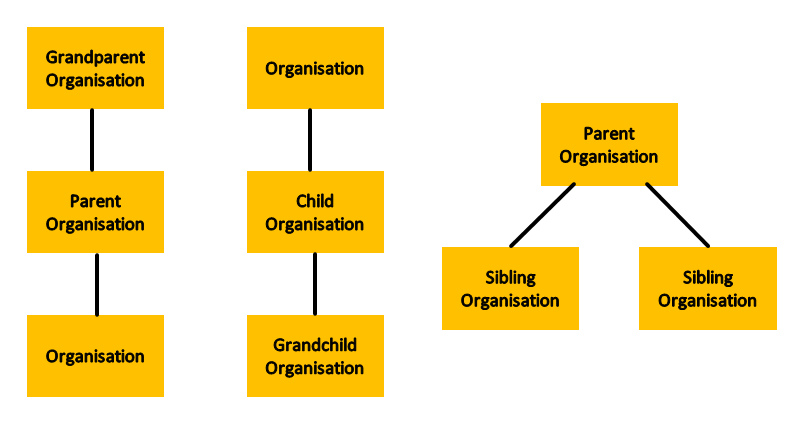
In the case of human society, the holons are individuals and organisations. Individuals are components of organisations, organisations are components of parent organisations, parent organisations are components of grandparent ones, and so on.

Figure – Family relationships between organisations in a hierarchy

As we progress downwards through this hierarchy of organisations, functional differentiation takes place. That is, the function or purpose of an organisation is broken down into the interacting component functions of child organisations. Alternatively, component functions can be carried out by other unrelated organisations through a process of trade.

Simplifying Social Complexity

In a stable society, functional differentiation naturally increases with time, and alongside it, social complexity. Up to a point, the efficiency with which any overall function is carried out also increases. However, there may be an optimum beyond which efficiency begins to decline.

If a system is complex and comprises too many components and relationships for the human mind to comprehend, then we attempt to simplify it. We do so by seeking fewer larger holons that bundle together components into recurring and recognisable patterns. Fortunately, society is structured in a way that makes it easy for us to find such holons. If we were, for example, to attempt to understand and predict the future of a nation by considering the relationships between individual citizens, then complexity would be so great that we would be unlikely to make progress. However, individual citizens form part of organisations such as sectors. If these sectors are taken as our holons and the relationships between them considered, then a far less complex model results.

In fact, this is what we do in practice. Furthermore, it is very likely that we structure society in this way to better enable us to understand it. For example, the field of international affairs uses nations as its holons, political science uses sectors, management theory organisations within parent organisations, and social psychology individuals. We do this intuitively, rather than as a consequence of any formal systems theory. However, the fact that social systems theory predicts what takes place in practice is strong support for the former’s validity.

Categories
06. Behaviour is a System

Behaviour is a System

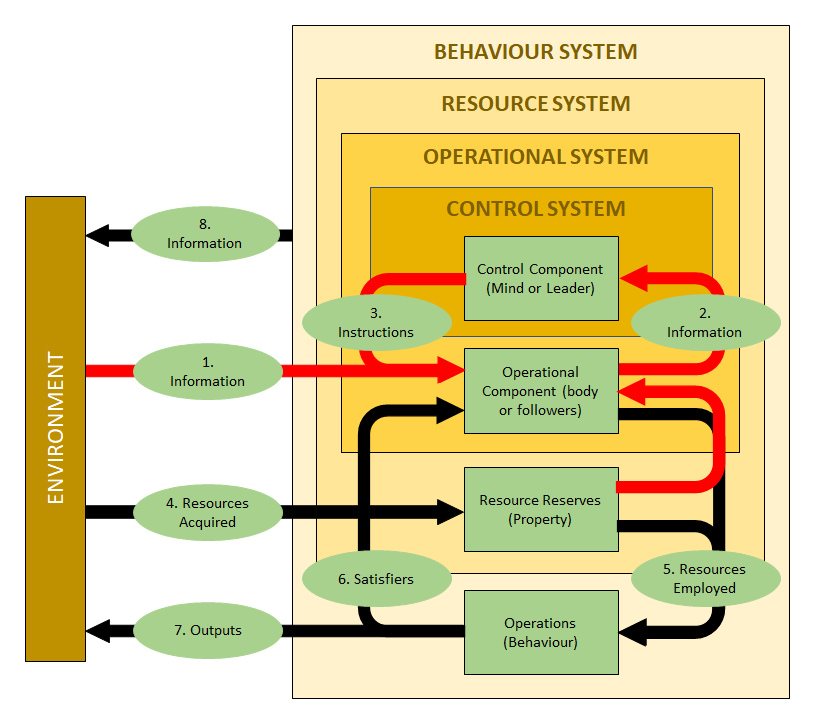
Human behaviour, whether that of an individual or that of a larger organisation, is a process. So, together with its inputs and outputs, it can be regarded as a system. The diagram below describes this system.

The behaviour system is part of a nested hierarchy comprising other systems. They are arranged as follows. The control component, in the case of an individual, is his mind, and in the case of a larger organisation, its leader. Together, the mental and physical resources that they directly control, i.e., the body of an individual or the people in a larger organisation, comprise the operational system. The operational system, together with the resources that it owns, comprise the resource system. Finally, the behaviour system comprises the resource system plus actual behaviour.

These systems operate in the following way. Paragraph numbers refer to those in the diagram.

  1. The environment comprises everything that is not a part of the system. It includes both the natural and the social environments. Inputs from the environment enter via the operational component. These inputs include risks and opportunities. The relevant parts of the operational component are, in the case of an individual, his physical senses, or in the case of a larger organisation particular individuals. For example, an individual may perceive a wasp as a threat of injury, or a government may see another nation as an opportunity for trade.
  2. Information from the environment is passed from the operational component to the control component, i.e., the mind or leader, where decisions are made. The operational component monitors the state of resources and satisfiers, i.e., those things that satisfy the individual or organisation’s needs. It also passes this information to the control component. For example, an individual may recognise that food in the refrigerator is running low, or a business that its stock of spare parts is too high.
  3. In return for this information, the control component makes decisions, and then, passes instructions to the operational component. These instructions are based on a risk, cost, benefit analysis that uses the value of satisfiers or contra-satisfiers and the resources required to create them. The value allocated to a satisfier or contra-satisfier depends on the interaction style of the individual or leader, i.e., whether they are co-operative, positively competitive, or negatively competitive. A negatively competitive individual may conclude that shoplifting is the way to fill their refrigerator. A government with a co-operative style may see a trading alliance as the way to improve their economy.
  4. Resources are acquired from the environment and become part of the resource reserves of the system, i.e., its property. They can be matter, energy or money. Resources can be acquired directly from the natural environment, or through trade with other individuals or organisations. Early humans were hunter-gatherers and acquired their food directly from nature. Today, however, many of us buy our bread from a baker or supermarket.
  5. The activities of the operational component, together with resources taken from reserves, act as inputs to the operations process. These inputs are satisfiers for the process. The operations process converts these resources into outputs. So, for example, an individual may cook the food in their refrigerator to create a meal. A business may assemble parts, or mix constituents, to create a sellable product.
  6. Some of these outputs are satisfiers for the operational component. We may, for example, eat part of the meal we have prepared to satisfy our personal need for sustenance. Similarly, governments and businesses pay the people who carry out their function.
  7. Other outputs can be satisfiers or contra-satisfiers that are used to trade for resources from other individuals or organisations. So, we may trade our labour for pay or provide a meal to friends in return for their friendship. Businesses do, of course, provide goods and services in return for payment. Alternatively, outputs can be operations on the natural environment to acquire resources, e.g., mining, hunting, or gathering. All behavioural outputs are constrained by the physical resources available, for example, an individual’s physical abilities. They are also constrained by the operational resources owned, for example, the financial capital of a business.
  8. Finally, behaviour can be observed, and so, the system of which it is a part outputs information to the environment. We can, for example, watch a football match or observe government activities, and thus, criticise them.

Organisations are recursive. Every organisation comprises several lesser ones. Every organisation, together with others, is also part of a larger one. This recursion continues downwards to individuals and upwards to all of humanity. This model describes the behaviour of every individual or organisation in that structure. So, it may provide the basis for a systems psychology of both individuals and organisations. Notably, it provides a basis for social learning theory which postulates that we emulate role models, that our behaviour is reinforced by the approval of others, i.e., satisfiers, and extinguished by their disapproval, i.e., contra-satisfiers.

The model may also be a basis for dynamic models of society, thereby enabling predictions to be made.

Categories
05. A Summary of Social Systems Theory

A Summary of Social Systems Theory

In this short series of articles, I will summarise the basic principles of Social Systems Theory. Full details are given in previous or subsequent articles.

The fundamental component of society or holon

The term holon was coined by Arthur Koestler in his 1967 book, The Ghost in The Machine. It refers to any entity that can be recognised as a whole in itself and which constitutes part of a larger whole. In social systems theory the fundamental component or holon of society is the organisation, that is, any group of people who work together with a common purpose. Organisations can be of any type and can range in size and extent from an individual, through clubs, businesses, sectors, political parties, governments, nations, and groups of nations, to the global community.

Family relationships between organisations

All organisations form a nested hierarchy. The structural relationships between them are similar to those in a family and the same names can be used. Thus, for example, child organisations are components of a parent one, and parent organisations are components of a grandparent one. Two organisations that are components of the same parent are known as sibling organisations. This nested hierarchy continues upwards until an isolated organisation or the global community is reached.

Every organisation comprises a number of component or child organisations, and this nested hierarchy continues downwards until individual people are reached.

Recursion

Recursion means that similar rules and principles can explain the behaviour of organisations irrespective of their size. Thus, for example, a department in a government agency has a leader, and so too does the entire agency.

The control component

All organisations have a control component, e.g., leadership or management, to co-ordinate their activities. Due to recursion, control components have their own control components until we arrive at the individual person. This creates a leadership or management hierarchy comprising individuals. It is natural to select leaders using a bottom-up process, i.e., followers choose a leader thought to be best qualified to co-ordinate their activities. However, managers are also frequently chosen by a top-down process whereby senior managers select junior ones thought to be best suited to the role.

Needs, satisfiers, and contra-satisfiers

All organisations have needs similar to those of individuals. These needs are prioritised using the same categories for individuals identified by Abraham Maslow and Clayton Alderfer, i.e., ERG or existence, followed by relatedness, in particular family relatedness, followed by growth. These priorities are consistent with the multilevel selection theory of evolution. This holds that we place greatest weight on personal survival and reproduction, followed by that of the community upon which we depend, followed by people more remote.

Satisfiers are those external things that increase the level of satisfaction of our needs, for example, food for hunger, or resources for manufacturing. Both individuals and larger organisations endeavour to gain satisfiers as efficiently as possible. Contra-satisfiers, on the other hand, are those external things that reduce the level of satisfaction of our needs and which we endeavour to avoid.

The applicability of systems science, function, and causality to organisations

All organisations are systems and comprise inputs, processes, and outputs. The fundamental principles of systems science apply to them, therefore.

Causality also applies to organisations. The combination of an input and the process is equivalent to a cause. The combination of the process and an output is equivalent to an effect. An organisation’s processes and outputs are also referred to as its function. Because causality applies to organisations we can, for example, say that a number of necessary causes or inputs are together sufficient for an effect in which the organisation carries out its function of producing outputs.

Matter, energy, or information is transferred from every organisation’s inputs to its outputs. This takes place within the region of space-time defined by the organisation’s process. Thus, the latter provides the overlap in space-time needed for a cause to be related to an effect.

All organisations comprise a group of people who work together with a common purpose. This purpose is also the organisation’s function, and the ability to carry out its function is an organisational need.

The applicability of motivation theory to organisations

All interactions between individuals, organisations, and parts of them comprise an exchange of satisfiers or contra-satisfiers for each other’s needs. These satisfiers and contra-satisfiers also take the form of matter, energy, or information. A satisfier or contra-satisfier received is an input, and one provided is an output. Thus, motivation theory also plays a key role in social systems theory.

The applicability of information theory to organisations

Information passes between organisations and flows within any organisation’s processes. Thus, information theory plays an essential role in social systems theory. Fundamentally, information is organised or structured matter or energy that we recognise due to its recurrence. It can exist “at source”, i.e., as the original structure perceived in the physical universe. It can also be translated into various symbolic forms capable of being transmitted, stored, or remembered. Importantly, information at source is, by definition, always true. However, information acquired in other ways, for example, from another organisation, can be false.

Direct interaction can only take place if two organisations are aware of one another, and for this to be the case, information must pass between them. However, organisations can be aware of one another but not interact. These criteria simplify the web of interactions in a social system.

Culture & interaction style

The ways in which individuals and organisations interact are determined by their culture and interaction style. These topics will be covered in a forthcoming article.

Categories
04. Self-interest vs. Collective Interest

Self-interest vs. Collective Interest

It is human nature to balance self-interest with community interest. So, all leaders will, to some extent, act in their own self-interest. However, if the balance swings too far in that direction, then the leader will usurp the function of the organisation to the detriment of other stakeholders, such as employees or customers, and it will fail.

The exact balance struck between self-interest and collective interest depends on the personality of the leader. Aspects of personality that can cause leaders to lean towards self-interest include dominance, the habitual pursuit of power and a weak conscience or super-ego.

In their 2016 paper, Dominance and Prestige: Dual Strategies for Navigating Social Hierarchies, Maner and Case state the following. “The motivations that drive people to attain social rank thus play a profound role in guiding their leadership behavior and the extent to which they prioritize the goals of the group over their own social rank.” They also state that “Several studies suggest that leaders high in dominance motivation—those who seek to attain social rank through the use of coercion and intimidation—selfishly prioritize their social rank over the well-being of the group.…Leaders high in prestige motivation, on the other hand, are motivated primarily by the desire for respect and admiration.” https://www.sciencedirect.com/science/article/pii/S0065260116300144

Some leaders can fully internalise the pursuit and defence of power. It becomes a habitual and unconscious form of behaviour that persists as a need in its own right.

It is easier to climb an existing hierarchy than to create a new one with oneself at the pinnacle. This is not a universal rule, of course, and there are, for example, self-interested leaders who have built empires from a silver spoon passed on by their parents. Nevertheless, once established, an organisation can attract individuals who seek power to satisfy their own personal objectives, for example wealth, fame, or influence.

In the competition to ascend a hierarchy, individuals who are relatively unconstrained by ethical considerations, or are willing to use negative competition, or who have learnt the “rules of the game” have an advantage over others. Thus, they often take control of and corrupt organisations that may have been set up with the best of intentions. There are three personality types that are a particular risk: the psychopath, the narcissist, and the dark empath. They will be discussed in more detail in future articles.

The concentration of power, i.e., the ability to direct resources for the satisfaction of a particular need, in the hands of a few seems to be the greatest source of misery, poverty, and injustice in the world. To cite just one example, the German philosopher, Immanuel Kant, argued that democracies are less likely to go to war than absolutist states, i.e., states where power is concentrated in the hands of the ruler. In a truly democratic state, leaders require the support of the population if they are to engage in war. The population will, of course, weigh up the advantages and disadvantages to themselves before giving their support. Consider, for example, the popular opposition in the USA to the Vietnam war and, in the UK, to the invasion of Iraq. In an absolutist state, on the other hand, only the advantages and disadvantages for the ruler are taken into consideration and the suffering of the population has little or no bearing on the decision. An example is Russia’s invasion of Ukraine. Essentially, the decision is a risk/benefit/cost calculation, and rulers frequently have far more to gain than their population. This is, of course, just one example on an international scale, but similar issues exist in all walks of life and at all scales. So, if we wish to tackle poverty, strife, and injustice in the world, then we must tackle its root cause, the concentration of unregulated power in the hands of a few.

Reference: Maner, J.K. and Case, C.R. 2016. “Chapter 3 – Dominance and Prestige: Dual Strategies for Navigating Social Hierarchies, Advances in Experimental Social Psychology”, Volume 54, Pages 129-180, ISSN 0065-2601, ISBN 9780128047385, https://doi.org/10.1016/bs.aesp.2016.02.001. https://www.sciencedirect.com/science/article/pii/S0065260116300144

Categories
03. The Failure of Control Systems

The Failure of Control Systems

Introduction

Control systems are a property that emerges with life. They do not appear in non-living things, except those created by mankind. Control systems co-ordinate the activities of the various specialised parts of an organism, or group of organisms, towards a common goal. However, because all systems comprise sub-systems, and those sub-systems, in turn, have control systems, there is a control hierarchy.

Due to the VUCA nature of the world, control systems must delegate if they are to be effective. If they do so, this enables the organism or group to deal with complexity. The information on which decisions are made is progressively simplified as it ascends the control hierarchy. Conversely, as instructions descend, the components of the organism or group increasingly interpret it.

If all decisions are centralised, then the larger the system, the less and more simplified the information on which a decision is based, and the greater the risk of error. Furthermore, as explained in a previous article, if decisions are made by trial and error, then only a single decision occurs rather than several. So, there is less likelihood of decisions being successful and of the system learning from its successes and failures.

In the case of human organisations, the control systems are management or government hierarchies. If there is no control system, then there is no organisation. So, the collapse of businesses, civilisations and nations is often due to the collapse of their managing or governing system. For example, an effective centralised state is necessary for a successful economy. It provides order, laws, mechanisms for resolving disputes, and basic public goods and services. Failed states, such as South Sudan and Somalia, have no central organisation or one which has no influence outside of the nation’s capital.

The Social Contract vs. The Personal Contract

The concept of the social contract is an ancient one. It was first described in the Greek philosopher Plato’s “Republic” in about 375 BC. The social contract is an explanation of the relationship between leaders and the led. In 1762, the French philosopher, Jean-Jaques Rousseau interpreted this relationship as one in which individuals are willing to give up some of their rights in the collective interest. They will, therefore, follow the instructions of a leader who acts in that collective interest.

On the other hand, as explained in previous articles, leaders can rise to power by delegating  benefits, such as power, wealth or status, to followers who support them. Leaders then use that support to gain benefits for themselves. This is a form of personal contract and is often how a leadership hierarchy develops.

In practical human affairs, there is an interplay between the social contract and the personal one. The actual motives of both leaders and followers lie somewhere on a scale between the two. The position on the scale varies from individual to individual. An organisation is also subject to this interplay. Individuals and other organisations will interact with it if this benefits them. However, they also expect the organisation to act in the collective interest. Again, the actual motive for interaction lies somewhere on a scale between the two.

Both leader-follower interactions and inter-organisational ones are a manifestation of our eusocial nature. This, in turn, is a consequence of evolution. We have evolved to optimise the satisfaction of our needs by balancing the immediate self-interest of the personal contract with the longer-term self-interest of the social contract. A more central and less extreme position is normally the optimum.

The balance point that defines actual behaviour is a consequence, in the case of individuals, of their personality, and in the case of organisations, of their culture. However, to a very large extent, the culture of an organisation is determined by its leaders, and so, individual personality is again the principal factor.

There is a relationship between the World Values Survey’s survival values and a tendency towards the social contract. For example, those with survival values are described as: tending “to seek strong authoritarian leadership to bind the community together into its survival endeavour”; as having a “tendency towards obedience of leaders”; and as having “a tendency towards conformity to group norms”. Thus, societies of this nature influence their members to favour the social contract. However, there does not appear to be a relationship between the World Values Survey’s self-expression values and either the personal or the social contract. Thus, societies of this nature do not influence their members one way or the other.

Trust is an important factor in deciding which leaders we will follow. We assess whether the leader will deliver on the social contract or personal contract. Trust or distrust is based on experience but can be passed from one individual, group, or generation to the next.

If a leader cannot be trusted to deliver on the social contract, and there is no personal benefit for the follower, then the follower will not support that leader. If there are no leaders who can be trusted to deliver on the social contract, then the best option for a follower is to support one who can be trusted to deliver on the personal contract.

Unfortunately, leaders will often feign a focus on the social contract. This is particularly the case in democracies and pseudo-democracies where popular support is needed. Much effort is put into public relations. A follower can, therefore, find himself following a leader who provides no personal or social benefits. Press scrutiny has an important role to play in challenging such leaders. However, the press can also enter into personal contracts with the leader or be coerced into silence.

The social contract becomes more important as society grows ever more complex, and we become ever more dependent on one another. However, the personal contract is far easier to monitor and many of us have a natural leaning in that direction. In extreme cases it entirely trumps the social contract.

So, to improve leadership and avoid the failure of human organisations, it is necessary for:

a) potential followers to focus on the social contract in deciding which leaders to support and what organisations to interact with; and

b) potential leaders to focus on improving followers’ trust that they will deliver against the social contract.