In this article, I will discuss from a social systems perspective the causes of all types of conflict. This perspective is a very general one and may appear somewhat abstract, therefore. There are many conflicts in the world today and it would be easy to give examples. However, it is also true that we tend to take sides. So, to avoid any suggestion of that, I will leave the reader to apply this general theory to any conflicts that they are aware of.
Firstly, I will define the basic concepts used in this article and describe their significance.
The term holon was coined by Arthur Koestler in his 1967 book, The Ghost in The Machine. It refers to any entity that can be recognised as a whole in itself, and which constitutes part of a larger whole. In social systems theory the fundamental component of society or social holon is any individual or group of people who work together with a common purpose. They can be an organisation of any type, and can range in size and extent from an individual, through clubs, businesses, sectors, political parties, governments, nations, and groups of nations, to the global community.
The genome comprises all genetic information held by an organism. In conjunction with the environment, it determines the physical manifestation of the organism. It also determines the nature of the organism’s needs for existence and procreation.
Culture is also information. It is held in the minds of individuals and, in conjunction with the environment, determines the nature of society. Culture comprises values, norms, beliefs, knowledge, and symbols. Values are those things that we hold good or bad; norms are socially desirable, acceptable, or unacceptable forms of behaviour; and symbols are those things, such as rituals, modes of dress, etc., that indicate our membership of a group.
Function is the common purpose of a group and the reason for its existence. It too is information held in the minds of individuals. This is evidenced by the fact that disagreement about the function of a group is relatively common.
Satisfiers are those external things that increase the level of satisfaction of our needs. Contra-satisfiers, on the other hand, are those things that reduce that level of satisfaction. Satisfiers and contra-satisfiers may be material, energy, or information both true and false. They can also be relationships between social holons. The status of a satisfier or contra-satisfier can be entrenched, precarious, latent, or absent. Entrenched means inextricably present in a situation; precarious means present but not guaranteed in the future; and latent means in the form of a promise or threat. The promise of a satisfier and the threat of a contra-satisfier both play a significant role in human affairs.
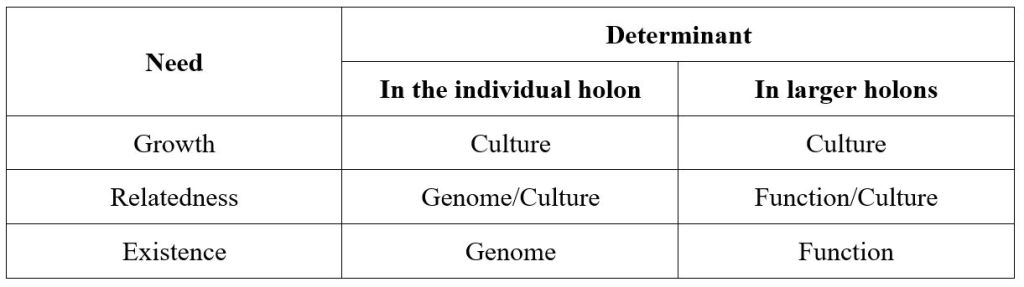
Genome, culture, and function are determinants of the needs of individuals or groups, as described in the table below.
It is often the case that people who have the most in common and who live closest to one another engage in conflict. The explanation for this is as follows.
Suppose we have two social holons, X and Y. The more similar their determinants, the more similar their needs. Individual human beings are, of course, genetically very similar and our existence needs are therefore almost identical. The functions of larger social holons or organisations are more diverse, and it is rarer, but still possible, for two to have identical needs. The relatedness needs of individuals, i.e., how we interact with others, are determined in part by the genome and in part by culture. This is evidenced by the fact that some cultures value the extended family more than others. Again, the relatedness needs of larger social holons are more diverse. They are influenced by a combination of the holon’s function and culture. Finally, the growth needs of both individuals and larger social holons are influenced largely by culture. Growth needs can be very diverse in both cases.
The more alike the needs of X and Y, the more similar the satisfiers of those needs. The more similar those satisfiers and the closer X and Y are geographically, the less likely it is that those satisfiers will be sufficient for both. X and Y then have three options. They can either:
- cooperate to gain greater mutual access to the satisfiers;
- one party can move to another geographical location, so that the satisfiers are sufficient for both; or
- the two parties can compete for the satisfier. It is this that can lead to conflict.
The way in which competition evolves depends on the cultures of the competing parties. This is determined in large part by their leadership. Leaders’ attitudes lie on a scale from entirely selfish to entirely selfless. This is influenced by their personality traits. Greater empathy leads to greater selflessness. Dark traits, such as those held by narcissists, psychopaths and Machiavellians, lead to greater selfishness. The more selfish a group the more likely it is to regard the other as a potential threat or contra-satisfier.
A group’s culture is also determined by the social transmission of information and the reinforcement of beliefs by socialisation, i.e., reward for compliance and censure for non-compliance. This information exists on at least three levels, each building on the information in the one below:
Level 1. Whether or not a threat or contra-satisfier can be physically observed. This information is normally true, although it is possible to misinterpret observed events.
Level 2. Beliefs about the existence or otherwise of a Level 1 threat, as passed from one individual to another. This information can be true or false. It is not uncommon for people to propagate false information in their self-interest. It is also not uncommon for ideologies to be based on false information.
Level 3. Beliefs about Level 2 beliefs and their effect on a culture. For example, concerns about false beliefs propagated by an ideology.
These two factors, i.e., the selfishness or selflessness of a culture and its beliefs about any threat posed by the other party, affect the likelihood of competition becoming conflict. The more selfish the individual or group and the stronger their belief about the threat posed by a competitor, the more likely it is that they will behave in a way that causes a contra-satisfier or threat to that competitor. Conversely, the more selfless a group and the weaker their belief in any threat posed by the other party, the less likely they are to behave in that way.
Once one party, physically imposes a contra-satisfier on the other, then the threat perceived by the other party becomes real. They will often reciprocate, and conflict will ensue. Unless there are controls, external or otherwise, a feedback process will occur in which the contra-satisfiers that the two parties impose on one another escalate until the conflict becomes violent.
It can be seen from the above description that there are many ways in which either party, or a third one, can intervene to prevent conflict. This does, of course, require an understanding of the processes involved, and intervention at an early stage before violence becomes inevitable and unpreventable. Unfortunately, it is also the case that parties can intervene to make conflict more likely, and those with beneficial intent must be cognisant of that too.
 Rational-Understanding.com