Categories
16. Polyperspectivism: Using Multiple Perspectives for a More Comprehensive Understanding of Reality

Exploring Poly-Perspectivism: Using Multiple Perspectives for a More Comprehensive Understanding of Reality

I was pleased to present my paper “Exploring Poly-Perspectivism: Using Multiple Perspectives for a More Comprehensive Understanding of Reality” at the ISSS 2025 Conference.

The work explores how we can engage with diverse perspectives more productively without collapsing them into a single truth or drifting into relativism. It introduces a new meta-framework that evaluates perspectives by the human needs they satisfy or the harms they help prevent, offering a human-centred complement to systems science.

If you’re interested in interdisciplinary collaboration, epistemic coordination, or the cognitive dynamics behind complex decision-making, this work may be of interest. You can download the following:

  • The full paper
  • A glossary of key terms
  • A list of key propositions
  • Guidance on overcoming personal blind spots
  • A summary of Motivated Symbolic Interpretation Theory
  • A summary of the Reflexive meta-Framework
  • The presentation slides
  • Speaking notes

From https://rational-understanding.com/my-books#polyperspectivism

I’d welcome feedback, collaboration, or questions. Feel free to get in touch.

Categories
07. A Conceptual Farmework for General System Theor

A Conceptual Framework for General System Theory

Introduction

This article proposes a single deep conceptual framework that unifies many of the concepts of systems theory, such as systems, holons, holism, relationships, emergence, causality, isomorphisms, etc. This framework may form the basis of a general system theory. Some of its definitions may seem obvious, but I have included them for the avoidance of doubt and to paint a complete picture.

Conceptual Frameworks

There are two ways to define a word. The first is by reference to observed reality. For example, we can all agree on the definition of the word “snake” because we can observe a snake in the external physical world. However, there is less agreement over more abstract words such as “justice” and “conflict”. This is because we are unable to observe all instances of those concepts. To overcome the latter problem, we attempt to define the word, but in doing so, we must use other words.

A conceptual framework is essentially a set of definitions of more abstract words that is internally consistent and founded on axiomatic words, i.e., words that are not defined and are taken as being self-evident. A conceptual framework comprises our understanding of the words and the universe that they represent. We all hold conceptual frameworks. However, they vary greatly in their depth and nature. The deeper a framework, the more fundamental and general the words it defines. For example, the word “relationship” is deep and has broad application, whilst “unhappiness” is far less so, applying only to human beings and some animals in a particular state.

The development of any theory first requires a conceptual framework. To use an analogy from physics, the absence of a framework is equivalent to attempting to build a structure with gas. On the other hand, if we do have a framework, then we are building with a solid. Furthermore, if more than one person is developing a theory, they will need to agree a single framework if they are to communicate successfully. It is OK to consider different perspectives, but ultimately, they must be drawn together into a single consistent whole. In the case of general system theory, we are attempting to develop a very general theory indeed. So, we need to ensure that the framework is as deep as we can make it.

The absence of a common framework can be seen on the internet. Authors do have their own conceptual frameworks of course, but rarely are they explained, and their number can be overwhelming. Furthermore, there is clearly competition between them for more general acceptance. So, the motives of their proponents must also be questioned. Finally, their depth is rarely great, and so, the theories that they underpin can be quite specific rather than general. To unify these frameworks, much effort would be required in drawing them together and analysing them for a deeper one that applies to most.

Cognitive Physicalist Philosophy

My proposed deep framework is founded on Cognitive Physicalist philosophy. The physicalist aspect of this philosophy holds that everything, including objects, abstract concepts, and information, is physical in nature and occupies a region or regions of space-time. The cognitive aspect recognises that human beings have limited perception and cognition. Because the universe of space-time is probably infinite, to understand and explain it we must simplify it. So, physicalism enables us to establish a single conceptual framework, but cognition limits our understanding and perception.

Spiritualism

Many people believe that there is also a spiritual aspect to nature, and so, reject physicalism. However, the source of our spiritual beliefs is probably an unconscious sense that we use emotion in our decision-making processes. It is certainly true that we rely heavily on the unconscious mind and on emotion when making our decisions. This is something that we have inherited from simpler organisms and that evolution has built upon. In the absence of a rational scientific explanation for the process, it can take on a mystical flavour, and can seem to be an alternative to our other skill, conscious rationality. In practice, from an evolutionary perspective, emotion-based decision-making is entirely reasonable, and the emotional and rational aspects of our minds work hand-in-hand to our benefit.

The Importance of true axioms

Over 25 years ago, I became very frustrated with conventional symbolic logic. It comprises numerous disparate branches and a plethora of different symbolisms that create much confusion. So, I embarked on a project to join up the various branches using a single common symbolism. Not only was I successful in unifying these branches, but also in including both natural language and mathematics. However, what was originally intended to be a five-year project turned out to be a twenty-three year one.

There were two main outputs from this project of significance for systems theory. Firstly, part of the project involved the axiomatization of logic, i.e. the identification of a number of self-evident but unprovable truths on which all of the remaining theory can be based. It was necessary that these axioms provide an explanation for all generally accepted laws of logic. As I unified the different branches, I found that many of the axioms for a traditional branch of logic, and indeed mathematics, were in fact theorems that could be derived from deeper and more general axioms. Nevertheless, a small number always remained that were particular to a branch and distinguished it from the others.

Secondly, physicalism was the only approach that would provide a single framework. Symbolic logic is almost self-defining. All its theorems arise from the operations of its axioms on themselves. The one and only axiom that might be regarded as not being of logic is the physicalist one.

These concepts can be used when considering a general system theory. Providing they have an empirical basis in reality, two ideas can be likened to two minor branches of a tree. If we are aware only of the branches but not the tree, then the two ideas may appear to contradict one another. However, if we can identify common truths from which both ideas can be explained, then we have identified the larger branch from which the minor ones sprout. That is, we are beginning to perceive the tree. In this analogy the common truths are, temporarily at least, the equivalent of axioms. This process can continue until we reach the trunk of the tree. The more ideas we are able to join up in this way the more likely their common explanation or axiom is to be true.

The truth of an axiom is not guaranteed of course. Many times, I have had to revise axioms that have proven inconsistent with other branches of logic. So, a certain amount of objectivity and persistence is needed. Furthermore, there is no certainty that the tree does ultimately have a trunk, i.e., that there are universal axioms. Bearing this in mind, together with the fact that some axioms are particular to a branch, i.e., are emergent, it seems unlikely that there is a single simple explanation for everything. Nevertheless, we can attempt to find one for those few things that lie within human experience, and this is what my proposed framework attempts to do.

The remainder of this article now describes the framework.

Information

According to physicalism, information is physical in nature. It also appears to be something that only living things and some of our artifacts are capable of recognizing and manipulating. The term information at source refers to the structure of a physical entity. When we see other things with a similar structure we recognise them, i.e., create a mental image of them, for future reference. We also give them a name so that we can pass our knowledge of those things to others. Thus, the original information is translated and communicated. Nevertheless, all of those translations and communications are physical in nature. A mental image is an arrangement of neurons and the way that they fire;  speech comprises patterns of vibration in air; and so on.

However, our perception and information processing abilities are limited. So, in translating and communicating  we simplify; we assume;  we make mistakes; we reject or modify new information that is not consistent with our existing knowledge; and so on. Thus, information can be false.

Holons

Arthur Koestler originally described a holon as being any entity that can be recognised as a whole in itself and which constitutes part of a larger whole. However, for the purpose of this framework, a holon is also an entity that comprises a collection of other holons with relationships between them. Every holon is a system with inputs, processes, and outputs. It is also physical in nature. These definitions are true not only of physical objects, but also, of events and more “abstract” concepts such as justice, conflict, etc.  For example, justice is the set of all just acts.

Holism

The term holism refers to a system having properties that its component parts do not, that is, emergent properties. For the purpose of this framework, a holon is further defined as being something at which a new property first emerges as the complexity of entities increases. Thus, all holons have emergent properties and are holistic.

Relationships

A relationship between two things comprises those things for so long as they are related to one another in a particular way. It also includes whatever is transferred either way in that relationship, whether it be space, matter, raw energy, or information.

Every relationship also has outputs. At least one of these is its appearance, i.e., its information at source. There is a question over whether this appearance is an emergent property, i.e., a property that the relationship has, but that its component parts do not. If so, then all relationships are holons because they have emergent properties. If not, then a relationship is not a holon. For this article I will assume the latter, i.e., that the appearance of an entity is not an emergent property. However, it should be borne in mind that this is an assumption and not necessarily true.

Complexity

The complexity of a relationship or holon can be measured by the number of fundamental particles that it comprises. For the present, at least, we can regard fundamental particles as those identified in the Standard Model of physics.

The more fundamental particles an entity comprises, the more variability there is between entities in the same set. This is because we form sets based on the similarities that we observe between entities. It is a human cognitive act, and we are limited in the amount of complexity that we can manage.  To address this variability we create prototypes, i.e., mental images of a typical member of the set that has only the characteristics we have used to define the set, and none of the variability.

Holon Formation & Chaos

There must be a certain number of relationships between holons before a higher level holon is formed, i.e., before an emergent property other than appearance is encountered. This emergent property can be an output from the holon which in turn can be the basis for relationships between higher level holons.

Between the formation of holons at one level and those at another, the number of relationships increases and may exceed the threshold of our comprehension, thus appearing chaotic.

Abstract Entities

Every relationship or holon is part of a set of similar ones, and this set is itself a relationship or holon. However, because it comprises components that occupy several separate regions of space-time, the set may not be observable in its entirety. This is reflected in natural language. For example, “conflict” comprises several instances of conflict, each of which is “a conflict”. We can perceive several instances of conflict but not “conflict” in its entirety, and so, we may label it an abstract concept. Nevertheless, it is real and physical.

Despite being collected together into a set on the basis of common features, the individual holons or relationships may also have features that are unique to themselves. This presents a communication problem. Each observer, a diplomat and a family counselor, say, will observe a different subset of conflicts, and so, will form a different understanding of the concept. So, when one is discussing the topic with the other misunderstandings are almost inevitable. Worse yet, different observers can give different names to the same thing in different contexts. This can make communication between the two difficult, if not impossible. It can also obscure the fact that they are discussing the same concept.

Causality

Holons or systems have outputs that act as inputs for other holons or systems. This is the same as causality and is reflected in our use of natural language. For example, “conflict” may cause “poverty”, and “a conflict” may cause “an instance of poverty”. It is what is exchanged between the two holons or systems that provides the causal link. Their processes and outputs are causes; their inputs and processes are effects. This transfer is evidenced by the fact that causality cannot propagate at greater than the speed of light. As Hume observed, a cause must be spatially contiguous to its effect and must precede it.

The normal laws of causality apply to these relationships. That is, a cause may be necessary or sufficient for an effect. Also, several necessary causes may only together be sufficient.

One thing that is often overlooked in causality is the existence of inhibitors. That is, those things that prevent an effect. Again, inhibitors can be necessary or sufficient to prevent an effect. Also,  several necessary inhibitors can only together be sufficient to prevent it. This is of importance when it comes to the discussion of living entities, holons, or systems.

Function & Purpose

The function of a holon or system can be regarded as its outputs. However, because these outputs are inputs for other holons or systems, i.e., effects, these effects can also be regarded as the holon or system’s function. The purpose of a non-living entity is the same as its function. However, a living entity with agency can regard its purpose as being what it would like its function to be.

Needs, Satisfiers and Contra-satisfiers

We use different language when referring to living entities, systems or holons. The needs of a living entity are the equivalent of its function. If those needs are not satisfied the entity fails to function. For example, if we lack oxygen we die. The same is true of some of our artifacts. If a factory lacks electricity it ceases to operate. The inputs to living entities and some of our artifacts are satisfiers or contra-satisfiers. A satisfier is something that increases or sustains the level of satisfaction of a living holon or system’s needs or that of an artifact. It is also a necessary cause of the system’s function. A contra-satisfier is something that reduces the level of satisfaction of a system’s needs. In other words, it is an inhibitor.

Isomorphisms

Isomorphic entities are instances of the same set of holons or relationships. That is, entities that have the same arrangement of components and the same causal relationships between them. They can be difficult to recognise because different people observe different subsets of the set, and so, form different understandings of it, and use different words to describe it. To refer to an earlier analogy, isomorphic entities are different minor branches of the same tree. They can only be identified by discovering the same branch from which they sprout.

It is not necessary to use mathematics to identify isomorphisms. Rather a comparison of their function, outputs, and the causal relationships between their components can achieve the same result. It can be challenging, however, to identify what is passed from one holon to another in a causal relationship.

To cite the example of conflict causing poverty, this is in fact an indirect causal relationship brought about by the agents of conflict competing with the impoverished for limited resources. The resulting shortages then act as a contra-satisfier for the latter.

To some extent the difficulties in identifying isomorphisms can be overcome by poly-perspectivism, i.e., understanding the language and opinions of others and seeking a common explanation for those apparently divergent views.
Categories
02. The VUCA Environment

The VUCA Environment

VUCA is a term first coined, in 1987, by the American economists Warren Bennis and Burt Nanus. It refers to the environment as being volatile, uncertain, complex, and ambiguous.

In a volatile environment, the nature of change can quickly alter, and the speed of change can be rapid. The classical example is, of course, stock market prices, but volatility also applies in other social arenas, for example the political arena when a scandal breaks.

In an uncertain environment, events and the outcomes of actions are unpredictable, can come as a surprise, and previous experience may not apply. Weather is an example in which unexpected droughts or deluges of rainfall occur.

Complexity refers to the way in which everything in the environment is causally inter-related. There may be no single cause resulting in a single effect, but rather multiple causes and effects that defy analysis. When situations are complex, a change in one place can have unintended consequences elsewhere. Chaos theory can also apply. For example, a small change in the behaviour of one individual can propagate through a crowd to completely alter its behaviour.

Finally, ambiguity refers to a lack of understanding or a misreading of the situation. Facts are unclear and cause and effect may be confused. This typically applies to the interpretation of historical events. Different historians can give different explanations based on different interpretations of the available information. For example, the two parties in a territorial dispute may both believe that their claim is reasonable due to different historical interpretations.

VUCA is a product not only of our inability to understand complexity and our inability to precisely model it, but also a product of genuine random events at the atomic and sub-atomic level. Examples of the latter are the radioactive decay of atoms and the appearance of virtual particles. Such events interact with the physical universe, and the change that they cause is magnified as it propagates ever more widely.

The VUCA concept can be used as an excuse for inaction and a lack of forward planning. However, the advantage of accepting it as reality is that we can better identify the risks associated with our actions and have measures ready if things do not go as we had hoped.

Unfortunately, we have an optimism bias and often underestimate the difficulties and risks involved in a project or enterprise. This is particularly the case when promoting a pet project to others. However, on the other hand, a greater awareness of the VUCA nature of reality can lead to a greater understanding of the knowns and unknowns in a situation. It also leads to the identification of potential surprises, and, where appropriate, trigger action to clarify any critical unknowns. Finally, it can lead to a better understanding of the potential threats and opportunities in a situation, and, where appropriate, lead to the planning of measures to avoid those threats or seize those opportunities.

A good understanding of an organisation’s vulnerabilities will enable it to plan resilience measures which limit damage in the face of the unexpected. A good understanding of an organisation’s objectives will better enable it to seize opportunities should they arise.

Clearly, this requires an organisation to be agile, flexible, and adaptable in the face of the unexpected. It also requires it to have a range of interventions, mitigation measures, plans B and C, etc., available should a change of direction become necessary. Finally, it requires the organisation to carefully monitor situations and the outcomes of its decisions.

This also applies to us as individuals. For example: we insure our homes, cars and holidays against the unexpected; we wear safety equipment when playing sports; we maintain cash reserves in the bank to see us through difficult times; and so on.

In the absence of such measures and in a VUCA world, organisations will inevitably run into difficulties and ultimately fail. A failure to recognise the VUCA world is one of the main reasons why government projects so often fail. In 2017, PricewaterhouseCoopers AG of Switzerland investigated the reasons for this. They produced a report entitled “Are public projects doomed to failure from the start?”. They found that the complexity of such projects was often underestimated, and an overoptimistic attitude would prevail. In practice, however, the political, organisational, and technical complexity of a project could render it unmanageable. They also found that deadlines were often set for political reasons, and political agendas could lead to an unwillingness to abandon projects that no longer fitted the business case. Furthermore, it was often the case that many different organisations would need to co-operate, but their IT systems differed, and they could resist the necessary changes to their practices. PricewaterhouseCoopers did, however, find that with proper management and diligence none of these factors were insurmountable.

Similar problems arise with government policy interventions. Like everyone else, the ability of politicians to understand complexity is limited. So, in practice the process of intervention is one of innovation, trial, and error. In other arenas there may be many actors some of whom will succeed and others of whom will fail, so trial and error is acceptable. However, government differs from the rest of society in that it is the sole actor and there is just one trial. Unfortunately, it is usually inexpedient for a politician to admit to error. So, government error is often only corrected when the opposition takes power.

On the positive side, many Western governments are now recognising the VUCA world and putting measures in place to better manage their function in its light. Recent guidance on managing complexity in the UK can be found at https://www.gov.uk/government/publications/systems-thinking-for-civil-servants

Categories
18. Social Systems Theory in Practice - An Example (Part 2)

Social Systems Theory in Practice – An Example (Part2)

Formalisation

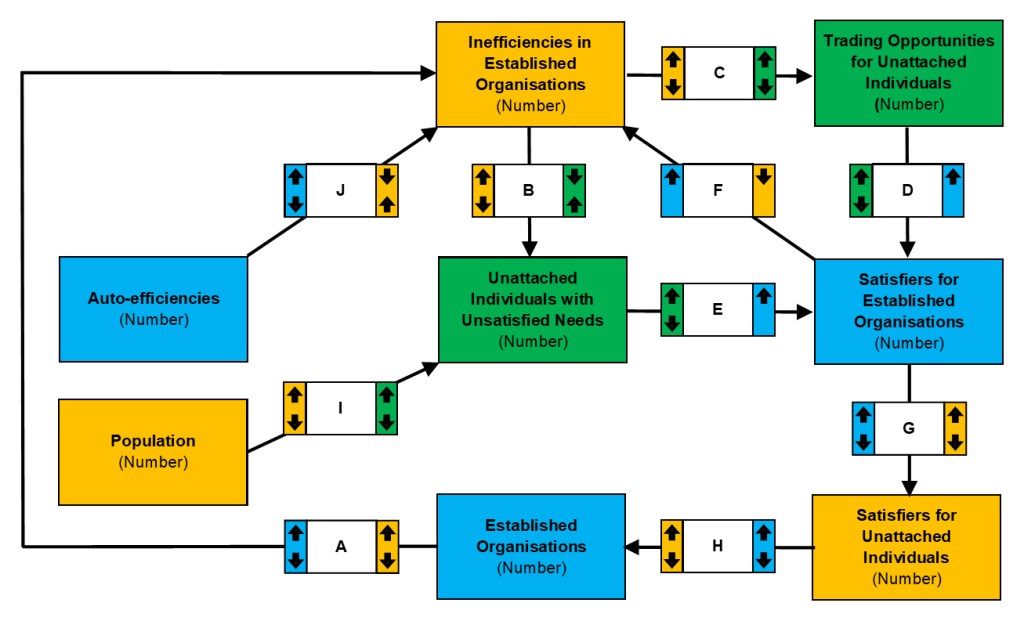
The example described in my previous post can be described graphically and, potentially, a mathematical or computer model can be created. A diagrammatic representation of the example is given in the figure below.

Figure 1. Causal diagram showing increasing complexity in Western society.

In this diagram, the coloured rectangles represent a society’s variable characteristics. These characteristics have numerical values that alter with time and can be related to one another mathematically. The variable characteristics interact causally as shown by the arrows, which point from cause to effect. In this diagram, all the arrows show the cause as being sufficient for the effect. If several sufficient causes impact on one effect, then their effect is cumulative. However, by joining arrows together after they have left their causes, it is possible to represent several necessary causes as, together, being sufficient for an effect.

The smaller rectangles describe the nature of the causal relationship. A small up arrow indicates an increase in the variable characteristic. A small down arrow indicates a decrease. The coloured background indicates whether the small arrow refers to the cause or to the effect. Small arrows are paired horizontally. In rectangle B, for example, an increase in the cause results in a decrease in the effect.

The diagram can be explained as follows.

A. As the number of established organisations increases, so too does the total number of inefficiencies. The reverse is also true.

B. As the number of inefficiencies decreases, the number of unattached individuals with unsatisfied needs increases. The reverse is also true.

I. The number of unattached individuals also increases as the population increases. The reverse is also true. Note that population growth is the number of people entering society due to births and immigration, less the number of people leaving it due to deaths and emigration. However, not all of the population is active.

C. As the number of inefficiencies increases, the number of trading opportunities for unattached individuals also increases. The reverse is also true.

D & E. As the number of trading opportunities and the number of unattached individuals increases, the number of goods and services that can reduce inefficiency in established organisations also increases. However, the reverse is not true. A decrease in the number of trading opportunities or a decrease in the number of unattached individuals has no effect.

F. As the number of goods and services provided increases, the number of inefficiencies decreases.

J. The number of inefficiencies also reduces because of efficiencies carried out by the organisations themselves, i.e., auto-efficiencies. The reverse is also true, and organisations can cause greater inefficiency in many ways.

G. As the number of goods and services provided increases, the satisfiers received in return also increase. The reverse is also true.

H. As the number of satisfiers received increases, the number of established organisations increases. The reverse is also true.

It can be seen from this diagram that the process is a positive feedback loop. With no constraints, the number of established organisations, and thus, the complexity of society can increase exponentially. However, the minor feedback loop BEF can have a damping effect if there is insufficient population growth.

There are many other examples that would benefit from the same approach. However, they may not be independent of this model, but rather may interact with and extend it. The more examples we consider, the more questions this will raise. If common questions arise from different examples, then this may be an indication of their significance. Answers to some of these common questions may be beneficial in all cases. However, it is also possible that they will be beneficial in some and harmful in others. This is not a bad thing, however, because it would prevent ill-considered decisions, and encourage us to seek optimal solutions.

Categories
17. Social Systems Theory in Practice - An Example (Part 1)

Social Systems Theory in Practice – An Example (Part1)

Introduction

The term “Social Systems Theory” is normally used to describe the work of the German social theorist Niklas Luhmann. However, the theory described here differs from Luhmann’s in several ways. In particular, the physicalist perspective holds that everything, including information, exists physically in space-time. This implies that the knowledge of an organisation lies in the neural connections that make up the minds of its members. Thus, contrary to Luhmann’s theory, those members must also be a part of the organisation.

Intuitively, many of us sense that there are intangible “forces” that are beyond our individual control and that shape our society. In this article, I draw together the information provided in my previous articles on evolution, psychology, organisations, and systems theory, to show that these intangible “forces” are, in fact, tangible processes. These processes provide an understanding of why society is as it is. To a limited extent, the processes also provide an understanding of where society is heading unless we intervene.

The social systems theory presented here is not a general theory of society. Rather it comprises an understanding of both human and systems behaviour that can be applied in different social contexts. The explanations that it provides will differ for different cultures and in different eras. Nevertheless, the approach has substantial potential value.

Example

To demonstrate the theory, I have chosen an example from the present-day Western world. The example provides an explanation of why the complexity of our society is increasing at an accelerating rate. Inevitably, this explanation raises many questions about where the process is heading, whether intervention is necessary, and, if so, what it should be. Some of these questions are considered at the end of this section.

Western society comprises many interacting organisations whose number increases day by day. Here the term “organisation” is generic. It includes any group of people who work together for a common purpose. It also includes any individual person. For example, an organisation’s function may be fishing, hunting, steelmaking, takeaway meals, or government. For a new organisation to form, a group of people must share a common need and perceive an opportunity to satisfy it by working together. Alternatively, they can share a common contra-need and perceive a way of avoiding it by working together.

In early simple societies, satisfiers for our needs were taken directly from the natural environment, for example, hunting, fishing, the gathering of vegetables, firewood, etc. To acquire these satisfiers, we formed groups or “organisations” under the leadership of experts. Other groups remained in camp to care for young children. As the size of the tribe increased, specialisation began, and some individuals spent most of their time on a particular activity. Thus, trading between specialist groups became necessary, for example, fish for childcare.

In present day Western society, few people can take their satisfiers directly from the environment. We all trade with others to satisfy our needs, and this is often in the form of employment by an organisation. Even farmers and miners need the goods and services provided by others to carry out their function.

This situation has arisen because of a positive feedback process which continues to this day. Because the process is cyclical and it is impossible to say what stage came first, I could begin its description at any point. So, beginning with increasing organisational efficiency, the process is as follows.

  • As the efficiency of an existing organisation increases, fewer people are required to carry out its function. The same is true of an individual, but efficiencies release the individual’s time.
  • However, these unattached individuals must still satisfy their needs and are usually unable to do so directly from the natural environment. So, they will seek opportunities to satisfy their needs by trading with established organisations. To that end, the unattached individuals will identify the needs of the established organisations. These needs may be goods or services that established organisations lack, or it may be aspects of the established organisations’ functions that could be carried out more efficiently.
  • If a group of unattached individuals share a common interest in providing goods, services, or efficiencies, then to do so more effectively they may form a new organisation and take on employees.
  • Not all new organisations are successful. The process is one of trial and error, and so, it is evolutionary.
  • The new organisation becomes established if it achieves its objective of trading with existing established organisations. This includes trading with individuals. Any efficiency that the new organisation provides results in the release of more people. Successful trading also satisfies the needs of the new organisation’s members.
  • Finally, the cycle is repeated with the new organisation as an established one.
  • Thus, the number of organisations in a society and the complexity of their interactions grows as time progresses.
  • Without any constraints, this growth would be exponential. However, constraints do exist, some of which are described below.

One constraint is the number of unattached people available to form new organisations. In a subsistence society there are none because everyone is fully engaged in satisfying their basic needs. So, the process may never begin without external intervention such as investment. In Western society, the growth of complexity initially relied on rapid population growth during the industrial revolution. This growth has now slowed to zero, and the release of people from established organisations through increased efficiency drives the process. An additional driver is immigration. However, for unattached people to be effective in forming new organisations, support and retraining is needed. Failing that, many may find themselves unable to satisfy their basic needs without turning to crime or other anti-social activities.

The constraints of natural resources and the problems they cause are well known. The latter include global warming, pollution, and the extinction of species. Although these issues are of enormous importance, I will not repeat here what has already been expressed very eloquently by others.

Our ability to understand complexity may also be a constraint. The more organisations there are, and the more diverse their function, the more complex society becomes. There are limits to the level of complexity that we can comprehend, and this has implications for government, the population, and crime. Can this increasing complexity be managed through technological advances? If not, then at what stage will national governments be incapable of governing effectively? At what stage will decentralisation become desirable? At what stage will citizens cease to be effective members of society and form a counterculture? At what stage will citizens begin to seek simple solutions, and at what stage will populist politicians begin to offer them?

As can be seen, the application of social systems theory to an issue raises many unanswered questions. However, it does begin to identify those that need to be addressed for the wellbeing of humanity and our environment.