Categories
07. Functional Differentiation

Functional Differentiation

In sociology, the term “functional differentiation” describes progressive specialisation within a society. This concept has long been well understood, but was brought to prominence by the American sociologist, Talcott Parsons, and the German one, Niklas Luhmann. Functional differentiation is a major contributor to increasing social complexity, and a feature of Western society today. When a society is relatively stable, ever-increasing knowledge and population leads to ever more specialisation, and organisations to carry out specialised activities. Up to a point, functional differentiation generally leads to increased efficiency, and is therefore beneficial to society. Unfortunately, however, it also leads to increasing communication distances, and thus, an increased risk of miscommunication. It also leads to ever more complex functional dependencies, i.e., reliance on a greater number of other organisations for the inputs needed to carry out one’s own function. This leads to an increasing risk of organisational failure. Functional differentiation can also lead to a reduced understanding of the roles of others, and thus, to potential conflict, and potential failure of the parent organisation. Finally, as will be discussed a future article, it can lead to an increasing risk of mental ill-health.

So, unless these disbenefits can be reduced, by for example improving information technology, there may be an optimum level of functional differentiation beyond which the benefits begin to decline.

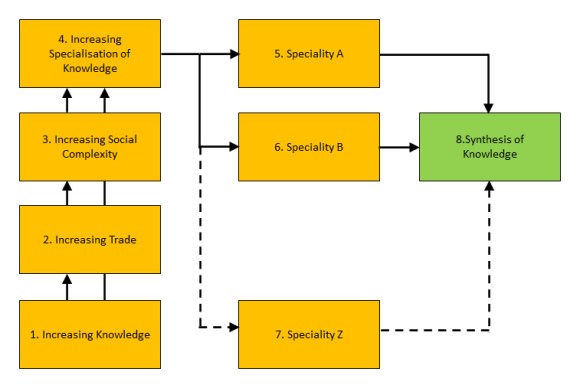
The academic sector provides an example of functional differentiation. This is summarised in the diagram below.

Our increasing knowledge has led to an increasing number of goods and services, and thus, to greater trade. This, in turn, has led to increasing social complexity which, alongside greater knowledge, has led to the formation of academic silos. Specialists now share knowledge mainly only with other specialists in the same discipline. There is a relative lack of cross-disciplinary sharing. This has developed to the point where the knowledge in one field can be incomprehensible to those working in another. As a consequence, our ability to identify inconsistencies between different branches of knowledge has reduced. Furthermore, our ability to draw on knowledge from one field to enhance that of another has also declined.

Specialisation will always be necessary. However, there is also now a pressing need for generalists, i.e., people with the knowledge and understanding of more than one speciality to carry our this cross-disciplinary work. Whilst the latter is now widely understood, the academic world has become highly institutionalised and is difficult to change. Limited moves are being made to introduce cross-disciplinary courses, but these are often little more than a year spent in another department. The following article in The Guardian provides further information: https://www.theguardian.com/higher-education-network/2018/jan/24/the-university-of-the-future-will-be-interdisciplinary

To date, however, relatively little work is being done to develop cross-disciplinary comparison techniques or to train students in their use, and this needs to change. Ironically, cross-disciplinary comparison is itself is a speciality and includes, for example, logic, epistemology or the theory of knowledge, causality, systems science, and poly-perspectivism.

So, there are ways to tackle the downsides of functional differentiation in the academic world. Similar techniques can be applied elsewhere.

Categories
06. Behaviour is a System

Behaviour is a System

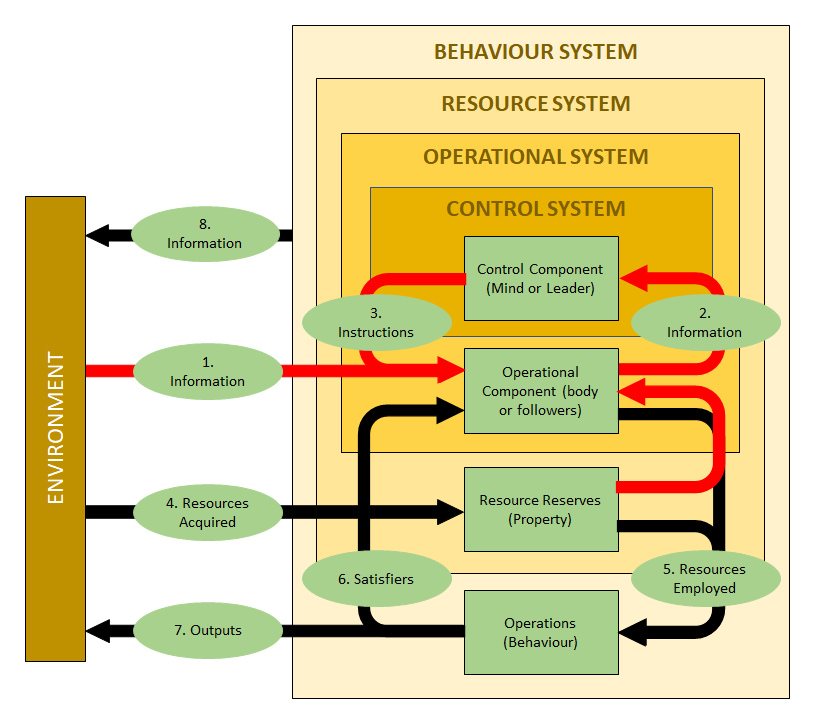
Human behaviour, whether that of an individual or that of a larger organisation, is a process. So, together with its inputs and outputs, it can be regarded as a system. The diagram below describes this system.

The behaviour system is part of a nested hierarchy comprising other systems. They are arranged as follows. The control component, in the case of an individual, is his mind, and in the case of a larger organisation, its leader. Together, the mental and physical resources that they directly control, i.e., the body of an individual or the people in a larger organisation, comprise the operational system. The operational system, together with the resources that it owns, comprise the resource system. Finally, the behaviour system comprises the resource system plus actual behaviour.

These systems operate in the following way. Paragraph numbers refer to those in the diagram.

  1. The environment comprises everything that is not a part of the system. It includes both the natural and the social environments. Inputs from the environment enter via the operational component. These inputs include risks and opportunities. The relevant parts of the operational component are, in the case of an individual, his physical senses, or in the case of a larger organisation particular individuals. For example, an individual may perceive a wasp as a threat of injury, or a government may see another nation as an opportunity for trade.
  2. Information from the environment is passed from the operational component to the control component, i.e., the mind or leader, where decisions are made. The operational component monitors the state of resources and satisfiers, i.e., those things that satisfy the individual or organisation’s needs. It also passes this information to the control component. For example, an individual may recognise that food in the refrigerator is running low, or a business that its stock of spare parts is too high.
  3. In return for this information, the control component makes decisions, and then, passes instructions to the operational component. These instructions are based on a risk, cost, benefit analysis that uses the value of satisfiers or contra-satisfiers and the resources required to create them. The value allocated to a satisfier or contra-satisfier depends on the interaction style of the individual or leader, i.e., whether they are co-operative, positively competitive, or negatively competitive. A negatively competitive individual may conclude that shoplifting is the way to fill their refrigerator. A government with a co-operative style may see a trading alliance as the way to improve their economy.
  4. Resources are acquired from the environment and become part of the resource reserves of the system, i.e., its property. They can be matter, energy or money. Resources can be acquired directly from the natural environment, or through trade with other individuals or organisations. Early humans were hunter-gatherers and acquired their food directly from nature. Today, however, many of us buy our bread from a baker or supermarket.
  5. The activities of the operational component, together with resources taken from reserves, act as inputs to the operations process. These inputs are satisfiers for the process. The operations process converts these resources into outputs. So, for example, an individual may cook the food in their refrigerator to create a meal. A business may assemble parts, or mix constituents, to create a sellable product.
  6. Some of these outputs are satisfiers for the operational component. We may, for example, eat part of the meal we have prepared to satisfy our personal need for sustenance. Similarly, governments and businesses pay the people who carry out their function.
  7. Other outputs can be satisfiers or contra-satisfiers that are used to trade for resources from other individuals or organisations. So, we may trade our labour for pay or provide a meal to friends in return for their friendship. Businesses do, of course, provide goods and services in return for payment. Alternatively, outputs can be operations on the natural environment to acquire resources, e.g., mining, hunting, or gathering. All behavioural outputs are constrained by the physical resources available, for example, an individual’s physical abilities. They are also constrained by the operational resources owned, for example, the financial capital of a business.
  8. Finally, behaviour can be observed, and so, the system of which it is a part outputs information to the environment. We can, for example, watch a football match or observe government activities, and thus, criticise them.

Organisations are recursive. Every organisation comprises several lesser ones. Every organisation, together with others, is also part of a larger one. This recursion continues downwards to individuals and upwards to all of humanity. This model describes the behaviour of every individual or organisation in that structure. So, it may provide the basis for a systems psychology of both individuals and organisations. Notably, it provides a basis for social learning theory which postulates that we emulate role models, that our behaviour is reinforced by the approval of others, i.e., satisfiers, and extinguished by their disapproval, i.e., contra-satisfiers.

The model may also be a basis for dynamic models of society, thereby enabling predictions to be made.

Categories
05. A Summary of Social Systems Theory

A Summary of Social Systems Theory

In this short series of articles, I will summarise the basic principles of Social Systems Theory. Full details are given in previous or subsequent articles.

The fundamental component of society or holon

The term holon was coined by Arthur Koestler in his 1967 book, The Ghost in The Machine. It refers to any entity that can be recognised as a whole in itself and which constitutes part of a larger whole. In social systems theory the fundamental component or holon of society is the organisation, that is, any group of people who work together with a common purpose. Organisations can be of any type and can range in size and extent from an individual, through clubs, businesses, sectors, political parties, governments, nations, and groups of nations, to the global community.

Family relationships between organisations

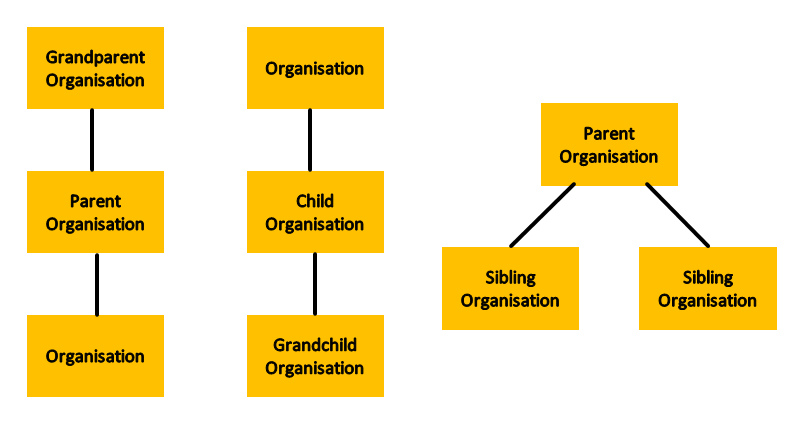
All organisations form a nested hierarchy. The structural relationships between them are similar to those in a family and the same names can be used. Thus, for example, child organisations are components of a parent one, and parent organisations are components of a grandparent one. Two organisations that are components of the same parent are known as sibling organisations. This nested hierarchy continues upwards until an isolated organisation or the global community is reached.

Every organisation comprises a number of component or child organisations, and this nested hierarchy continues downwards until individual people are reached.

Recursion

Recursion means that similar rules and principles can explain the behaviour of organisations irrespective of their size. Thus, for example, a department in a government agency has a leader, and so too does the entire agency.

The control component

All organisations have a control component, e.g., leadership or management, to co-ordinate their activities. Due to recursion, control components have their own control components until we arrive at the individual person. This creates a leadership or management hierarchy comprising individuals. It is natural to select leaders using a bottom-up process, i.e., followers choose a leader thought to be best qualified to co-ordinate their activities. However, managers are also frequently chosen by a top-down process whereby senior managers select junior ones thought to be best suited to the role.

Needs, satisfiers, and contra-satisfiers

All organisations have needs similar to those of individuals. These needs are prioritised using the same categories for individuals identified by Abraham Maslow and Clayton Alderfer, i.e., ERG or existence, followed by relatedness, in particular family relatedness, followed by growth. These priorities are consistent with the multilevel selection theory of evolution. This holds that we place greatest weight on personal survival and reproduction, followed by that of the community upon which we depend, followed by people more remote.

Satisfiers are those external things that increase the level of satisfaction of our needs, for example, food for hunger, or resources for manufacturing. Both individuals and larger organisations endeavour to gain satisfiers as efficiently as possible. Contra-satisfiers, on the other hand, are those external things that reduce the level of satisfaction of our needs and which we endeavour to avoid.

The applicability of systems science, function, and causality to organisations

All organisations are systems and comprise inputs, processes, and outputs. The fundamental principles of systems science apply to them, therefore.

Causality also applies to organisations. The combination of an input and the process is equivalent to a cause. The combination of the process and an output is equivalent to an effect. An organisation’s processes and outputs are also referred to as its function. Because causality applies to organisations we can, for example, say that a number of necessary causes or inputs are together sufficient for an effect in which the organisation carries out its function of producing outputs.

Matter, energy, or information is transferred from every organisation’s inputs to its outputs. This takes place within the region of space-time defined by the organisation’s process. Thus, the latter provides the overlap in space-time needed for a cause to be related to an effect.

All organisations comprise a group of people who work together with a common purpose. This purpose is also the organisation’s function, and the ability to carry out its function is an organisational need.

The applicability of motivation theory to organisations

All interactions between individuals, organisations, and parts of them comprise an exchange of satisfiers or contra-satisfiers for each other’s needs. These satisfiers and contra-satisfiers also take the form of matter, energy, or information. A satisfier or contra-satisfier received is an input, and one provided is an output. Thus, motivation theory also plays a key role in social systems theory.

The applicability of information theory to organisations

Information passes between organisations and flows within any organisation’s processes. Thus, information theory plays an essential role in social systems theory. Fundamentally, information is organised or structured matter or energy that we recognise due to its recurrence. It can exist “at source”, i.e., as the original structure perceived in the physical universe. It can also be translated into various symbolic forms capable of being transmitted, stored, or remembered. Importantly, information at source is, by definition, always true. However, information acquired in other ways, for example, from another organisation, can be false.

Direct interaction can only take place if two organisations are aware of one another, and for this to be the case, information must pass between them. However, organisations can be aware of one another but not interact. These criteria simplify the web of interactions in a social system.

Culture & interaction style

The ways in which individuals and organisations interact are determined by their culture and interaction style. These topics will be covered in a forthcoming article.

Categories
10. The Evolution of Knowledge

The Evolution of Knowledge

Introduction

In this article, I describe the evolutionary stages in the development of human knowledge. Many of these stages took place in our ancestor species. The first almost certainly began in relatively simple animals, and subsequent stages followed on as complexity increased. At each stage, an increase in the sophistication of the ancestor’s brain would have been necessary to accommodate the new ability.

The process is summarised in the diagram below.

The recognition of holons or meaningful entities

The term “holon” was coined by Arthur Koestler in his 1967 book, The Ghost in The Machine. Another term for “holon” is “meaningful entity”. Both terms refer to any entity that can be recognised as a whole in itself and which constitutes part of a larger whole. We recognise such entities by virtue of the static or dynamic structure that forms them, and by the recurrence of instances of the same structure at different times, in different places, and in different circumstances. This recurrence enables us to draw a boundary around each instance which distinguishes it from its surroundings.

The recognition of holons requires memory. We must be capable of encoding in a mental form what we perceive with our senses. This is so that we can compare what we have experienced with what we may experience in the future. It is notable that the repetition of a meaningful entity or event reinforces our memory of it, whilst a lack of recurrence causes the memory to fade.

The recognition of equilibrium states

The next stage in the evolution of knowledge was the recognition of equilibrium states. That is states that persist for a period, and which also recur. For example, traffic lights have several static equilibrium states: red, red and amber, green, amber, and back to red. As most motorists know to their frustration, traffic lights also have dynamic equilibrium states: not operating, operating slowly, or operating quickly.

The recognition of causal relationships between holons in equilibrium states.

There can be recurring relationships between holons in a particular state, and these form the basis of causality. For example, traffic flows through green traffic lights, but is static at red ones. The ability to recognise recurring relationships is of great benefit to an animal’s ongoing survival. It enables it to predict events from experience, seize opportunities, and avoid threats.

However, with this ability also comes the ability to imagine and speculate. Thus, not all knowledge and beliefs are empirical and derived from the environment. When empirical information is absent knowledge can also be a consequence of the speculative juxtaposition of holons.

The development of language

In the case of humans, and to a limited extent some higher animals, experience can be passed on via language. This involves encoding, as speech, items of information held in memory. We are a social species and natural language has evolved alongside our cognitive abilities. Language enables us to share information and co-ordinate our activities, and this conveys an evolutionary advantage. Unsurprisingly, natural language reflects holons, their equilibrium states, and the causal relationships between them. This structure is represented in the form of sentences containing a subject, i.e., a holon, and a predicate, i.e., an equilibrium state. Causality is reflected in compound sentences, such as “If sentence A then sentence B”.

With this ability also came the ability to communicate not only speculative information but also deliberate misinformation. Unfortunately, unless the speaker explains its source, it is difficult for the recipient to know whether the information communicated is true.

The development of writing

However, spoken language is transient. Speech does not linger and is gone as soon as it has been spoken. The brain is still necessary to store information, therefore. During our early development we relied on aural tradition. Individuals would remember knowledge and pass it to others through speech, stories, or songs. In so doing they would reinforce their own memory and prevent it from fading. However, we then developed writing. This is another form of encoded information, and it is notable that many alphabets are, in part at least, phonetic. Thus, written language encodes spoken language, which in turn encodes memorised information. The development of writing enabled us to store information externally and refer to it when necessary. Furthermore, written memory does not fade, and so, we became able to recognise holons and causal relationships that recur less frequently.

The development of formal languages

The next stage comprised the comparatively recent development of formal languages such as mathematics, chemical formulae, Feynman diagrams, etc. These present written information in a condensed form and enable predictions to be made by manipulating it with formal rules that always apply.

Paradigm changes

Human knowledge has evolved through a series of paradigm changes. The development of present day rational, scientific knowledge began in ancient times, in particular with ancient Greek civilisation. The ancient Greeks produced knowledge of major importance including the works of Archimedes, the great mathematician, inventor, and experimenter. An example of Archimedes work is the case of the crown of King Hiero. Archimedes was able to determine the volume of the crown by immersing it in water and measuring the volume displaced. From this and the weight of the crown, he was able to determine its density, and thus, show that the goldsmith had cheated the king by mixing gold with silver.

However, metaphysics, i.e., speculative knowledge with no empirical basis and often in the form of religion, superstition or mysticism, has hampered progress. The methodology of the Middle Ages was to give equal, and sometimes greater weight to speculative theological knowledge over that gained from observation and experiment. This resulted in, for example, the so-called sciences of alchemy and astrology. To a limited extent this brake on progress still exists today, and metaphysical explanations are often proffered for physical events. For example, the World Values Survey found that in 2017, 33.6% of the United States population agreed or strongly agreed that “whenever science and religion conflict, religion is always right.” In other countries this can be as high as 98.8% (Egypt) or as low as 2.8% (Japan).

A significant paradigm change occurred in the Renaissance era. It required that any knowledge produced by imagination must be confirmed by empirical data and that any predictions should be testable. Thus, the scientific method was invented, and this change resulted in the modern disciplines of physics, chemistry, geology, geography, etc.

The present-day situation

These disciplines first began their development in an era when our scientific knowledge was still very limited, and specialisation was unnecessary. Thus, at their foundations they are relatively consistent with one another. However, in the present day, our scientific knowledge is extensive, and it is impossible for any individual to know it all in detail. Specialisation has become necessary. This has brought with it problems of communication, consistency between specialist fields, and reduced ability to recognise the inconsistencies necessary for paradigm shifts.

Categories
05. Leadership Competence

Leadership Competence

Competence to lead an organisation requires certain skills. There are hundreds of lists of such skills on the internet, usually prepared by management consultants. We could even pick and choose between them to find the closest fit to ourselves. If I were to compile a complete list of the recommended skills, then their number would probably be in the thousands. No individual could possibly have them all. Fortunately, they can be condensed down into just five basic skills:

  1. experience, i.e., an understanding of the organisation, its function, and its environment;
  2. sound judgement and problem-solving ability;
  3. an ability to inspire subordinates to enthusiastically co-operate in pursuing the organisation’s goals;
  4. an ability to communicate those goals and ways of achieving them; and
  5. an ability to acquire and understand information from sub-ordinates.

There are, of course, many ways in which those skills manifest themselves in a leader. For example, the ability to inspire followers can be through confidence, humour, likeability, setting an example, and so on. However, if any one of the basic skills is absent, then mistakes are inevitable, and some may cause the organisation to fail. So, I will discuss each skill in turn, giving reasons for why they may be absent. The topic is enormous and there are many such reasons. So, I will concentrate on just a few of the most significant ones and how they can be addressed.

Experience

The main reason why leaders lack experience is poor recruitment practice. For example, the founders of charities sometimes recruit board members who are friends or family members. The latter often have no experience of the goals of the organisation or basic operating practice. Another reason is the personal contract, i.e., trading status for support. Those who support a leader can be promoted to a managerial position despite a lack of experience. Filling a leadership role can also be a simple matter of expediency, i.e., “there is no-one suitable, but we must have someone in post”. Finally, experience can be absent in those whose skills are principally the acquisition of power.

Obviously, a lack of experience betrays itself through the questions a leader asks, and the mistakes that he or she makes. However, there is, a hierarchy of knowledge in an organisation. The higher we are in a leadership hierarchy, the broader but less detailed our knowledge must be, and the more reliant we are on subordinates for any necessary detail. We cannot expect our immediate leader to know the same detail as ourselves. However, to manage effectively, he or she must grasp the basic principles of our roles.

The solution to the problem of lack of experience clearly lies in the processes of recruitment, training, and promotion. We should carefully check that candidates have the necessary experience for a role and are being truthful about it. We should also avoid the need for expedient promotions by training people for greater responsibility.

Unfortunately, senior leaders control these processes. Leaders who lean towards the personal contract will be less supportive of them than those who lean towards the social one. Ultimately, the leader at the top of the hierarchy determines the quality of leadership below him, and so, a vicious circle can form. Self-interested leadership begets self-interested leadership until the organisation ultimately fails.

Judgement and Problem Solving

A leader’s judgement and problem-solving skills can be poor or even absent. The main reasons for this are: inexperience, poor communication, decision overload, personality traits, or mental incapacity. This problem manifests itself when upper management are not making educated decisions or are making very bad decisions despite the resources available to them.

Inexperience was discussed in the previous section. Communication will be discussed in the next.

Decision overload can be avoided by delegating less critical decisions to subordinates. However, if a leader tends toward the personal contract rather than the social one, then the leader’s trust and the abilities of the subordinates may not allow this. Thus, the leader who tends toward the personal contract risks either decision overload or poor-quality decisions by subordinates.

Personality traits include indecisiveness. They can also be due to mental incapacity, extreme age, low IQ, brain tumours, etc. These problems can all be tested for. However, senior leaders again control the process. Those who tend towards the personal contract are more likely to reject testing. So, a vicious circle prevents its introduction.

Inspiring Subordinates

The absence of an inability to inspire followers can be due to lack of experience and poor communication, as discussed in the relevant sections. There is no doubt that personality traits that inspire trust and confidence are also an important factor. But charm alone will not inspire subordinates. Experience and good decision making are also necessary.

Another factor is a lack of focus on the goals of the organisation, and the concentration of leaders on day-to-day operational activities. If this occurs, subordinates will fail to understand the goals of the organisation and will be unable to contribute to them. Furthermore, if managed in too much detail, they are less likely to take responsibility for operational activities or suggest improvements.

Finally, we are all motivated to satisfy our needs. Nothing inspires subordinates more to achieve an organisation’s goals than the promise of personal benefits. However, what has been promised must be delivered if subordinates are not to lose trust in the leader.

Communication

This section discusses the personal communication skills of leaders and the effect that this can have on an organisation. General communication within an organisation will be discussed in a future article. Good leadership communication increases morale, productivity and commitment. Poor communication has the reverse effect and, in the extreme, can lead to failure of the organisation.

The main constraint on communication is almost certainly a lack of time. This results in leadership invisibility. The solution is not to work longer hours as this impacts on the quality of decisions. Rather, it is to make time by delegating decisions and work. Leadership is a profession. It is OK to walk around and chat, providing this is mainly focussed on the organisation’s objectives.

Poor leader communication skills can also be due to a lack of transparency. That is, secrecy or a “need to know” attitude. This can result in subordinates believing that the leader has something to hide, uncertainty about the aims of the organisation, and poor decision making at lower levels in the hierarchy. So, unless there are very good reasons to the contrary, transparency will generally benefit the organisation.

A lack of mastery of language and presentation skills can lead to miscommunication, and thus, to poor decisions at subordinate level. However, this can easily be tested for during the appointment process and, if necessary, training provided.

Personality traits, such as a lack of confidence, extreme introversion or extroversion, can also hamper communication. Introverts can suffer information overload when in large groups and find it difficult to express themselves. They are more able to express themselves on a one-to-one basis where there is greater two-way communication. Extroverts, on the other hand find it difficult to take in information. They too can benefit from one-to-one communication. These difficulties can, however, be overcome through training and experience.

A lack of empathy can hinder communication. That is, the leader may not understand or may misinterpret a subordinate’s motives for saying what he does. The leader can also fail to understand the information that an effective subordinate requires. However, empathy can be developed. For example, people who spend more time with those different to themselves develop greater empathy. Reading novels also helps to foster empathy by putting us in the minds of others.

Conclusions

The conclusions are inescapable. Human capital must be developed if an organisation is to be successful. Organisations can fail for a multitude of reasons, but it is leaders who create the necessary conditions. The power of leaders must therefore be constrained by democratic control and the safeguards suggested above put in place. Many of these safeguards do, of course, seem idealistic. Vicious circles prevent their implementation. So, they can only be introduced progressively as opportunities arise. Are we sufficiently culturally advanced to begin doing so? Each country must make its own decision. However, those that do make a beginning are likely to be the most successful and experience least organisational failure.

Categories
04. Self-interest vs. Collective Interest

Self-interest vs. Collective Interest

It is human nature to balance self-interest with community interest. So, all leaders will, to some extent, act in their own self-interest. However, if the balance swings too far in that direction, then the leader will usurp the function of the organisation to the detriment of other stakeholders, such as employees or customers, and it will fail.

The exact balance struck between self-interest and collective interest depends on the personality of the leader. Aspects of personality that can cause leaders to lean towards self-interest include dominance, the habitual pursuit of power and a weak conscience or super-ego.

In their 2016 paper, Dominance and Prestige: Dual Strategies for Navigating Social Hierarchies, Maner and Case state the following. “The motivations that drive people to attain social rank thus play a profound role in guiding their leadership behavior and the extent to which they prioritize the goals of the group over their own social rank.” They also state that “Several studies suggest that leaders high in dominance motivation—those who seek to attain social rank through the use of coercion and intimidation—selfishly prioritize their social rank over the well-being of the group.…Leaders high in prestige motivation, on the other hand, are motivated primarily by the desire for respect and admiration.” https://www.sciencedirect.com/science/article/pii/S0065260116300144

Some leaders can fully internalise the pursuit and defence of power. It becomes a habitual and unconscious form of behaviour that persists as a need in its own right.

It is easier to climb an existing hierarchy than to create a new one with oneself at the pinnacle. This is not a universal rule, of course, and there are, for example, self-interested leaders who have built empires from a silver spoon passed on by their parents. Nevertheless, once established, an organisation can attract individuals who seek power to satisfy their own personal objectives, for example wealth, fame, or influence.

In the competition to ascend a hierarchy, individuals who are relatively unconstrained by ethical considerations, or are willing to use negative competition, or who have learnt the “rules of the game” have an advantage over others. Thus, they often take control of and corrupt organisations that may have been set up with the best of intentions. There are three personality types that are a particular risk: the psychopath, the narcissist, and the dark empath. They will be discussed in more detail in future articles.

The concentration of power, i.e., the ability to direct resources for the satisfaction of a particular need, in the hands of a few seems to be the greatest source of misery, poverty, and injustice in the world. To cite just one example, the German philosopher, Immanuel Kant, argued that democracies are less likely to go to war than absolutist states, i.e., states where power is concentrated in the hands of the ruler. In a truly democratic state, leaders require the support of the population if they are to engage in war. The population will, of course, weigh up the advantages and disadvantages to themselves before giving their support. Consider, for example, the popular opposition in the USA to the Vietnam war and, in the UK, to the invasion of Iraq. In an absolutist state, on the other hand, only the advantages and disadvantages for the ruler are taken into consideration and the suffering of the population has little or no bearing on the decision. An example is Russia’s invasion of Ukraine. Essentially, the decision is a risk/benefit/cost calculation, and rulers frequently have far more to gain than their population. This is, of course, just one example on an international scale, but similar issues exist in all walks of life and at all scales. So, if we wish to tackle poverty, strife, and injustice in the world, then we must tackle its root cause, the concentration of unregulated power in the hands of a few.

Reference: Maner, J.K. and Case, C.R. 2016. “Chapter 3 – Dominance and Prestige: Dual Strategies for Navigating Social Hierarchies, Advances in Experimental Social Psychology”, Volume 54, Pages 129-180, ISSN 0065-2601, ISBN 9780128047385, https://doi.org/10.1016/bs.aesp.2016.02.001. https://www.sciencedirect.com/science/article/pii/S0065260116300144

Categories
Admin

Learn More about Systems Science

I have made much mention of Systems Science in my recent articles. If you would like to learn more on this topic, then I recommend following Shingai Thornton’s blog at: https://systemsexplorers.substack.com/

Shingai is a member of the International Society for the Systems Sciences (ISSS) and will write about the topic on a weekly basis. Each article takes about 5 to 10 minutes to read.

Initially, they will focus on making some of the core concepts in George
Mobus’ Principles of Systems Science textbook easily accessible to a
broader audience who might not have time to read the book.

Shingai is an aspiring systems scientist looking for critical feedback on his writing, and collaborations around the application of systems science to issues in the social sciences. He is receiving advice from George and other members of the ISSS education committee and together they are also developing an online course based on the book.

Categories
03. The Failure of Control Systems

The Failure of Control Systems

Introduction

Control systems are a property that emerges with life. They do not appear in non-living things, except those created by mankind. Control systems co-ordinate the activities of the various specialised parts of an organism, or group of organisms, towards a common goal. However, because all systems comprise sub-systems, and those sub-systems, in turn, have control systems, there is a control hierarchy.

Due to the VUCA nature of the world, control systems must delegate if they are to be effective. If they do so, this enables the organism or group to deal with complexity. The information on which decisions are made is progressively simplified as it ascends the control hierarchy. Conversely, as instructions descend, the components of the organism or group increasingly interpret it.

If all decisions are centralised, then the larger the system, the less and more simplified the information on which a decision is based, and the greater the risk of error. Furthermore, as explained in a previous article, if decisions are made by trial and error, then only a single decision occurs rather than several. So, there is less likelihood of decisions being successful and of the system learning from its successes and failures.

In the case of human organisations, the control systems are management or government hierarchies. If there is no control system, then there is no organisation. So, the collapse of businesses, civilisations and nations is often due to the collapse of their managing or governing system. For example, an effective centralised state is necessary for a successful economy. It provides order, laws, mechanisms for resolving disputes, and basic public goods and services. Failed states, such as South Sudan and Somalia, have no central organisation or one which has no influence outside of the nation’s capital.

The Social Contract vs. The Personal Contract

The concept of the social contract is an ancient one. It was first described in the Greek philosopher Plato’s “Republic” in about 375 BC. The social contract is an explanation of the relationship between leaders and the led. In 1762, the French philosopher, Jean-Jaques Rousseau interpreted this relationship as one in which individuals are willing to give up some of their rights in the collective interest. They will, therefore, follow the instructions of a leader who acts in that collective interest.

On the other hand, as explained in previous articles, leaders can rise to power by delegating  benefits, such as power, wealth or status, to followers who support them. Leaders then use that support to gain benefits for themselves. This is a form of personal contract and is often how a leadership hierarchy develops.

In practical human affairs, there is an interplay between the social contract and the personal one. The actual motives of both leaders and followers lie somewhere on a scale between the two. The position on the scale varies from individual to individual. An organisation is also subject to this interplay. Individuals and other organisations will interact with it if this benefits them. However, they also expect the organisation to act in the collective interest. Again, the actual motive for interaction lies somewhere on a scale between the two.

Both leader-follower interactions and inter-organisational ones are a manifestation of our eusocial nature. This, in turn, is a consequence of evolution. We have evolved to optimise the satisfaction of our needs by balancing the immediate self-interest of the personal contract with the longer-term self-interest of the social contract. A more central and less extreme position is normally the optimum.

The balance point that defines actual behaviour is a consequence, in the case of individuals, of their personality, and in the case of organisations, of their culture. However, to a very large extent, the culture of an organisation is determined by its leaders, and so, individual personality is again the principal factor.

There is a relationship between the World Values Survey’s survival values and a tendency towards the social contract. For example, those with survival values are described as: tending “to seek strong authoritarian leadership to bind the community together into its survival endeavour”; as having a “tendency towards obedience of leaders”; and as having “a tendency towards conformity to group norms”. Thus, societies of this nature influence their members to favour the social contract. However, there does not appear to be a relationship between the World Values Survey’s self-expression values and either the personal or the social contract. Thus, societies of this nature do not influence their members one way or the other.

Trust is an important factor in deciding which leaders we will follow. We assess whether the leader will deliver on the social contract or personal contract. Trust or distrust is based on experience but can be passed from one individual, group, or generation to the next.

If a leader cannot be trusted to deliver on the social contract, and there is no personal benefit for the follower, then the follower will not support that leader. If there are no leaders who can be trusted to deliver on the social contract, then the best option for a follower is to support one who can be trusted to deliver on the personal contract.

Unfortunately, leaders will often feign a focus on the social contract. This is particularly the case in democracies and pseudo-democracies where popular support is needed. Much effort is put into public relations. A follower can, therefore, find himself following a leader who provides no personal or social benefits. Press scrutiny has an important role to play in challenging such leaders. However, the press can also enter into personal contracts with the leader or be coerced into silence.

The social contract becomes more important as society grows ever more complex, and we become ever more dependent on one another. However, the personal contract is far easier to monitor and many of us have a natural leaning in that direction. In extreme cases it entirely trumps the social contract.

So, to improve leadership and avoid the failure of human organisations, it is necessary for:

a) potential followers to focus on the social contract in deciding which leaders to support and what organisations to interact with; and

b) potential leaders to focus on improving followers’ trust that they will deliver against the social contract.

Categories
02. The VUCA Environment

The VUCA Environment

VUCA is a term first coined, in 1987, by the American economists Warren Bennis and Burt Nanus. It refers to the environment as being volatile, uncertain, complex, and ambiguous.

In a volatile environment, the nature of change can quickly alter, and the speed of change can be rapid. The classical example is, of course, stock market prices, but volatility also applies in other social arenas, for example the political arena when a scandal breaks.

In an uncertain environment, events and the outcomes of actions are unpredictable, can come as a surprise, and previous experience may not apply. Weather is an example in which unexpected droughts or deluges of rainfall occur.

Complexity refers to the way in which everything in the environment is causally inter-related. There may be no single cause resulting in a single effect, but rather multiple causes and effects that defy analysis. When situations are complex, a change in one place can have unintended consequences elsewhere. Chaos theory can also apply. For example, a small change in the behaviour of one individual can propagate through a crowd to completely alter its behaviour.

Finally, ambiguity refers to a lack of understanding or a misreading of the situation. Facts are unclear and cause and effect may be confused. This typically applies to the interpretation of historical events. Different historians can give different explanations based on different interpretations of the available information. For example, the two parties in a territorial dispute may both believe that their claim is reasonable due to different historical interpretations.

VUCA is a product not only of our inability to understand complexity and our inability to precisely model it, but also a product of genuine random events at the atomic and sub-atomic level. Examples of the latter are the radioactive decay of atoms and the appearance of virtual particles. Such events interact with the physical universe, and the change that they cause is magnified as it propagates ever more widely.

The VUCA concept can be used as an excuse for inaction and a lack of forward planning. However, the advantage of accepting it as reality is that we can better identify the risks associated with our actions and have measures ready if things do not go as we had hoped.

Unfortunately, we have an optimism bias and often underestimate the difficulties and risks involved in a project or enterprise. This is particularly the case when promoting a pet project to others. However, on the other hand, a greater awareness of the VUCA nature of reality can lead to a greater understanding of the knowns and unknowns in a situation. It also leads to the identification of potential surprises, and, where appropriate, trigger action to clarify any critical unknowns. Finally, it can lead to a better understanding of the potential threats and opportunities in a situation, and, where appropriate, lead to the planning of measures to avoid those threats or seize those opportunities.

A good understanding of an organisation’s vulnerabilities will enable it to plan resilience measures which limit damage in the face of the unexpected. A good understanding of an organisation’s objectives will better enable it to seize opportunities should they arise.

Clearly, this requires an organisation to be agile, flexible, and adaptable in the face of the unexpected. It also requires it to have a range of interventions, mitigation measures, plans B and C, etc., available should a change of direction become necessary. Finally, it requires the organisation to carefully monitor situations and the outcomes of its decisions.

This also applies to us as individuals. For example: we insure our homes, cars and holidays against the unexpected; we wear safety equipment when playing sports; we maintain cash reserves in the bank to see us through difficult times; and so on.

In the absence of such measures and in a VUCA world, organisations will inevitably run into difficulties and ultimately fail. A failure to recognise the VUCA world is one of the main reasons why government projects so often fail. In 2017, PricewaterhouseCoopers AG of Switzerland investigated the reasons for this. They produced a report entitled “Are public projects doomed to failure from the start?”. They found that the complexity of such projects was often underestimated, and an overoptimistic attitude would prevail. In practice, however, the political, organisational, and technical complexity of a project could render it unmanageable. They also found that deadlines were often set for political reasons, and political agendas could lead to an unwillingness to abandon projects that no longer fitted the business case. Furthermore, it was often the case that many different organisations would need to co-operate, but their IT systems differed, and they could resist the necessary changes to their practices. PricewaterhouseCoopers did, however, find that with proper management and diligence none of these factors were insurmountable.

Similar problems arise with government policy interventions. Like everyone else, the ability of politicians to understand complexity is limited. So, in practice the process of intervention is one of innovation, trial, and error. In other arenas there may be many actors some of whom will succeed and others of whom will fail, so trial and error is acceptable. However, government differs from the rest of society in that it is the sole actor and there is just one trial. Unfortunately, it is usually inexpedient for a politician to admit to error. So, government error is often only corrected when the opposition takes power.

On the positive side, many Western governments are now recognising the VUCA world and putting measures in place to better manage their function in its light. Recent guidance on managing complexity in the UK can be found at https://www.gov.uk/government/publications/systems-thinking-for-civil-servants

Categories
02. Constitutional Monarchy or Republic?

Constitutional Monarchy or Republic?

On 6th May, 2023, at Westminster Abbey, King Charles III will be crowned as the United Kingdom’s head of state. The UK has always had a republican minority and, whilst Queen Elizabeth II was admired for her professionalism, other members of the royal family have behaved in far less admirable ways. This is unsurprising because the royal family are, after all, human and have the same frailties as the rest of us. However, as the following graph shows, there has been a recent increase in republican sentiment in the UK.

By Ralbegen – Own work, CC BY-SA 4.0, https://commons.wikimedia.org/w/index.php?curid=101419103

So, is it a good idea for the UK to become a republic? This article looks at the question from a neutral and objective standpoint.

The six main types of national government are:

  • Absolute Monarchies, e.g., Saudi Arabia and Oman;
  • Constitutional monarchies in which the monarch is executive head of state, e.g., Morocco and Jordan;
  • Constitutional monarchies in which the monarch is ceremonial head of state, e.g., the United Kingdom and Spain;
  • Republics in which the president is executive head of state, e.g., the United States and France;
  • Republics, in which the president is ceremonial head of state, e.g., Ireland and Italy; and
  • Provisional Governments with no constitutionally defined basis, e.g., Libya and Sudan.

I have compared these categories of national government, as described in https://en.wikipedia.org/wiki/List_of_countries_by_system_of_government, with the average Fragile States Index for nations in each category. The Fragile States Index is compiled by the Fund for Peace and is intended to be a measure of the likelihood that a state will erupt into mass violence due to internal conflicts. The lower the value of the index the less fragile the state. Data and the method by which it is gathered can be found at https://fragilestatesindex.org/

The results are shown in the following graph.

Clearly, on average, nations with a constitutional monarchy whose role is purely ceremonial are the most stable. They are considerably less fragile than republics whose president has an executive role. The reasons for this can be found in the UK’s history.

Unlike other nations, the UK does not have a written constitution. Rather its constitution has evolved over time and comprises numerous documents and practices. The general evolutionary trajectory has been towards the control of power. This process has, of course, faced resistance. Furthermore, it remains incomplete and, because new sources of power continue to emerge, probably always will be. The monarchy, religion, and political establishment are amongst those whose power has been constrained. However, for the purposes of this article, I will outline only the constraints placed on the monarchy and why they came about.

The monarch’s power probably reached its peak following the Norman invasion of 1066. There were several important milestones on the path from that peak to the present-day constitutional monarchy. What is notable however is that all followed the rule of a tyrannical, and sometimes inept, head of state.

The Magna Carta. In 1215, following a period in which he used his powers in an arbitrary and exploitative way, attempted to weaken his barons, and ultimately faced rebellion, King John agreed to limit his power over his subjects by signing the Magna Carta. Among the rights granted by the Magna Carta was the right to judgement by one’s peers and in accordance with the law.

The English Civil War. King Charles I had frequent conflicts with parliament over the division of power. Ultimately from 1629 to 1640, he ruled without parliament and his policies on religion and taxation created great opposition. In 1642, this led to the English Civil War between royalists and parliamentarians. Ultimately, parliament prevailed, King Charles I was executed, the monarchy overthrown, and the Commonwealth of England established.

Unfortunately, the commonwealth suffered considerable factional infighting and instability. In 1653, in the hope of restoring stability, Oliver Cromwell seized power and was declared Lord Protector. Essentially, he became a religiously inspired military dictator.

The Restoration. In 1660, following the death of Cromwell and after a brief ineffectual reign as Lord Protector by Cromwell’s son, the throne was restored to King Charles II. However, in 1681, Charles II dissolved parliament and ruled without it until his death in 1685.

The Glorious Revolution. Charles II’s son, James II, caused opposition by maintaining a large standing army, appointing Roman Catholics to high political or military office, and imprisoning Church of England clerics who opposed his decisions. Consequently, a group of influential protestants invited James’ daughter Mary and her husband William of Orange to “invade” England and depose him. An important part of the agreement with William and Mary was the Bill of Rights, 1689, which affirmed parliamentary supremacy.

Since then, royal influence over parliament has progressively declined and voting rights have been progressively extended. Today, with minor exceptions, every citizen over 18 has the right to vote for their member of parliament, and it is the convention for monarchs not to express political opinions.

So, the benefits of a constitutional monarchy can be summarized as follows. The presence of a hereditary monarch in the country’s highest status constitutional role prevents that role from being occupied by those who would misuse power in a corrupt or anti-social manner. The role is unavailable to those whose motivation may be personal power and self-interest. Furthermore, whilst providing that safeguard, the monarch’s relative lack of political power prevents them from behaving in a manner detrimental to the nation. So, for this reason, I would suggest that a constitutional monarchy probably is a good idea.