Categories
03. Organisational Motivators, Satisfiers and Decisions

Organisational Motivators, Satisfiers, and Decisions

Organisational Satisfiers and Contra-satisfiers

If an organisation is treated as a system, then its satisfiers are its inputs, its processes are its function, and its outputs are satisfiers or contra-satisfiers for others. Note that these others can be a part of the organisation, another familial organisation, or a non-familial organisation. A business which manufactures ice cream requires inputs such as milk, sugar, premises, equipment, electricity, employees, recipes, and so on. These are its satisfiers. Its outputs are ice cream which satisfies the needs of distributors, retailers, and customers. A contra-satisfier for this organisation might, for example, be an outbreak of listeria in the factory.

Organisational Motivators

The behaviour of an organisation is governed by its motivators. These are the status of its satisfiers and contra-satisfiers, i.e., whether a satisfier or contra-satisfier is absent, latent, precarious, or entrenched. An organisation is self-maintaining, and its aim is to ensure that all satisfiers are entrenched and all contra-satisfiers absent. In the case of satisfiers, the organisation responds to opportunities. In the case of contra-satisfiers, it responds to threats or risks. There is an industry of consultants providing business organisations with a plethora of strategies for doing so. These can be researched on the internet, and I will not therefore go into detail here.

In summary, however, the source of satisfiers and contra-satisfiers is the organisation’s environment, and the organisation will either:

  1. adapt to changes in its environment, e.g., by altering its function;
  2. attempt to extend its environment, e.g., through globalization; or
  3. attempt to alter its environment, e.g., through advertising, moving to another country, or offshoring.

In doing so it alters its environment which, of course, includes other organisations. They too will adapt to any changes, further alter the environment, and a complex dynamic situation can result.

Organisational Decisions

Individuals make their initial decisions sub-consciously, using improvements to their overall emotional state as a basis. However, before acting, they consciously criticize their initial decision in a more rational way, and if it is unsatisfactory, tell the sub-conscious mind to go back and think again. The same is true of organisations but with some differences.

  1. The initial decision may be by a leader or other member of the organisation who has already gone through the individual decision-making process. Significantly, there may be several competing initial decisions from different sources.
  2. Initial decisions must be communicated and there are many ways in which this can fail. The decisions may simply not be communicated; they may contain information that is false at source; they may contain deliberately false information; they may be expressed inaccurately; they may be transmitted inaccurately; they may be interpreted inaccurately; the recipients may suffer information overload; or the recipients may modify them to fit their existing schemata. Many of these problems do not arise when an individual is deciding on their own personal actions.
  3. The initial decisions are subject to conscious review by other members of the organisation. Any found to be unsatisfactory are rejected, and the originator is either asked to think again, or a satisfactory competing decision is accepted. Individuals may  consider competing options in this way, but only when the decision is highly significant. On a day-to-day basis, individuals act on the first option recognised to be both satisfactory and sufficient. However, organisations have a greater tendency to seek optimal solutions. Decision making in organisations is generally less emotional and more rational, because individuals tasked with decision-making are responsible to one another and must justify and explain their decisions. Justifying rationales are possible, however.
  4. Organisational decision-making is a considerably slower process than that of an individual. The larger the organisation the slower the process.
  5. Several organizational decisions can be in progress at any one time. In some ways this is the same for individuals, as we do try to satisfy multiple needs with a single action. However, in an individual, this process is well coordinated, whereas in an organisation it may not be, and contradictions can arise.
  6. There can be contradictions between a leader’s needs, which may have a greater personal and emotional basis, and the organisation’s needs. In individuals this contradiction does not exist, except perhaps for those with a mental illness. Individuals are masters of their own actions. Organisations are not.
  7. The principle of sub-optimisation recognises that a focus on optimising the performance of one component of an organisation can lead to greater inefficiency in the organisation as a whole. This is because efficiencies for one part of the organisation can lead to inefficiencies in another. Rather the whole organisation must be optimised if it is to perform at maximum efficiency, and individual components must sometimes operate sub-optimally.
Categories
02. Why Hierarchy is Necessary in Organisations

Why Hierarchy is Necessary in Organisations

In his book “General System Theory”, the biologist Ludwig von Bertalanffy describes three processes which play an important role in biology. They are progressive mechanization, progressive centralization, and progressive individualization.

Bertalanffy uses the example of an embryo to describe progressive mechanization. At a very early stage in its life, all cells play the same role. The embryo is merely a collection of identical cells bound together. However, as its development continues the cells begin to exhibit differences and take on specialised roles according to their location. As the embryo’s development continues, the cells then assemble into different organs.

Progressive centralization often goes hand in hand with progressive mechanization. The various component parts of an organism become subordinated under dominant parts, which serve to co-ordinate their activities. In an embryo for example, the dominant part is the nervous system, which, in turn, is subordinated to the brain.

Finally, progressive individualization describes the way in which an organism becomes more unified and individual. In the early stages of an embryo, for example, when individualization has not begun, any splitting of the collection of cells results in identical twins. However, the embryo becomes progressively more complex, and progressively more a system in which the whole is more than the sum of its parts. It cannot be broken down into its separate parts without losing the feature that makes it a living individual, i.e., without dying.

These three processes, which appear to be a natural feature of life, extend into organisations, i.e., groups of people with a common purpose. Organisations emulate as far as they can an individual organism. They comprise specialists, managed by a hierarchy, under the ultimate control of a leader, and have an individual identity. However, we are not telepathic and have no group mind. Thus, the leadership role must be taken on by an individual and communication is via language. Whilst the mind of an individual is capable of controlling their own body, an organisation is more complex, and we are, therefore, less able to comprehend and control it. So, a hierarchy becomes necessary.

As we ascend the hierarchy, information is simplified by subordinate leaders for those of higher status. This enables the latter to comprehend and co-ordinate the activities of the specialists under their control. The number of specialists and degree of complexity that must be managed increases as we ascend the hierarchy. So too is the amount of simplification needed. At each stage, as information is passed up the hierarchy, some of it is lost. Commands coming down must also be interpreted in more detail by leaders of lower status. So, the reverse occurs and, at each stage descending the hierarchy, information is added to any communications. Clearly, the more levels there are in a hierarchy, the greater the risk that critical information will be lost, or misinformation gained. Ultimately, to avoid mistakes becoming too frequent or too serious, it becomes necessary for decentralization to take place.

In summary, hierarchy is a natural feature of life. Leaders exist because of the need to co-ordinate specialists. They form a hierarchy because progressive simplification is needed to deal with increasing complexity, as the number of specialists under a leader’s ultimate control increases.

This natural system can, however, break down because the people who populate a hierarchy are determined by the trading of status for support and can act in their personal interest rather than that of the organisation.

Organisational Attraction

Individuals and organisations are attracted to other individuals or organisations that they believe will satisfy their needs. This applies to:

  1. Normal human needs. Thus, people will seek employment by an organisation as a satisfier of those needs.
  2. Normal organisational needs. For example, a business may be attracted to a political party whose ideology supports its purpose.
  3. The need for inner consistency. Thus, people and organisations with a particular view will join others with the same or similar views. This enables them to hold that view, whilst at the same time satisfying the need for relatedness.
  4. Antisocial needs. People will join an organisation which appears to provide opportunities to satisfy these. In the case of an individual, it may, for example, be easy access to money. However, organisations can also have anti-social needs, and are attracted to parent organisations which facilitate their satisfaction, e.g., groups of mercenaries.
Categories
01. Organisational Needs

Organisational Needs

All organisations have a purpose. This may be: one of the following.

  1. To yield benefits for members of the organisation, e.g., a social club.
  2. To yield benefits for external individuals or organisations, e.g., a charity.
  3. A combination of the two, e.g., a business. Because an organisation must maintain itself, it is never entirely altruistic. However, because it requires inputs to function, it is normally co-operative, involving a process of negotiation and agreement.
  4. To yield disbenefits for other individuals or organisations, e.g., an army. In this case, the organisation is normally doing so on behalf of a larger one of which it is a part, so that the latter, e.g., a nation, benefits in some way.

In the same way as individuals, organisations fulfil their purpose by satisfying their needs, and avoiding their contra-needs. According to the Modified ERG system of needs, based on Maslow’s hierarchy, individual human needs can be categorised and form a hierarchy. The same is true of organisations. A comparison of an individual’s needs and an organisation’s needs is given below.

Within these general categories of need, there are, of course, numerous specific needs.

An organisation also has contra-needs. These are the reverse of its needs, i.e., its demise rather than its existence, poor rather than good relationships with others, or decline rather than growth.

Maslow explained that individuals must satisfy needs lower in the hierarchy and ensure that this satisfaction is sustained before effort is expended on higher needs. Similarly, we must also avoid contra-needs and ensure that this avoidance is sustained. He did, however, qualify this by referring to degrees of relative satisfaction. It is not the case, he argued, that a need only emerges when those lower in the hierarchy have all been fully satisfied. Rather we are usually in a state where all our needs are, to a greater or lesser degree, only partially satisfied. Furthermore, the level of satisfaction of our needs tends to decrease as we ascend the hierarchy. A higher need may not be apparent at all if lower needs are not adequately satisfied. However, it will emerge by degrees as their level of satisfaction increases.

A similar principle applies to organisations. All organisations have a purpose, and this purpose cannot be pursued if the organisation ceases to exist. Thus, the continued existence of the organisation must always take priority over other needs.

Because the function of an organisation normally requires inputs from others, and delivers  satisfiers to others, relatedness is the next highest priority. These “others” may be:

  1. Parent or grandparent organisations, i.e., larger organisations to which the relevant one belongs.
  2. Sibling organisations, i.e., other organisations which also belong to the same parent or grandparent organisation as the relevant one.
  3. Child organisations, i.e., parts of the relevant organisation. Child organisations may even be individuals.

Relatedness to such “familial” organisations has a greater priority than relatedness to non-familial ones. Without co-operation between them, the relevant organisation’s function is in jeopardy.

Relatedness to non-familial organisations is also important, but such relationships are usually more easily replaced.

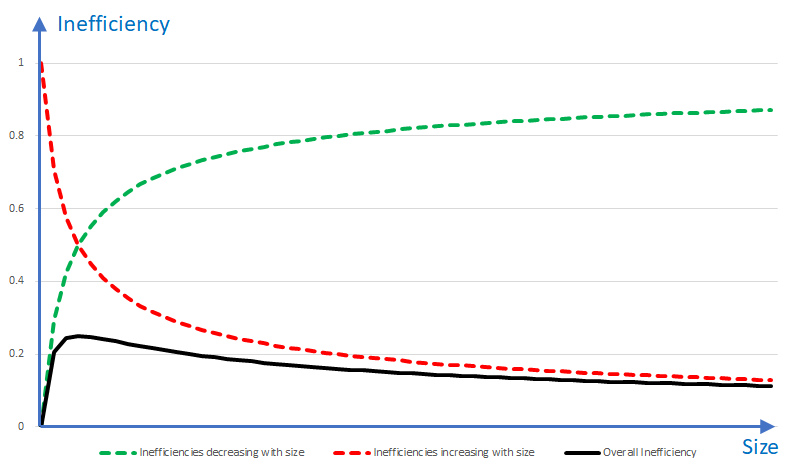
An organisation needs to grow. This can comprise growth in physical size or improvements in the exercise of its function. Once an organisation has established an ability to carry out its function, it can commit resources to improving its processes, extending its function, or enlarging the number of beneficiaries. Growth in physical size is, however, constrained by communication within the organisation. As an organisation grows the people within it become ever more specialised, and this improves efficiency. However, co-ordination of their activities becomes ever more necessary. Communication must increase, therefore. However, the effort involved in doing so and the increased risk of miscommunication reduces efficiency. There is, therefore, an optimum size of organisation at which efficiency is greatest, and to either side of which efficiency decreases.

Categories
03. Language (Part 1)

Language

“No matter how abstractly formulated are a general theory of systems, a general theory of evolution and a general theory of communication, all three theoretical components are necessary for the specifically sociological theory of society. They are mutually interdependent.”
– Niklas Luhmann, The Differentiation of Society (1982), quoted in http://scihi.org/niklas-luhmann-social-systems/

The German sociologist and systems theorist, Niklas Luhmann (1927 – 1998), regarded social systems as systems of communication, i.e., he believed human society to be based largely on the transmission and processing of information. In this regard animals, particularly human beings, are unusual. Unlike other physical entities, except perhaps the machines we have created, information can lead to action. For example, we may reason that “there may be an accident so I will drive carefully”. In this statement, “there may be an accident” is information and “I will drive carefully” is a physical event. This does not apply to other physical entities, such as boulders, which cannot roll carefully due to information received. Evolution is undoubtedly the source of this ability, and we can see its progressive emergence as nervous systems become ever more complex. Its pertinence to people is largely a consequence of our social nature and the evolutionary advantages that this gives us.

The flow of information is what binds human beings together into society. However, the flow of goods and services also has a part to play. As might be expected from a characteristic that has evolved, there is a strong correlation with the hierarchy of needs. Satisfiers for our existence and procreation needs are largely material, i.e., air, water, food, shelter, etc. However, we do rely on information to know where and how to acquire these satisfiers. As we climb the hierarchy, material satisfiers become ever less important, and information plays an ever-increasing role. For example, although an exchange of material satisfiers has a part to play, relatedness is largely based on communication between the parties. At the top of the hierarchy, the growth of an individual is based almost entirely on knowledge or information. This is something that many religions stress.

The transmission and replication of information, an important feature of social systems, requires language. Language can take many forms: written or spoken words, icons or diagrams, the stream of bits in the internet, or even the formal language of mathematics. Language is not the sole preserve of human beings. Many animals communicate using a very basic language. For example, bees communicate by dancing, and ants communicate via scent pheromones. It is even thought that trees communicate with one another via mycelium, a thread like fungus, between their roots. What distinguishes human languages, however, are their complexity, versatility, and adaptability.

Typically, a language comprises:

  • Symbols such as words, images, sounds, etc. which represent the entities that we encounter in the world around us.
  • A grammar, i.e., the way in which these symbols are concatenated or otherwise laid out and connected. This represents the relationships between the entities.

Natural spoken language has evolved alongside our minds. This is evidenced by the fact that there is no central language processing part of the brain. Rather, language processing is distributed throughout it. Any processing centre is concerned only with motor functions, i.e., turning language into speech.

Language must be efficient, and so, resonate with the way that we think and understand the world we inhabit. Thus, it must reflect the structure of thought. Natural languages contain “universals”, therefore, i.e., features common to every language, and the most notable of these is the proposition. This comprises two entities and the relationship between them. For example, a simple natural language proposition comprises a subject (entity 1) an object (entity 2) and a verb (relationship). For example, “The apple (entity 1) is (relationship) green (entity 2)”. Here “green” is a simplification of the phrase “a green thing”. The same is true of formal languages such as mathematics. For example, 1 (entity 1) < (relationship) 2 (entity 2). Propositions are fundamental to the way that we reason. They reflect our understanding of the universe, which comprises physical things and the relationships between them.

An extreme interpretation of the Sapir-Whorf hypothesis is that thought or mental content is constrained by natural language, i.e., that we can only think of things that can be expressed in that way. However, this is demonstrably not the case. We have the ability to form and remember visual, sound, or taste images of physical objects and events. Furthermore, we can manipulate and combine these in our imagination to create, for example, images of unicorns or mermaids. Using iconic analogues or visual representations, we can also manipulate more abstract concepts, although, due to the constraints of geometry, this can lead us astray.

The use of imagery is known as the iconic mode of representation. Natural spoken language is our symbolic mode. We use it to communicate efficiently, and translation from iconic mode is often necessary. When doing so, we often search for, or even invent, appropriate words. An example is the word “contra-satisfier”, used in these articles. It was invented by the author because no suitable word pre-existed. “Dissatisfied” and “unsatisfied” mean not satisfied, and every antonym of satisfy has its own specific colouration that disqualifies it. A contra-satisfier, on the other hand, reduces existing satisfaction or makes an unsatisfied state worse. In this way, new words are created, and a language evolves. Were the extreme interpretation of the Sapir-Whorf hypothesis true, then no new words would enter a language.

All human languages are structured in a way which provides us with logical reasoning skills, although this is often obscured by the simplifications we use to express ourselves efficiently. Few of us are taught formal logic, and it is the preserve of those who study mathematics or philosophy at university level. Nevertheless, all of us can reason logically when we choose to. This skill is acquired through our use of natural language, which has evolved to represent, reasonably accurately, the world in which we live. Our native language can, therefore, affect us through our reasoning skills, and in other more subtle ways. For example, we mentally translate between imagery and language. If a translation is relatively frequent and easy, then this will reinforce the concept being translated. If it is relatively infrequent and difficult it will have the opposite effect.

Categories
16. Social Interactions (Part 2)

Social Interactions (Part 2)

Inter-organisational Interactions

Three main factors affect whether an organisation interacts co-operatively with another, or engages in positive or negative competition. The same principles apply to individuals except that they are their own leader. These are:

  1. Leadership. Organisations reflect their leadership. Their behaviour differs according to whether the leader acts in his or her personal interest or in that of the organisation. Usually, there is a balance between the two.
  2. Resources. If a necessary input or resource is plentiful, then there will normally be co-operation or positive competition for it. On the other hand, if it is, or is becoming, insufficient to satisfy all parties, then negative competition will result. The planning, establishment, existence, or growth of an organisation can act as negative motivator to another that, either directly or indirectly, needs the same resource. If a threatened organisation already exists, it will engage in negative competition. If it does not, then one may be established with the same result. When two organisations are in negative competition, then the belief system and culture of each is progressively strengthened and becomes more selfish. Positive feedback then occurs, in which stronger identity and self-interest leads to greater perceived threat, which in turn leads to stronger identity and self-interest. Ultimately, conflict can result. Usually, both parties lose, but negative competition can also lead to some maintaining or even improving their situation, whilst making the situation worse for others.
  3. Distance. The effect that one organisation can have on another depends on distance, i.e., how many causally connected organisations form a chain. Clearly, if there is a chain of such connections between organisations, then it is also possible for there to be positive, negative, or regulating feedback. The example of negatively competing organisations given above embodies positive feedback. With just one organisation in a causal chain, feedback must, by definition, exist, i.e., the organisation’s outputs become its inputs. This is the basis of self-maintenance and growth. For example, a business normally reinvests some of its income. If there are two organisations in a chain, then the outputs from one form inputs for the other. As explained above, the former’s outputs may be necessary for the latter, or there may be other organisations providing the same inputs, i.e., redundancy, and this makes the recipient more resilient. A particular input may also be necessary, but not sufficient, and others are usually required for an organisation to carry out its function. Thus, the relationships on the input side of an organisation are more like a tree, with several organisations providing inputs for one, several also providing inputs to each of those, and so on. Nevertheless, a chain exists between any two organisations in this tree. For example, a farmer provides flour to a wholesaler, who refines it and supplies it to a baker, who in turn supplies bread to a supermarket. In general, the longer the chain, the more likely it is that redundancies will occur, and the less influence a supplier at one end will have over a consumer at the other. Nevertheless, there may still exist critical suppliers or consumers whose failure will either directly impact on an organisation or indirectly via the demise of others in the chain. For example, a critical supplier may source resources unethically, or a critical consumer may cause pollution, thereby generating opposition and their ultimate demise. So, longer term organisational survival depends on the identification of any such critical external organisations, and the introduction of changes or redundancies.

Intra-organisational Interactions

Social intra-organisational interactions are not possible for individuals. For an individual, internal interactions are biological. Thus, social interactions apply only to organisations comprising two people or more.

The same three factors, i.e., leadership, resources, and distance, affect intra-organisational interactions. Their impact is, however, via the attributes necessary for an organisation to carry out its purpose or function successfully. These are:

  1. The purpose or function of the organisation:
    • relates to an external demand or need;
    • is agreed by members of the organisation, i.e., individuals and component organisations;
    • is clearly defined and communicated;
    • has the commitment of members of the organisation; and
    • is consistent with the culture of the organisation.
  2. Organisational structure:
    • is effectively divided into component functions;
    • includes effective operational systems;
    • includes effective interaction between component functions, including the transmission of information; and
    • includes an acceptable balance of effort vs. reward for individuals and sub-organisations.
  3. Leadership:
    • has the appropriate skills;
    • is effectively structured; and
    • comprises effective management, monitoring, and control.
  4. Resources.
    • There is adequate availability of the necessary resources.

If all these attributes exist, then attitudes will be ones of of co-operation or positive competition. However, negative competition can arise if just one is deficient. There are causal relationships between these attributes, and a deficiency in one can lead to negative competition, which, in turn, can lead to a deficiency in another. For example, if the purpose of the organisation is not clearly defined and communicated, then competing opinions can arise. If these are expressed in the form of positive competition, then ultimately there will be agreement on the better option. However, if competition becomes negative, then members of the organisation will commit to one or the other, interactions between parts of the organisation will be less effective, and so on. There are many possibilities, and the range is too great to list here.

Extra-organisational Interactions

Positive extra-organisational competition is the natural order, i.e., both the natural world and humanity are evolving, in different ways, thereby improving our likelihood of survival. The outcome is unknown but, as mentioned in a previous article, the direction of travel seems to be one of subsuming the natural environment into the human economy.

For the present at least, the non-human environment generally lacks agency, and any agency that it does have cannot successfully compete with that of humanity. The natural world cannot engage in negative competition, therefore. Any apparent pushback, e.g., viral pandemics, is simply a matter of evolutionary adaptation to the existence of humanity.

We rely on the environment for our continued existence, and any environmental damage, depletion of resources, or other form of misuse ultimately has an adverse effect on us. If extra-organisational interactions comprise negative competition, i.e., if we prevent our environment from carrying out its function, then people will see this as a threat and engage in negative competition on the environment’s behalf.

On the other hand, if extra-organisational interactions are co-operative, then this leads to stable and sustainable relationships with the environment, in which both are able to pursue their destiny without the one impeding the other. The environment is unable to actively co-operate with humanity and help us in this. However, the reverse is not true and is the path that I would advocate.

Categories
15. Social Interactions (Part 1)

Social Interactions (Part 1)

Introduction

Any organisation, when treated as a system, comprises inputs, internal processes, and outputs. Inputs are external interactions that comprise the passing of space/place, matter, energy, and information from some unspecified source to the organisation. It is a causal relationship, but the cause is not specified. Outputs comprise the passage of the same from the organisation to an unspecified recipient. It is a causal relationship in which the effect is not stated. Finally, the organisation’s processes comprise internal systems, some of which are child organisations such as departments, others of which are physical processes such as production machinery, and the relationships between them. The latter are also causal relationships.

Although this system concept is helpful in focusing on the internal behaviour of an organisation, it does have its drawbacks. Typically, for example, it can result in the effects of an organisation’s outputs being neglected, resulting, for example, in social or environmental harms. It can also result in the sources of its inputs not being fully appreciated, resulting, for example, in their loss. A more wholistic approach to the management of an organisation is suggested in the section entitled “Distance” in my next article.

The functioning of an organisation can therefore be regarded as a matter of complex causality. Several inputs, i.e., causes, may be necessary, but only together may they be sufficient for the organisation to function, and thus, persist. If there is only one source of a necessary input, then the organisation is dependent on that source, and the one producing it has power over the one receiving it. A topical example is Europe’s current dependence on Russian gas. However, if there are several sources, then this power is much diminished.

Likewise, an organisation’s outputs can form the inputs of just one organisation, or of several. Clearly, if there is just one, and if the inputs are unnecessary or if there are several suppliers, then the customer has power over the supplier.

Interactions

Organisations, in a very general sense and including individuals, are the elementary entities in social systems. However, it is their interactions that are important for social systems theory. They are what forms society. These interactions are of three types:

  1. Intra-organisational Interactions or Processes, i.e., interactions between an organisation and a familial organisation. These interactions can be vertical, i.e., parent/child, or horizontal, i.e., sibling/sibling.
  2. Inter-organisational Interactions, i.e., interactions between separate organisations.
  3. Extra-organisational Interactions or Environmental Impacts, i.e.,interactions between organisations and the non-human environment.

They all pass space/place, matter, energy, or information from one place to another and are, therefore, causal relationships.

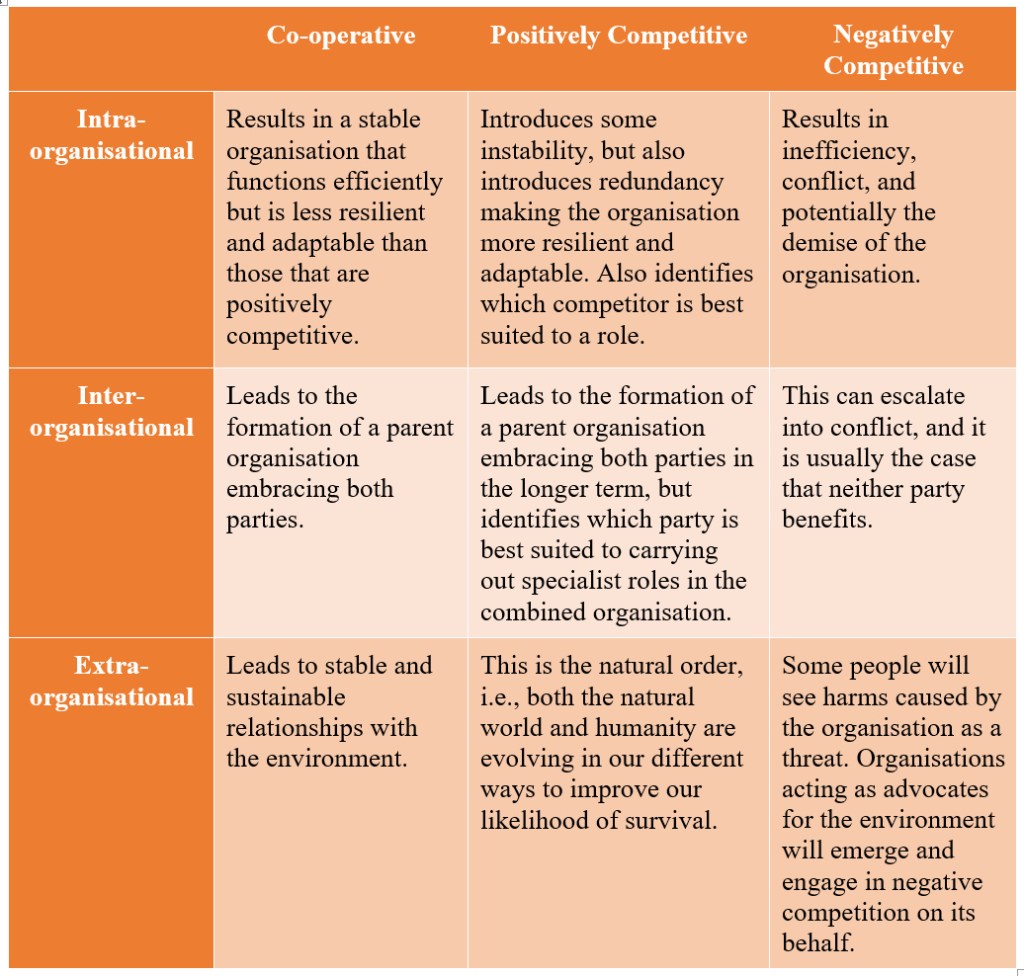
In a previous article it was explained that organisations can interact with others in their environment in one of three ways: co-operation, positive competition in which each competitor strives to excel, and negative competition in which each competitor strives to prevent the other from achieving their aims. Thus, interactions are two dimensional as follows:

Asymmetrical Interactions

The discussion above assumes that all interactions are symmetrical, i.e., that the attitude of both parties is either co-operative, positively competitive, or negatively competitive. However, asymmetrical interactions are also possible, in the short term at least.

Co-operation or positive competition can deteriorate and become negative via asymmetrical interaction. If one party to co-operation feels under threat, or if one party engaging in positive competition feels they will lose, they may begin to engage in negative competition. If this is overt, then, unless the other party has ethical objections, they will reciprocate. Negative competition can, of course, be carried out covertly, whilst maintaining a façade of co-operation or positive competition. If so, then the interaction becomes asymmetrical, i.e., one party engaging in negative competition and the other in genuine co-operation or positive competition. Usually, however, the interaction becomes symmetrically negative when the deceit is discovered.

Theoretically, the reverse is also possible, i.e., negative competition can become positive or cooperative, but this requires reciprocal de-escalation, whilst the interaction remains symmetrical. If one party de-escalates unilaterally, they will lose.

Organisational Inputs and Outputs

The basis for inter- and intra-organisational interactions is the reciprocal trading of satisfiers, or in some cases contra-satisfiers. Such satisfiers or contra-satisfiers comprise outputs from one organisation, in the form of space/place, matter, energy or information, and inputs to the other.

In a co-operative interaction, satisfiers are exchanged by mutual agreement to the benefit of both parties. In a positively competitive interaction, there is no trade between the two. However, space/place, matter, energy, or information can be passed, inadvertently, from one to the other. Finally, negatively competitive interactions involve the provision of contra-satisfiers by one to the other and vice versa, as in the case of war. This is to the detriment of both, although one party may ultimately prevail. Negatively competitive interactions can also involve the extraction of satisfiers without reciprocation or with the threat of contra-satisfiers, e.g., robbery at gunpoint.

Clearly, feedback loops are involved. For example, organisation A may provide a satisfier for organisation B, which in turn provides a satisfier for organisation A. However, in the modern world, organisational distance is a significant factor. For example, if organisation A provides a satisfier to organisation B, then the latter may be unable to reciprocate with physical satisfiers. A much larger and more complex arrangement of feedback loops, comprising many organisations, may be necessary for the equitable satisfaction of all parties. Clearly, such complexity can become unmanageable, and so, money has been introduced as a token of exchange in markets, thereby forming the basis of economics.

Categories
02. Basic Social Systems Theory

Basic Social Systems Theory

Introduction

The term “Social Systems Theory” has been used to describe the sociologist, Niklas Luhmann’s theory, but the one presented here differs in important respects. In this article I will describe its core principles.

Firstly, we use different terminology in different fields of study, but as can be seen from the table below it is all the same thing really. So, please refer to this table if in any doubt about the meaning of a term.

The Social Systems Concept

The basic framework of social systems theory can be described as follows:

  1. A general system comprises inputs, processes, and outputs. Processes, in turn, comprise components and their interactions. These components are also systems.
  2. Humanity is a social system which follows the same structure and rules as a general system. Its components are organisations. The reader may recall that, in these articles, an organisation is defined as any group of people who work together for a common purpose. Thus, an organisation may be a single individual, a club, a nation, or all of humanity.
  3. The interactions between organisations are the trade of satisfiers and contra-satisfiers between them. The satisfiers and contra-satisfiers traded take the form of information, matter, and energy. In more familiar terms, they comprise raw materials, products or artifacts, services and, as a general token of exchange, money.
  4. The satisfiers exchanged are related to the needs of the organisations concerned which, in general terms, are existence, relatedness and growth.

So, organisations are the elementary entities in social systems theory. At the next level of complexity up, i.e., ecology, the elementary entity is the species. Humanity is one such species and its inputs and outputs are those things that it takes from and gives to the natural ecosystem.  At the next level of complexity down, i.e., biology, the elementary entity it is the organ. The domain of social systems theory lies between these two boundaries.

The most notable aspect of organisational behaviour is its similarity to that of individual people. This is not because organisations have a “group mind”, but rather because every organisation is ultimately led by a single individual, and its specialist activities are also carried out by individuals. There are, however, important variations in the behaviour of both individuals and organisations which depend on their time, place, and size. These common features and the ways in which they vary are summarised below.

Theory

The following core principles apply to all organisations no matter what their size, location, or era. They are therefore universal and constant. They will be explained in more detail in future articles and only a simplified summary is given below.

  • Agency. All organisations have agency. They have choices available to them, they process information and act on it.
  • Purpose. All organisations have a purpose or function.
  • Needs. All organisations have needs which when prioritised form a hierarchy.
  • Satisfiers, Contra-satisfiers, and Motivators. Every organisation is affected by these and, together with its knowledge and needs, they influence its behaviour.
  • Inputs, Processes and Outputs. All organisations require inputs to carry out their function, which is to produce outputs. These inputs and outputs comprise materials, services, and/or information. However, information must always form a part.
  • Self-maintenance. All organisations are self-maintaining, i.e., they use a proportion of their inputs in self-maintenance as opposed to producing outputs.
  • Recursiveness. All organisations are recursive. Every organisation, except an individual person, comprises a number of component organisations and is a component of larger organisations.
  • Specialisation. All organisations comprise specialised sub-organisations or individuals. This is commonly known as a division of labour.
  • Co-ordination. All organisations require a control component, i.e., leaders, to co-ordinate specialised activities. This is carried out via an internal feedback loop with information passing upwards and instructions downwards.
  • Culture. Every organisation has a culture comprising values, norms, beliefs, operational knowledge, and symbols.
  • Schemata. Every organisation holds knowledge in schemata which are resistant to change. These include a schema for worldview/purpose, an internal ethical schema, external ethical schema, operating schemata, self-image, etc.
  • Misinformation. All organisations are capable of concealing information from others or supplying misinformation to them.
  • Adaptation. In response to both internal and external change, all organisations adapt their processes, attempt to adapt their environment, or both. Without adaptation, an organisation will eventually fail.
  • Evolution. The laws of evolution apply to organisations of all sizes, i.e., random mutation occurs within them, and natural selection occurs through the way in which they and their environment interact.
  • Inter-organisational Distance. Ultimately, every organisation interacts with every other. In some cases, they interact directly. In others there is no direct interaction. Rather any interaction is via a chain of direct connections.
  • Competition/Co-operation. The choice between co-operation, positive competition and negative competition always applies when one organisation interacts with another.

Some relationships between organisations, and thus, social systems theories, change with size, time, and place. These changes are due to:

  • Availability of Resources. The availability of resources varies from time to time and from place to place. This affects culture, which also then varies in the same way. Culture in turn affects knowledge, the relative priorities of needs, satisfiers, motivators, and attitudes towards relationships, i.e., whether co-operation, positive competition, or negative competition is favoured.
  • Knowledge. This, including knowledge of social systems, is part of an organisation’s culture. Because knowledge is one component affecting behaviour, the latter also alters from place to place. Knowledge can also be gained or lost, and so varies with time. If new knowledge is gained this can alter culture, and thus, social theory. However, progress is not inevitable, shocks can occur, and knowledge can be lost, e.g., the collapse of the Roman Empire and the subsequent Dark Ages. Loss of knowledge can cause an organisation or society to revert to behaviours similar to those of earlier years.
  • Redundancy. The amount of redundancy, i.e., duplicated capability, in an organisation, and thus its resilience, varies depending on factors such as whether an organisation has been designed or has evolved. This includes redundancy of potential command.
  • Size. As organisations increase in size the following characteristics alter and affect their efficiency. The interaction of efficiencies and inefficiencies of scale usually results in an optimum organisational size.
    • Specialisation, Departmentalisation, and the Formalisation of roles generally increase. Departmentalisation is the collection of specialised tasks into groups under a leader. Formalisation is the specification of tasks and the introduction of rules and regulations regarding the way in which they are carried out.
    • Informal Innovation generally decreases.
    • Hierarchy, i.e., the number of levels of command, generally increases.
    • Distance of Intra-organisational Communication, including Leadership Distance and Peer Distance, i.e., the lengths of chains of communication, generally increase, and along with them, the likelihood of communication errors.
    • Decentralisation, i.e., the delegation of power and control, generally becomes increasingly necessary.
    • The relative amount of Self-maintenance or Administration generally increases.
    • Speed of Decision-making generally decreases.
    • Cultural Entrenchment, i.e., the unchangeability or otherwise of an organisation’s culture, generally increases.
    • Cultural Homogeneity, i.e., whether all members of an organisation share a common culture, generally decreases.
    • Frequency of Restructuring, i.e., reorganisation, generally decreases.
    • Social Traffic, i.e., irrelevant communication, generally increases.

Explanation/Prediction/Design

The theory of social systems can be used to explain society, but not to predict it with certainty or to design an ideal system. This is because there are approximately seven and a half billion people in the world. So, the vast number of relationships between organisations, including individuals, leads to great complexity. Added to this is the vast number of relationships with the non-human environment. We do not have the mental capacity to understand such complexity. Even if we were able to model the human social system, then our understanding of it would change, and so too would its behaviour. Furthermore, predictability would diminish due to a build-up of un-anticipatable random events. The best we can do, therefore, is imagine relatively small, closed, sections of society, and make predictions about them, with reasonable confidence but no certainty, a short distance into the future.

Categories
01. Are the Social Sciences Scientific?

Are the Social Sciences Scientific?

Scientific inquiry is a process that enables us to gain new knowledge with greatest likelihood of it being correct. As a starting point, a hypothesis, i.e., a proposed explanation of a phenomenon based on limited evidence, is proposed. This hypothesis is then tested by experiment, by gathering data, or by reference to existing experiments and data. If this supports the hypothesis, then it is proposed as a theory, the research is written up, subjected to peer review or checks by other specialists in the field, and published.

Together, the accepted theories and the way in which they are developed form a paradigm. Wikipedia defines a paradigm as “a distinct set of concepts or thought patterns, including theories, research methods, postulates, and standards for what constitute legitimate contributions to a field.” An initial hypothesis is usually consistent with other theories in the prevailing paradigm, but sometimes not.

The philosopher of science, Thomas Kuhn, argued that science does not progress in a linear manner, but that the prevailing paradigm is relatively resistant to change, and undergoes periodic revolutions when the amount of contradictory evidence reaches a critical mass. In part, this resistance is brought about by human nature. I think it is fair to say that scientists and academic organisations are more objective than most. Nevertheless, they are still human, and the following traits will tend to introduce a bias in favour of the existing paradigm.

At the level of the individual, considerable effort is put into developing a theory. It becomes a part of his or her mental schema and is resistant to change. Furthermore, reputation and livelihood depend on any theory promoted as being correct. There will, therefore, be a personal vested interest in its acceptance and a resistance to any challenges. Obviously, acceptance is more likely if it is consistent with the prevailing paradigm.

Every organisation, including academia, is organised hierarchically, i.e., there are higher status individuals who command groups of lower status ones, and this assembles into a pyramidical structure. This structure is maintained by a process of trade or negotiation. Typically, a senior may delegate some of his power, influence, reputation, wealth, etc. in return for a subordinate’s support. Status is gained from the resources we control, and so, if one has many supporting subordinates, then one has greater status. With increasing status comes increasing power, influence, reputation, and wealth. Thus, there can be a personal vested interest in a theory and in the prevailing paradigm. Independence can be had by refusing to trade, but obviously this will result in a personal loss.

Experimental proof must be reproducible, and data must be readily accessible, so that others can check it. However, in the social sciences, there are several difficulties with this:

  1. Variables in the social sciences are often qualitative rather than quantitative, i.e., they are either true or not. Even if a variable is quantitative, there can be difficulties in measuring it. In physics it is relatively easy to determine the mass of an object and apply a number to it. However, in the social sciences, there are, for example, no objective ways of quantifying personality traits. These are probably more acquired than inherited, and so, more to do with the brain’s software than its hardware. This means, that they are unlikely to be revealed by MRI scans, etc. There are also issues with the reliability of questionnaires in which we report on our own personality.
  2. Experimental proof based on historical analysis can be flawed. History comprises reports and interpretations that can be highly subjective. In addition, there are often only a small number of examples to which we can refer.
  3. Experimental proof which relies on direct experience can also be highly subjective and is not reproducible.
  4. Experimental design is constrained by ethical considerations. For example, if one wished to prove that an event x always causes war, then it would be unethical to cause such an event.
  5. Finally, culture can have a strong influence on both hypotheses and the evidence used in their proof. For this reason, cross-cultural studies are becoming increasingly common. It is also the case that knowledge is a part of culture and so, new knowledge can alter culture. Thus, a feedback loop exists, i.e., culture affects social theory, which can, in turn, affect culture.

So, the paradigm for the physical sciences is very different to that for the social sciences. An analogy might be to regard the former as a criminal law case in which it is necessary to prove the defendant guilty. The latter can be regarded as a civil case, that is judged on the balance of evidence. This does, of course, mean that theories in the social sciences are less likely to be true than those in the physical sciences. Nevertheless, their pursuit is worthwhile because an understanding of human nature does, in general, and in the long term at least, appear to lead to an improvement in our circumstances.

Categories
14. The Acquisition of Status

The Acquisition of Status

Those who rise to the top of an organisation are not necessarily those whose skills are associated with its intended function. Rather, they can be those whose skill is the acquisition of status. People who achieve high social status often show some or all of the following characteristics.

Ambition. As well as carrying out a community function, organisations also satisfy the needs of their members. For example, normal employment provides a salary, social interaction, etc. In a voluntary organisation, it provides for more social and psychological needs. To be ambitious one must have a pressing need to satisfy. The more pressing the need, the more vigorously we will pursue its satisfaction, and thus, the more likely we are to succeed.

Negotiating skills. To acquire status, one must trade support for it. Some are more skilled in this than others. We may, for example, have learned these skills during our upbringing or from a role model. Imbalances in trading skills will eventually lead to a situation in which those with greater skills have greater status than others.

Skill in Selecting an Existing Hierarchy to Climb. A point worth noting is that it is far easier to climb an existing hierarchy than to create a new one with oneself at the pinnacle. The latter requires genuine leadership skills and much effort. This is not a universal rule, of course. There are, for example, politicians, press magnates, businessmen, and celebrities who have achieved high status with the help of a silver spoon from their parents.

Displays of Status. Clearly, those who aspire to higher social status must be seen to have something to trade with potential supporters. They must, therefore, overtly display the attributes of leadership and/or power. Irrespective of the role that they fill, the more successful they are in this, the more support they will receive. Conversely, those of lower status must display a willingness and ability to provide support.

Status is displayed through symbols, e.g., material goods such as clothing, cars, houses, etc. They are also displayed through communication, e.g., “name dropping”. A common strategy for acquiring social status, leadership and power is therefore the false display of such symbols and communications. People will create an impression of status by creating an impression of power or influence. Potential supporters will respond accordingly, and thus, status comes to those who appear to have it.

Within a very large hierarchy such as a nation, the various strata may be so large that they form their own distinct culture, for example the social classes in the UK. Displaying the values, norms, symbols, and beliefs of a higher status culture are often necessary to enhance one’s social status. Again, this can be learnt through upbringing or the emulation of a role model. However, it is more difficult to do so if one has been raised in a lower stratum of society. This reinforces the strata in a hierarchy, making movement between them more difficult.

Displays of Competence. Leadership skills will attract followers, thus enhancing social status. However, such skills also need to be overtly displayed.

Displays of Altruism. People who aspire to climb a hierarchy can be altruistic only to the extent necessary for others to support them. A common strategy among those who would lead is to give the impression that it is the needs of the group which are valued most highly whilst, in reality, it may be personal needs. However, the individual will take care that this is not recognised by the group until his or her status is established, or convincingly faked.

Emulation of Role Models. To attract followers, members of the higher strata will display the trappings of their status to those in the lower ones. In many cases they will become a role model to those in the lower strata. Note that people learn both leadership skills and the use of power from role models. There are formal leadership courses but none for managing power.

Cultural Adaptation. If a higher status individual is seen to be behaving in a way contrary to the conscience or self-concept of a lower status one, then the latter may conclude that there is something wrong with their conscience or self-concept and modify it. Even if the behaviour of the higher status individual is believed to be wrong, the lower status one may value membership of the group to such an extent that, rather than risk rejection, they will adopt a strategy for dealing with internal conflicts, such as rationalisation, repression, or denial. Often a rationale will be provided by the organisation, which the lower status individual accepts and adopts.

Expansionism.  The larger a group, the greater the power of those in the highest stratum. Thus, there is a natural tendency for the latter to seek to expand their organisation or part of it. This applies whether the group is a department, business organisation, religion, or nation. Such expansion is not necessarily in the interest of the group as a whole, however, and may be solely in the interest of the highest stratum.

Chance, luck, or fortune. Finally, Imbalances in chance, luck, or fortune will inevitably lead to some individuals achieving greater social status than others.

Categories
13. Trading Status for Support and Vice Versa

Trading Status for Support and Vice Versa

In any organisation people advance their position by trading status for support. The process typically involves a higher status, or senior, individual identifying lower status, or junior, individuals who are likely to support their aspirations, whatever those aspirations may be. Many lower status individuals, in turn, signal their willingness to participate in such a process. They may for example, offer vocal support at meetings, act out the culture of their seniors, and so on. If a successful partnership appears to be possible, then the senior will delegate some of his or her status to the junior in return for their support. Thus, promotions within a hierarchy often have more to do with “politics” than aptitude.

Social exchange theory holds that the negotiation is based on a risk/cost/benefit analysis for both parties, as described in a previous article. A relationship will be successful if it provides a net benefit for both parties, but will fail if it provides a net disbenefit for one or the other. The former can even apply when the junior partner is coerced, if the disbenefit of the punishment exceeds that of compliance. The relationship is not based solely on the ability of the senior partner to provide something that the junior partner desires, therefore. Rather it is an aggregate of the rewards and punishments that the former can dispense. The same is true of the junior partner, of course, but the options to mete out disbenefits to a senior are often much reduced and, unless done covertly, may prompt reciprocal action.

This form of trading is so commonplace in human society that it is often carried out unconsciously.

Other forms of trading can take place within an organisation, of course, e.g., bribery, corruption, sexual services, etc. Fortunately, however, some forms of social interaction can be tempered by social norms, i.e., what forms of interaction are acceptable and what are not.

In a stratified organisation, the greater the support an individual can provide to the higher strata, the greater the delegated status they receive in return. The higher an individual is in the hierarchy, the more resources they control, the greater the support they can provide and the greater their ability to trade. Conversely, the higher they are in the hierarchy, the greater the threat they can pose, and the greater the adverse reaction if they do so. Thus, they will be more cautious not to upset the status quo.

Trading tends to take place between people in adjacent strata. Those in the stratum immediately below are the most familiar individuals and have the greatest support to offer to those in the stratum above. Those in the lowest strata tend to be of least consequence to those in the highest, and opportunities for trading between these strata are fewer, therefore.

In practice, a balance is often negotiated between the strata. This results in the lower strata being sufficiently satisfied to support the organisation, even though they are denied its full potential benefits. Conversely, the upper strata are denied the full potential benefit that they might otherwise take, in return for a stability which ensures that their benefits are sustained. Thus, degrees of egalitarianism and stratification within organisations can vary.