Holons and Nested Hierarchies
We understand the world in terms of holons and the relationships between them. A holon is any entity that can be recognised as a whole in itself. We recognise holons because they recur in different circumstances or environments, and so, we can draw a boundary around them that distinguishes them from their environment.
Holons exist in nested hierarchies. That is, every holon comprises several lesser holons and every holon is also part of a greater one. For example, particles are components of atoms, atoms components of molecules, molecules components of planets, and so on.
In the case of human society, the holons are individuals and organisations. Individuals are components of organisations, organisations are components of parent organisations, parent organisations are components of grandparent ones, and so on.
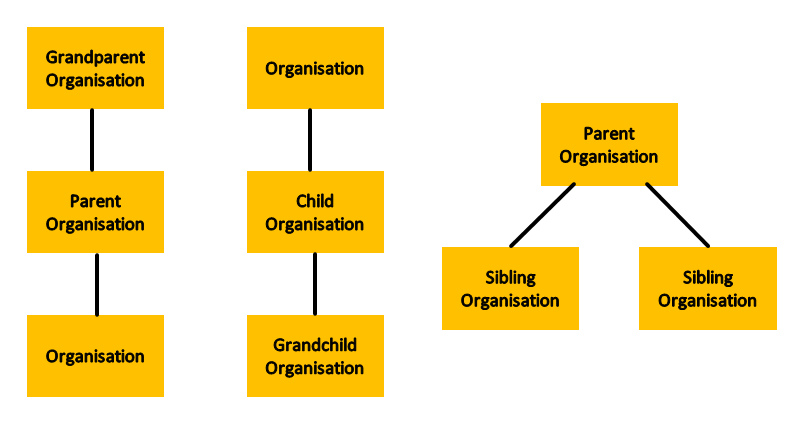
Figure – Family relationships between organisations in a hierarchy
As we progress downwards through this hierarchy of organisations, functional differentiation takes place. That is, the function or purpose of an organisation is broken down into the interacting component functions of child organisations. Alternatively, component functions can be carried out by other unrelated organisations through a process of trade.
Simplifying Social Complexity
In a stable society, functional differentiation naturally increases with time, and alongside it, social complexity. Up to a point, the efficiency with which any overall function is carried out also increases. However, there may be an optimum beyond which efficiency begins to decline.
If a system is complex and comprises too many components and relationships for the human mind to comprehend, then we attempt to simplify it. We do so by seeking fewer larger holons that bundle together components into recurring and recognisable patterns. Fortunately, society is structured in a way that makes it easy for us to find such holons. If we were, for example, to attempt to understand and predict the future of a nation by considering the relationships between individual citizens, then complexity would be so great that we would be unlikely to make progress. However, individual citizens form part of organisations such as sectors. If these sectors are taken as our holons and the relationships between them considered, then a far less complex model results.
In fact, this is what we do in practice. Furthermore, it is very likely that we structure society in this way to better enable us to understand it. For example, the field of international affairs uses nations as its holons, political science uses sectors, management theory organisations within parent organisations, and social psychology individuals. We do this intuitively, rather than as a consequence of any formal systems theory. However, the fact that social systems theory predicts what takes place in practice is strong support for the former’s validity.
 Rational-Understanding.com